The Road Was Built, but the Slope Slid
When a bulldozer cuts a road across a steep hillside, the soil above the cut loses the support that was holding it in place. If no channel is made for the rain water running down the slope, that water spreads over the bare cut soil. Soaked soil is heavy, and heavy soil with nothing below it slides away. This is why so many freshly dug hill roads slip in their very first monsoon. A road that has been opened is not a finished job. If it breaks up inside a year, the money, the time and the labour that went into it are all wasted, and the village is back where it started.
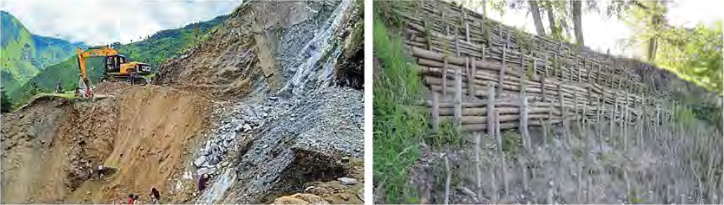
Two questions belong together whenever a road is built on a steep slope. The first is how quickly it can be opened. The second is how many years it will last. A road built without an answer to the second question does not last. So before the digging starts, it must be settled where the water runs, where the excavated soil will be placed, what will hold the cut face, and what effect the work will have on the fields and houses nearby.
Lasting Ways to Hold a Slope
Putting a timber or bamboo frame on a slipped slope catches the soil that is about to move, and it gives new seedlings a chance to grow there. But a frame on its own is only one measure. To stop landslides for the long term, the measures below are used together.
- Cut a drain along the upper and lower edge of the road so that rain water runs in a channel instead of spreading over loose soil.
- Support the cut slope from below with a stone retaining wall or with wire cages packed with stones.
- Plant deep rooted grasses, broom grass, napier grass, bamboo and hill cane on the slope. The roots hold the soil together like a net.
- Put up a timber or bamboo frame to catch sliding soil, and do not leave the slope bare until plants have taken hold.
- Never tip the excavated soil loosely down the hillside. A heap of loose spoil below the road becomes the start of the next landslide.
- Finish the digging before the rains begin, and carry out the protection work at the same time as the digging, not years later.
Do not stand below a slope that has just slipped, and do not walk across it. Stones and soil can come down from above without warning.
The Lesson in a Broken Field Ridge
Norbu was helping his father, who was ploughing a wet field made ready for planting. All at once the bund of the terrace gave way and water began running down towards the terrace below. Father and son set to work packing wet mud into the broken part. But the more soil they put in, the wider the break grew. The water from the field poured down as a stream onto the terrace below, and the bund there broke as well.
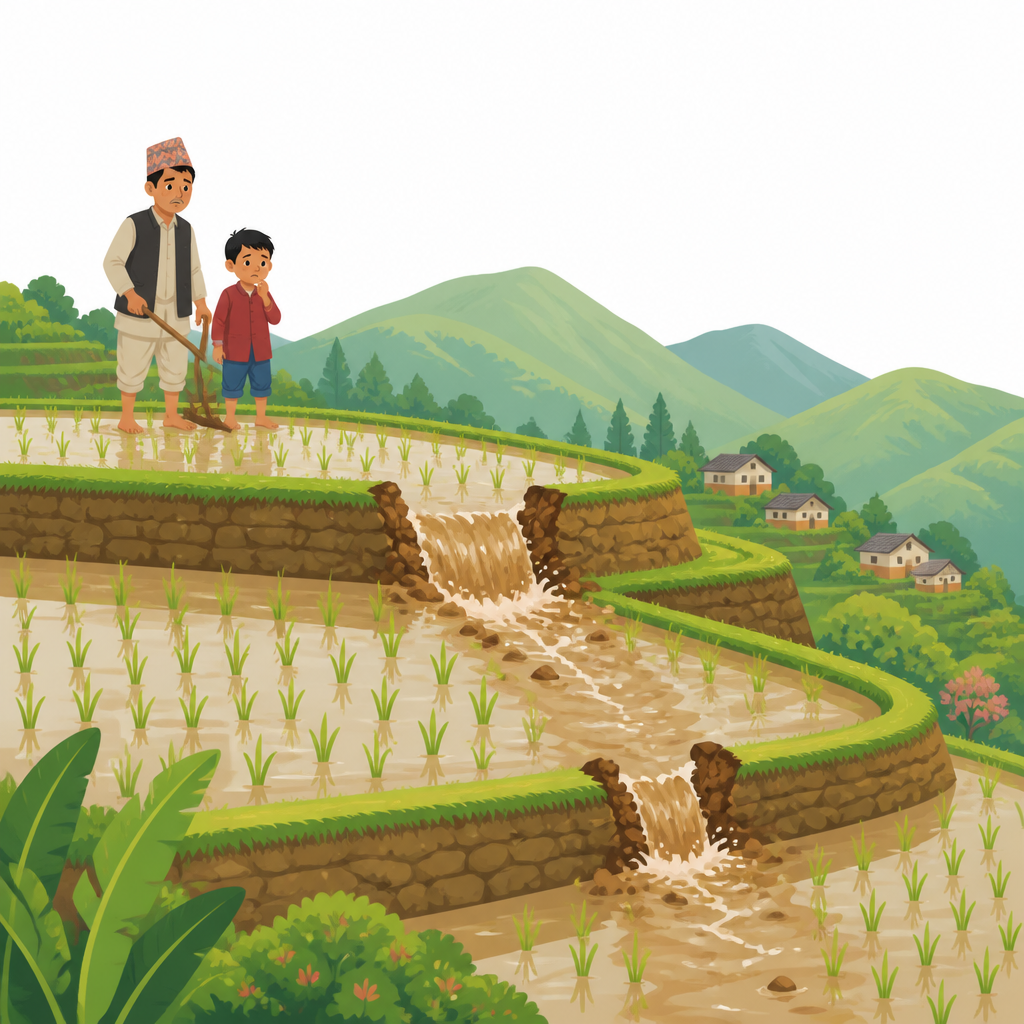
Wet mud is soaked and soft. There is nothing in it that grips and binds, so the water still pouring through carried away every handful as fast as it was put in. While the water runs, no repair will hold. Norbu first shut off the water coming into the field from the irrigation channel. Only after that could the bund be rebuilt with leafy branches. Branches grip the soil for a while, but they rot within months, so this is a temporary fix.
A repair made while the cause is still working will not hold. Stop the flowing water first, then rebuild the ridge.
To make a bund last for years, a few more things are needed. Stones are set carefully at its foot. Deep rooted grass is planted along the top so that the roots bind the soil. A separate inlet and outlet are made so that water enters and leaves the field at chosen points. And before planting each year the whole bund is walked and even the small holes are closed. A bund built this way serves not for one season but for many.
Natural Resources, Services and the Structures We Build
The grain we eat, the water we drink, the air we breathe, the firewood we burn, the timber we build with and the fertile soil of our fields all come from nature. They reach us as natural resources and as the services an ecosystem provides. Most of what people need is met from these resources and services.
Ecosystem service: the benefit that the living and non living parts of nature go on giving people free of cost, such as clean air, spring water, fertile soil, pollination by insects and forests that hold back floods.
To carry those services to where people live, different kinds of infrastructure have to be built: roads, bridges, water taps, irrigation canals, school buildings, health posts and power lines. Whenever infrastructure is built, it is extremely important that service can be taken from it over a long period and that it lasts. A structure that falls apart in a short time gives no service at all, and it damages resources and the environment on its way down.
Infrastructure: the structures built so that natural resources and services reach people, such as roads, bridges, canals, water taps, buildings and power lines.
The Four Sides of Sustainable Development
Four sides have to be watched together whenever something is built. Work done with only one of them in view fails sooner or later. A road built simply because it was the cheapest option, for example, spoils the environment around it and then collapses of its own accord.
The economic side: the money put in must keep paying back for many years. A structure that needs rebuilding again and again turns out to be the costly one.
The social side: the benefit must reach every group and every settlement. Nobody should be left out of what is built.
The cultural side: resting platforms, temples, monasteries, traditional skills and local ways of living must not be destroyed by what is built.
The environmental side: the work must be done without spoiling the air, water, soil, forest and wildlife around it.
Sustainable development: development that is carried out while keeping economic, social, cultural and environmental balance is called sustainable development.
| Side | The question to ask while a road is being built |
| Economic | Will the money spent go on giving service for years? |
| Social | Does the road reach every settlement, or only a few? |
| Cultural | Will any resting platform, temple or heritage site be damaged? |
| Environmental | Will the slope, the stream and the forest be spoiled or kept safe? |
The Brundtland Commission's Definition
Once the world began to accept that development and the environment have to be looked at together, a commission on world environment and development was set up in 1987. That commission gave the definition of sustainable development that is still used today.
According to the Brundtland Commission on world environment and development, formed in 1987, sustainable development is development that meets the needs of the present generation while keeping environmental balance, in such a way that future generations are also able to take benefit from it.
Sustainable development does not mean building nothing. Roads, bridges and schools must be built. The difference is that they are built in a way that serves people today without using up what the next generation will need.
A Long-Term Goal and the Base It Stands On
Sustainable development keeps a long term goal in view and prepares in advance the base for reaching it. Where a slope has slipped, for instance, enough landslide control must be carried out before a bridge is built there, and only then does the bridge stand for years. However strong the bridge may be, it is of no use once the slope it rests on washes away.
- Study the site first. Find out what the soil is like, where the water runs and why the slope slipped.
- Remove the cause. Lead the water away in a drain, and hold the slope with a wall and with planting.
- Only after the slope is stable, decide where the foundation of the bridge will sit.
- After the bridge is built, check the drains, the wall and the foundation after every monsoon, and repair small damage at once.
Today's Benefit and Tomorrow's Generation
What sets sustainable development apart is that it does not count only today. The people living now must get their benefit, and the people born later must still find the same resources. A forest can be cleared and a great deal of timber sold in a single year, but after that the spring dries up, the soil washes off and the children of tomorrow have neither timber nor water. A protected forest or a national park keeps the forest alive, earns an income from visitors and guards the source of the water.
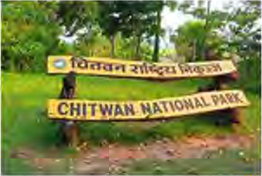
So there is a simple way to test whether a piece of development work has been done well. Ask two questions. Will this still be useful twenty years from now? And is it giving its benefit only by taking from the air, water, soil and community around it? Only when both answers come out well is the work sustainable development.
Make a Model of a Clean Village
The four sides of sustainable development are understood best by building something with your own hands and seeing them meet in one place. The aim of this activity is to construct a model of a clean village.
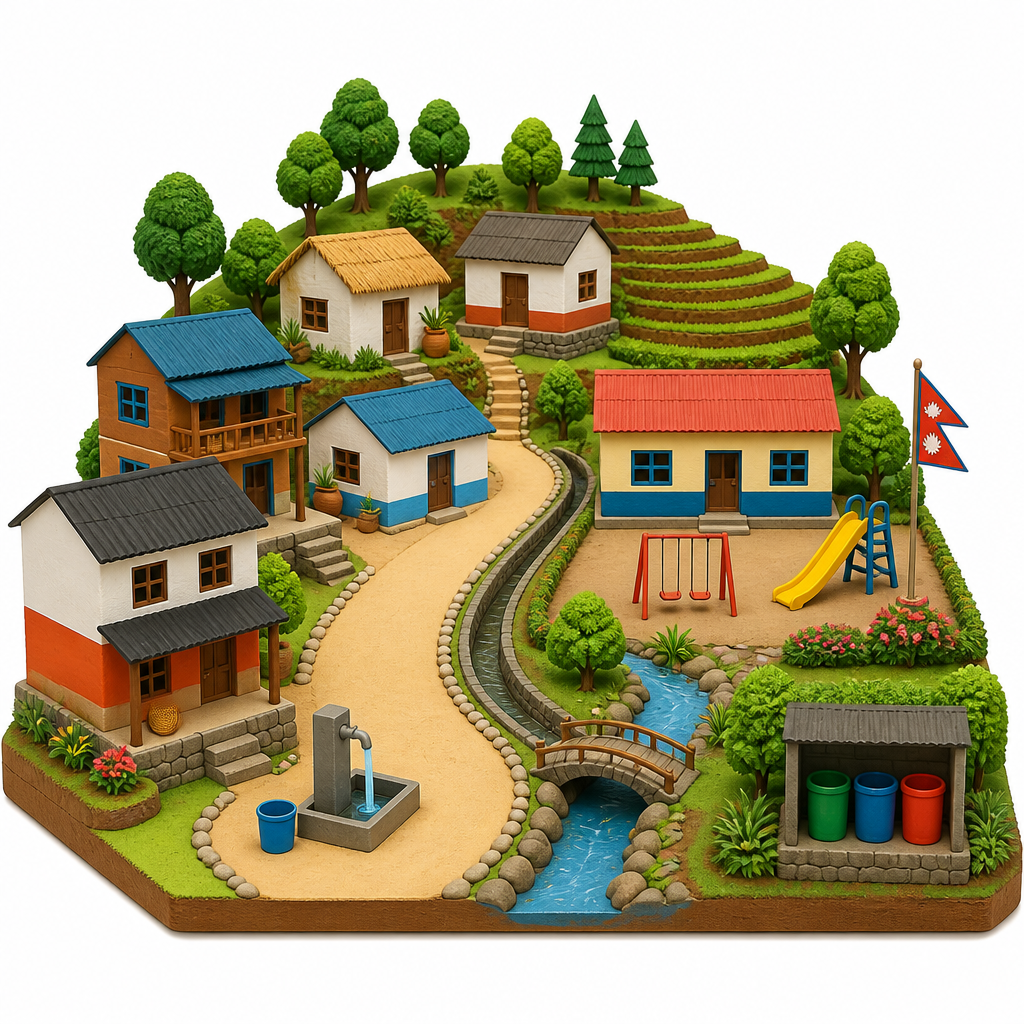
Collect the following materials for the model.
- Clay, and pieces of wood and bamboo
- Cardboard paper or thick card
- String, white glue or gum, and scissors
- Colour pencils, and other waste material lying at home
- Collect pictures of clean villages from the internet or from newspapers so that you know what you are aiming for.
- Prepare the base of the village on cardboard or a wooden board, and mark out where the hill, the fields and the stream will go.
- Using clay, wood and bamboo, build the houses, road, drains, water tap, school, waste collection point and the trees around them, then decorate the model.
- Ask your teacher for help at any step where you need it.
- Leave the finished model to dry properly before moving it.
- Display the model in class, discuss which sides of sustainable development it covers, and write your conclusion.
Always hold scissors by the closed blades and never point them at a friend. Do not put glue in your mouth, and wash your hands with soap and water when the work is over.
Look at the finished model and ask these questions. Is there a drain beside the road? Is the waste point well away from the stream? Are there trees around the source of the drinking water? Have the resting place and the old buildings been kept? The answers show which sides of sustainable development your model has covered.
The full lesson is waiting for you
The notes are free to read in full. A free account opens the rest of the practice, and tracks your progress and confidence score for every subject. Presentations and videos need approval from Learn Yeti.