The Reach of Sustainable Development
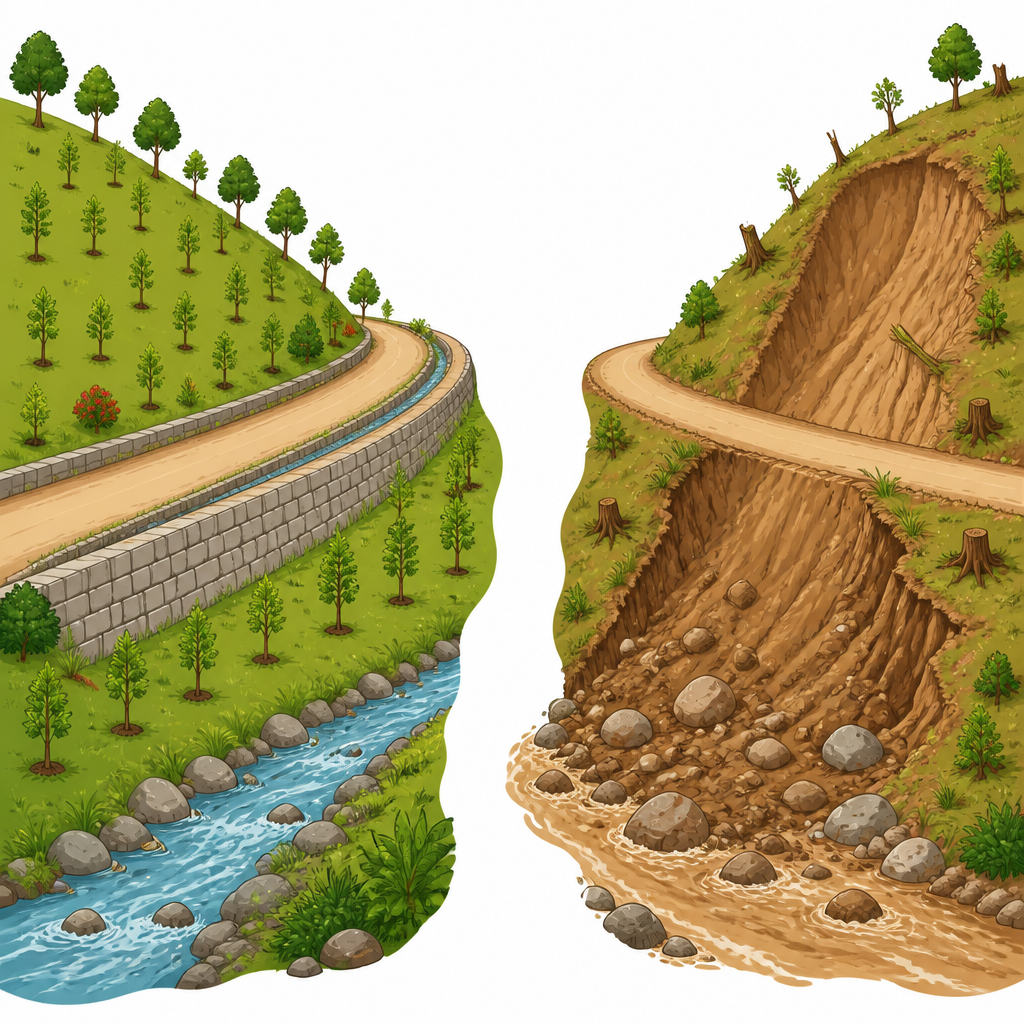
When a village gets a new road, a school and an irrigation canal, we call it development. But if cutting that road brought the hillside down, buried the stream and put money into only a few houses, that development will not last many years. Sustainable development pays attention to exactly this, so it never looks at one thing alone. It speaks for and addresses the challenges the whole world faces: poverty, infrastructure development, inequality, climate change, imbalance in the environment, biodiversity, sustainable management of forests, peace and justice.
The dimensions that sustainable development takes in are called its aspects. By worldwide agreement there are three of them, and because all three hold sustainable development up, they are called the three pillars of sustainable development. They are:
- (a) The economic aspect
- (b) The social aspect
- (c) The environmental aspect
Aspects of sustainable development: the dimensions sustainable development takes in, that is, the things that must all improve together before any development can be called sustainable.
Think of a stool with three legs. If one leg is short the stool tips over, and with only two legs nobody can sit on it at all. Sustainable development works the same way. If income rises but discrimination stays in society, or if society and income are both healthy while the forest, the stream and the soil are destroyed, the development cannot stand. All three aspects have to be made strong together.
The Economic Aspect
The first question the economic aspect asks is this: does this development raise people's income, and will that income last? The economic aspect of sustainable development mainly means steady and balanced economic growth. Its vision is that high economic progress comes through equal distribution of natural resources and access to them for everyone. It argues that economic activities such as production, distribution and consumption should satisfy the present generation. But excessive exploitation of economic resources is not part of what it accepts.
Economic aspect: the aspect of sustainable development that seeks steady and balanced economic growth built on equal distribution of natural resources and access to them.
Suppose vegetable farming starts to bring a good income to a village. If every farmer gets a turn at the irrigation water, and seed and the route to market are not limited to the big landholders alone, that income will last for years. But if the soil is loaded with chemical fertiliser to squeeze out a large harvest in a single season, fertility drops within two or three years and the income stops on its own. The first road is the one the economic aspect asks for.
Do not read the economic aspect as earning as much as possible. Income that rises by stripping a resource until it is finished is not counted as economic progress in sustainable development.
The Social Aspect
People of many different kinds live in a society. Some are rich, some are poor, and their languages, cultures and occupations differ too. Only balanced community progress, in which all of them move forward together, gives sustainable development a base to stand on. For that, a society has to hold on to the following:
- Equality
- Alleviation of poverty
- Access of everyone to means and resources
- Empowerment
- Participation of all
- Cultural identity for every group
- Peace and social justice
Social aspect: the aspect of sustainable development that seeks balanced community progress, with equality, empowerment, participation, cultural identity, peace and social justice.
For a prosperous society to be built, this aspect must stay balanced. If a settlement has a drinking water tap but some communities are not allowed to fill their vessels there, that tap does not belong to everyone. In the same way, if a girl has to leave school simply because she is a girl, the social aspect there is weak. Building a tap and a school is not development by itself. Development is when everyone can reach them.
The Environmental Aspect
For human life to advance, the natural environment has to be more productive and more dependable. That means conserving the water, land, air, forest, minerals and biodiversity that nature holds. Sustainable environmental development is the proportionate human use of natural resources while the ecosystem is kept in balance. Enough natural resources is not a luxury for human life and development, it is essential, so today's generation must not finish them off.
Environmental aspect: the aspect of sustainable development that conserves water, land, air, forest, minerals and biodiversity and uses natural resources proportionately while keeping the ecosystem in balance.
Resources must not be damaged while development work is carried out. When roads, bridges and houses are built, care for the environment has to be part of the plan. Control of river cutting and control of landslides are things that must be thought about. The natural habitat of animals and plants must not be disturbed. When a road is cut into a hillside, a retaining wall below it, a drain for the running water and saplings planted on the cut slope will keep that road usable for years and keep the settlement below it safe.
How the Three Aspects Interlock
These three aspects are not separate boxes. They are circles that overlap. The environmental circle stands for a viable natural environment, the social circle for a nurturing community, and the economic circle for a sufficient economy. Where two circles cross, a different gain appears, and only the middle space where all three cross is sustainable development.
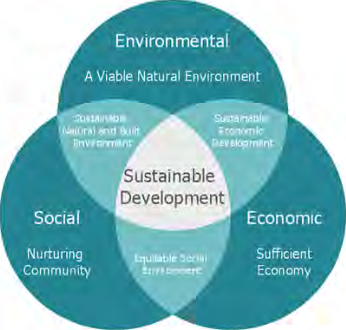
Environmental and economic together: sustainable economic development, income earned without spoiling nature.
Environmental and social together: a sustainable natural and built environment, with clean air and water and safe settlements.
Social and economic together: an equitable social environment, where income and opportunity are shared by all.
Examples of two aspects without the third make this clear. A hydropower project that leaves the river healthy and earns well, but gives the local people neither electricity nor jobs, has dropped the social aspect, and protests follow. A stone and gravel business that pays villagers a good wage while digging the riverbed away has dropped the environmental aspect, and the work itself stops within a few years. A clean village that has guarded its forest but offers no way to earn has dropped the economic aspect, so its young people move away. Development lasts only when all three are present at once.
Only the small middle space where all three circles meet is sustainable development. If one aspect is missing, the other two cannot make the work sustainable however well they perform.
A Settlement Where All Three Meet
A settlement where all three aspects meet can be recognised by looking at it. The houses are linked to the road and their waste is managed, the fields keep bringing in an income, the water in the pond and the canal stays clean, and the trees around the houses and the forest on the ridge are left as they are. The road, the school and the market are open to everybody who lives there.
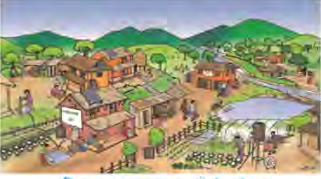
Such a settlement can be tested with three questions. Do the people here have an income that will last? Does everyone get the same opportunity and the same respect? Will the water, soil, air and forest reach the next generation in this same condition? When the answer to all three is yes, that settlement is on the road to sustainable development.
The Three Aspects at a Glance
| Aspect | What it aims at | What happens when it is dropped |
| Economic aspect | Steady, balanced growth with equal distribution of and access to resources | Young people migrate and the settlement empties out in search of work |
| Social aspect | Equality, empowerment, participation, peace and social justice | Discrimination and resentment grow, and the gains reach only a few |
| Environmental aspect | Conservation of water, land, air, forest, minerals and biodiversity | Pollution, landslides and river cutting increase until the resource itself runs out |
The full lesson is waiting for you
The notes are free to read in full. A free account opens the rest of the practice, and tracks your progress and confidence score for every subject. Presentations and videos need approval from Learn Yeti.