Can a Magnet Produce Electricity?
When an electric current flows through a wire, a magnetic field forms around that wire. Electromagnets, electric bells and electric motors all work because of this magnetic effect of current. Once scientists knew this, they asked the reverse question. If electricity can produce magnetism, can magnetism produce electricity? Put another way: if a conducting wire is placed in a magnetic field, can we get an electric current out of it?
The answer is yes, but only under one condition. A wire lying still beside a magnet, however strong the magnet, gives no current at all. Something has to change. What has to change, and how much voltage that change produces, is what this topic is about.
Faraday's Discovery of 1831
Around the beginning of the nineteenth century, about 1800 AD, the voltaic cell was the main source of electric current. A cell produces electricity from chemical reactions. It gives only a small current, and it runs down after some time.
In 1831, Michael Faraday discovered a completely different way to produce electricity. He found that when a conducting wire cuts the magnetic lines of force perpendicularly, that is at right angles, a voltage is generated in the wire. If the two ends of the wire are connected to form a closed circuit, an electric current flows through it. No cell is needed. This discovery brought a remarkable change in the sources of electricity, because it showed that electricity could be produced from motion and magnetism instead of from chemicals.
The Magnet and Coil Experiment
Faraday's idea can be tested with very simple apparatus. A solenoid, which is a long coil of insulated copper wire wound in many turns on a hollow tube, has its two ends joined to a galvanometer. A bar magnet is kept ready in front of the hollow part of the coil. There is no cell or battery anywhere in this circuit, so if any current flows, it can only have come from the magnet and the coil.
Galvanometer: an instrument that detects a small electric current and shows its direction. Its needle rests at zero in the middle of the scale and swings to one side or the other depending on which way the current flows.
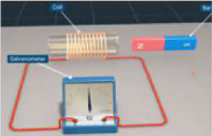
Now the magnet is moved while the needle of the galvanometer is watched closely. This is what is seen:
- When the north pole of the magnet is pushed into the coil, the needle swings to one side.
- When the magnet stops and rests inside the coil, the needle returns to zero.
- When the magnet is pulled out again, the needle swings to the opposite side.
- When the south pole is pushed in instead, the needle swings the opposite way to the way it swung for the north pole.
- When the magnet is moved in and out quickly, the needle swings much further than when it is moved slowly.
- When the magnet is held still and the coil is moved towards it, the needle swings as well.
So the current does not come from the magnet simply being near the coil. It comes from motion between the magnet and the coil. It does not matter which of the two moves; what matters is that one moves relative to the other. The direction of the current depends on the direction of the motion and on which pole faces the coil. The size of the current depends on how fast the motion is.
A magnet resting inside a coil produces no current, however strong the magnet is. The needle moves only while the magnet or the coil is actually moving.
Induced current: an electric current produced in a closed coil or wire by a changing magnetic field, with no cell or battery in the circuit. The voltage that drives it is called the induced voltage or induced e.m.f.
Magnetic Flux: What Actually Changes
A magnet is surrounded by magnetic lines of force. They are crowded together near the poles and spread further apart as you move away. When a coil is near a magnet, some of these lines pass through the turns of the coil. How many pass through depends on how close the magnet is and which way the coil faces.
Magnetic flux: the number of magnetic lines of force passing through the surface of a coil. It is called the magnetic flux linked with that coil.
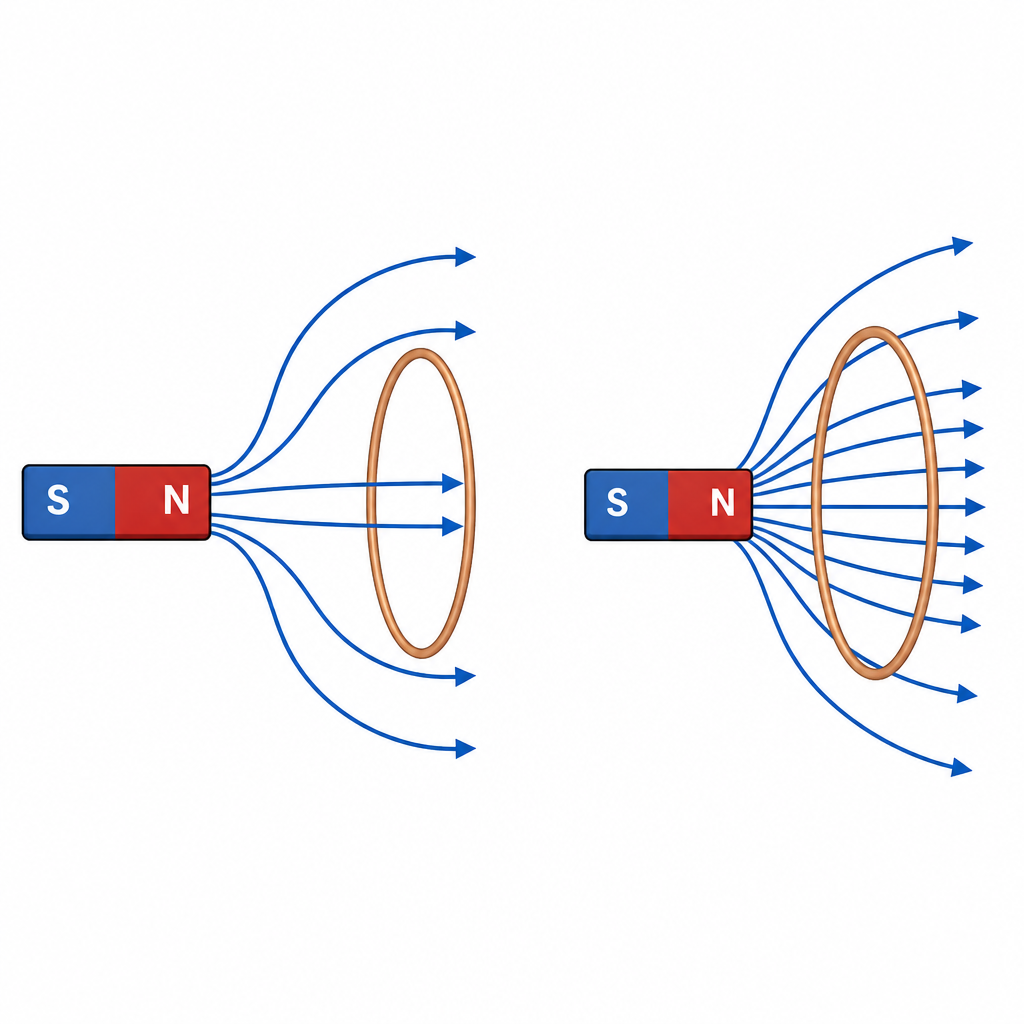
Now the experiment makes sense. When the magnet is far from the coil, only a few lines pass through it, so the flux is small. As the magnet moves in, more and more lines pass through the coil and the flux increases. As it moves out, the flux decreases. While the magnet is moving, the flux linked with the coil keeps changing continuously, and it is this change that induces a voltage in the coil. When the magnet stops, the number of lines through the coil stays the same. The flux no longer changes, and the voltage disappears.
A voltage is induced by a CHANGE in magnetic flux, not by the flux itself. A large flux that stays steady induces nothing.
Rotating a Coil in a Magnetic Field
Pushing a magnet in and out is not the only way to change the flux. A coil of conducting wire can be placed between two opposite magnetic poles and rotated. When the flat face of the coil faces the poles, the lines of force pass straight through it and the flux is at its largest. When the coil has turned a quarter of a circle so that its edge faces the poles, the lines slip past it without passing through, and the flux is zero. As the coil keeps turning, the flux linked with it keeps rising and falling, so a voltage is induced in the coil for as long as it rotates.
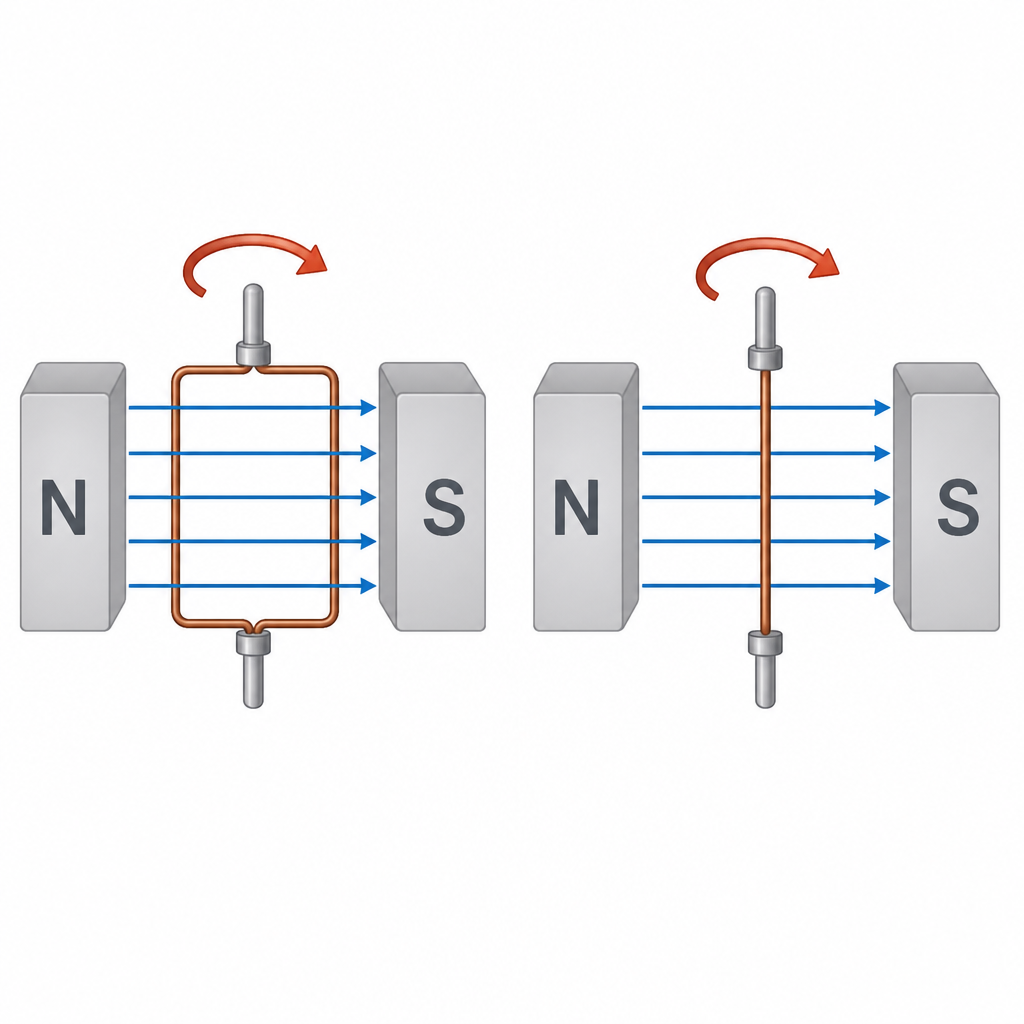
In both cases, something has to do work. The hand that pushes the magnet, or whatever turns the coil, supplies mechanical energy, the energy of motion. That mechanical energy is converted into electrical energy in the coil. This is why a magnet held still gives nothing: no work is being done, so there is no energy to convert.
Electromagnetic induction does not create energy from nothing. It converts mechanical energy into electrical energy.
Electromagnetic Induction
Everything seen so far can now be given one name. Whether the magnet moves or the coil moves or the coil rotates, the same thing happens underneath: the flux linked with the conductor changes, and a voltage appears in the conductor.
Electromagnetic induction: the process of inducing an electromotive force (e.m.f.), that is, a voltage, in a conductor when there is a change in the magnetic flux linked with that conductor.
Electromotive force (e.m.f.): the voltage that drives an electric current round a circuit. When it is produced by a changing flux, it is called an induced e.m.f.
Notice the three parts of the definition: a conductor, a change in the flux linked with it, and the voltage that results. The word 'induced' means the voltage is brought about from outside, by the magnet, without any cell touching the circuit. Take away the change and the voltage disappears.
What Decides the Size of the Induced Voltage
The same kind of apparatus can give a tiny flicker of the needle or a large swing. Three things decide how big the induced voltage is:
- The strength of the magnetic field. A stronger magnet has more lines of force, so more voltage is produced.
- The number of turns in the coil. Each turn gets its own small voltage, and the voltages of all the turns add up, so more turns give more voltage.
- How quickly the lines of force link the coil. Moving the magnet in and out very slowly induces a negligible voltage, while moving it at a higher speed induces more.
| Change made | Effect on the induced voltage |
| A stronger magnet is used | Increases |
| A coil with more turns is used | Increases |
| The magnet is moved faster | Increases |
| A weaker magnet is used | Decreases |
| The magnet is moved very slowly | Becomes negligible |
| The magnet is held still | No voltage at all |
All three changes do the same job underneath. A stronger magnet, more turns and faster motion each make the flux linked with the coil change by a larger amount in every second.
Faraday's Law of Electromagnetic Induction
Faraday brought all these observations together into a single law, based on the size of the e.m.f. that is induced.
Faraday's law: when there is a relative motion between a conductor and a magnet, an electromotive force (e.m.f.) is induced in the conductor, and the magnitude of this e.m.f. is directly proportional to the rate of change of the magnetic flux linked with the conductor.
'Rate of change of flux' means how much the flux changes in each second. Written with symbols, where \( E \) is the induced e.m.f., \( \Delta \phi \) is the change in magnetic flux and \( \Delta t \) is the time taken for that change:
\[ E \propto \frac{\Delta \phi}{\Delta t} \]
The sign \( \propto \) means 'is directly proportional to'. Suppose pushing a magnet into a coil changes the flux by a certain amount in 2 seconds. If the same push is done in 1 second, the same change of flux happens in half the time. The rate of change doubles, so the induced e.m.f. doubles. This is exactly why a quick push swings the needle further than a slow one, even though the magnet and the coil are the same.
Faraday's Law and the Generator
When a conducting coil is rotated inside a magnetic field, the magnetic flux linked with it changes continuously, so by Faraday's law an e.m.f. is induced in the coil. This is the working principle of a generator. A generator is a machine that uses this idea to convert mechanical energy into electrical energy.
An induced e.m.f. lasts only as long as the change in magnetic flux continues, which means only as long as the coil keeps moving. The moment the coil stops, the flux stops changing and the e.m.f. falls to zero. A generator therefore has to be kept turning by something that goes on supplying mechanical energy.
To get a larger e.m.f. from a rotating coil, the rate of change of the flux linked with it must be increased. This is done by:
- increasing the number of turns of the coil
- increasing the strength of the magnet
- increasing the speed of rotation of the coil
Each of these makes the flux linked with the coil change faster, and a faster change of flux means a larger induced e.m.f.
The full lesson is waiting for you
The notes are free to read in full. A free account opens the rest of the practice, and tracks your progress and confidence score for every subject. Presentations and videos need approval from Learn Yeti.