Keeping the Lights On During Load Shedding
When the main electricity supply is cut off for a few hours, we call it load shedding, an electrical power cut. Homes, shops and offices do not simply wait in the dark. People have worked out several other ways to keep a light burning and a few machines running until the power comes back.
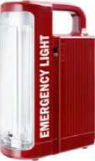
The simplest answer is a rechargeable emergency lamp or torch. Each one has a battery inside. The battery is charged while the main line has electricity, and when the power goes, that stored charge lights the lamp.

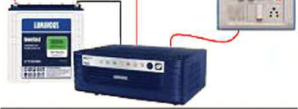
Many homes keep a large battery connected to an inverter. The battery charges whenever the main supply is on, and when it goes off, fans, televisions, computers and bulbs run through the inverter. Some families use a solar panel instead, so sunlight charges the battery, and an inverter connected to it runs the same kinds of devices.
The other answer is a petrol or diesel generator. They come in many capacities, from small portable ones to large machines, and they produce electricity whenever it is needed.


The electricity from these sources is not all of one kind. A cell, a battery and a solar panel always push current round a circuit in the same direction. A generator, and the power station that feeds the main line, give a current whose direction keeps reversing. That is why a battery needs an inverter: the inverter changes the battery's current into the kind most household devices are built to use. These two kinds are called direct current and alternating current.
Direct Current
Take an ordinary dry cell. One end is its positive terminal, marked with a plus sign, and the other end is its negative terminal, marked with a minus sign. Join it with wires to a switch and a bulb, turn the switch on, and the bulb lights. The electric charges in the wire are now flowing in a certain direction: out of the negative terminal of the cell, through the bulb, and back to the positive terminal. For as long as the circuit stays closed they keep moving that same way. They never turn round.
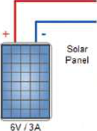
A solar panel does exactly the same. A small panel rated 6 V and 3 A also has a fixed positive terminal and a fixed negative terminal. In sunlight it lights a bulb, and the current in the wire flows in one particular direction only.
Direct current (d.c.): The current which flows in a particular direction is called direct current.
The sources of direct current share one feature: each has a separate positive and negative terminal that stay fixed and never swap places. The main sources of d.c. are:
- dry cells, like the ones in a torch or a TV remote
- photocells, that is, solar panels
- batteries, such as those in a mobile phone, an inverter or a vehicle
Alternating Current
Think of the dynamo that lights a bicycle lamp. This small device presses against the tyre. As the wheel turns, it turns the dynamo's spindle, the spindle spins a magnet inside a coil of wire, and the lamp glows. Here, unlike a dry cell or a solar panel, there is no separate positive terminal and negative terminal.
Here is what goes on inside, in a simplified form. A magnet spins between two coils, and the coils are joined to a bulb. As one pole of the magnet swings towards a coil, the charges in the wire are pushed forward. Half a turn later the other pole has arrived, and the same charges now flow the opposite way. As long as the magnet keeps turning, the direction of the current reverses again and again at a regular interval of time.
It is not only the direction that changes. The size of the current, its magnitude, also changes gradually. It climbs from zero to its highest value, falls back to zero, and then does the same again in the opposite direction. So both the magnitude and the polarity keep changing all the time.
Alternating current (a.c.): The current in which magnitude and polarity change continuously at a fixed interval of time is called alternating current.
Dynamos and a.c. generators are sources of alternating current. The huge generators in a hydropower station are a.c. generators too, which is why the electricity reaching our homes through the main line is alternating current.
Current Time Graphs
The difference between the two kinds of current shows up most clearly on a graph. Time (t) goes along the horizontal axis and current (I) goes up the vertical axis, so the graph shows how much current is flowing at every moment.
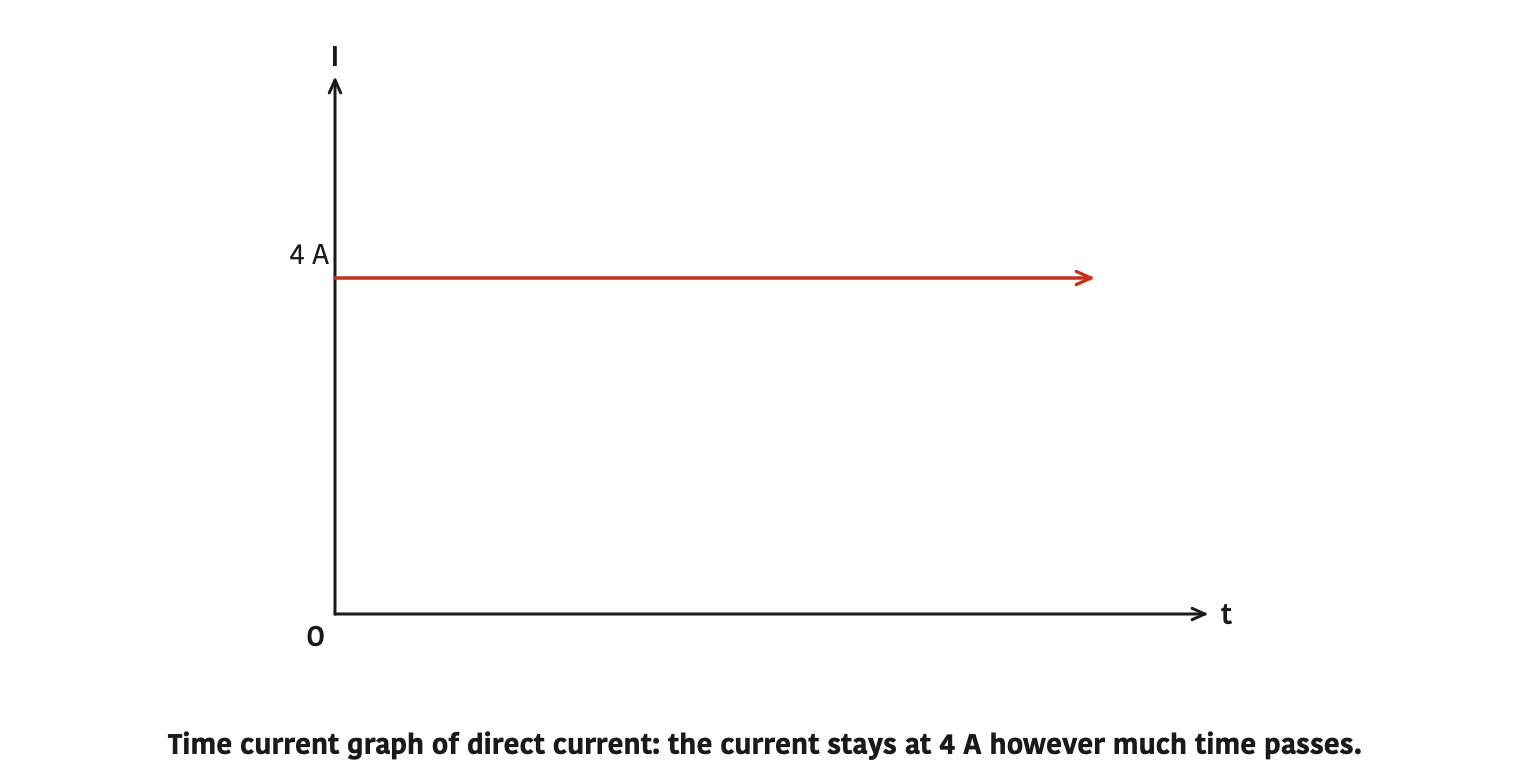
Suppose a battery sends a steady current of 4 A. Whenever you measure it, you get 4 A. Time goes on, and the current neither rises nor falls. So the graph of this direct current is a straight horizontal line at a height of 4 A, running parallel to the time axis.
Now look at an alternating current whose largest value is 5 A. Its graph is a wave. The current changes like this:
- The current rises from zero to 5 A.
- It then falls back to zero.
- It rises again, but in exactly the opposite direction, reaching \( -5\ \text{A} \).
- Finally it returns to zero.
Once all four changes have happened, one cycle is complete, and the whole pattern repeats. In the graph below, the first cycle ends at 0.02 s and the second at 0.04 s.
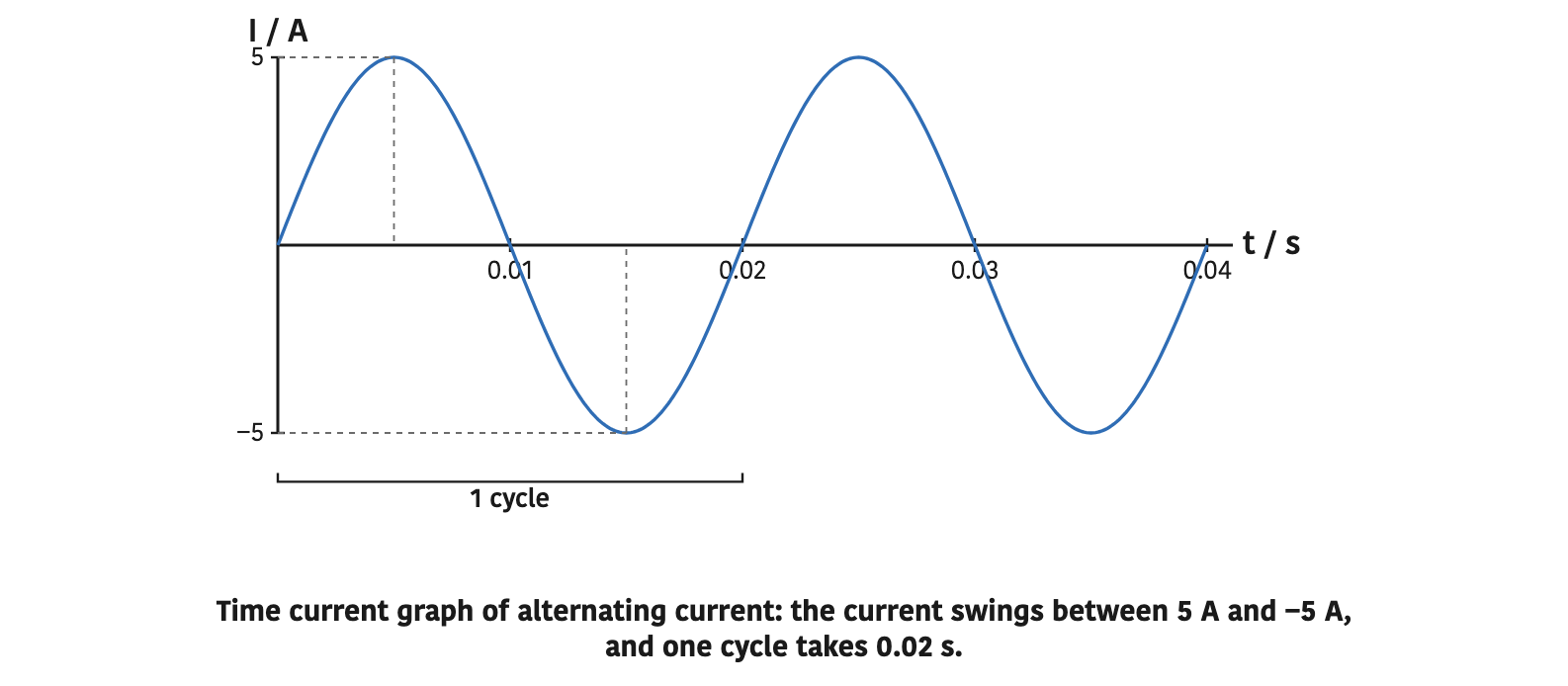
Cycle: One complete set of changes of an alternating current, rising from zero to its maximum, falling to zero, rising to its maximum in the opposite direction and falling to zero again, is called one cycle.
The part of the wave above the time axis shows current flowing one way; the part below shows it flowing the opposite way. The minus sign in −5 A tells you the direction. It does not mean less than no current.
Frequency
How many cycles an alternating current completes each second matters a great deal, because it tells us how fast the current is reversing.
Frequency: For a.c., the number of cycles completed in one second is called frequency. Its unit is the hertz (Hz).
One hertz (1 Hz): If one cycle of a.c. is completed in one second, the frequency of that a.c. is 1 hertz.
The alternating current used in Nepal has a frequency of 50 Hz, and its average voltage ranges from 220 V to 240 V. A frequency of 50 Hz means 50 complete cycles every second. In each cycle the direction changes twice: once from forward to backward, and once from backward to forward again. So the direction of the a.c. used in our country changes 100 times every second.
The direction of direct current never changes with time. It completes no cycles at all, so the frequency of d.c. is zero.
Do not read 50 Hz as 50 changes of direction per second. It means 50 cycles, and since the direction changes twice in every cycle, the current reverses 100 times each second.
Worked Examples on Frequency
Example 1: In the alternating current graph above, one cycle takes 0.02 s. What is the frequency of this current, and how many times does its direction change in one second?
Step 1: Reading the time for one cycle from the graph:
\[ \text{time for 1 cycle} = 0.02\ \text{s} \]
Step 2: Dividing one second by this time, to count how many cycles fit into one second:
\[ \frac{1\ \text{s}}{0.02\ \text{s}} = 50 \]
Step 3: Writing 50 cycles per second as a frequency:
\[ \text{frequency} = 50\ \text{Hz} \]
Step 4: Multiplying by 2, because the direction changes twice in every cycle:
\[ 50 \times 2 = 100 \]
So this current has a frequency of 50 Hz and reverses its direction 100 times every second. That is exactly the supply in our homes.
Example 2: A small a.c. generator completes 150 cycles in 3 seconds. What is its frequency?
Step 1: Writing down the cycles completed in 3 seconds:
\[ 150\ \text{cycles in } 3\ \text{s} \]
Step 2: Dividing by 3 to find the cycles in one second:
\[ 150 \div 3 = 50 \]
Step 3: Writing the answer as a frequency:
\[ \text{frequency} = 50\ \text{Hz} \]
Always write the unit Hz with a frequency. An answer of just 50 is incomplete.
Appliances That Use AC, DC or Both
Of the electrical appliances we use every day, some run on a.c., some run on d.c., and some can run on either.
| Kind of current | Examples of appliances |
| Alternating current (a.c.) | Fans, motors, refrigerators |
| Direct current (d.c.) | The internal circuits of mobile phones and computers |
| Both | Electric heaters, filament lamps |
Heaters and filament lamps work on either kind because they do their job by heating a wire, and a wire gets hot whichever way the current flows through it. A mobile phone is different. Its circuits run on d.c. from its battery, yet we charge it from an a.c. socket on the wall. The rectifier explains how.
The Rectifier
Rectifier: A rectifier is a device used to convert alternating current into direct current.
A block diagram shows a rectifier simply: a wavy alternating current goes into the box on the left, and a flat, steady direct current comes out on the right. A mobile charger and a laptop adapter each hold a rectifier, which turns the a.c. from the socket into the d.c. that charges the battery.
The inverter used during load shedding does the reverse job: it turns the battery's direct current into the alternating current that household appliances expect.
Direct Current and Alternating Current Compared
| Point | Direct current (d.c.) | Alternating current (a.c.) |
| Direction | Flows in one particular direction | Reverses at a fixed interval of time |
| Magnitude | Stays constant | Changes continuously between zero and a maximum |
| Terminals | Fixed positive and negative terminals | No fixed positive and negative terminals |
| Frequency | Zero | 50 Hz in Nepal |
| Time current graph | A straight horizontal line | A wave |
| Sources | Dry cells, photocells (solar panels), batteries | Dynamo, a.c. generator |
| Used in | Internal circuits of mobile phones and computers | Fans, motors, refrigerators |
The full lesson is waiting for you
The notes are free to read in full. A free account opens the rest of the practice, and tracks your progress and confidence score for every subject. Presentations and videos need approval from Learn Yeti.