Electricity from a changing magnetic flux
Around every magnet there are magnetic lines of force. The amount of magnetic field passing through a coil is called the magnetic flux linked with that coil. When a conductor and a magnet move relative to each other, the flux linked with the conductor changes, and an electromotive force (e.m.f.) is induced in the conductor. The size of this e.m.f. is directly proportional to the rate of change of the magnetic flux. This is Faraday's law of electromagnetic induction.
Working principle of a generator: when a conducting coil is rotated inside a magnetic field, the magnetic flux linked with the coil keeps changing, so an e.m.f. is induced in the coil. The induced e.m.f. lasts only as long as the flux keeps changing, which means only as long as the coil keeps moving.
Three changes make the flux change faster, and so make the induced e.m.f. larger:
- increasing the number of turns of wire in the coil
- using a stronger magnet
- rotating the coil faster
Every machine in this topic, from the small dynamo on a bicycle to the giant generator in a power station, works on this one idea. The only differences are the size of the machine and what supplies the turning.
Dynamo and generator
On some bicycles a lamp glows while you pedal and goes dark when you stop. The current for that lamp comes from a dynamo. Motorcycles also use a dynamo to produce current. The electricity that reaches the bulbs, fans and sockets of your home, however, comes from a far bigger machine: the alternating current generator, usually written a.c. generator. It produces the current used in domestic electric circuits in daily life.
Dynamo: a device that induces electric current on a small scale by rotating a magnet close to a coil. It is used in bicycles and motorcycles.
Generator: a machine that produces electric current on a large scale by rotating a coil at very high speed in a strong magnetic field.
How a bicycle dynamo works
A bicycle dynamo is a small cylinder clamped to the frame beside a wheel. At its top is a small cap that presses against the side of the tyre. Inside there is a magnet that can spin, and a coil of wire fixed very close to it. The coil is kept so close to the magnet that the magnet's lines of force cut through the coil as the magnet turns.
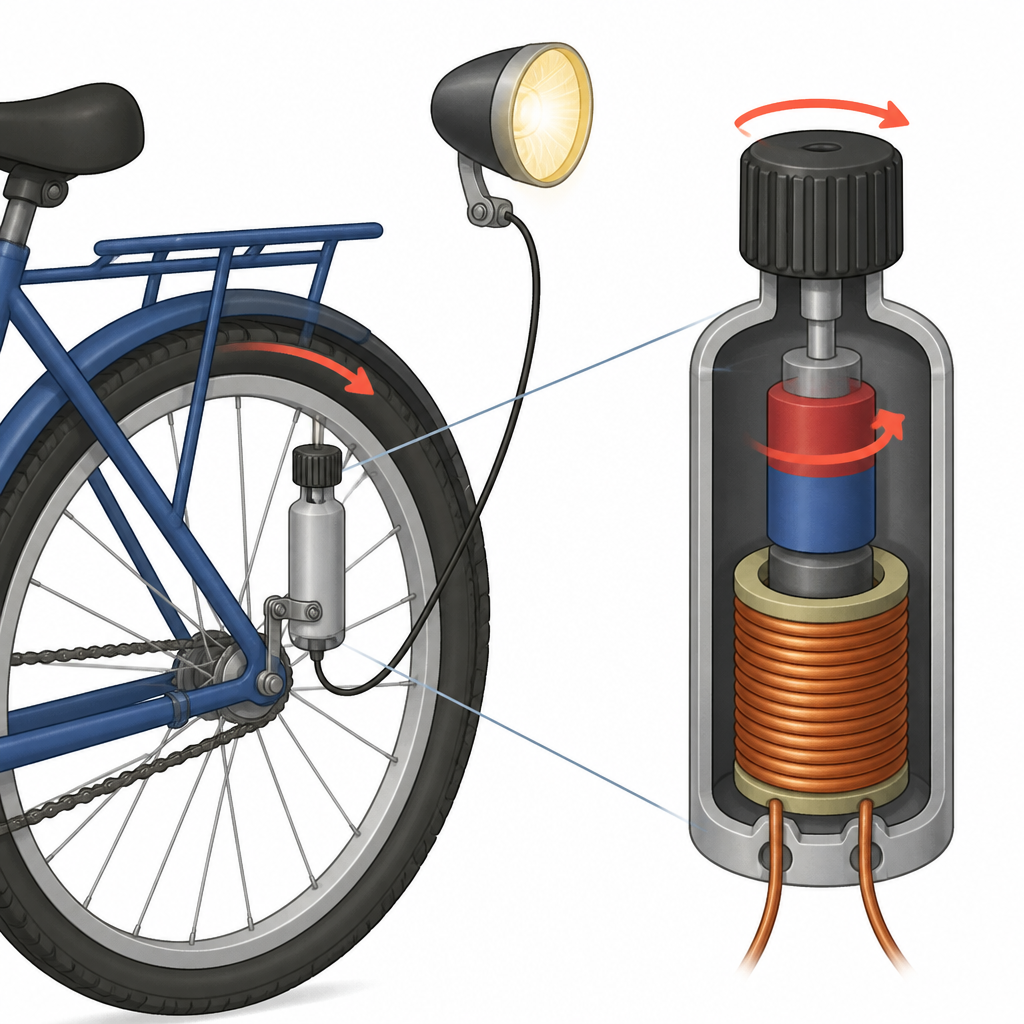
When the bicycle moves, electricity is made inside the dynamo like this:
- The turning tyre rubs against the cap of the dynamo, and the friction between them makes the cap spin.
- The cap turns the magnet inside the dynamo.
- The lines of force of the spinning magnet cut across the nearby coil, so the magnetic flux linked with the coil keeps changing.
- An e.m.f. is induced in the coil, and current flows through the wires to the lamp.
In a dynamo the coil stays still and the magnet moves. That is enough, because induction needs only relative motion between the two. When the bicycle stops, the magnet stops, the flux stops changing, and the lamp goes out.
The size of the voltage induced in the coil of a dynamo depends on:
- the number of turns in the coil
- the strength of the magnetic field
- the speed of rotation of the magnet
All three really control one thing: the rate of change of magnetic flux. That is why a bicycle lamp glows dimly when you ride slowly uphill and brightly when you speed down a slope.
Large-scale sources of electricity
A dynamo can light one small lamp, but a town needs millions of times more power. To produce a large quantity of electricity, a generator has a large coil placed in a strong magnetic field, and the coil is rotated at a very high speed. So every power station faces the same question: what turns the generator? That job is done by a turbine.
Turbine: a wheel with many blades, fixed on the same shaft as the generator. When water, steam or wind pushes on the blades, the turbine spins and turns the generator with it.
Power stations differ from one another only in how they turn the turbine. The final step is the same in all of them.
Hydropower stations
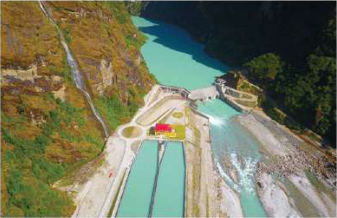
Nepal's rivers fall steeply from the Himalayas, and that makes flowing water the country's greatest source of electricity. In a hydropower station, river water is held back and stored behind a dam. The stored water is allowed to flow at high pressure through a tunnel to the turbines of the generator. The fast water pushes the turbine blades and rotates them with great speed, and the generator on the same shaft produces a large amount of electricity.
The heart of the station is the turbine and generator. Water enters through the wicket gate and pushes against the curved turbine blades. The blades turn the turbine generator shaft. At the top of the shaft sits the generator: the rotor, which turns, spins inside the stator, which stays still, and electricity is induced as one moves past the other.
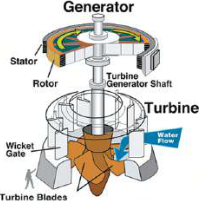
So the potential energy of water held behind the dam becomes the kinetic energy of rushing water, then the kinetic energy of the spinning turbine, and finally electrical energy.
Thermal, diesel and wind power
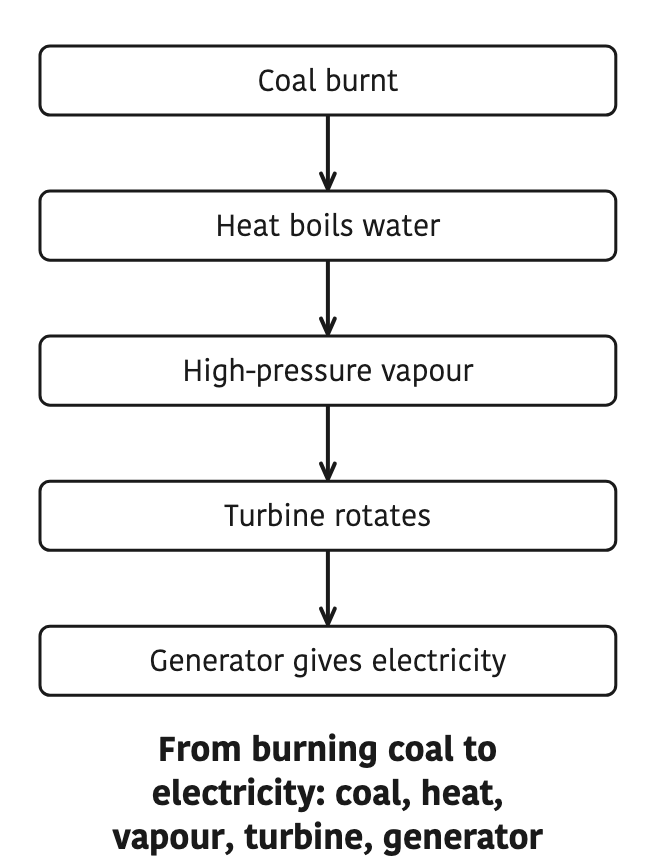
Thermal plants use fossil fuels such as coal and diesel to produce electricity. In a thermal plant run with coal, the work happens in this order:
- A large amount of coal is burnt to produce heat energy.
- The heat boils water and turns it into vapour.
- The vapour produced in this way builds up high pressure.
- The high-pressure vapour rotates the turbine, and the turbine turns the generator to produce electricity.
A diesel power plant makes no steam. Its generator's turbine is rotated directly by a diesel engine. In a windmill, moving air pushes the large blades, and wind energy rotates the turbine of the generator to produce electricity.
Nuclear power plants
A nuclear power plant works on the same principle as a coal thermal plant: heat boils water, the vapour turns the turbine, and the turbine turns the generator. The only difference is where the heat comes from. Instead of burning coal, the plant takes the heat it needs from the tremendous amount of energy released during the fission of radioactive elements such as uranium. Fission is the splitting of the nucleus of a heavy atom. It is carried out under a controlled mechanism so that the energy comes out steadily and safely. This technology for producing electricity is not used in Nepal.
What turns the generator in each plant
| Power plant | What turns the turbine | Source of energy |
| Hydropower | Water flowing at high pressure from a dam through a tunnel | Water stored in the dam |
| Coal thermal | High-pressure vapour from water heated by burning coal | Coal |
| Diesel | A diesel engine | Diesel |
| Wind | Moving air pushing the blades | Wind energy |
| Nuclear | High-pressure vapour from water heated by fission | Radioactive elements such as uranium |
The last step in every power plant is the same: a coil rotates in a magnetic field and electricity is induced. Only the thing that turns the turbine is different.
Electricity production in Nepal
According to the data published by the Nepal Electricity Authority in 2022 AD, the position of electricity in Nepal is as follows:
| Item | Amount |
| Hydroelectric potential of Nepal | 2200 MW |
| Electricity produced by thermal plants at Duhabi and Hetauda | about 487 MW |
| Hydroelectric projects under construction | about 487 MW |
| Proposed: Upper Arun, Uttar Ganga and Dudh Koshi (with reservoir) | additional 3219 MW |
MW stands for megawatt, and 1 MW is one million watts. The table shows that Nepal's electricity rests mainly on hydropower, that some comes from thermal plants, and that nuclear power is not used at all. Large projects such as Upper Tamakoshi keep adding to what the country can produce.
The alternating current generator
An a.c. generator has these main parts:
- Magnet: a north pole (N) and a south pole (S) facing each other, with a strong magnetic field between them.
- Coil: a rectangular coil of conducting wire placed between the poles, able to rotate on an axle.
- Slip rings: two metal rings fixed on the axle, one joined to each end of the coil. They rotate together with the coil.
- Carbon brushes: two brushes that press lightly on the slip rings but do not turn. They carry the current from the rotating rings to the terminals connected to the load.
As the coil rotates, its sides cut the magnetic field and the magnetic flux linked with the coil changes. As a result an e.m.f. is produced in the coil, and its magnitude is directly proportional to the rate of change of magnetic flux linkage. The slip rings and brushes let the current leave the spinning coil without the outside wires ever twisting.
How the coil produces a changing e.m.f.
The e.m.f. in the coil is not the same at every moment. Follow the coil through one full turn:
- When the plane of the coil is perpendicular to the field, facing the poles squarely, its sides move along the lines of force instead of cutting across them. The flux is not changing at that instant, so the e.m.f. is zero.
- As the coil turns further, its sides begin to cut the lines of force, and the e.m.f. grows.
- When the plane of the coil lies horizontal, parallel to the field lines, its sides cut across the lines at the fastest rate. The e.m.f. is then at its maximum, \( +E_0 \).
- After another quarter turn the coil is perpendicular again, and the e.m.f. falls back to zero.
- In the second half of the turn each side of the coil moves the opposite way through the field, so the e.m.f. reverses. It reaches its maximum in the opposite direction, \( -E_0 \), and then returns to zero.
Plotted against time, the e.m.f. forms a smooth wave that rises from zero, falls back, dips below zero and comes back again. One full turn of the coil makes one complete wave, and during that turn the e.m.f. is zero twice. Because the direction of the e.m.f. reverses every half turn, the current it drives through the load also reverses. Such a current is called alternating current, and this is why the machine is called an a.c. generator.
Alternating current (a.c.): an electric current whose direction reverses again and again at regular intervals.
When the coil faces the poles squarely, the most flux passes through it, but at that very instant the flux is changing slowest, so the e.m.f. is zero. The e.m.f. is largest when the plane of the coil is parallel to the field. How much flux there is and how fast it is changing are two different things.
The full lesson is waiting for you
The notes are free to read in full. A free account opens the rest of the practice, and tracks your progress and confidence score for every subject. Presentations and videos need approval from Learn Yeti.