From a straight wire to a coil
A straight wire carrying an electric current is surrounded by a magnetic field. Its lines of force are circles with the wire at their centre, and the direction of those circles depends on the direction of the current. Now imagine bending the wire into a single loop. Inside the loop, the circles made by every part of the wire point the same way, so their effects add together. Wind the wire into many loops lying side by side and the small fields of all the loops join into one strong field running through the middle of the coil. This is why a coil of wire behaves like a magnet when current flows in it, even though no iron and no magnet were used to make it.
What is a solenoid?
Solenoid: a cylindrical coil made of insulated wire. When current flows through it, a magnetic field develops in and around it.
A solenoid is usually made by wrapping insulated wire around a cylindrical object, such as a thin pipe or a marker pen, and then sliding the object out. What is left looks like a spring. The insulation matters because the turns lie touching one another. If the wire were bare, the current would jump straight across from one turn to the next instead of travelling all the way round each loop, and the coil would give almost no magnetic field. At the two ends, however, the insulation is scraped off, so that bare copper can touch the terminals of a battery and current can enter and leave the coil.
Finding the poles of a solenoid
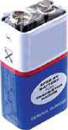
A home-made solenoid can be tested with a magnetic compass. The coil is connected to a 9 V battery through a battery connector, and a compass is placed beside one end of the coil.
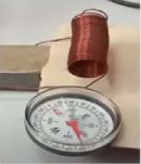
The needle of a compass is itself a small magnet, and unlike poles attract each other. So when the current is switched on, watch which end of the needle swings towards the coil. If the south pole of the needle is pulled towards the right-hand end of the coil, then that end of the coil must be a north pole. The left-hand end must then be a south pole, and a compass placed there will have its north pole pulled in. Now swap the connections to the battery so that the current flows the other way round the coil. The needle now turns the other way: the end that was north has become south. Reversing the current reverses the poles.
Take care when scraping the insulation off with a knife or burning it off in a candle flame: cut away from your fingers and keep hair and paper away from the flame. Disconnect the battery as soon as you have made your observation. A coil left connected for a long time heats up and drains the battery.
The shape of the field around a solenoid
The magnetic field outside a current-carrying solenoid has the same shape as the field around a bar magnet. Lines of force come out of one end, curve round the outside of the coil and go back in at the other end. Outside the coil, the field is strong at both ends and weak beside the middle portion. Inside the coil the lines run straight and parallel, evenly spaced from one end to the other, so the field inside is uniform: it has the same strength and the same direction everywhere. One end of the solenoid behaves as a North Pole and the other as a South Pole, and if the current flows in the opposite direction, the two poles change places.
| Feature | Bar magnet | Current-carrying solenoid |
| Poles | North at one end, South at the other | North at one end, South at the other |
| Field outside | Strong at the ends, weak in the middle | Strong at the ends, weak in the middle |
| Can it be switched off? | No, it is permanent | Yes, the field goes when the current stops |
| Can the poles be reversed? | Only by turning the magnet round | Yes, by reversing the current |
A current-carrying solenoid is a bar magnet that you can switch on, switch off and turn round simply by controlling the current.
Maxwell's right-hand grip rule
A compass tells you which end is north after the circuit is built. A simple rule tells you before you even switch on, as long as you know which way the current goes round the turns.
Maxwell's right-hand grip rule: if a solenoid is held in the right hand so that the fingers point in the direction of the current through the turns, the thumb points to the north pole of the magnetic field developed in the solenoid.
- Use your right hand, never your left.
- Curl your fingers around the solenoid so that they follow the direction of the current in the turns.
- Stretch your thumb out along the length of the solenoid.
- The end your thumb points to is the north pole. The other end is the south pole.
Try it on an example. A solenoid lies across a table. When you curl the fingers of your right hand around it in the direction the current flows, your thumb points to the left. So the left end is the north pole and the right end is the south pole. Now turn the battery round. The current runs the other way round every turn, your fingers must curl the other way, and your thumb now points to the right. The right end has become the north pole, which is exactly what the compass showed when the battery was swapped.
| Rule | What the thumb shows | What the curled fingers show |
| Right-hand thumb rule, straight wire | Direction of the current | Direction of the magnetic field |
| Right-hand grip rule, solenoid | The north pole | Direction of the current in the turns |
The two right-hand rules give the thumb and the fingers opposite jobs. For a straight wire the thumb follows the current. For a solenoid the fingers follow the current and the thumb finds the north pole. Mixing them up gives the wrong pole every time.
What makes the field stronger
The strength of the magnetic field around a solenoid depends on three things.
- (a) The magnitude of the current in the solenoid. A larger current gives a stronger field, and a smaller current a weaker one.
- (b) The number of turns in the coil. Each turn adds its own small field, so a coil with more turns gives a stronger field.
- (c) The material placed inside the solenoid, called its core. A soft iron cylinder slid inside becomes magnetised by the coil, and its own field adds to the coil's field, making it much stronger.
Electromagnets
The field of a solenoid is temporary. It is there while current flows and it disappears when the current stops. This is exactly what makes a solenoid useful for building an electromagnet. A soft iron core is used because soft iron loses its magnetism as soon as the current is switched off, so the magnet really does turn off.
Electromagnet: a solenoid, usually wound on a soft iron core, that acts as a magnet only while current flows through it.
Because it can be switched on and off, and made stronger or weaker by changing the current, an electromagnet can do jobs a permanent magnet cannot. A crane in a scrapyard lifts a heap of iron with an electromagnet and drops it by switching the current off. An electric bell uses a small electromagnet to pull its hammer towards the gong again and again.
Magnetic lines of force from different sources
Every source of magnetism is surrounded by lines of force, but the shape of those lines depends on the source. Around a straight wire they are circles. Around a single loop they bunch together through the middle of the loop. Around a solenoid and around a bar magnet they run from one end to the other. Around the Earth they spread out from near one geographic pole and return near the other, as if a huge bar magnet lay inside the planet. Place any object in one of these fields and the number of lines passing through it depends on where it is put.
Magnetic flux
To judge how strongly a magnet acts at different places, you can simply count how many lines of force pass through the surface of an object placed there. That count has its own name.
Magnetic flux: the total number of magnetic lines of force passing through a surface area within a magnetic field. It is a measure of the magnetic field passing through that surface.
Magnetic flux is written with the Greek letter \( \Phi \), read as phi. Its unit is the weber, written Wb.
Weber (Wb): the unit of magnetic flux, named after the German physicist Wilhelm Eduard Weber.
Reading flux from the density of lines
The density of the lines of force, meaning how closely they are packed together, shows the size of the magnetic flux. Where the lines are crowded, the flux is strong. Where they are spread far apart, the flux is weak. Picture holding a small card near one pole of a bar magnet: many lines pass through it. Slide the same card along to beside the middle of the magnet and far fewer lines cross it. So the flux of a bar magnet is stronger at the poles than in the middle portion. The same reading works for a solenoid. Its lines crowd together at both ends, and inside the coil they are evenly spaced, which is another way of saying that the field inside is uniform.
The full lesson is waiting for you
The notes are free to read in full. A free account opens the rest of the practice, and tracks your progress and confidence score for every subject. Presentations and videos need approval from Learn Yeti.