The two coils of a transformer
A transformer is made of two coils of insulated copper wire wound on the same soft iron core. The coils are not joined to each other by any wire. When alternating current flows in one coil, the magnetic field in the core keeps changing, and this changing field induces an alternating voltage in the other coil. This is mutual induction. It happens only while the current keeps changing, which is why a transformer works with alternating current and not with direct current.
The two coils do different jobs, so they have different names.
Primary coil: the input coil of a transformer. It is connected to the supply, and alternating current is fed into it.
Secondary coil: the output coil of a transformer. Alternating current is induced in it, and it supplies the device connected to it.
Every time the wire goes once round the core, it makes one turn. A turn is also called a winding. Four quantities describe every transformer, and every calculation in this topic uses them:
- Primary turns, \( N_p \): the number of turns of wire in the primary coil.
- Secondary turns, \( N_s \): the number of turns of wire in the secondary coil.
- Primary voltage or input voltage, \( V_p \): the AC voltage sent into the primary coil.
- Secondary voltage or output voltage, \( V_s \): the AC voltage received from the secondary coil.
The whole point of a transformer is to change the voltage of alternating current. For that, the number of primary windings and secondary windings is always kept different. If both coils had the same number of turns, the voltage coming out would equal the voltage going in, and the transformer would change nothing.
Turns decide the voltage
Whether a transformer raises the voltage or lowers it depends only on how many turns each coil has. To find out, compare the output coil with the input coil.
- If the secondary coil has fewer turns than the primary, the output voltage is lower than the input voltage.
- If the secondary coil has more turns than the primary, the output voltage is higher than the input voltage.
- If both coils have the same number of turns, the output voltage equals the input voltage.
The coil with more turns always has the higher voltage. More turns on the output side means more volts out. Fewer turns means fewer volts out.
This gives two types of transformer, each named after what it does to the voltage: the step-down transformer and the step-up transformer.
Step-down transformer
Suppose a transformer has 1000 turns in its primary coil and only 500 in its secondary coil. The ratio of primary turns to secondary turns is 1000 : 500, which is 2 : 1. The secondary has half as many turns as the primary, so it gives out half the voltage. Connect this transformer to a 220 V supply and exactly 110 V comes out.
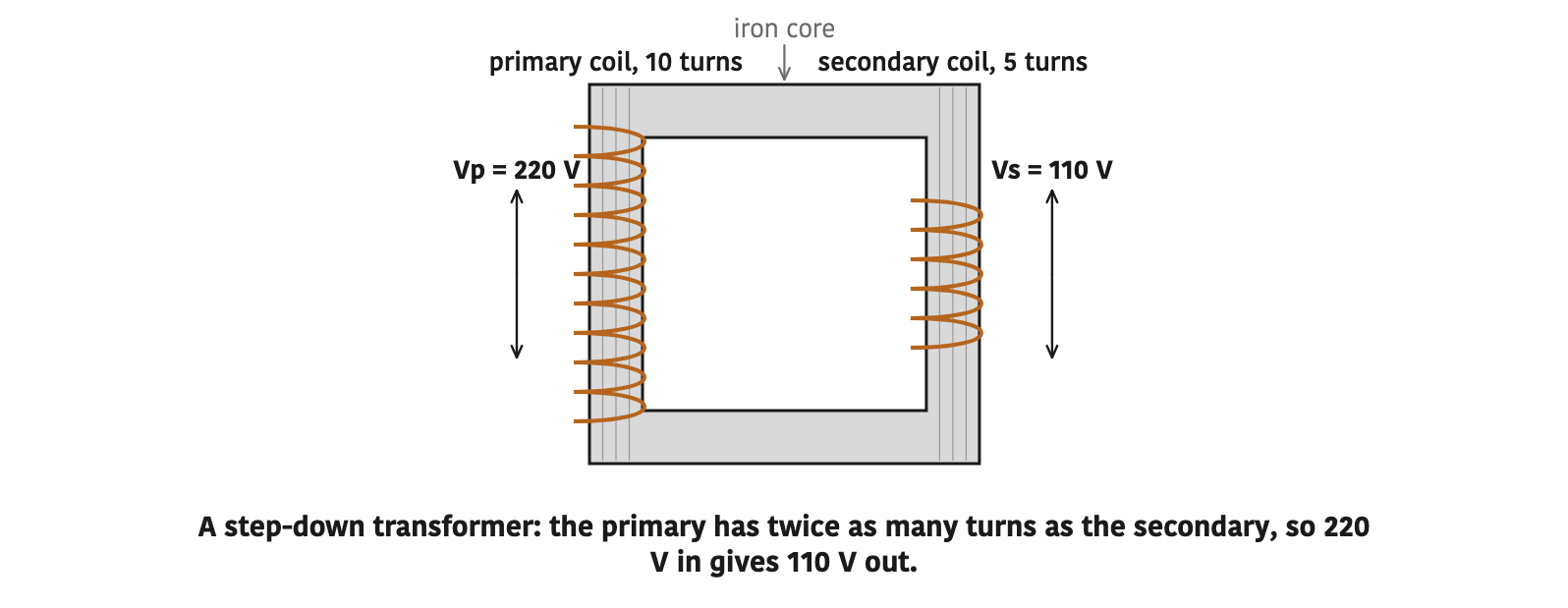
Step-down transformer: a transformer that reduces the voltage of an alternating current. Its secondary coil has fewer turns than its primary coil, so \( N_s < N_p \) and \( V_s < V_p \).
A step-down transformer is needed whenever a device works on a small voltage but has to be plugged into the 220 V mains. The adapter of a Wi-Fi router, a mobile charger and a laptop charger all contain one.
Step-up transformer
Now swap the numbers of turns. Give the primary coil 500 turns and the secondary coil 1000. The ratio of primary turns to secondary turns is now 1 : 2. The secondary has twice as many turns as the primary, so it gives out twice the voltage. Feed 110 V into this transformer and exactly 220 V comes out.
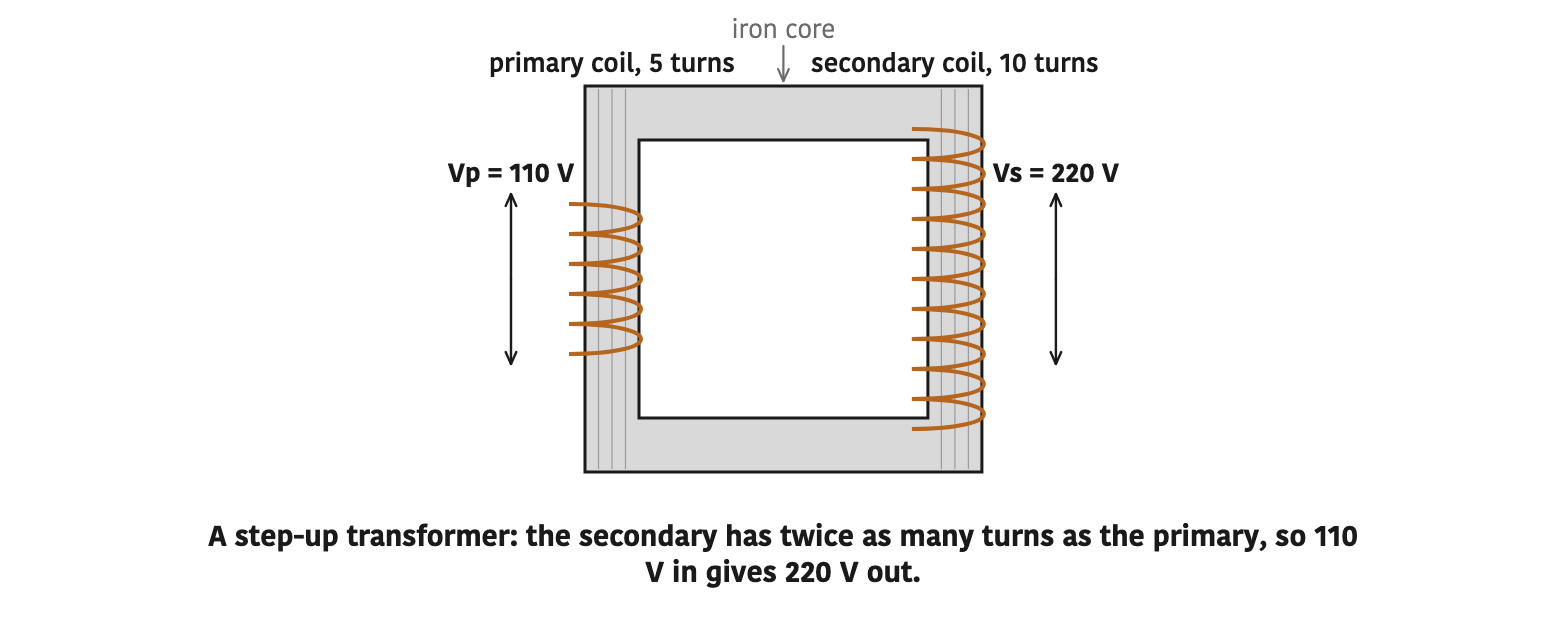
Step-up transformer: a transformer that increases the voltage of an alternating current. Its secondary coil has more turns than its primary coil, so \( N_s > N_p \) and \( V_s > V_p \).
The names come from a staircase: a step up raises you and a step down lowers you. Both types change only the size of the voltage. The current that comes out is still alternating current.
Step-down and step-up side by side
| Feature | Step-down transformer | Step-up transformer |
| Turns in the coils | Secondary has fewer turns than primary | Secondary has more turns than primary |
| Voltage | Output voltage is less than input voltage | Output voltage is more than input voltage |
| Symbols | \( N_s < N_p \), \( V_s < V_p \) | \( N_s > N_p \), \( V_s > V_p \) |
| Example | 2 : 1 turns, 220 V becomes 110 V | 1 : 2 turns, 110 V becomes 220 V |
| Used in | Adapters, chargers, transformers near houses | Power stations, microwave ovens |
The transformer formula
Look again at both examples. When the turns were in the ratio 2 : 1, the voltages were also 2 : 1, that is 220 V to 110 V. When the turns were 1 : 2, the voltages were 1 : 2, that is 110 V to 220 V. This is true of every transformer: the ratio of the turns equals the ratio of the voltages. Written with the four symbols, it is the transformer formula:
\[ \frac{N_p}{N_s} = \frac{V_p}{V_s} \]
Transformer formula: the ratio of the number of turns in the primary coil to the number of turns in the secondary coil is equal to the ratio of the primary voltage to the secondary voltage.
In words: primary turns divided by secondary turns equals primary voltage divided by secondary voltage. The primary quantity stays on top on both sides, and the secondary quantity stays at the bottom on both sides. If you know any three of the four quantities, the formula gives you the fourth. The two rearranged forms used most often are:
\[ V_s = V_p \times \frac{N_s}{N_p} \]
\[ N_s = N_p \times \frac{V_s}{V_p} \]
Rearranging the formula gives \( \frac{V_p}{N_p} = \frac{V_s}{N_s} \). This means every turn of wire, on either coil, carries the same number of volts. In the 2 : 1 transformer above, 220 V across 1000 turns is 0.22 V per turn, so 500 turns give \( 500 \times 0.22 = 110 \) V.
Do not turn one side of the formula upside down. Writing \( \frac{N_p}{N_s} = \frac{V_s}{V_p} \) mixes up primary and secondary, and a step-down transformer then gives a step-up answer. Check your answer at the end: if the secondary has fewer turns, the output voltage must come out smaller.
Worked example: the router adapter
A Wi-Fi router is to be connected to the 220 V mains through its adapter. The label on the adapter gives its power rating, which tells you the output voltage it supplies.
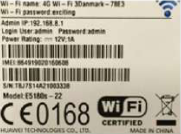
The label reads 12V. The transformer inside the adapter has 500 turns in its primary coil. Find the number of turns in its secondary coil.
Known values:
- Primary voltage, \( V_p = 220\ \text{V} \)
- Secondary voltage, \( V_s = 12\ \text{V} \), from the label
- Primary turns, \( N_p = 500 \)
- Secondary turns, \( N_s \): to be found
Step 1: Writing the transformer formula:
\[ \frac{N_p}{N_s} = \frac{V_p}{V_s} \]
Step 2: Substituting the known values:
\[ \frac{500}{N_s} = \frac{220}{12} \]
Step 3: Cross-multiplying to get \( N_s \) on its own:
\[ N_s = \frac{500 \times 12}{220} \]
Step 4: Multiplying on top, then dividing top and bottom by 20:
\[ N_s = \frac{6000}{220} = \frac{300}{11} \]
Step 5: Dividing 300 by 11:
\[ N_s \approx 27.27 \]
Step 6: Rounding to a whole number of turns. A coil cannot have part of a turn. With 27 turns the adapter would give only 11.88 V, a little under 12 V, so the number is rounded up:
\[ N_s = 28 \]
The secondary coil has 28 turns. It has far fewer turns than the primary, so the adapter contains a step-down transformer, which is exactly what a device needing only 12 V should have.
Worked example: raising the voltage ten times
In a transformer, the ratio of primary turns to secondary turns is 1 : 10. It is connected to a 220 V supply. Find the secondary voltage.
Known values:
- Primary voltage, \( V_p = 220\ \text{V} \)
- Turns ratio, \( N_p : N_s = 1 : 10 \)
- Secondary voltage, \( V_s \): to be found
Step 1: Writing the transformer formula:
\[ \frac{N_p}{N_s} = \frac{V_p}{V_s} \]
Step 2: Writing the turns ratio as a fraction and putting in the primary voltage:
\[ \frac{1}{10} = \frac{220}{V_s} \]
Step 3: Cross-multiplying:
\[ V_s = 220 \times 10 \]
Step 4: Multiplying:
\[ V_s = 2200\ \text{V} \]
The secondary voltage is 2200 V. The secondary coil has ten times as many turns as the primary, so the voltage is ten times larger. This is a step-up transformer.
Every voltage in an answer carries its unit, V. An answer of 2200 without the V is incomplete. A number of turns, on the other hand, has no unit.
Where each type is used
Electricity made at a power station must travel a long way through cables before it reaches homes. Much less energy is wasted in the wires when it is sent at a very high voltage, so a step-up transformer at the power station raises the voltage before the electricity leaves. Near the town, a step-down transformer lowers it again, and houses receive 220 V.
Uses of a step-up transformer:
- At power stations, to raise the voltage before electricity is sent over long distances.
- Inside a microwave oven, where the secondary coil has many more turns than the primary to produce a very high voltage.
Uses of a step-down transformer:
- Near houses and localities, to bring the high voltage of the power lines down to 220 V.
- In mobile chargers, laptop chargers and router adapters, to lower 220 V to the few volts these devices need.
- In doorbells and other small devices that work on a low voltage.
The full lesson is waiting for you
The notes are free to read in full. A free account opens the rest of the practice, and tracks your progress and confidence score for every subject. Presentations and videos need approval from Learn Yeti.