What a Compass Needle Can Tell Us
A magnetic compass is a small, light magnet balanced on a pin so that it can turn freely. Left on its own, its needle settles along the north and south direction, because it lines up with the Earth's magnetic field. Bring a bar magnet near it and the needle swings round, because the magnet's field is now stronger at that spot than the Earth's. This makes a compass a simple detector of magnetism. Whenever its needle turns and nothing has touched it, some magnetic field is acting on it.
For a long time, scientists treated electricity and magnetism as two separate subjects. A battery, a wire and a bulb were not expected to have any effect on a compass at all.
Oersted's Discovery of 1820
In the year 1820, Hans Christian Oersted, a Danish physicist and science teacher, was performing an experiment with electric current. A magnetic compass happened to be lying near the circuit, and he saw its needle deflect when the current flowed. There was no magnet nearby. The only new thing was the current in the wire.
He studied the effect further and found a clear pattern:
- When the current was switched on, the needle turned away from north.
- When the current was switched off, the needle returned to north.
- When the direction of the current was reversed, the needle turned the other way.
Oersted concluded that the deflection of the compass needle is caused by a magnetic effect produced by the electric current itself. Electricity and magnetism are related to each other.
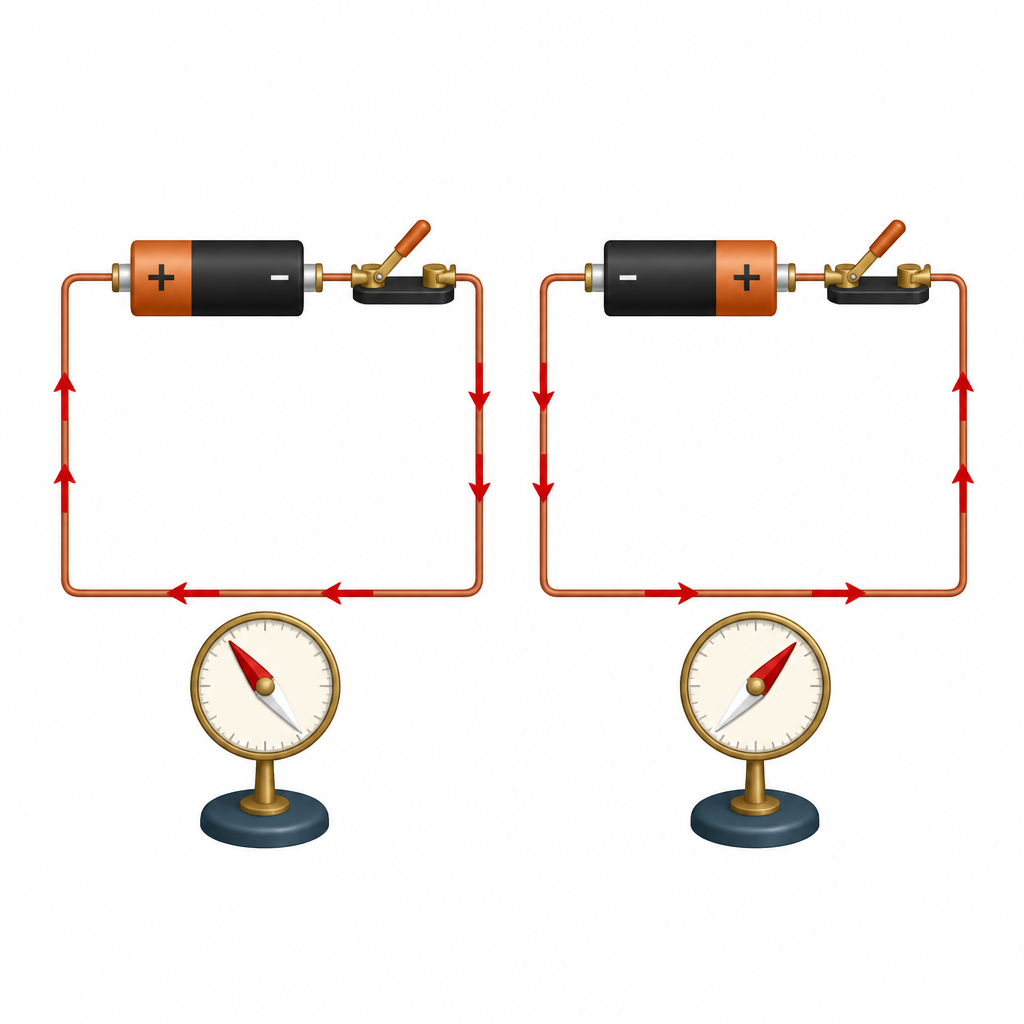
Magnetic effect of electric current: The formation of a magnetic field around a conducting wire when there is electric current in it.
The direction of the magnetic field formed around a wire depends on the direction of the electric current in the wire. Reverse the current and the field reverses too.
Tracing the Field with Compasses
Oersted's compass tells us that a field exists. To find its shape, pass a straight wire vertically through a square piece of cardboard, connect it to a cell and a switch, and place several small plotting compasses on the card in a ring around the wire. Then compare the needles with the switch off and with it on.
- Switch off: every needle points the same way, towards north. The wire has no effect.
- Switch on: each needle turns until it lies along a circle around the wire, like the rim of a wheel whose axle is the wire.
- Follow the needles round the ring: their north poles point one after another in the same sense, all clockwise or all anticlockwise.
- Cell reversed: every needle swings round and points the opposite way round the circle.
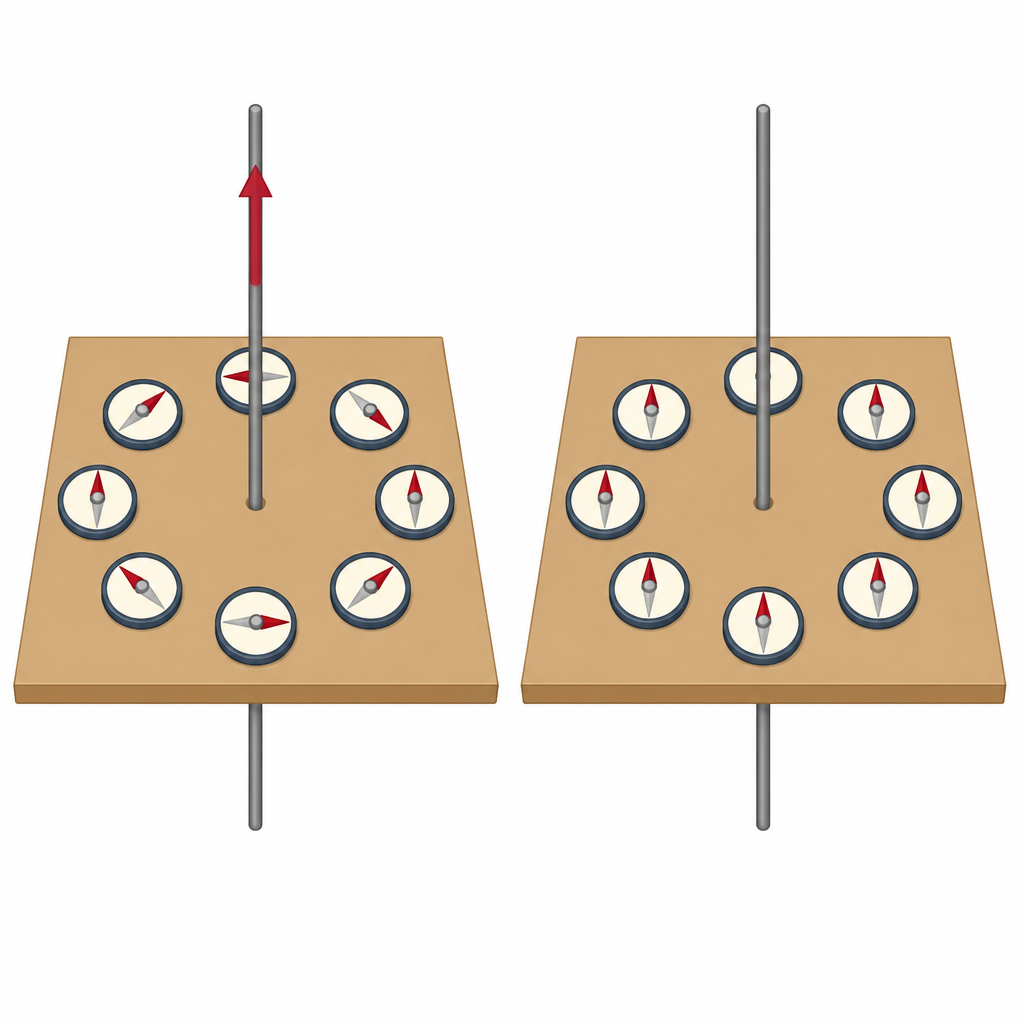
Each needle shows the direction of the magnetic field at the spot where it sits. Because the needles together make a circle, the magnetic field around a straight current-carrying wire is circular, with the wire at the centre.
This circuit has no proper load such as a bulb, so a large current flows and the wire heats up quickly. Keep the switch on only long enough to look at the needles, then switch it off immediately.
Seeing the Whole Pattern with Iron Filings
A few compasses show the field at a few points. Iron filings show the whole pattern at once. Sprinkle very fine iron powder over the cardboard around the wire, switch on, and tap the card gently with your fingers. Each tiny grain of iron becomes a small magnet in the field and turns to lie along it. The tapping lifts the grains off the card for a moment so that they are free to move.
The iron dust settles into rings around the wire, one inside another, all with the wire as their common centre. The rings are clearest close to the wire and fade farther out, because the field is strongest near the wire and becomes weaker with distance.
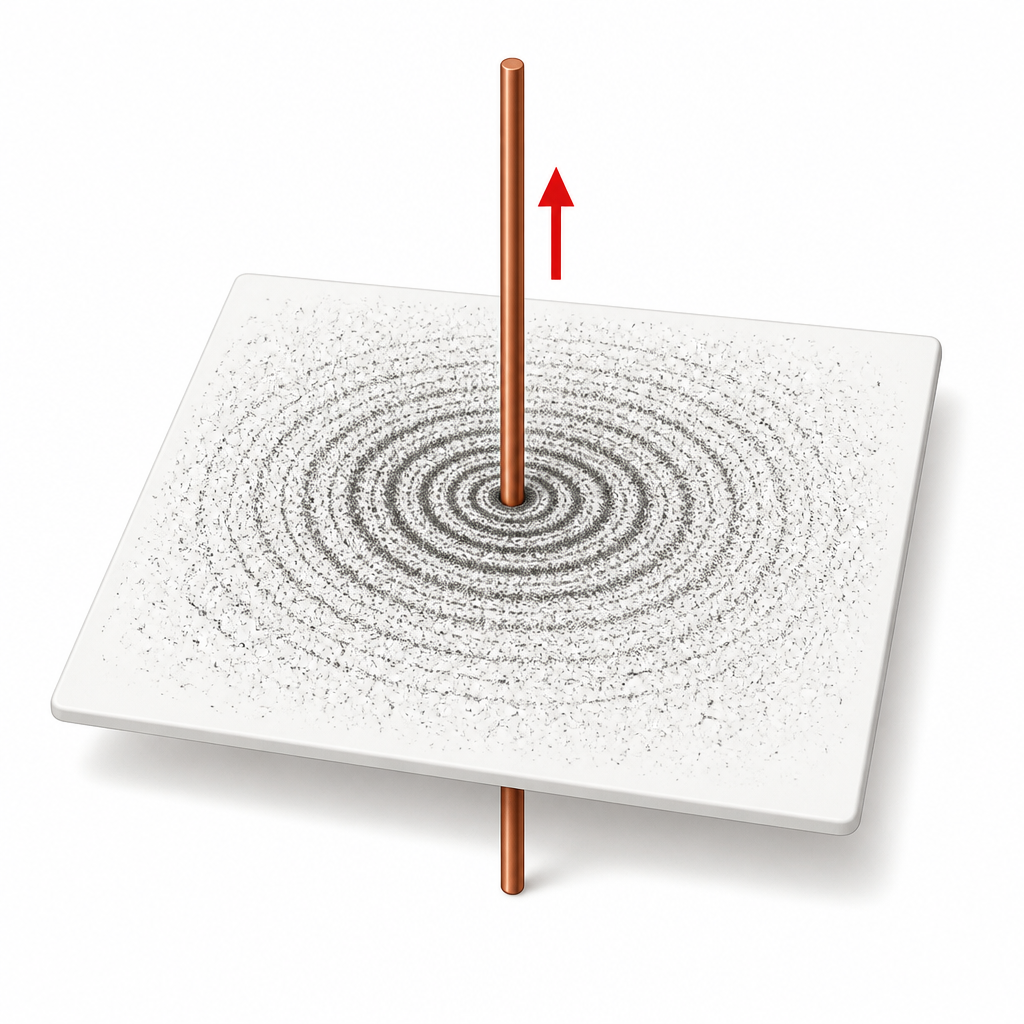
When these rings are drawn as lines on paper, they are called lines of magnetic force. For a straight wire they are concentric circles, and each one is a closed loop with no beginning and no end. Filings show the shape of the field, but not which way round it runs. For the direction, a compass is still needed.
Lines of magnetic force: Imaginary lines drawn to show a magnetic field. At every point on a line, the north pole of a compass needle placed there points along the line.
The Direction Depends on the Current
Imagine looking down on the cardboard from above. Which way the circular field runs depends only on which way the current flows in the wire.
| Current in the wire | Field seen from above |
| Upwards | Anticlockwise |
| Downwards | Clockwise |
| No current | No circular field, needles point north |
A compass placed anywhere on the card confirms this: its north pole points along the circle in the direction of the field. So during the experiment, the direction of the field can be read from the pointer of the compass needle.
Maxwell's Right-Hand Thumb Rule
There is no need to learn the table case by case. Your right hand carries the answer.
Maxwell's right-hand thumb rule: If a current-carrying wire is gripped with the right hand so that the thumb points in the direction of the current, then the fingers curled around the wire point in the direction of the magnetic field.
- Use your right hand.
- Hold the wire as if gripping a stick, with your thumb stretched along it.
- Turn your hand so that the thumb points the same way as the current.
- Look at the way your fingers curl around the wire. That is the direction of the magnetic field.
Using the left hand gives exactly the wrong direction. Also, the thumb always stands for the current and the fingers always for the field. Swapping them gives a wrong answer.
Using the Rule: Worked Examples
Example 1: A vertical wire carries current downwards through a horizontal card. Which way does the field run, seen from above?
- Step 1: Grip the wire with your right hand, thumb pointing down.
- Step 2: Look down at your hand from above.
- Step 3: Your fingers curl clockwise.
Answer: The field runs clockwise when seen from above.
Example 2: A long straight wire lies flat on a table. You look along it from one end, and the current flows away from you. Which way does the field run, as you see it?
- Step 1: Point your right thumb along the wire, away from you.
- Step 2: Look at your curled fingers from behind your hand.
- Step 3: They curl clockwise.
Answer: Clockwise. If the current were flowing towards you, the field would be anticlockwise.
Example 3: Compass needles around a vertical wire point anticlockwise when seen from above. Which way is the current flowing?
- Step 1: Curl the fingers of your right hand anticlockwise, as seen from above.
- Step 2: With the fingers curled that way, your thumb points upwards.
Answer: The current flows upwards through the wire. The rule works both ways: knowing the direction of the current gives you the field, and knowing the field gives you the current.
The full lesson is waiting for you
The notes are free to read in full. A free account opens the rest of the practice, and tracks your progress and confidence score for every subject. Presentations and videos need approval from Learn Yeti.