What the Blood Circulation System Is
Whether you are asleep, reading or playing football, blood keeps moving through your body without a pause. The heart pushes it into tubes called blood vessels. It travels all the way to your fingertips and toes, and then it comes back to the heart to be pushed out again. This never-ending movement of blood around the body is called circulation.
Blood circulation system: the system that keeps blood moving inside the blood vessels to every part of the body, driven by the heart.
Three parts make up this system: the heart, the blood and the blood vessels. The heart works like a pump, the blood is what gets carried, and the vessels are the roads it travels along. Think of a water tank on a roof sending water through pipes to every tap in a house. The difference is that tap water leaves the pipes, while blood stays inside its vessels and returns to the heart in a closed loop.
Heart: the pump that pushes blood around the body
Blood: the liquid that carries oxygen, nutrients and other substances
Blood vessels: the tubes that blood flows through
People did not always know that blood travels around the body. The British doctor William Harvey proved in 1628 that blood circulates in our body.
Functions of the Circulatory System
Working together, the heart, the blood and the blood vessels do these jobs for the body:
- (a) It carries the oxygen we breathe into our lungs out to the tissues of the body, and brings carbon dioxide from the tissues back to the lungs.
- (b) After the digestive system has digested our food, it carries the absorbed nutrients to the cells that need them.
- (c) It takes unwanted waste to the kidneys so that the waste can be removed from the body.
- (d) It delivers the hormones, enzymes and minerals the body needs to its cells.
- (e) It helps control body temperature.
In short, the circulatory system is the body's delivery service. It brings every cell what it needs and takes away what it does not need.
Blood
Blood is the red liquid you see when you cut your finger or graze your knee. Inside the body it always flows in one direction. To the naked eye it looks like one plain red liquid, but under a microscope it turns out to be made of several different parts.
Blood: the red liquid that flows through the body in one direction. Blood is a liquid connective tissue.
A connective tissue is a tissue that links and supports the other parts of the body. Blood does this job as a liquid. By flowing everywhere, it connects every organ with every other organ. That is why blood is called a liquid connective tissue.
Blood makes up seven to eight percent of the total weight of the human body.
For example, how much of a 50 kg person's weight is blood? Seven percent of 50 is 3.5, and eight percent of 50 is 4. So about 3.5 to 4 kg of that person's weight is blood.
Composition of Blood
Although blood looks like a plain liquid, it contains both liquid and solid matter. The liquid part is called plasma, and the solid part is made of blood cells. Blood is 55 percent plasma and 45 percent blood cells. When a laboratory spins a sample of blood in a machine, the heavier cells sink to the bottom and the pale yellow plasma stays on top.
Inside the body the two parts do not separate. The blood cells float in the plasma and are carried along with it through the blood vessels. If a blood vessel is opened up, the three kinds of blood cells can be seen floating in the plasma like this:
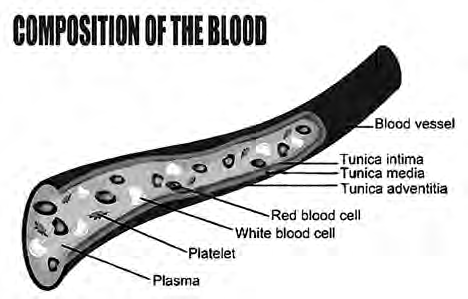
Plasma
Plasma is the liquid part of blood. It is 92 percent water. The rest is made up of nutrients, oxygen, metabolic waste and hormones, all dissolved in the water in the same way that sugar dissolves in tea. Metabolic waste means the leftover substances that cells produce while doing their work, which the body does not need.
Plasma: the liquid part of blood. It is 92 percent water, with nutrients, oxygen, metabolic waste and hormones dissolved in it.
Blood Cells
Blood cells: the solid part of blood. They make up about 45 percent of blood.
There are three kinds of blood cells:
- (a) red blood cells
- (b) white blood cells
- (c) platelets
Red Blood Cells
Red blood cells are also called erythrocytes. They are made in the marrow inside our bones, and billions of new ones are made in the body every day. Each one is round, 6 microns in diameter and 2 microns thick. A micron is one thousandth of a millimetre, so these cells can only be seen under a microscope. One cubic millilitre of blood holds about 4 to 5 million red blood cells.
A red blood cell has no nucleus, but it is flexible. It is round, flat, and dipped inwards on both sides, like a round flat sweet pressed in at the centre from above and below. This shape and this flexibility let red blood cells bend and slip easily through even the finest blood vessels, the capillaries.
Red blood cells contain haemoglobin, and it is haemoglobin that makes blood look red. Haemoglobin contains iron. It takes up oxygen and carries it to every tissue of the body.
Haemoglobin: the iron-containing substance in red blood cells that takes up oxygen, carries it to all the tissues, and gives blood its red colour.
In an adult, red blood cells are made by the bone marrow of the arm and leg bones, the backbone, the ribs, the sternum (breastbone) and the skull. A red blood cell lives for about 120 days. Dead red blood cells are collected in the spleen. Because old cells keep dying while the marrow keeps making new ones, the number of red cells in the blood stays steady.
Red blood cell (erythrocyte): a blood cell made in the bone marrow, with no nucleus and full of haemoglobin, whose main job is to carry oxygen to all the tissues of the body.
Anaemia
Anaemia: the condition in which the number of red blood cells in the blood is much lower than it should be.
When a person has anaemia, the iron in their haemoglobin also falls. With less iron there is less haemoglobin to carry oxygen, so less oxygen reaches the tissues. Anaemia is most likely in pregnant women, women who have recently given birth, and people who have had an operation.
To avoid anaemia, a person should eat more of these foods:
- green vegetables
- fruits
- iron-rich foods
White Blood Cells
White blood cells are bigger than red blood cells. Together, the white blood cells of the blood are called leucocytes. Each white blood cell has a nucleus in its middle. They measure from 8 to 20 micrometres across, and there are 4,000 to 11,000 of them in each cubic millilitre of blood. Like red blood cells, they are made in the bone marrow.
The chief work of white blood cells is to protect the body from disease. When germs get into the body from outside, white blood cells destroy them, working as antibodies and as the body's defence against disease. They also help clear away things the body does not need. Because they fight germs, white blood cells can be thought of as the body's soldiers.
White blood cell (leucocyte): a blood cell with a nucleus in its middle, larger than a red blood cell and made in the bone marrow, whose chief job is to protect the body from disease.
Platelets
Platelets are the smallest blood cells, only 2 to 4 microns across. There are 150,000 to 400,000 platelets in each cubic millilitre of blood.
Platelets carry several substances that blood needs in order to clot. When you are hurt and start bleeding, platelets work to stop the bleeding. If you fall and graze your knee while playing, it bleeds at first, but within a few minutes the blood thickens into a clot and stops flowing. That is the platelets at work.
Platelets: the smallest blood cells, 2 to 4 microns across, which carry the substances needed for blood to clot and stop bleeding from a wound.
The Three Blood Cells Compared
| Blood cell | Size (diameter) | Number in one cubic millilitre | Main job |
| Red blood cell | 6 microns (2 microns thick) | 4 to 5 million | Carries oxygen |
| White blood cell | 8 to 20 micrometres | 4,000 to 11,000 | Protects against disease |
| Platelet | 2 to 4 microns | 150,000 to 400,000 | Clots blood to stop bleeding |
The most numerous blood cell and the largest blood cell are not the same. Red blood cells are the most numerous, white blood cells are the largest, and platelets are the smallest.
Functions of Blood
The main work of blood is to take oxygen from the lungs to the cells, and to take the carbon dioxide made in the cells back to the lungs. Blood also carries nutrients to every cell and helps the body get rid of waste. Besides these, blood:
- (a) keeps body temperature controlled and balanced
- (b) carries hormones to different parts of the body
- (c) protects the body from diseases
- (d) keeps the tissues moist
- (e) helps balance the amount of fluid and salt in the body
- (f) carries different kinds of nutrients to the tissues
Each job of blood belongs to one of its parts. Red cells carry oxygen, white cells fight disease, platelets stop bleeding, and plasma carries the dissolved nutrients, hormones and waste.
Blood Groups
Everyone's blood looks alike, but it is not all of one kind. Human blood is divided into four main groups: A, B, AB and O.
Blood groups: the four main types, A, B, AB and O, into which human blood is divided. Each group is also either Rhesus (Rh) positive or Rh negative.
Every blood group is either Rhesus (Rh) positive or Rh negative. Splitting each of the four groups in this way gives eight subgroups:
| Blood group | Rh positive | Rh negative |
| A | A+ | A- |
| B | B+ | B- |
| O | O+ | O- |
| AB | AB+ | AB- |
Most people's blood is Rh positive. People with Rh negative blood are very few in Nepal. Each person has blood of one group only.
Blood Transfusion: Who Can Receive Whose Blood
Blood transfusion: giving blood from one person to another person whose body is short of blood because of illness or an accident.
Someone who has lost a lot of blood through illness or an accident may need blood from another person. But not just any blood will do. For a transfusion, the blood group and the Rh factor must match. Blood can be given like this:
| Group of the person receiving | Blood that can be given |
| Group A | Group A and group O |
| Group B | Group B and group O |
| Group AB | Any group |
| Group O | Group O only |
Because a person with group AB can take blood from any group, group AB is called the universal recipient. A person with group O needs group O blood when they themselves need blood, but they can give blood to people of every other group, so group O is called the universal donor.
Universal recipient: the blood group that can receive blood from any group. This is group AB.
Universal donor: the blood group that can give blood to every other group, though it can itself receive only group O. This is group O.
Do not mix up giving and receiving. Group O can give blood to everyone but can receive from group O only. The other way round, group AB can receive from everyone, but by the table above, AB blood can go only to a person of group AB.
The Rh Factor and Cross-Matching
When blood is given, the blood group is not the only thing to check. The Rh factor, positive or negative, must be checked too. So a person with group A+ who needs blood should receive A+ blood. A person who is A+ should not be given A- blood, and a person who is A- should not be given A+ blood. The Rh must match on both sides.
So whenever one person's blood is transfused into another person, both the blood group and the Rh, positive or negative, must match. That is why, before a patient is given someone else's blood, the blood group and Rh factor are cross-matched. Cross-matching means testing the blood of both the giver and the receiver to make sure they match before any blood is given.
Example: a patient's blood group is B negative (B-). Which blood can this patient be given?
- Step 1: Look at the group. The patient is group B. By the table, group B can receive group B and group O blood.
- Step 2: Look at the Rh. The patient is Rh negative, so the donor must also be Rh negative.
- Step 3: Put the two together. B- or O- blood fits.
- Step 4: Cross-match the blood of the donor and the patient before the blood is given.
A blood group is never guessed. Before any transfusion, the blood group and Rh of both the donor and the patient are tested and cross-matched.
Blood Donation
Blood donation: a healthy person giving some of their blood so that it can be given to patients who need it.
Not everyone can give blood. Certain conditions are set so that giving blood does not harm the donor. Healthy women and men who meet all of these conditions can donate blood:
- has completed 17 years of age and has not yet reached 60
- weighs more than 45 kg
- has a haemoglobin level of 12 to 16 grams
- is a healthy woman or man
Even a donor who meets these conditions cannot give blood again and again. The body needs time to make new blood, so there must be a gap between donations:
| Donor | Gap between donations | Times a year |
| Healthy man | 3 months | 4 times |
| Healthy woman | 4 months | 3 times |
A year has 12 months. Twelve divided by 3 is 4, so a man can donate 4 times a year. Twelve divided by 4 is 3, so a woman can donate 3 times a year.
The blood we donate goes to patients whose lives are in danger: people hurt in accidents, people having operations, people who have lost a lot of blood. If a little of our blood gives a patient a new life, that is the greatest good deed and the greatest service in the world. That is why giving blood brings the deepest satisfaction a person can feel.
Most students in class 10 are 15 or 16 years old. Once you have completed 17 years and meet the other conditions, you too can become a blood donor and help save someone's life.
The full lesson is waiting for you
The notes are free to read in full. A free account opens the rest of the practice, and tracks your progress and confidence score for every subject. Presentations and videos need approval from Learn Yeti.