What Reproduction Means
The word reproduction is made of two English parts: Re + Production. Re means again, and production means making, so reproduction literally means making again. You can see it at work in any family. A son may have his father's nose, and a daughter may have her mother's curly hair, because features pass from parents to their young. Every living thing, from a mango tree to a buffalo to a human being, can produce young of its own kind. This power to produce offspring is one of the main features of life.
Reproduction: producing new offspring in a way that passes on a living being's characteristics, and so keeping its line of descendants going.
A family line continues only because each generation has children. Grandparents, parents, children and grandchildren form one unbroken chain. If a kind of living thing stopped producing young, its line would end with the last one alive.
The Reproductive System
In human beings, a new life begins when a cell from a man and a cell from a woman join. It happens in this order:
- During sexual intercourse, sperm from the man travel into the woman's uterus.
- An egg is released from the woman's ovary and moves towards the uterus.
- The egg and a sperm meet and join inside the fallopian tube, and pregnancy begins.
- About nine months and seven days later, the baby is born.
Reproductive system: the group of organs that take part in producing offspring.
Men and women have different reproductive organs. They differ in shape and in the work they do, yet both sets serve one purpose: starting a new life. The male organs are explained one at a time below.
Organs of the Male Reproductive System
The main organs of the male reproductive system are the testes, the epididymis, the vas deferens, the seminal vesicles, the ejaculatory ducts and the penis. Two more structures, the prostate gland and the urethra, also play an important part. These organs are joined to each other by tubes, so together they make one pathway running from the place where sperm are made to the place where they leave the body.
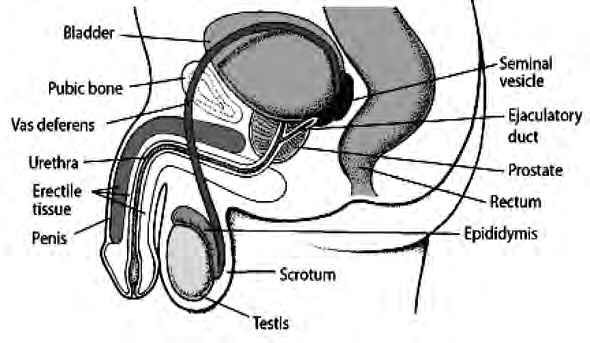
The picture also shows the bladder, the pubic bone and the rectum. These are not reproductive organs. They are landmarks that help you find everything else: the bladder sits above the prostate, the pubic bone is at the front, and the rectum is behind.
1. Testes
The testes are the most important male reproductive organs. They lie below the penis, between the two thighs. A man has two testes. Each is covered by skin and kept safe inside a pouch of skin called the scrotum. The testes are oval, shaped like an egg, and each weighs about 15 to 25 grams. The testes are the male reproductive glands.
Testes: the two egg-shaped male reproductive glands that sit in the scrotum below the penis and produce sperm and the hormone testosterone.
Scrotum: the pouch of skin that holds and protects the two testes.
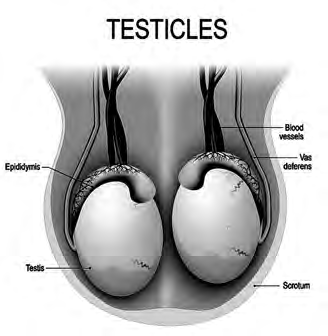
Inside, each testis is divided into 200 to 300 small compartments called testicular lobules. Every lobule holds three or four fine, tightly coiled tubes called seminiferous tubules, and these tubes connect to the epididymis. The cells of the seminiferous tubules produce sperm. They also produce the hormone testosterone.
Testosterone: the male sex hormone made in the testes, which brings about the development of male characteristics.
The changes a boy notices in adolescence, such as a deeper voice, hair on the face and stronger muscles, are brought about by this hormone. The testes have two main jobs:
- Producing sperm.
- Producing testosterone, the male sex hormone.
2. Epididymis
The epididymis lies just on top of each testis. At its lower end it is joined to the testis by countless seminiferous tubules, and at its upper end it is joined to the vas deferens, so it is the link between the two. Sperm made in the testis move into the epididymis, and here they develop their movement: this is where they become able to swim. Cells in the epididymis also produce semen, and the sperm float in it.
Epididymis: the part lying just on top of the testis, joined to the testis below and the vas deferens above, where sperm gain the power to move.
The main jobs of the epididymis are:
- Giving sperm the right surroundings in which to mature.
- Giving sperm the ability to move.
- Passing sperm on to the vas deferens.
3. Vas Deferens
The vas deferens starts at the epididymis and runs up to the seminal vesicle. It is about 45 cm long. Sperm travel along this tube from the testis to the seminal vesicle. In the side view of the male organs, you can follow it climbing up from the testis, looping over the top of the bladder and coming down behind it to the seminal vesicle.
Vas deferens: the tube, about 45 cm long, that runs from the epididymis to the seminal vesicle and carries sperm from the testis to the seminal vesicle.
When a man chooses permanent family planning, this tube is cut and both cut ends are tied. After that, sperm can no longer reach the seminal vesicle, so no pregnancy can result. Because the operation cuts and ties the vas deferens, male sterilisation is called a vasectomy.
Vasectomy: male sterilisation for permanent family planning, in which the vas deferens is cut and both ends are tied.
4. Seminal Vesicle
There are two seminal vesicles, one on the right and one on the left, just below the bladder. Sperm arriving through the vas deferens are stored here. The seminal vesicles produce a thick, sticky fluid called semen. This fluid feeds the sperm and protects them. From the bottom of each seminal vesicle a short tube joins the vas deferens. That short tube is the ejaculatory duct.
Seminal vesicles: the two pouches, one on each side just below the bladder, where sperm are stored and semen is produced.
Semen: the thick, sticky fluid in which sperm float, and which feeds and protects them.
Semen and sperm are not the same thing. Sperm are the tiny reproductive cells made in the testes. Semen is the thick fluid the sperm float in. If a question asks where sperm are made, the answer is the testes, not the seminal vesicles.
5. Ejaculatory Duct
The short tube that leaves the seminal vesicle and joins the vas deferens is the ejaculatory duct. It is about 2.5 cm long, very short compared with the 45 cm vas deferens. During sexual intercourse, and during a wet dream, the semen and sperm in the ejaculatory duct pass into the urethra and leave the body through the penis. A wet dream is a release of semen that happens by itself during sleep.
Ejaculatory duct: the tube, about 2.5 cm long, formed where the seminal vesicle joins the vas deferens, which carries semen and sperm into the urethra.
6. Prostate Gland
This gland is found only in males, so it is also called the male gland. It lies just below the bladder and is shaped like a betel leaf. It wraps around the first part of the urethra and the last part of the ejaculatory ducts. Because it surrounds the urethra, when the gland grows larger it squeezes the urethra, and passing urine becomes difficult.
The prostate produces a thin, alkaline fluid. The acid present in the vagina and in the penis can harm sperm, and an alkaline fluid cancels out that acid, so the sperm survive. The jobs of the prostate are:
- Making a thin alkaline fluid that protects sperm from the acid in the vagina and the penis.
- Cleaning the urethra.
- Helping sperm to move.
Prostate gland: the gland found only in males, lying below the bladder and shaped like a betel leaf, which surrounds the start of the urethra and the end of the ejaculatory ducts and makes a thin alkaline fluid.
7. Urethra
The urethra is the tube, about 19 to 20 cm long, that starts at the bladder and ends at the tip of the penis. In males it is a shared passage: both urine and semen leave the body through it. During intercourse it helps to deliver semen into the vagina.
Urethra: the tube, about 19 to 20 cm long, running from the bladder to the tip of the penis, which in males is the shared passage for urine and semen.
In males one tube does two jobs: urine leaves the body through it, and so does semen.
8. Penis
The penis is made of stretchable tissues and soft muscle, and it is covered by thin skin. The rounded tip, shaped like a betel nut, is called the glans penis. The skin covering the glans is called the prepuce, or foreskin. The urethra opens at the tip of the penis. In its normal state the penis is 8 to 9 cm long, and when erect it is 16 to 19 cm long.
Glans penis: the rounded tip of the penis, shaped like a betel nut.
Prepuce: the skin that covers the glans penis.
Urine and semen both leave the body through the penis. An erection happens, and ends, like this:
- During intercourse, extra blood flows into the penis through its blood vessels.
- The blood collects in the spongy tissue of the penis, and the penis becomes erect.
- After ejaculation the arteries narrow, and the penis returns to its earlier state.
The size of the penis differs from person to person because of body build, diet and inherited family and ethnic traits. The main jobs of the penis are:
- Passing urine out of the body.
- Delivering sperm and semen into the woman's vagina during intercourse.
Just as height and faces differ between people, it is natural for the size of the penis to differ too.
The Journey of Sperm: All the Organs Together
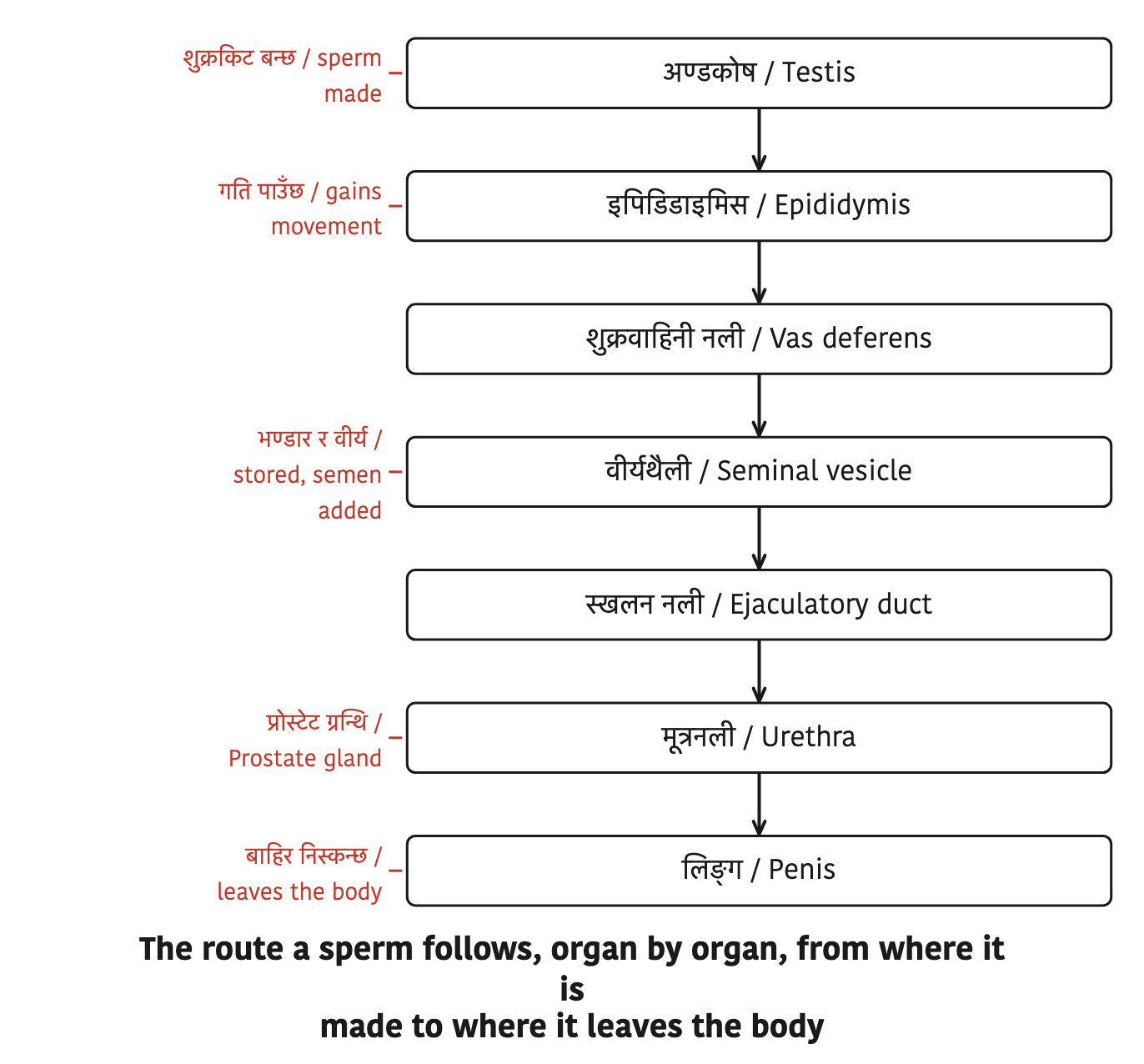
All eight organs are parts of one route. From the moment a sperm is made until it leaves the body, it travels in this order:
- A sperm is made in the seminiferous tubules of the testis.
- It moves into the epididymis and gains the power to swim.
- It travels through the vas deferens, about 45 cm long, to the seminal vesicle.
- It is stored in the seminal vesicle and mixed with semen.
- It passes through the ejaculatory duct, about 2.5 cm long, inside the prostate, and into the urethra, picking up the prostate's alkaline fluid.
- It moves along the urethra and leaves the body at the tip of the penis.
Organs and Their Work at a Glance
| Organ | Where it is | Main job |
| Testes | In the scrotum, below the penis | Make sperm and testosterone |
| Epididymis | Just on top of each testis | Gives sperm the power to move and passes them on |
| Vas deferens | From the epididymis to the seminal vesicle | Carries sperm to the seminal vesicle |
| Seminal vesicles | Below the bladder, one on each side | Store sperm and make semen |
| Ejaculatory ducts | Where the seminal vesicle meets the vas deferens | Send semen and sperm into the urethra |
| Prostate gland | Below the bladder, around the urethra | Alkaline fluid protects sperm; cleans the urethra |
| Urethra | From the bladder to the tip of the penis | Shared passage for urine and semen |
| Penis | Outside the body, above the scrotum | Passes urine; delivers semen into the vagina |
The measurements and numbers that are worth learning:
- Weight of each testis: 15 to 25 grams
- Testicular lobules in each testis: 200 to 300
- Seminiferous tubules in each lobule: three or four
- Length of the vas deferens: about 45 cm
- Length of the ejaculatory duct: about 2.5 cm
- Length of the urethra: about 19 to 20 cm
- Length of the penis: 8 to 9 cm normally, 16 to 19 cm when erect
The full lesson is waiting for you
The notes are free to read in full. A free account opens the rest of the practice, and tracks your progress and confidence score for every subject. Presentations and videos need approval from Learn Yeti.