What a Gland Is
Your cells and tissues need more than food, water and oxygen to stay healthy. They also need hormones, the chemical messengers that tell different parts of the body what to do. Hormones, and many other juices the body uses, are made by glands. A gland is a group of special tissue whose job is to produce a secretion.
Gland: A group of epithelial tissue in the body that can produce a secretion is called a gland.
Many of these secretions enter the bloodstream and travel to different organs, where each one does its own special job. Different glands make different secretions, and together they help the body in these ways:
- to help the body grow
- to keep the amount of water in the body balanced
- to make good use of the nutrients we eat
- to digest food
- to protect the body from diseases and keep it healthy
Glandular system: All the glands in the body, taken together with their structure and their functions, are called the glandular system.
Glands are sorted into two groups by their structure, and one question decides the group: does the gland have its own tube, called a duct, to carry its secretion to the organ that needs it? A gland with a duct is an exocrine gland. A gland without a duct is an endocrine gland.
Exocrine Glands
Exocrine gland: A gland that has its own duct to carry its secretion to the organ where it is needed is called an exocrine gland.
An exocrine gland may be made of a single cell, when it is called unicellular, or of many cells, when it is called multicellular. These glands mainly produce enzymes. The salivary glands and the gastric glands are two examples. When the smell of hot food makes your mouth water, your salivary glands are sending saliva straight into your mouth through their ducts. In the same way, the gastric glands pour their digestive juice through ducts into the stomach, where it helps to digest food.
Endocrine Glands and Hormones
Endocrine gland: A gland that has no duct of its own to carry its secretion to an organ is called an endocrine gland.
Because it has no duct, an endocrine gland releases its hormone directly into the blood. Blood flows all round the body, so the hormone is carried along with it to the tissues and organs where it acts. In this way hormones keep the internal environment of the body balanced. Bringing blood sugar back down after a meal, making less urine when the body is short of water and getting the body ready when you are frightened are all jobs done by hormones.
Hormone: A special chemical substance released by an endocrine gland is called a hormone.
Endocrinology: The science that studies the endocrine glands is called endocrinology.
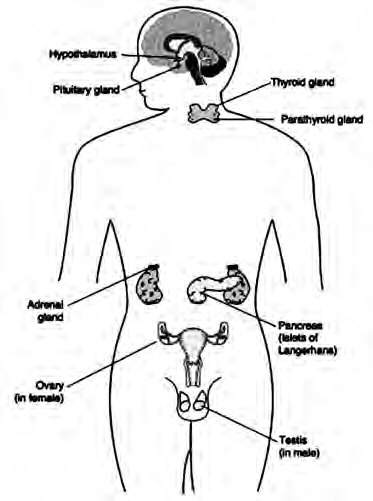
Endocrine glands are found in many different places in the body. The main ones are:
- (a) the pituitary gland
- (b) the thyroid gland
- (c) the parathyroid glands
- (d) the thymus gland
- (e) the adrenal glands
- (f) the pancreas
- (g) the sex glands, also called gonads
The pineal gland, which lies inside the head, is also an endocrine gland. The diagram below shows where the main glands sit, from the head down to the lower abdomen.
The Pituitary Gland: the Master Gland
The pituitary gland is also called the hypophysis. It hangs just below the front part of the cerebrum, the large main part of the brain. It is very small: about 1 cm long, 1.5 cm wide and 0.5 cm thick. It is oval in shape, weighs only about 0.5 g, and from the outside looks like a large pea.
Small as it is, the pituitary controls, directs and runs all the other endocrine glands. Just as a head teacher organises the work of every class in a school, the pituitary sends signals telling the other glands when to make their hormones and how much to make.
Master gland: The pituitary gland is called the master gland because it controls, directs and runs all the other endocrine glands of the body.
To study it, the pituitary is divided into two parts: the anterior lobe at the front and the posterior lobe at the back.
Anterior Lobe of the Pituitary
The anterior lobe takes up about three quarters of the pituitary gland. It makes several hormones, and these hormones affect the work of other glands. Its main hormones are:
- (i) Growth hormone: helps every organ and part of the body grow and develop properly, and keeps the size of the body in balance.
- (ii) Prolactin: during pregnancy it makes a woman's breasts grow, and after the baby is born it stimulates the breasts to produce milk.
- (iii) Adrenocorticotropic hormone (ACTH): stimulates the adrenal gland to produce the hormone cortisol.
- (iv) Thyroid stimulating hormone (TSH): stimulates the thyroid gland in the neck to produce thyroxine, and plays a direct part in the growth and development of the thyroid gland itself.
- (v) Gonadotropic hormones: these are follicle stimulating hormone (FSH) and luteinizing hormone (LH), and they affect the work of the sex and reproductive organs. In males, FSH controls the work of the testes. In females, both hormones control the work of the ovaries.
The right amount of growth hormone matters a great deal. If too much is made, the arms and legs grow very long and the person becomes unusually tall. If the pituitary makes too little, the person does not grow as tall as others of the same age.
Thyroid stimulating hormone is made by the pituitary, not by the thyroid. Its job is only to push the thyroid into making thyroxine. In the same way, adrenocorticotropic hormone is a pituitary hormone, not an adrenal one.
Posterior Lobe of the Pituitary
The posterior lobe is smaller than the anterior lobe, white in colour and solid. It is shaped like a tube and has nerve fibres joined to it. It produces two hormones: antidiuretic hormone (ADH) and oxytocin.
ADH makes the nephrons of the kidney take back more water. Less urine is made, and the amount of water in the body stays balanced. On a hot day when you have sweated a lot, your urine is small in amount and dark: that is ADH at work. When a person loses a lot of blood, ADH also helps to raise the blood pressure.
Oxytocin, at the last stage of pregnancy or during labour pains, makes the muscles of the uterus contract, which helps the baby to be born. Later, when the baby sucks at the breast, oxytocin squeezes the milk ducts of the breast so that the milk flows out.
The Thyroid Gland
The thyroid gland is in the neck. It has a right part and a left part, one on each side of the trachea (windpipe), and the two parts are joined together. A thin layer covers it on all sides. It spreads out to the right and left of the cartilage at the front of the larynx, the voice box. It weighs 30 to 60 g.
The thyroid makes two thyroid hormones: thyroxine and tri-iodothyronine. To make them it needs iodine, which we get from green vegetables, iodised salt and other foods.
When these hormones are short, the effect depends on age. A child who makes too little thyroid hormone becomes physically and mentally weak, stays short and is slow to understand. In an adult, a shortage makes the body heavy and swollen, and thinking and speech become slow.
Myxoedema: The condition in adults, caused by a shortage of thyroid hormones, in which the body becomes heavy and swollen and thinking and speech become slow.
Goitre: The condition in which the thyroid gland becomes enlarged because the body is short of iodine.
What thyroid hormones do:
- They help mental and physical development.
- They help the nervous system and the heart do their work.
- They keep the skin and hair clean and healthy.
- They produce heat in the body.
- They support metabolism, the chemical work that goes on in the tissues.
- They lower the amount of calcium in the blood by using that calcium to build teeth and bones.
The Parathyroid Glands
The parathyroid glands sit on the back of the thyroid gland. There are four of them in all, two at the top and two at the bottom, and each is about the size of a pea. The hormone they release is called parathormone, or parathyroid hormone. It helps the muscles to contract and controls the amount of calcium and phosphorus in the blood.
Thyroid and Parathyroid Compared
Their names sound alike and they sit side by side, but these are two different glands. The table sets out how their structure and work differ.
| Point | Thyroid gland | Parathyroid glands |
| Position | In the neck, on the right and left of the trachea | On the back of the thyroid gland |
| Number | One gland made of two joined parts | Four, two at the top and two at the bottom |
| Size | Weighs 30 to 60 g | Each about the size of a pea |
| Hormones | Thyroxine and tri-iodothyronine | Parathormone |
| Main work | Growth, body heat, metabolism, nerve and heart work | Helps muscles contract |
| Link with calcium | Lowers blood calcium by using it for teeth and bones | Controls the amount of calcium and phosphorus in the blood |
The Adrenal Glands
The body has two adrenal glands, one sitting like a cap on the top of each kidney. Each adrenal gland has two parts: the outer part is called the adrenal cortex and the inner part is called the adrenal medulla.
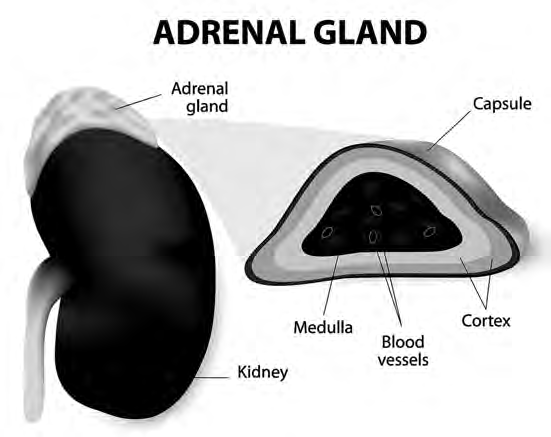
The adrenal cortex makes three kinds of hormones belonging to the corticosteroid group: glucocorticoids such as cortisone, mineralocorticoids and androgens. These hormones:
- control the amount of sodium, water and potassium in the body
- help the body break down and use carbohydrates, fats and proteins (metabolism)
- increase the store of glucose in the liver and so control the amount of glucose in the blood
- help the blood vessels to narrow
- support sexual development
The adrenal medulla is the central part of the gland, with the cortex wrapped around it. It produces adrenaline and noradrenaline. These hormones:
- turn the glycogen stored in the liver into glucose, giving the body energy
- raise the blood pressure and the heartbeat
- in special situations, widen the blood vessels of the heart, brain and muscles so that more blood reaches them
- in moments of fear and danger, prepare the body to face it: the muscles become stronger, the heart beats faster and the pupils of the eyes grow larger
If a dog suddenly chases you on the way home, your heart pounds, your legs find new strength and you run faster than you could on an ordinary day. That is adrenaline at work. When adrenal hormones are too low, the body becomes weak, the person feels sick and the blood pressure falls. When too much is made, features of the opposite sex can appear: a woman may grow a moustache, and a man's voice may become like a woman's.
The Pancreas: a Mixed Gland
The pancreas lies inside the abdomen, behind the stomach and to the left of the duodenum, the first part of the small intestine. It is shaped like a small leaf. It is long, broad at the end near the duodenum and pointed at the end near the spleen.
The pancreas is a mixed gland because it does two kinds of work. First, it makes pancreatic juice and sends it along the pancreatic duct into the duodenum to digest food, which is exocrine work. Second, acting as an endocrine gland, it makes the hormones insulin and glucagon, which pass straight into the blood. The groups of cells that make these hormones are called the pancreatic islets, also known as the islets of Langerhans.
Mixed gland: A gland that does the work of both an exocrine and an endocrine gland is called a mixed gland. The pancreas is a mixed gland.
Pancreatic islets: The groups of cells in the pancreas that produce the hormones insulin and glucagon.
Insulin and glucagon keep the amount of glucose in the blood right. Insulin lowers blood glucose, and glucagon raises it. Insulin does this by turning glucose into glycogen and storing it in the liver and muscles. After a big meal of rice, blood glucose rises and insulin sends the extra into store. After many hours without food, glucagon brings blood glucose back up.
Diabetes: The disease a person gets when the body has too little insulin, or when insulin cannot do its work properly.
Insulin and glucagon work in opposite directions. Insulin lowers blood glucose and glucagon raises it. Because both come from the same gland, students often swap them.
The Sex Glands
Sex glands: The testes of a male and the ovaries of a female are called the sex glands, or gonads.
There are two of each, and they make the sex hormones. Many of the body changes that happen during adolescence are brought about by these hormones.
Ovaries
The ovaries are the main organs of the female reproductive system, and they produce ova, the egg cells. They lie in the lower abdomen, in the pelvis, one on the right and one on the left of the uterus. The ovaries make the hormones oestrogen and progesterone, which are linked with a woman's sexual development and with reproduction. These hormones:
- keep menstruation regular
- help the ovaries produce ova
- bring about sexual development in females
- help during pregnancy and childbirth
- help a breastfeeding mother produce milk
Testes
The testes are the main organs of the male reproductive system, and a male has two of them. They make the hormones testosterone and androgen, which help a male's physical and sexual development. These hormones:
- bring about physical and sexual development in males
- stimulate the sex organs
- help the testes produce sperm (spermatozoa) and support the male reproductive system
The Glandular System at a Glance
| Gland | Where it is | Hormones | Main work |
| Pituitary | Below the front part of the cerebrum | Growth hormone, prolactin, ACTH, TSH, FSH, LH, ADH, oxytocin | Runs all the other endocrine glands |
| Thyroid | In the neck, on both sides of the trachea | Thyroxine, tri-iodothyronine | Development, body heat, metabolism |
| Parathyroid | On the back of the thyroid, four in all | Parathormone | Controls calcium and phosphorus |
| Adrenal cortex | On top of each kidney, outer part | Corticosteroids | Controls sodium, water, potassium and glucose |
| Adrenal medulla | On top of each kidney, inner part | Adrenaline, noradrenaline | Prepares the body in fear and danger |
| Pancreas | Behind the stomach | Insulin, glucagon | Keeps blood glucose right |
| Ovaries | In the pelvis, either side of the uterus | Oestrogen, progesterone | Menstruation, sexual development, pregnancy, milk |
| Testes | Two, in the male | Testosterone, androgen | Physical and sexual development, sperm |
The glandular system works like the body's messaging service. Carried by the blood, hormones organise growth, digestion, the balance of water and sugar, protection in danger and reproduction. When a single gland makes too much or too little, problems such as stunted growth, goitre or diabetes follow.
The full lesson is waiting for you
The notes are free to read in full. A free account opens the rest of the practice, and tracks your progress and confidence score for every subject. Presentations and videos need approval from Learn Yeti.