What Menstruation Is
When a girl reaches adolescence, her body begins to change in many ways. She grows taller, her breasts develop, and some time later her periods begin. In simple words, the flow of blood from a woman's vagina about once a month is called menstruation, or having a period. This blood does not come from a wound. It comes from the inner lining of the uterus and leaves the body through the vagina.
Menstruation: the process in which blood from the uterus flows out of the body through the vagina about once every month.
During a period, blood flows out of the vagina for about 4 days. Periods usually begin between the ages of 12 and 15. Once they have started, they continue for as long as a woman is able to become pregnant, which is until about the age of 49. In everyday speech in Nepal, menstruation is known by several other names. Some of those names mean things like 'not to be touched' or 'moved aside', and they come from old beliefs that you will read about further on.
Menarche, Menopause and the Menstrual Cycle
A woman's menstrual life has two special points: the day it begins and the time it stops for good. Each has its own name. Suppose Sarita has her very first period at the age of 13. That first period is her menarche. If her mother's periods stop completely when she is 47, her mother has reached menopause.
Menarche: a girl's first menstruation.
Menopause: the stage, usually between the ages of 45 and 49, when menstruation stops.
Between menarche and menopause, menstruation does not happen once and stop. After adolescence, the same process repeats itself every month. Because the same sequence keeps coming round again, it is called a cycle.
Menstrual cycle: the monthly series of changes in a woman's body that repeats from adolescence onwards and ends each time in menstruation, unless the egg is fertilized.
The Hormones That Control the Cycle
The menstrual cycle does not run by itself. Four hormones control it. Two come from the pituitary gland, which sits just below the brain, and the other two come from inside the ovary. The pituitary hormones tell the ovary what to do, and the ovary's hormones get the lining of the uterus ready.
| Hormone | Where it comes from | What it does |
| Follicle stimulating hormone (FSH) | Pituitary gland | Helps one follicle in the ovary to develop |
| Oestrogen | The developing follicle | Thickens the uterine lining so it can feed a fertilized egg |
| Luteinising hormone (LH) | Pituitary gland | Makes the corpus luteum produce progesterone |
| Progesterone | The corpus luteum | Makes the endometrium even thicker and rich in nutrients |
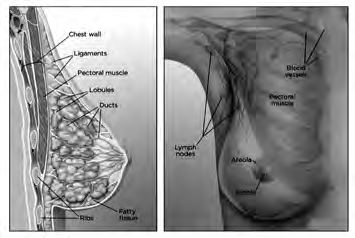
Oestrogen and progesterone do not work only on the uterus. They also act on the breasts. These are the hormones that make the breasts grow when puberty begins, and during pregnancy they are produced in even larger amounts. That is why breast development is usually seen around the same time that a girl's periods begin.
The Stages of a 28-Day Cycle
For many women the menstrual cycle lasts about 28 days. The days are counted from the first day of bleeding, which is day 1. The day numbers below are for a woman whose cycle is exactly 28 days long, and some women have a slightly shorter or longer cycle. The cycle moves forward in this order:
- The pituitary gland releases FSH, which helps one follicle inside the ovary to develop.
- The growing follicle produces the hormone oestrogen.
- Oestrogen prepares the wall of the uterus. More blood vessels and mucus-producing glands grow in it, its cells divide quickly, and the wall becomes thick.
- On day 14 the follicle bursts and the egg is released. The finger-like fimbriae at the end of the fallopian tube catch the egg and guide it into the tube.
- Now, under the influence of LH from the pituitary gland, the part of the follicle left behind, called the corpus luteum, produces the hormone progesterone.
- Together, oestrogen and progesterone make the uterine lining, the endometrium, even thicker. If conception happens at this time, the nutrients stored in this lining feed the growing embryo.
Corpus luteum: the part of the follicle that stays behind in the ovary after it has burst and released its egg. It produces the hormone progesterone.
Endometrium: the inner lining of the uterus, which thickens in every cycle and breaks down if the egg is not fertilized.
When the Egg Is Not Fertilized
The thick lining was prepared to receive an embryo. If the egg is not fertilized, that preparation is no longer needed, and the body clears it away. This happens next:
- The corpus luteum begins to break down, and the supply of progesterone in the blood stops.
- Without progesterone, the blood vessels in the uterine wall shrink, and less and less oxygen reaches the lining.
- The blood vessels burst, the cells die, and blood leaves the body through the vagina, carrying the unfertilized egg with it. This is the menstrual flow.
- This monthly flow lasts about five or six days.
- After that, new cells begin to grow in the uterine wall, blood vessels and glands develop again, and a new cycle begins.
| If the egg is fertilized | If the egg is not fertilized |
| The corpus luteum keeps making progesterone | The corpus luteum breaks down and progesterone stops |
| The thick lining feeds the embryo | The lining breaks down and leaves with the blood |
| There is no period | A period happens and a new cycle begins |
If the egg is fertilized, or the woman is pregnant, there is no period, because the uterine lining is kept to feed the embryo.
Looking After Yourself During Menstruation
During a period, blood flows for 4 to 5 days. The body is losing blood and may feel tired, so it needs good care at this time. There are three main things to do:
- Cleanliness: pay special attention to keeping clean. Keep the body clean, change the pad or cloth regularly, and keep your hands clean.
- Rest: do less heavy physical work at this time, and get enough rest.
- Food: eat more nutritious food and more liquid food, such as soups and lentil broth.
Superstitions About Menstruation
Some wrong superstitions about menstruation are still found in our society. Making a woman sit alone in a dark room during her period, or forbidding her to touch anyone, are two examples. Practices like these give her neither rest nor cleanliness. Instead they make her feel ashamed, afraid and alone. Menstruation is a natural process controlled by the body's hormones. It is not an illness, and it does not make anyone impure.
Do not follow superstitions such as keeping a menstruating girl alone in a dark room or refusing to touch her. She should not be separated from others. She needs a clean place, rest and nutritious food.
As a student, you can help remove these superstitions:
- Share the correct fact at home and in your neighbourhood that menstruation is a natural process.
- Support a sister or friend who is having her period instead of teasing her.
- Spread awareness at school through discussions, short plays or wall magazines.
- Remind your family that a menstruating person at home needs rest, cleanliness and good food.
How Fertilization Happens
In humans, a new life begins when a sperm and an egg join. During sexual intercourse between a man and a woman, the man's penis releases countless sperm into the woman's vagina. The following then happens in order:
- The sperm swim from the vagina up through the uterus towards the fallopian tubes.
- If an egg is in the fallopian tube at that time, only one of the many sperm reaches and meets it.
- As soon as that one sperm meets the egg, the egg is fertilized and all the other sperm die.
Fertilization: the joining of a sperm with an egg. It usually takes place inside the fallopian tube.
Fertilization is not possible on every day, because an egg is released only once a month. It can happen only within a certain period, but that period cannot be fixed exactly. The chance of fertilization is highest if intercourse takes place between the 12th and the 20th day after a period begins, because in a 28-day cycle the egg is released around day 14.
The Zygote and Conception
The single cell formed when a sperm and an egg join is the very first form of a new human being. This cell moves slowly along the fallopian tube towards the uterus. When it reaches the uterus, it attaches itself to the thick lining there. This is exactly the job the thick lining was prepared for during the menstrual cycle.
Zygote: the fertilized egg, formed when a sperm and an egg join.
Conception: the stage when the fertilized egg reaches the uterus and attaches itself to the inner lining of the uterus.
Placenta: the organ formed in the womb through which the growing baby receives the nutrients it needs from the mother's body.
How the Baby Grows in the Womb
After conception, every nutrient the growing group of cells needs comes from the mother's body through the placenta. So the mother's nutrition decides how well the baby grows. If she does not get good nutrition, the baby cannot develop properly either. The baby develops in this order:
| Time | What develops |
| First three months of pregnancy | The baby's head and spine develop, and the placenta becomes fully developed |
| From the fourth month | The ears, eyes and nose develop |
| Throughout pregnancy | The baby receives its nutrients from the placenta |
The menstrual cycle and fertilization are two halves of one story. Every month the cycle prepares an egg and a thick lining. If the egg is fertilized, conception follows. If it is not, a period follows.
The full lesson is waiting for you
The notes are free to read in full. A free account opens the rest of the practice, and tracks your progress and confidence score for every subject. Presentations and videos need approval from Learn Yeti.