What the Nervous System Does
You wake up, hear your mother calling, notice whether your tea is hot or has gone cold, remember what you studied at school yesterday, and walk off with your bag. Every one of these actions is controlled by one system: the nervous system. It is counted among the highest and most important systems of the body, because it fully controls both what the body does and what the mind does.
The nervous system is the body's communication network. News of what is happening in one part reaches another part, and that is why the organs can work together. It also controls every other system in the body. Its main jobs include:
- moving and running the different organs of the body
- seeing, hearing, feeling heat and cold, and tasting
- making us feel hunger and thirst
- remembering things
- keeping the heart beating
- making the body produce digestive juices and hormones
The nervous system is built from a special kind of tissue that responds to stimulation. This tissue becomes active the moment it receives a stimulus and can carry a message onward. It is called nervous tissue.
Nervous system: the group of organs, made of nervous tissue, that coordinates, controls and directs the work of all the other systems of the human body.
The Neurone
Neurone: the smallest working unit of the nervous system. It is also called a nerve cell.
A house is built from bricks, and the nervous system is built from neurones joined together. Each neurone is made of a nerve cell body and nerve fibres. On one side of the cell body there is a single long fibre called the axon. On the other side there are many short fibres that branch like the twigs of a tree, called dendrites. The axon is wrapped in a covering called the myelin sheath. Many neurones bundled together make a nerve.
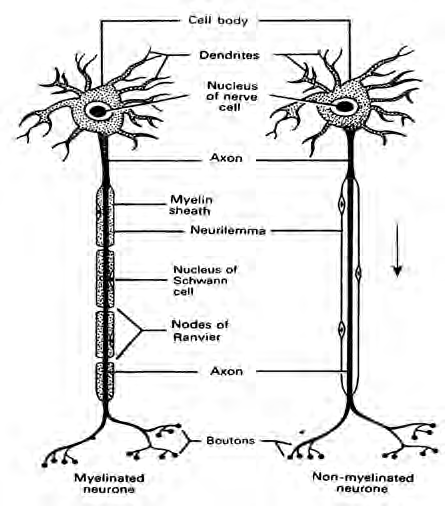
The picture shows two neurones. On the left, the axon is covered by the myelin sheath in short segments; this is a myelinated neurone. The neurone on the right has no such covering, so it is a non-myelinated neurone. The arrow shows the direction a message travels: from the cell body, down the axon, to its far end.
| Part | What it is |
| Cell body | The main body of the neurone, holding its nucleus |
| Dendrites | Short branching fibres on one side of the cell body |
| Axon | The single long fibre on the other side of the cell body |
| Myelin sheath | The covering wrapped around the axon |
Three Types of Nerve
All neurones are built in much the same way, but they do different jobs. The key question is which way the message travels: from the body towards the brain, or from the brain out to the body. On the basis of their work, neurones are divided into three main types.
(a) Sensory nerve (afferent nerve): a neurone that carries news and stimuli from the different parts of the body to the brain or the spinal cord. Feelings of cold, heat and pain travel along it.
(b) Motor nerve (efferent nerve): a neurone that carries news and instructions from the brain or the spinal cord out to the different parts of the body.
(c) Mixed nerve: a neurone with the qualities of both the sensory and the motor type. It is also called a mixed or connecting neurone. It carries stimuli to the brain and brings messages back from it.
Here is an example. Someone taps your shoulder from behind. The touch is picked up by your skin, and a sensory nerve carries that news to the brain. The brain decides that you should turn and look, and a motor nerve carries this order to the muscles of your neck. You turn around.
| Type of nerve | Direction of the message | Example |
| Sensory (afferent) | From body parts to the brain or spinal cord | The news that a pot is hot |
| Motor (efferent) | From the brain or spinal cord to body parts | The order to pull the hand away |
| Mixed | Both ways | Carries messages in and out |
Afferent and efferent sound alike, and students often swap them. Afferent means sensory: it carries news in towards the brain. Efferent means motor: it carries orders out from the brain to the organs. One way to hold it: Efferent goes to the Effect, the muscle that acts.
The Three Parts of the Nervous System
The nervous system is made of several parts working together. It is divided into three main parts:
- (a) the central nervous system
- (b) the peripheral nervous system
- (c) the autonomic nervous system
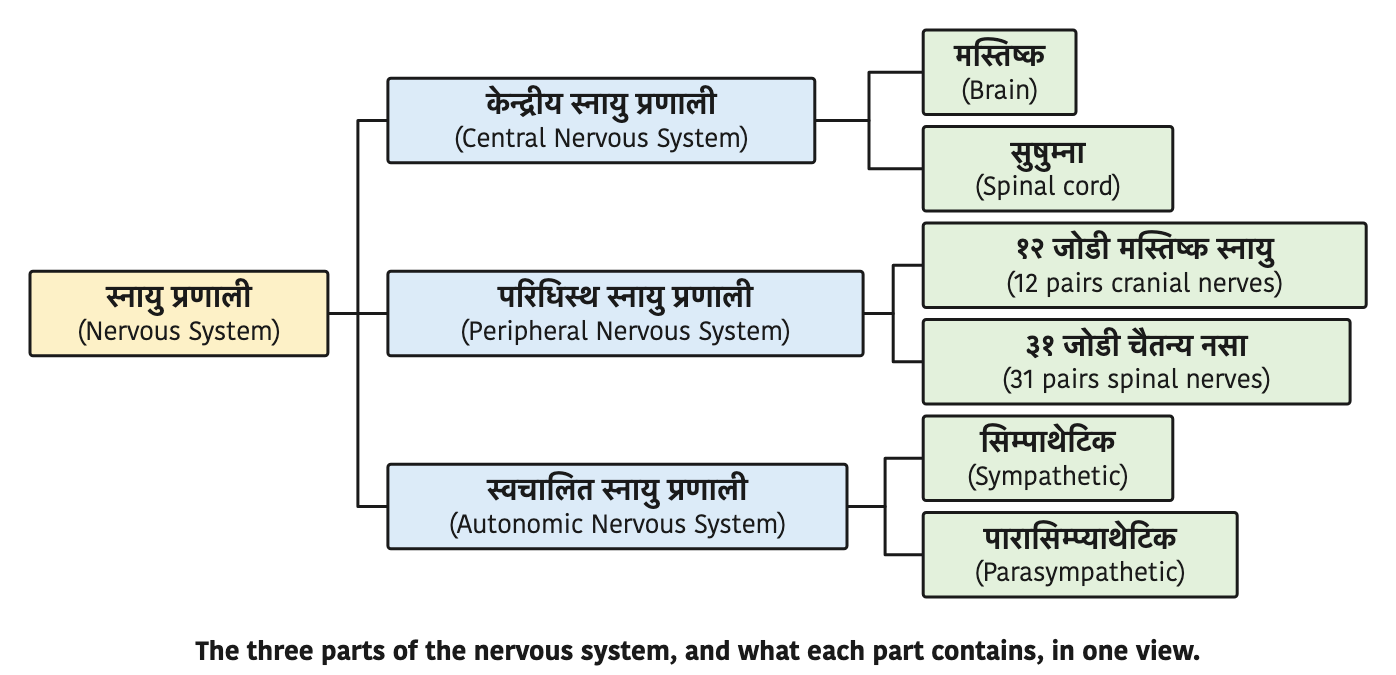
The central part is like a control room, where decisions are made. The peripheral part is like the wiring that connects that room to every corner of the body. The autonomic part looks after the work that goes on without our thinking about it.
The Central Nervous System
Central nervous system: the most important part of the nervous system. It is made up of the brain and the spinal cord.
The Brain
The brain is the main part of the central nervous system. It sits safely inside the skull, in a space called the cranial cavity. The brain is very soft and delicate, which is why it is enclosed in a box of hard bone. It weighs 1.5 kg. The brain receives stimuli and sends messages to the different parts of the body.
The brain can be divided into five parts:
- (i) the cerebrum, or large brain
- (ii) the cerebellum, or small brain
- (iii) the midbrain
- (iv) the pons
- (v) the medulla oblongata
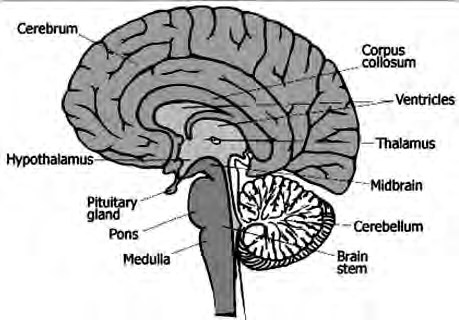
Notice how the parts are stacked. The large, folded cerebrum sits on top. The cerebellum, with its tree-like pattern inside, sits below its back part. Down the middle runs a column: the midbrain at the top, the pons below it, and the medulla at the bottom, where the brain meets the spinal cord.
The Cerebrum
The cerebrum is the largest and most important part of the brain. It fills the front and middle of the cranial cavity. It makes up 80 percent of the total weight of the brain.
A deep groove runs down the middle of the top of the cerebrum. This groove splits the cerebrum into two halves, the right hemisphere and the left hemisphere. The two hemispheres are joined to each other by nerve fibres.
The right hemisphere controls the left side of the body, and the left hemisphere controls the right side. So if the right side of the cerebrum is injured or diseased, the effect appears on the left side of the body, and an injury on the left side affects the right side of the body.
The outer layer of the cerebrum is grey matter and the inside is white matter. Grey matter is made of nerve cell bodies, while white matter is made of nerve fibres. Each hemisphere of the cerebrum is divided into four main lobes:
- the frontal lobe, behind the forehead
- the parietal lobe, under the crown of the head
- the temporal lobe, behind the temples at the side of the head
- the occipital lobe, at the back of the head
What the Cerebrum Does
- It controls the higher mental activities: awareness, memory, thinking, judgement and intelligence.
- It makes us aware of sensations such as pain, temperature, sound, taste, smell and sight.
- It controls all the voluntary muscles of the muscular system, the muscles we move by choice.
Reading an exam question and working out the answer, recognising a friend's face, noticing the smell of a rose, and picking up a pen to write: all of these are the work of the cerebrum.
The Cerebellum
The cerebellum lies below the back part of the cerebrum and behind the pons. Like the cerebrum, it has grey matter outside and white matter inside. A small groove also divides the cerebellum into two halves.
The cerebellum does three jobs:
- it controls the movement and speed of the voluntary muscles
- it keeps the body balanced
- it makes the joints and muscles work smoothly together
Riding a bicycle without falling over, standing on one foot, and keeping your arms and legs in time while dancing are all possible because of the cerebellum.
The Midbrain and the Pons
The midbrain lies below the cerebrum and above the pons. It passes impulses back and forth, acting as a road along which messages travel up and down.
The pons lies below the midbrain and above the medulla. It is made of both grey and white matter, but it has only a little grey matter and a lot of white matter. It contains two kinds of white matter. Its work:
- It acts as a bridge joining the two halves of the cerebellum.
- It carries nerve impulses between the cerebrum and the cerebellum.
The word pons means bridge. Just as a bridge joins the two banks of a river, the pons joins parts of the brain to each other, and that is where its name comes from.
The Medulla Oblongata
The medulla oblongata is the lowest part of the brain. It lies between the pons and the spinal cord. Its layers are the reverse of the cerebrum's: white matter on the outside and grey matter inside. It joins the brain to the spinal cord. It holds the control centres for breathing, the heart and the blood vessels. Its work:
- Its respiratory centre controls breathing.
- Its vasomotor centre controls the width of the blood vessels.
- Its cardiac centre controls the movement of the heart muscles.
- It also contains centres for reflex actions.
- It passes impulses to and from the brain.
The Spinal Cord
The spinal cord is the longest part of the central nervous system. It is a long, cylinder-shaped cord of nerve tissue. It begins at the medulla, passes out through a hole at the base of the skull called the foramen magnum, runs down the neural canal inside the backbone, and ends at the first lumbar vertebra in the lower back. The bones of the backbone protect it.
The spinal cord is about as thick as your little finger. Its outer part is white matter and its inner part is grey matter. Thirty-one spinal nerves branch out from its right side and thirty-one from its left, making 31 pairs of spinal nerves. The work of the spinal cord:
- It connects the brain with the rest of the body.
- It works as the main centre of reflex action.
- It carries many kinds of impulses up and down.
Reflex Action
Reflex action: a bodily response that happens on its own to a sensation, before we are aware of it or have decided anything.
Reflex actions are run by centres in the spinal cord, and the brain plays no part in them. Some sudden actions of this kind:
- Your hand touches a flame and is snatched back at once.
- A thorn pricks your foot and the foot jerks up.
- A speck of dust or an insect comes at your eye and the eye shuts.
Here is what happens, in order, when your hand touches a flame:
- The skin of the finger senses the heat.
- A sensory nerve carries that news to the spinal cord.
- A centre in the spinal cord sends out an order straight away, without waiting for the brain.
- A motor nerve carries the order to the muscles of the arm.
- The muscles contract and the hand pulls away from the flame.
A reflex is so fast that the spinal cord has already responded before the news of the burn reaches the brain. We only realise it was hot after the hand has moved. This speed is what protects the body from serious injury.
The Peripheral Nervous System
Peripheral nervous system: the nerves that connect the brain and the spinal cord with the different parts of the body.
Peripheral means at the edge, away from the centre. This part is made of the nerves that spread out from the central nervous system to every corner of the body. It has two groups of nerves:
- 12 pairs of cranial nerves, which come out of the brain
- 31 pairs of spinal nerves, which come out of the spinal cord
| Nerves | Number | Work |
| Cranial nerves | 12 pairs | Give us smell, sight, hearing and taste |
| Spinal nerves | 31 pairs | Carry information from the body to the brain and spinal cord, and from them back to the body |
These nerves are linked to the different organs. For example, the smell of food drifting from the kitchen reaches you through a cranial nerve, while the order to wiggle your toes travels along a spinal nerve.
The Autonomic Nervous System
Even while you sleep, your heart keeps beating, your lungs keep breathing and your food keeps being digested. You do not have to think about any of this, and you could not stop it if you tried. Such work goes on automatically, without our will, and is not under our control.
Autonomic nervous system: the group of nerves that keeps the heart beating and the lungs working regularly even while we sleep, and runs the work of organs such as the stomach, the urinary bladder and the intestines.
It is divided into two parts:
- (a) the sympathetic system
- (b) the parasympathetic system
These two systems do exactly opposite jobs. The sympathetic system widens the pupil of the eye, narrows the blood vessels and speeds up the heartbeat. The parasympathetic system narrows the pupil and slows the heartbeat down.
| Organ | Sympathetic | Parasympathetic |
| Pupil of the eye | Widens it | Narrows it |
| Heartbeat | Speeds it up | Slows it down |
When a dog chases you, your heart pounds. That is the sympathetic system at work. Once you are safe and sit down, your heartbeat slowly settles again. That is the parasympathetic system. Like the accelerator and the brake of a car, these two systems together keep the automatic work of the body in balance.
The Whole Nervous System at a Glance
| Part | What it contains | Main work |
| Central nervous system | Brain and spinal cord | Receives stimuli, decides, sends messages |
| Peripheral nervous system | 12 pairs of cranial nerves and 31 pairs of spinal nerves | Connects the brain and spinal cord to the body |
| Autonomic nervous system | Sympathetic and parasympathetic | Balances the work that happens without our will |
The full lesson is waiting for you
The notes are free to read in full. A free account opens the rest of the practice, and tracks your progress and confidence score for every subject. Presentations and videos need approval from Learn Yeti.