Elements, Compounds and Atoms
Everything around us is made of matter, and every kind of matter is either an element or a compound. Metals such as gold, silver and copper are elements. So are non-metals such as sulphur and iodine. Water, common salt and sugar are compounds. Scientists have discovered 118 elements so far, and the search for new ones is still going on.
There are only a limited number of elements, yet they combine to make millions of compounds. It is like the alphabet: a small set of letters builds every word in the dictionary. Every compound contains atoms of elements. Water, for example, is made of atoms of hydrogen and oxygen joined together. So to understand matter, we first have to understand the atom.
What Is an Atom?
What is the smallest particle of an element called? An element is a pure substance. However much you break it up, you cannot turn it into another substance with different chemical properties. Imagine cutting a copper wire in half, then cutting one half in half again, and again. Every piece, however tiny, is still copper. If you could keep going, you would finally reach a particle that cannot be made any smaller and still behave as copper. That particle is an atom.
Element: a pure substance made of many atoms of only one kind, which cannot be broken into another substance with different chemical properties.
Atom: the smallest particle of an element that takes part in a chemical reaction.
All the atoms of one element are alike. Every atom in a gold ring is a gold atom, and they are all the same. A gold atom, however, is different from a silver atom, and a copper atom is different from both. Elements differ from each other because their atoms differ.
Most atoms take part in chemical reactions with atoms of other elements. A few, however, are chemically inactive and do not combine with anything. Why some atoms react and others do not can only be explained by looking inside the atom.
One element contains one kind of atom. Different elements have different atoms.
Inside an Atom
An atom is extremely small. Its average diameter is about \( 10^{-10} \) metre. That is so small that about ten million atoms placed side by side would make a line only one millimetre long. Even so, an atom is built from three kinds of still smaller particles. These are called sub-atomic particles, and they are the electron, the proton and the neutron.
Sub-atomic particles: the particles smaller than an atom that an atom is made of, namely electrons, protons and neutrons.
The protons and neutrons are packed tightly together at the centre of the atom. This centre is called the nucleus. The electrons move very fast around the nucleus in paths called shells, also called orbits. In Fig 14.1 the protons and neutrons sit together in the nucleus at the middle, while the electrons travel on the rings around it.
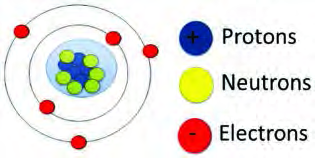
Nucleus: the central part of an atom, where the protons and neutrons are found.
The Three Particles Compared
In Fig 14.1 the protons carry a plus sign and the electrons a minus sign. A proton has a positive charge, an electron has a negative charge, and a neutron has no charge at all. Protons and neutrons have almost the same mass, while an electron is far lighter than either. So nearly all the mass of an atom is in its nucleus.
| Particle | Where it is found | Charge |
| Proton | Inside the nucleus | Positive (+) |
| Neutron | Inside the nucleus | No charge |
| Electron | In the shells around the nucleus | Negative |
In an ordinary atom the number of protons equals the number of electrons. The positive and negative charges balance each other, so the atom as a whole has no charge. The number of protons in the nucleus of an atom is called its atomic number. Carbon has atomic number 6, so a carbon atom has 6 protons and 6 electrons.
Atomic number: the number of protons in the nucleus of an atom. In an ordinary atom it is equal to the number of electrons.
Shells and Electron Arrangement
Electrons do not wander anywhere they like. They stay in shells at fixed distances from the nucleus. The shell nearest the nucleus is the K shell, the next is the L shell, then the M shell, then the N shell. These shells are also numbered 1, 2, 3 and 4 in that order, and this number is written as n. The way the electrons of an atom are placed in its shells is called its electron arrangement, or electron configuration.
Electron configuration: the arrangement of an atom's electrons in its K, L, M and N shells.
The largest number of electrons a shell can hold is given by the formula below, where n is the number of the shell:
\[ 2n^2 \]
| Shell | n | Working | Most electrons it holds |
| K | 1 | \( 2 \times 1^2 \) | 2 |
| L | 2 | \( 2 \times 2^2 \) | 8 |
| M | 3 | \( 2 \times 3^2 \) | 18 |
| N | 4 | \( 2 \times 4^2 \) | 32 |
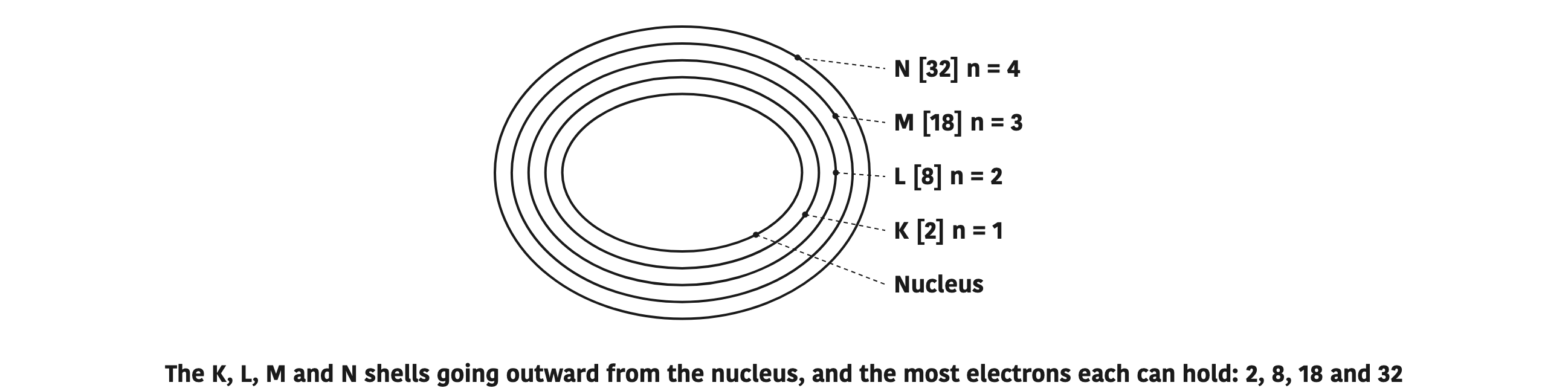
Electrons always fill the inner shells first. Only when the K shell is full do electrons go into the L shell, and only when L is full do they go into M.
The outermost shell of an atom never holds more than 8 electrons. So potassium, with 19 electrons, is 2, 8, 8, 1 and not 2, 8, 9. The M shell can hold 18, but while it is the outermost shell it takes only 8.
Worked Example: The Electrons of Sodium
Step 1: Sodium has atomic number 11, so a sodium atom has 11 electrons to place.
Step 2: Placing 2 electrons in the K shell, which is all it can hold, and finding how many are left:
\[ 11 - 2 = 9 \]
Step 3: Placing 8 of the remaining electrons in the L shell, which fills it, and finding how many are left:
\[ 9 - 8 = 1 \]
Step 4: Putting the last electron in the M shell gives the full arrangement:
\[ \text{K} = 2,\; \text{L} = 8,\; \text{M} = 1 \]
This is written in short as 2, 8, 1. The same method gives the arrangement of any element with atomic number from 1 to 20. Some examples are shown below.
| Element | Symbol | Atomic number | Electron arrangement |
| Hydrogen | H | 1 | 1 |
| Helium | He | 2 | 2 |
| Lithium | Li | 3 | 2, 1 |
| Carbon | C | 6 | 2, 4 |
| Oxygen | O | 8 | 2, 6 |
| Neon | Ne | 10 | 2, 8 |
| Sodium | Na | 11 | 2, 8, 1 |
| Chlorine | Cl | 17 | 2, 8, 7 |
| Argon | Ar | 18 | 2, 8, 8 |
| Calcium | Ca | 20 | 2, 8, 8, 2 |
The Duplet and the Duplet Rule
A helium atom has only one shell, the K shell. So the K shell is both the first and the last shell of helium. By the \( 2n^2 \) rule, the K shell can hold only two electrons. Helium has exactly two electrons, so its only shell is completely full. Fig 14.2 shows the two electrons sitting in helium's K shell.
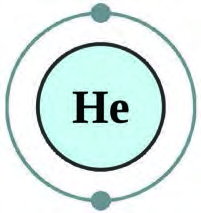
Duplet state: the state in which an atom whose only shell is the K shell has two electrons in it, making the atom stable.
Because it has a duplet, a helium atom is chemically inactive. It takes part in no chemical reaction at all. This is why helium atoms are found free in nature, not joined to atoms of any other element.
Atoms of elements such as hydrogen (H), lithium (Li) and beryllium (Be) do not have this arrangement. They take part actively in chemical reactions, gaining, losing or sharing electrons so that they end up with a duplet like helium. Hydrogen has 1 electron, so it gains or shares 1 more to make 2 in its K shell. Lithium is 2, 1, so when it loses its single outer electron, only the 2 in its K shell remain. Beryllium is 2, 2, and losing its 2 outer electrons does the same.
Duplet rule: the rule that an atom gains, loses or shares electrons to bring two electrons into its K shell and so reach a chemically stable state.
The Octet and the Octet Rule
Apart from helium, the other elements in the group of inert gases, placed in group 18 of the periodic table, are neon (Ne), argon (Ar), krypton (Kr), xenon (Xe) and radon (Rn). Each of these has 8 electrons in its outermost shell. This arrangement is called the octet state. Neon has 10 electrons: 2 in the K shell and 8 in the L shell, as Fig 14.3 shows.
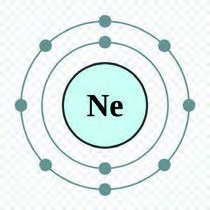
Octet state: the state in which an atom has eight electrons in its outermost shell.
Atoms in the octet state take no part in chemical reactions and are found in nature as gases. For this reason these elements are called inert gases.
Inert gases: the gaseous elements of group 18, which take no part in chemical reactions because their outermost shell is complete.
Atoms with fewer than 8 electrons in their outermost shell take part in chemical reactions to reach an octet. They do this by gaining, losing or sharing one or more electrons. Sodium is 2, 8, 1. When it loses its one outer electron it is left with 2, 8, the same as neon. Chlorine is 2, 8, 7. When it gains one electron it becomes 2, 8, 8, the same as argon. An atom takes whichever route needs the fewest electrons to move.
Octet rule: the rule that an atom gains, loses or shares electrons to bring eight electrons into its outermost shell and so reach a chemically stable state.
| Point | Duplet | Octet |
| Electrons needed | 2 | 8 |
| Which shell | The K shell, when it is the only shell | The outermost shell |
| Natural example | Helium (He) | Ne, Ar, Kr, Xe, Rn |
| Atoms that move towards it | H, Li, Be | Na, Cl and others |
Why do atoms react at all? To become stable. An atom without a duplet or an octet gains, loses or shares electrons until its arrangement matches that of an inert gas.
The full lesson is waiting for you
The notes are free to read in full. A free account opens the rest of the practice, and tracks your progress and confidence score for every subject. Presentations and videos need approval from Learn Yeti.