Molecules and Molecular Formulas
If you keep breaking salt, water or sugar into smaller and smaller pieces, you finally reach a tiny particle that cannot be split any further without the substance stopping being itself. That smallest part of a compound is called a molecule. A molecule is not a single atom. It is formed when two or more atoms join together chemically.
Molecule: the smallest part of a compound, formed by the chemical combination of two or more atoms.
Look at a few examples. One molecule of water, \( \mathrm{H_2O} \), is made of two hydrogen atoms and one oxygen atom. A molecule of sodium chloride, \( \mathrm{NaCl} \), is made of one sodium (Na) atom joined to one chlorine (Cl) atom. Elements have molecules too. A hydrogen molecule, \( \mathrm{H_2} \), is two hydrogen atoms joined together, and an oxygen molecule, \( \mathrm{O_2} \), is two oxygen atoms joined together.
We do not write the full name of an element every time. We use a symbol instead: H for hydrogen, O for oxygen. A molecule can be written in short in the same way, by putting the symbols of its atoms side by side. This group of symbols that stands for a molecule is called its molecular formula.
Molecular formula: the group of symbols of the atoms present in a molecule, used to represent that molecule.
The small number written low and to the right of a symbol tells how many atoms of that element there are. In \( \mathrm{H_2O} \) the 2 under H means two hydrogen atoms. There is no number under O, so there is one oxygen atom. When no number is written, the number is 1.
Formulas of Some Common Substances
The table below gives the names and molecular formulas of substances you will meet again and again, at home and in the laboratory. They are worth learning by heart.
| No. | Substance | Molecular formula |
| 1 | Hydrochloric acid | \( \mathrm{HCl} \) |
| 2 | Sulphuric acid | \( \mathrm{H_2SO_4} \) |
| 3 | Sodium hydroxide | \( \mathrm{NaOH} \) |
| 4 | Magnesium hydroxide | \( \mathrm{Mg(OH)_2} \) |
| 5 | Ammonia | \( \mathrm{NH_3} \) |
| 6 | Sodium chloride | \( \mathrm{NaCl} \) |
| 7 | Magnesium carbonate | \( \mathrm{MgCO_3} \) |
| 8 | Magnesium chloride | \( \mathrm{MgCl_2} \) |
| 9 | Water | \( \mathrm{H_2O} \) |
| 10 | Calcium carbonate | \( \mathrm{CaCO_3} \) |
| 11 | Carbon dioxide | \( \mathrm{CO_2} \) |
| 12 | Potassium nitrate | \( \mathrm{KNO_3} \) |
| 13 | Sodium bicarbonate | \( \mathrm{NaHCO_3} \) |
| 14 | Potassium sulphate | \( \mathrm{K_2SO_4} \) |
| 15 | Ammonium phosphate | \( \mathrm{(NH_4)_3PO_4} \) |
Writing a Formula by the Criss-Cross Method
The criss-cross method is used to write the molecular formula of a compound. You need three things: the name of the compound, the symbols of the elements or ions in it, and the valency of each. Valency is the combining capacity of an atom or ion. The name of the method describes what you do: the valencies are exchanged in the shape of a cross, X.
Criss-cross method: a way of writing a molecular formula in which the valencies of two elements or ions are exchanged, so that the valency of each is written low and to the right of the other's symbol.
- Step 1: Write the name of the compound whose formula you want.
- Step 2: Under the name, write the symbols of the elements or ions it is made of.
- Step 3: Above each symbol, write its valency.
- Step 4: Exchange the valencies, sending each one across to the other symbol, and show this with two crossing arrows (→).
- Step 5: Write each exchanged valency as a small number low and to the right of the symbol it has moved to. This gives the formula.
The valencies used in the examples of this topic are listed below. Ions such as NH₄ and SO₄ are made of atoms of more than one element, but they behave as a single unit.
| Element or ion | Symbol | Valency |
| Sodium, potassium, hydrogen | Na, K, H | 1 |
| Magnesium, calcium | Mg, Ca | 2 |
| Aluminium, boron | Al, B | 3 |
| Carbon | C | 4 |
| Chloride | Cl | 1 |
| Oxide | O | 2 |
| Ammonium | \( \mathrm{NH_4} \) | 1 |
| Nitrate, bicarbonate | \( \mathrm{NO_3} \), \( \mathrm{HCO_3} \) | 1 |
| Sulphate | \( \mathrm{SO_4} \) | 2 |
Worked Example: Magnesium Chloride
Here are the five steps used on one real compound.
Step 1: The name of the compound is magnesium chloride.
Step 2: Writing the symbols under the name:
\[ \mathrm{Mg} \quad \mathrm{Cl} \]
Step 3: Writing the valencies above the symbols, 2 for magnesium and 1 for chlorine:
\[ \overset{2}{\mathrm{Mg}} \quad \overset{1}{\mathrm{Cl}} \]
Steps 4 and 5: Exchanging the valencies, the 2 of Mg moves under Cl and the 1 of Cl moves under Mg:
\[ \mathrm{Mg_1Cl_2} \]
Final form: dropping the 1, because a 1 is never written:
\[ \mathrm{MgCl_2} \]
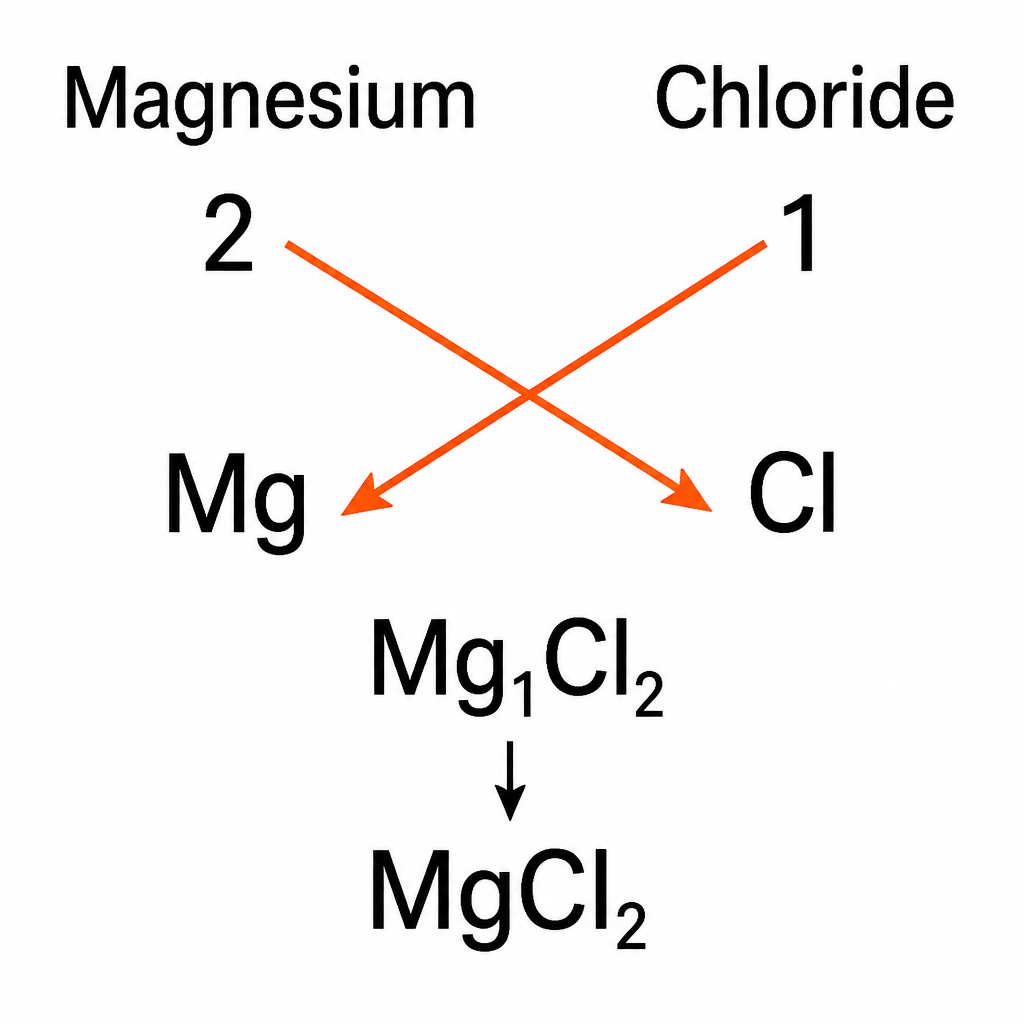
Think about what this means. Magnesium can form two bonds but chlorine can form only one. So one magnesium atom needs two chlorine atoms to be satisfied, and that is exactly what the 2 in the formula shows.
Rules for Tidying the Formula
After the valencies have been exchanged, three rules turn the result into a finished formula:
- (a) A subscript of 1 is not written. \( \mathrm{Na_1Cl_1} \) is written as \( \mathrm{NaCl} \).
- (b) If both subscripts can be divided by the same number, divide them and write the formula with the smaller numbers.
- (c) If an ion is made of atoms of more than one element and more than one of it is needed, its group of symbols goes inside brackets ( ), and the number is written low and to the right, outside the bracket.
Carbon dioxide shows rule (b) at work. Carbon has valency 4 and oxygen has valency 2.
Step 1: Exchanging the valencies gives:
\[ \mathrm{C_2O_4} \]
Step 2: Both 2 and 4 divide by 2, so dividing each by 2:
\[ \mathrm{C_1O_2} = \mathrm{CO_2} \]
Magnesium bicarbonate shows rule (c). Magnesium has valency 2 and the bicarbonate ion \( \mathrm{HCO_3} \) has valency 1.
Step 1: After the exchange, two bicarbonate ions are needed, so the ion goes into brackets:
\[ \mathrm{Mg_1(HCO_3)_2} \]
Step 2: Dropping the 1 gives the final formula:
\[ \mathrm{Mg(HCO_3)_2} \]
In sodium bicarbonate, however, sodium and bicarbonate both have valency 1. Only one bicarbonate ion is needed, so no bracket is used and the formula is \( \mathrm{NaHCO_3} \).
Never change the numbers inside an ion. The 4 in \( \mathrm{SO_4} \) and the 3 in \( \mathrm{NO_3} \) belong to the ion itself. Only the exchanged valencies are divided, and forgetting the bracket turns \( \mathrm{Mg(HCO_3)_2} \) into a meaningless \( \mathrm{MgHCO_{32}} \).
More Formulas Written by Criss-Cross
The picture below works nine compounds by the criss-cross method. Each one has the valencies at the top, the crossing arrows in the middle and the finished formula at the bottom.
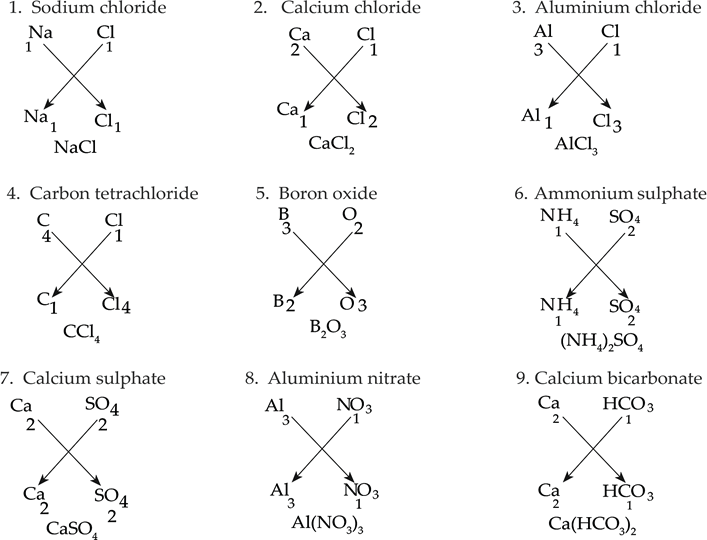
- In carbon tetrachloride, carbon's valency of 4 moves to chlorine, giving \( \mathrm{CCl_4} \).
- In boron oxide, 3 and 2 have no common factor, so the formula stays \( \mathrm{B_2O_3} \).
- In calcium sulphate the exchange gives \( \mathrm{Ca_2(SO_4)_2} \). Dividing both by 2 gives \( \mathrm{CaSO_4} \).
- Ammonium sulphate \( \mathrm{(NH_4)_2SO_4} \), aluminium nitrate \( \mathrm{Al(NO_3)_3} \) and calcium bicarbonate \( \mathrm{Ca(HCO_3)_2} \) use brackets, because more than one of the ion is needed.
What a Molecular Formula Tells Us
A formula is short, but it carries a lot of information:
- the names and symbols of the elements present in the molecule
- the valency of each element or ion
- the number of atoms of each kind in the molecule
For example, \( \mathrm{H_2SO_4} \) tells us that the molecule contains hydrogen, sulphur and oxygen, with 2 hydrogen atoms, 1 sulphur atom and 4 oxygen atoms, which is 7 atoms in all. In \( \mathrm{MgCl_2} \), the 2 under chlorine came across from magnesium, so the formula also tells us that the valency of magnesium is 2.
Atomic Weight
Almost all the mass of an atom is in its nucleus, because the protons and neutrons there are far heavier than the electrons. So the weight of an atom is found by adding up its protons and neutrons.
Atomic weight: the sum of the number of protons and neutrons in the nucleus of an atom. It is expressed in atomic mass units (amu).
\[ \text{Atomic weight} = p^+ + n^0 \]
Here \( p^+ \) is the number of protons and \( n^0 \) is the number of neutrons. An oxygen atom has 8 protons and 8 neutrons.
Step 1: Putting in the numbers of protons and neutrons:
\[ 8 + 8 \]
Step 2: Adding gives the atomic weight of oxygen:
\[ 16 \ \mathrm{amu} \]
In the same way, a sodium (Na) atom has 11 protons and 12 neutrons in its nucleus, so its atomic weight is \( 11 + 12 = 23 \) amu. The table below gives the atomic weights used for the calculations that follow.
| Element | Protons | Neutrons | Atomic weight (amu) |
| Hydrogen (H) | 1 | 0 | 1 |
| Carbon (C) | 6 | 6 | 12 |
| Nitrogen (N) | 7 | 7 | 14 |
| Oxygen (O) | 8 | 8 | 16 |
| Sodium (Na) | 11 | 12 | 23 |
| Magnesium (Mg) | 12 | 12 | 24 |
| Phosphorus (P) | 15 | 16 | 31 |
| Sulphur (S) | 16 | 16 | 32 |
| Calcium (Ca) | 20 | 20 | 40 |
Molecular Weight
A molecule is made of atoms, so the weight of a molecule is simply the total weight of all the atoms inside it.
Molecular weight: the sum of the atomic weights of all the atoms present in a molecule.
To find a molecular weight, count the atoms of each element from the formula, multiply each count by that element's atomic weight, and add the results. Here is water, \( \mathrm{H_2O} \):
Step 1: The formula has 2 atoms of H and 1 atom of O:
\[ \mathrm{H_2O} = 2 \times \mathrm{H} + 1 \times \mathrm{O} \]
Step 2: Putting in the atomic weights:
\[ = 2 \times 1 + 1 \times 16 \]
Step 3: Multiplying:
\[ = 2 + 16 \]
Step 4: Adding gives the molecular weight of water:
\[ = 18 \ \mathrm{amu} \]
A formula with brackets needs more care. In ammonium phosphate, \( \mathrm{(NH_4)_3PO_4} \), the 3 outside the bracket multiplies every atom inside it. So there are \( 1 \times 3 = 3 \) atoms of N and \( 4 \times 3 = 12 \) atoms of H. There is 1 atom of P and there are 4 atoms of O.
Step 1: Writing each element with its number of atoms:
\[ 3 \times \mathrm{N} + 12 \times \mathrm{H} + 1 \times \mathrm{P} + 4 \times \mathrm{O} \]
Step 2: Putting in the atomic weights:
\[ = 3 \times 14 + 12 \times 1 + 1 \times 31 + 4 \times 16 \]
Step 3: Multiplying:
\[ = 42 + 12 + 31 + 64 \]
Step 4: Adding gives the molecular weight of ammonium phosphate:
\[ = 149 \ \mathrm{amu} \]
The number outside a bracket multiplies every atom inside it. In \( \mathrm{(NH_4)_3} \) there are 12 hydrogen atoms, not 4. Missing this multiplication is the most common error in molecular weight sums.
To find a molecular weight, multiply the number of atoms of each element by its atomic weight and add them all. Worked this way, calcium carbonate \( \mathrm{CaCO_3} \) has a molecular weight of \( 40 + 12 + 3 \times 16 = 100 \) amu.
The full lesson is waiting for you
The notes are free to read in full. A free account opens the rest of the practice, and tracks your progress and confidence score for every subject. Presentations and videos need approval from Learn Yeti.