Why Nonmetal Atoms Share Electrons
An atom becomes stable when its outermost shell, called the valence shell, is full. For most atoms the valence shell is full when it holds 8 electrons. This is called the octet state. Hydrogen is different. It has only one shell, the K shell, and that shell is full with just 2 electrons. So hydrogen aims for the duplet state instead.
A metal atom has only 1, 2 or 3 electrons in its valence shell, so it can easily give them to another atom. That is what happens in an electrovalent bond. Calcium, for example, hands its two valence electrons to two chlorine atoms, and the oppositely charged ions that form are pulled towards each other.
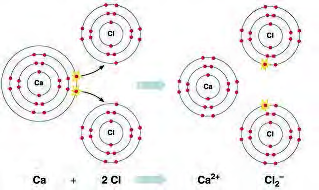
Nonmetal atoms are a different story. Apart from hydrogen, a nonmetal atom has 5, 6 or 7 electrons in its valence shell, so it needs to gain 3, 2 or 1 electrons to reach the octet. Now think about two nonmetal atoms meeting in a reaction. Both want to receive electrons and neither wants to give any away, so a transfer of electrons cannot happen. Instead, the atoms share some of their electrons. Each shared electron is counted by both atoms, so both reach the octet or duplet state, and a chemical bond is formed.
What a Covalent Bond Is
Covalent bond: the chemical bond formed by the equal sharing of pairs of electrons between two or more atoms of the same or different nonmetals.
The atoms that share can belong to the same element. In chlorine gas, two chlorine atoms share one electron each. More often the atoms belong to different elements, such as hydrogen with chlorine or hydrogen with oxygen. Sharing always happens in pairs: one shared pair contains two electrons.
Covalent compound: a compound whose atoms are joined by covalent bonds. Water (H₂O), hydrogen chloride (HCl), methane (CH₄) and ammonia (NH₃) are examples.
In an electrovalent bond electrons are transferred. In a covalent bond electrons are shared.
Writing a Covalent Bond as a Line
A covalent bond is shown by drawing a straight line between the symbols of the two atoms. One line stands for one shared pair of electrons. When nonmetals form covalent compounds they can share one, two or three pairs of electrons.
- One shared pair is drawn as one line, as in hydrogen chloride, \( \mathrm{H - Cl} \)
- Two shared pairs are drawn as two lines, as in oxygen gas, \( \mathrm{O = O} \)
- Three shared pairs are drawn as three lines, as in nitrogen gas, \( \mathrm{N \equiv N} \)
How Hydrogen Chloride (HCl) Forms
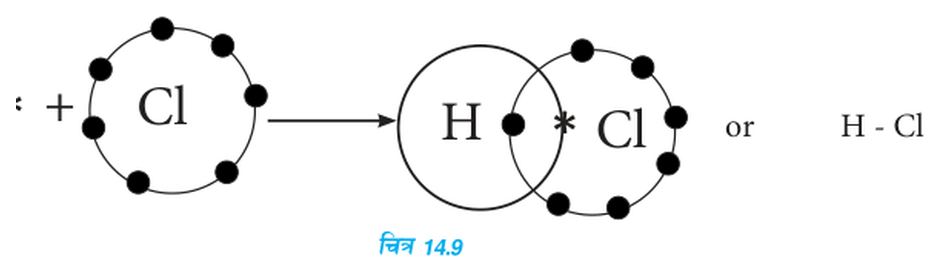
One hydrogen atom (H) and one chlorine atom (Cl) join to make one molecule of hydrogen chloride. Hydrogen has a single electron in its K shell. Chlorine has the electron arrangement 2, 8, 7, so there are seven electrons in its valence shell. Hydrogen needs one more electron to reach the duplet, and chlorine needs one more to reach the octet.
\[ \mathrm{H + Cl \rightarrow HCl} \]
So each atom puts forward one electron and together they make one shared pair. Hydrogen now counts 2 electrons around itself and reaches the duplet state. Chlorine counts 8 and reaches the octet state. Because the two atoms are held by one covalent bond, hydrogen chloride is a covalent compound.
How a Water Molecule (H₂O) Forms
A water molecule is made of two hydrogen atoms and one oxygen atom. A hydrogen atom has only one electron, while an oxygen atom has eight electrons in total. Their electron arrangements are:
| Element | K shell | L shell |
| Hydrogen | 1 | |
| Oxygen | 2 | 6 |
Hydrogen has just one electron in its valence shell and oxygen has six. Oxygen needs two more electrons for the octet, but one hydrogen atom can offer only one. So the oxygen atom shares one pair of electrons with each of two hydrogen atoms. Each hydrogen then has a duplet and the oxygen has an octet.
\[ \mathrm{2H + O \rightarrow H_2O} \]
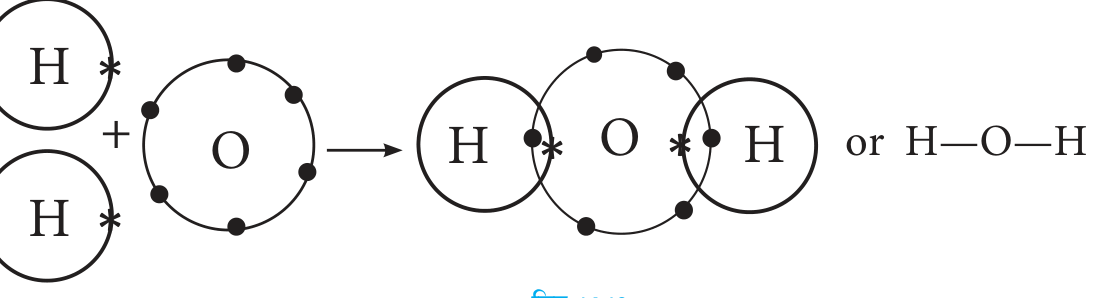
Since the bonds between hydrogen and oxygen in water are covalent, water is a covalent compound. Written with lines it is \( \mathrm{H - O - H} \).
How Methane (CH₄) Forms
Methane is formed when one carbon atom and four hydrogen atoms share four pairs of electrons. Carbon has the electron arrangement 2, 4, so it has four valence electrons and needs four more for the octet. Each hydrogen atom has one electron in its K shell.
So the carbon atom shares one pair with each of the four hydrogen atoms, four pairs in all. Carbon reaches the octet and every hydrogen reaches the duplet. Methane has four covalent bonds between carbon and hydrogen, so it is a covalent compound. Methane is the main gas in biogas.
\[ \mathrm{4H + C \rightarrow CH_4} \]
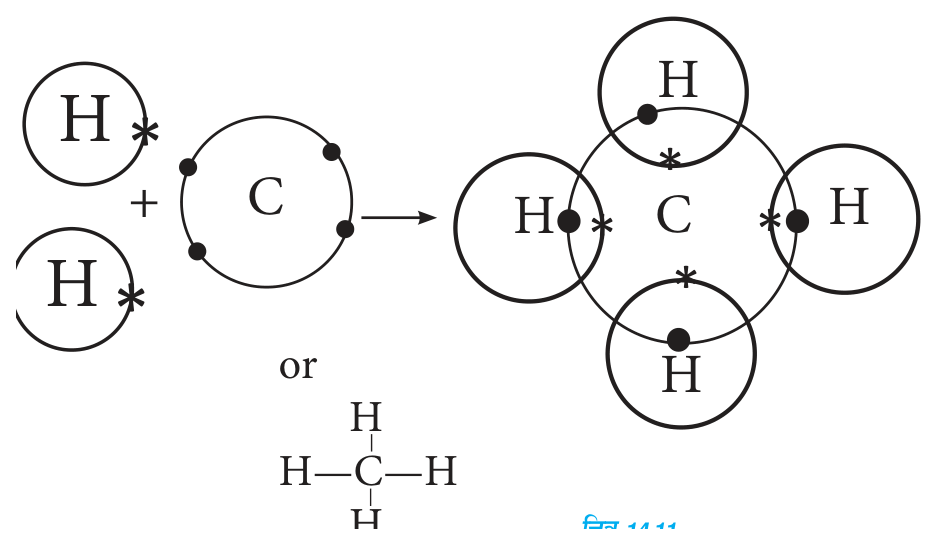
Written with lines, methane looks like this:
\[ \begin{array}{ccccc} & & \mathrm{H} & & \\ & & | & & \\ \mathrm{H} & - & \mathrm{C} & - & \mathrm{H} \\ & & | & & \\ & & \mathrm{H} & & \end{array} \]
How Ammonia (NH₃) Forms
Ammonia is formed when one nitrogen atom and three hydrogen atoms share three pairs of electrons. Nitrogen has the electron arrangement 2, 5. With five valence electrons, it needs three more to reach the octet. Each hydrogen atom has one electron.
So the nitrogen atom shares one pair with each of the three hydrogen atoms. Nitrogen reaches the octet and all three hydrogen atoms reach the duplet. Ammonia is held together by covalent bonds, so it is a covalent compound. It is the gas with the sharp smell you notice near a dirty toilet or a heap of rotting waste.
\[ \mathrm{3H + N \rightarrow NH_3} \]
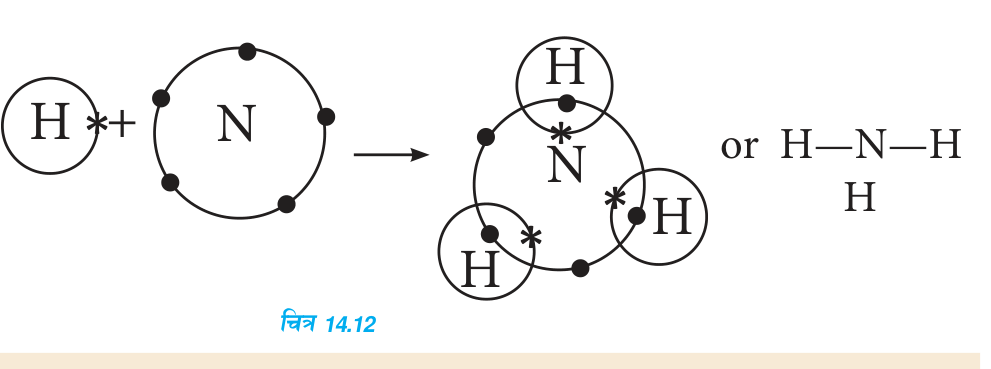
\[ \begin{array}{ccccc} \mathrm{H} & - & \mathrm{N} & - & \mathrm{H} \\ & & | & & \\ & & \mathrm{H} & & \end{array} \]
Hydrogen never needs an octet. It has only the K shell, which is full with 2 electrons. In a diagram, show only 2 electrons around each hydrogen atom and never give hydrogen more than one bond.
The Four Molecules Compared, and How to Draw Them
| Molecule | Central atom and arrangement | Valence electrons | Electrons needed | Shared pairs (bonds) |
| HCl | Cl: 2, 8, 7 | 7 | 1 | 1 |
| H₂O | O: 2, 6 | 6 | 2 | 2 |
| NH₃ | N: 2, 5 | 5 | 3 | 3 |
| CH₄ | C: 2, 4 | 4 | 4 | 4 |
A nonmetal shares as many pairs as the number of electrons it needs. That is why chlorine makes 1 bond, oxygen 2, nitrogen 3 and carbon 4.
The sharing diagram for any of these molecules is drawn in the same order:
- Write the electron arrangement of each atom and find its valence electrons.
- Count how many electrons each atom needs to reach its octet or duplet.
- Draw the central atom as a circle with its valence electrons as dots, and each hydrogen with its electron as a star.
- Let the circles overlap, and put one dot and one star in each overlap to show a shared pair.
- Check: there should be 8 electrons around the central atom and 2 around each hydrogen.
- Finally, replace each shared pair with one line to write the bond formula of the molecule.
Characteristics of Covalent Compounds
Covalent compounds share these properties:
- (a) They are made of one or more nonmetal elements. There is no metal in them.
- (b) Most covalent compounds do not dissolve in water.
- (c) They do not split into positive and negative ions.
- (d) Their melting and boiling points are low.
These properties make sense when you set covalent compounds beside electrovalent ones. Electrovalent compounds contain a metal and a nonmetal, dissolve in water to give ions, and melt only at high temperatures. Covalent compounds contain no ions at all, only molecules. The pull between one molecule and the next is weak, so a little heat is enough to separate them. Methane is already a gas at room temperature and water boils at 100 °C, while sodium chloride melts only at about 801 °C. Candle wax and kerosene are covalent too, and neither dissolves in water.
Property (b) says most, not all. Sugar is a covalent compound and it dissolves in water. In an answer, write that most covalent compounds are insoluble, never that all of them are.
The full lesson is waiting for you
The notes are free to read in full. A free account opens the rest of the practice, and tracks your progress and confidence score for every subject. Presentations and videos need approval from Learn Yeti.