Stable Atoms and the Octet Rule
Every atom has a nucleus at its centre, and its electrons move around it in shells named K, L, M and N. The first shell, K, can hold at most 2 electrons. For the shells after it, an atom becomes very stable when its outermost shell holds 8 electrons.
A helium atom has only 2 electrons, and both sit in the K shell. That is all the K shell can hold, so helium is stable. A neon atom has 10 electrons: 2 in the K shell and 8 in the L shell. Its outer shell holds 8 electrons, so neon is stable too.
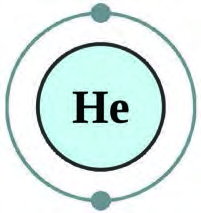
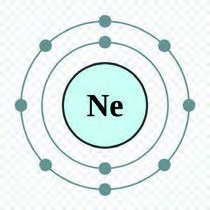
The condition of having 8 electrons in the outer shell is called the octet state. Atoms that are already in the octet state do not take part in chemical reactions, and they are found in nature as gases. That is why elements such as helium, neon and argon are called inert gases.
Inert gases: elements whose outer shell is already full, so they do not take part in chemical reactions and are found in nature as gases, for example helium, neon and argon.
Atoms with fewer than 8 electrons in the outer shell are not stable. They try to reach the octet state by taking electrons from other atoms, by losing some of their own, or by sharing electrons. This is the reason they take part in chemical reactions.
Octet rule: the rule that atoms react so as to have 8 electrons in their outermost shell and so reach a chemically stable state.
Valence Shell and Valence Electrons
A sodium atom has 11 electrons: 2 in the K shell, 8 in the L shell and 1 in the M shell. Not all of them take part in a chemical reaction. The inner electrons are held tightly by the nucleus. Only the single electron in the outermost M shell takes part.
So the M shell of sodium is its valence shell, and the one electron in it is its valence electron. A chlorine atom has 17 electrons arranged as 2, 8, 7. Its outermost shell is also M, so M is its valence shell and the 7 electrons there are its valence electrons.
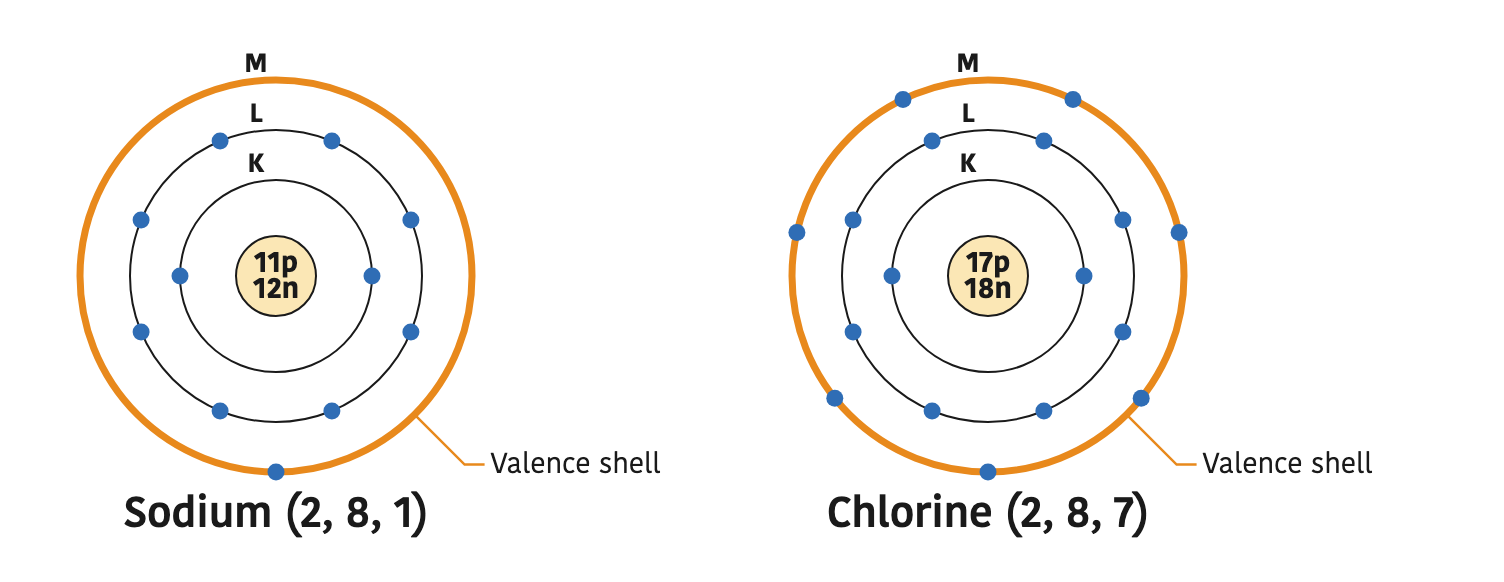
Valence shell: the outermost shell of an atom.
Valence electrons: the electrons in the valence shell. These are the electrons that take part in chemical reactions.
Valency
Valence electrons are the electrons that can take part in a chemical reaction. When atoms react, they give, take or share one or more electrons from the valence shell. The number of electrons given, taken or shared tells us how strongly an atom can combine with other atoms.
Valency: the number of electrons given, taken or shared by an atom during a chemical reaction. In other words, valency is the combining capacity of an atom.
For example, sodium gives away its one valence electron when it reacts, so the valency of sodium is 1. Chlorine needs just one more electron to complete its octet. It takes that one electron, so the valency of chlorine is also 1.
Working Out Valency from the Electron Arrangement
Whether an atom gives or takes electrons depends on which is the easier route. An atom with 1, 2 or 3 valence electrons finds it easier to give them away. An atom with 5, 6 or 7 valence electrons finds it easier to take the few it is missing to reach 8. Using this, valency can be worked out in these steps.
- Step 1: Use the atomic number to place the electrons in the K, L, M and N shells in order.
- Step 2: Find the outermost shell and count the valence electrons in it.
- Step 3: If there are 4 or fewer valence electrons, the valency is that number.
- Step 4: If there are more than 4 valence electrons, subtract that number from 8.
- Step 5: If the outer shell is already full, the valency is 0.
Example 1: the valency of magnesium, atomic number 12.
Step 1: Arranging the 12 electrons shell by shell:
\[ K = 2,\; L = 8,\; M = 2 \]
Step 2: The outer M shell has 2 electrons. This is fewer than 4, so magnesium gives these 2 electrons away. The valency is therefore:
\[ \text{Valency} = 2 \]
Example 2: the valency of oxygen, atomic number 8.
Step 1: Arranging the 8 electrons shell by shell:
\[ K = 2,\; L = 6 \]
Step 2: The outer L shell has 6 electrons, which is more than 4. Oxygen takes the electrons it needs to reach 8. Subtracting 6 from 8:
\[ \text{Valency} = 8 - 6 = 2 \]
Step 3: So the valency of oxygen is 2.
The number of valence electrons and the valency are not always the same. Oxygen has 6 valence electrons, but its valency is 2, not 6. Neon and argon have 8 electrons in the outer shell, but their valency is 0, not 8.
Hydrogen is a little different. It has 1 electron in its only shell, K, and the K shell is full with just 2. Hydrogen can give, take or share that 1 electron, so its valency is 1.
Valency of Elements with Atomic Number 1 to 20
The table below gives the shell by shell electron arrangement and the valency of the first 20 elements. For each row, look at the number in the outer shell and check that the steps above give the valency shown.
| Element | Symbol | Atomic number | K | L | M | N | Valency |
| Hydrogen | H | 1 | 1 | 1 | |||
| Helium | He | 2 | 2 | 0 | |||
| Lithium | Li | 3 | 2 | 1 | 1 | ||
| Beryllium | Be | 4 | 2 | 2 | 2 | ||
| Boron | B | 5 | 2 | 3 | 3 | ||
| Carbon | C | 6 | 2 | 4 | 4 | ||
| Nitrogen | N | 7 | 2 | 5 | 3 | ||
| Oxygen | O | 8 | 2 | 6 | 2 | ||
| Fluorine | F | 9 | 2 | 7 | 1 | ||
| Neon | Ne | 10 | 2 | 8 | 0 | ||
| Sodium | Na | 11 | 2 | 8 | 1 | 1 | |
| Magnesium | Mg | 12 | 2 | 8 | 2 | 2 | |
| Aluminium | Al | 13 | 2 | 8 | 3 | 3 | |
| Silicon | Si | 14 | 2 | 8 | 4 | 4 | |
| Phosphorus | P | 15 | 2 | 8 | 5 | 3, 5 | |
| Sulphur | S | 16 | 2 | 8 | 6 | 2, 6 | |
| Chlorine | Cl | 17 | 2 | 8 | 7 | 1 | |
| Argon | Ar | 18 | 2 | 8 | 8 | 0 | |
| Potassium | K | 19 | 2 | 8 | 8 | 1 | 1 |
| Calcium | Ca | 20 | 2 | 8 | 8 | 2 | 2 |
The table shows a pattern. From lithium to neon, and again from sodium to argon, the valency rises 1, 2, 3, 4 and then falls 3, 2, 1 to 0. Potassium and calcium start the pattern again with 1 and 2. Carbon and silicon have 4 valence electrons, so rather than giving or taking 4, they usually share 4 electrons.
The table gives two valencies for phosphorus and for sulphur. Phosphorus sometimes takes 3 electrons and sometimes uses all 5 of its valence electrons. In the same way, sulphur sometimes uses 2 electrons and sometimes 6. The sections below explain more about why this happens.
Valency and Chemical Reactivity
In general, elements with a low valency are more reactive, and elements with a higher valency are less reactive. An atom that has to give away only one electron becomes stable easily, while an atom that has to give away two or three electrons needs more effort.
For example, sodium metal, with valency 1, is more reactive than magnesium metal, with valency 2. That is why sodium is kept under kerosene to protect it from air and water, while a magnesium ribbon can be left in the open.
Elements with More Than One Valency
The valency of some elements can change depending on the compound they are forming. If only the electrons of the outermost shell take part in a reaction, the element has just one valency. But if electrons from the shell just inside the outermost one also take part, the element has more than one valency. This is called variable valency.
For example, iron has valencies 2 and 3. Sometimes iron forms a compound by giving 2 electrons, and sometimes it gives one more from an inner shell, making 3. In the same way, copper (Cu) can have valency 1 or 2, and gold (Au) has valency 1 or 3.
| Element | Valency |
| Iron (Fe) | 2 and 3 |
| Silver (Ag) | 1 and 2 |
| Gold (Au) | 1 and 3 |
| Mercury (Hg) | 1 and 2 |
| Copper (Cu) | 1 and 2 |
Variable valency: two or more valencies shown by one element, because it gives, takes or shares a different number of electrons in different compounds. It happens when electrons from an inner shell also take part in the reaction.
Valency is decided by the outer shell. If the outer shell is full, the valency is 0. If it is not, the valency is the number of electrons given, taken or shared to complete the octet.
The full lesson is waiting for you
The notes are free to read in full. A free account opens the rest of the practice, and tracks your progress and confidence score for every subject. Presentations and videos need approval from Learn Yeti.