Why an Atom Has No Overall Charge
Every atom is made of three kinds of particles. Protons and neutrons sit in the nucleus, and electrons move in shells around it. Each proton carries one unit of positive charge. Each electron carries one unit of negative charge. A neutron carries no charge at all.
In an atom of any element, the number of protons is exactly equal to the number of electrons. A sodium atom, for example, has 11 protons and 11 electrons. The eleven positive charges and the eleven negative charges cancel each other out, so the atom as a whole is electrically neutral.
Electrically neutral: having no overall charge, because the positive and negative charges inside are equal in number.
During a chemical reaction the number of protons in the nucleus never changes. The electrons in the outermost shell, called the valence shell, are further from the nucleus and held more loosely. These are the particles an atom can give away or take in. As soon as the number of electrons goes up or down, the balance between protons and electrons is broken.
What an Ion Is
When an atom, or a group of atoms joined together, loses one or more electrons from its valence shell, or takes one or more electrons from another atom, its protons and electrons are no longer equal in number. The particle now carries a charge. A charged atom or group of atoms like this is called an ion.
Ion: an atom or a group of atoms that carries an electric charge because it has lost or gained one or more electrons.
To find the charge on an ion, subtract the number of electrons from the number of protons. In the relation below, \( q \) is the charge on the ion, \( p \) is the number of protons and \( e \) is the number of electrons:
\[ q = p - e \]
If the answer is positive, the ion is positively charged. If it is negative, the ion is negatively charged. An ion is written as the symbol of the element with a small sign at its top right. Each + sign stands for one unit of positive charge and each - sign for one unit of negative charge. Some ions written this way are \( \text{Na}^{+} \), \( \text{Mg}^{++} \), \( \text{Al}^{+++} \), \( \text{K}^{+} \), \( \text{Ca}^{++} \), \( \text{Zn}^{++} \), \( \text{Cu}^{+} \), \( \text{Cl}^{-} \), \( \text{O}^{--} \) and \( \text{N}^{---} \).
The Charge on an Ion and Its Valency
The number of positive or negative charges on an ion is the valency of that ion. \( \text{Na}^{+} \) has one positive charge, so its valency is 1. \( \text{O}^{--} \) has two negative charges, so its valency is 2. \( \text{Al}^{+++} \) has three positive charges, so its valency is 3. The kind of sign tells you whether the charge is positive or negative, and the number of signs tells you the valency.
Valency of an ion = the number of positive or negative charges it carries. So \( \text{Ca}^{++} \) has valency 2 and \( \text{N}^{---} \) has valency 3.
The Two Kinds of Ions
By charge, ions are of two kinds: positively charged ions and negatively charged ions. Which kind an atom forms depends on whether it loses electrons or gains them. An atom that loses electrons forms a positive ion, and an atom that gains electrons forms a negative ion.
Positive Ions: Cations
When an atom loses electrons from its valence shell, it is left with more protons than electrons. The extra protons give it a positive charge. An ion formed by losing one or more electrons from the valence shell is a positively charged ion, called a cation. Atoms of metals such as sodium, magnesium, calcium and aluminium usually form cations.
Cation: a positively charged ion, formed when an atom or group of atoms loses one or more electrons.
Example 1: how a sodium ion forms. The 11 electrons of a sodium atom are arranged as 2, 8, 1. There is only one electron in the outer shell, and that is the electron sodium gives away.
Step 1: Counting the protons and electrons in a sodium atom:
\[ 11\ p^{+},\ 11\ e^{-} \]
Step 2: The atom loses its one valence electron:
\[ \text{Na} \rightarrow \text{Na}^{+} + e^{-} \]
Step 3: Adding the charges of the 11 protons and 10 electrons that remain:
\[ (+11) + (-10) = +1 \]
So the sodium ion \( \text{Na}^{+} \) carries one unit of positive charge, and its valency is 1.
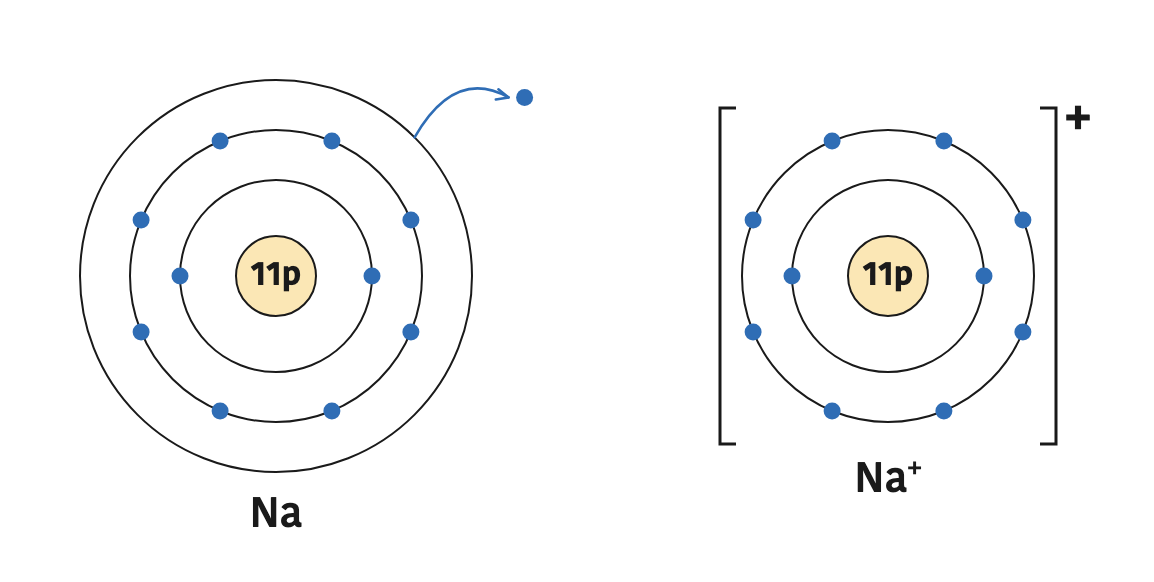
Example 2: how a magnesium ion forms. The 12 electrons of a magnesium atom are arranged as 2, 8, 2. It loses both electrons in its outer shell.
Step 1: Magnesium loses its two valence electrons:
\[ \text{Mg} \rightarrow \text{Mg}^{++} + 2e^{-} \]
Step 2: Adding the charges of the 12 protons and 10 electrons that remain:
\[ (+12) + (-10) = +2 \]
So \( \text{Mg}^{++} \) has valency 2. In the same way aluminium, with electrons arranged as 2, 8, 3, loses three electrons and becomes \( \text{Al}^{+++} \), which has valency 3.
A positive ion is not formed by gaining protons. It is formed by losing electrons. When an ion forms, the number of protons in the nucleus never changes; only the number of electrons does.
Common Cations and Their Valencies
The table below groups the most common positive ions by valency 1, 2 and 3. One of them, ammonium \( \text{NH}_4^{+} \), is not a single atom. It is a group of one nitrogen atom and four hydrogen atoms, and the whole group carries one unit of positive charge together.
| Ion | Symbol | Valency |
| Hydrogen | \( \text{H}^{+} \) | 1 |
| Lithium | \( \text{Li}^{+} \) | 1 |
| Sodium | \( \text{Na}^{+} \) | 1 |
| Potassium | \( \text{K}^{+} \) | 1 |
| Ammonium | \( \text{NH}_4^{+} \) | 1 |
| Cuprous | \( \text{Cu}^{+} \) | 1 |
| Silver | \( \text{Ag}^{+} \) | 1 |
| Mercurous | \( \text{Hg}^{+} \) | 1 |
| Aurous | \( \text{Au}^{+} \) | 1 |
| Beryllium | \( \text{Be}^{++} \) | 2 |
| Magnesium | \( \text{Mg}^{++} \) | 2 |
| Calcium | \( \text{Ca}^{++} \) | 2 |
| Manganese | \( \text{Mn}^{++} \) | 2 |
| Cupric | \( \text{Cu}^{++} \) | 2 |
| Mercuric | \( \text{Hg}^{++} \) | 2 |
| Ferrous | \( \text{Fe}^{++} \) | 2 |
| Boron | \( \text{B}^{+++} \) | 3 |
| Aluminium | \( \text{Al}^{+++} \) | 3 |
| Ferric | \( \text{Fe}^{+++} \) | 3 |
| Auric | \( \text{Au}^{+++} \) | 3 |
Copper, mercury, gold and iron each appear twice in the table. Copper can form both \( \text{Cu}^{+} \) and \( \text{Cu}^{++} \), and iron can form both \( \text{Fe}^{++} \) and \( \text{Fe}^{+++} \). Such elements form ions of different valency under different conditions, so each of their ions is given its own name.
Negative Ions: Anions
When an atom takes electrons from other atoms, it ends up with more electrons than protons. The extra electrons give it a negative charge. An ion formed by gaining one or more electrons from other atoms is a negatively charged ion, called an anion. Atoms of non-metals such as chlorine, oxygen and nitrogen usually form anions.
Anion: a negatively charged ion, formed when an atom or group of atoms gains one or more electrons.
Example 3: how a chloride ion forms. The 17 electrons of a chlorine atom are arranged as 2, 8, 7. With seven electrons in its outer shell, it takes one electron from another atom.
Step 1: Counting the protons and electrons in a chlorine atom:
\[ 17\ p^{+},\ 17\ e^{-} \]
Step 2: The atom gains one electron:
\[ \text{Cl} + e^{-} \rightarrow \text{Cl}^{-} \]
Step 3: Adding the charges of 17 protons and 18 electrons:
\[ (+17) + (-18) = -1 \]
So the chloride ion \( \text{Cl}^{-} \) carries one unit of negative charge, and its valency is 1.
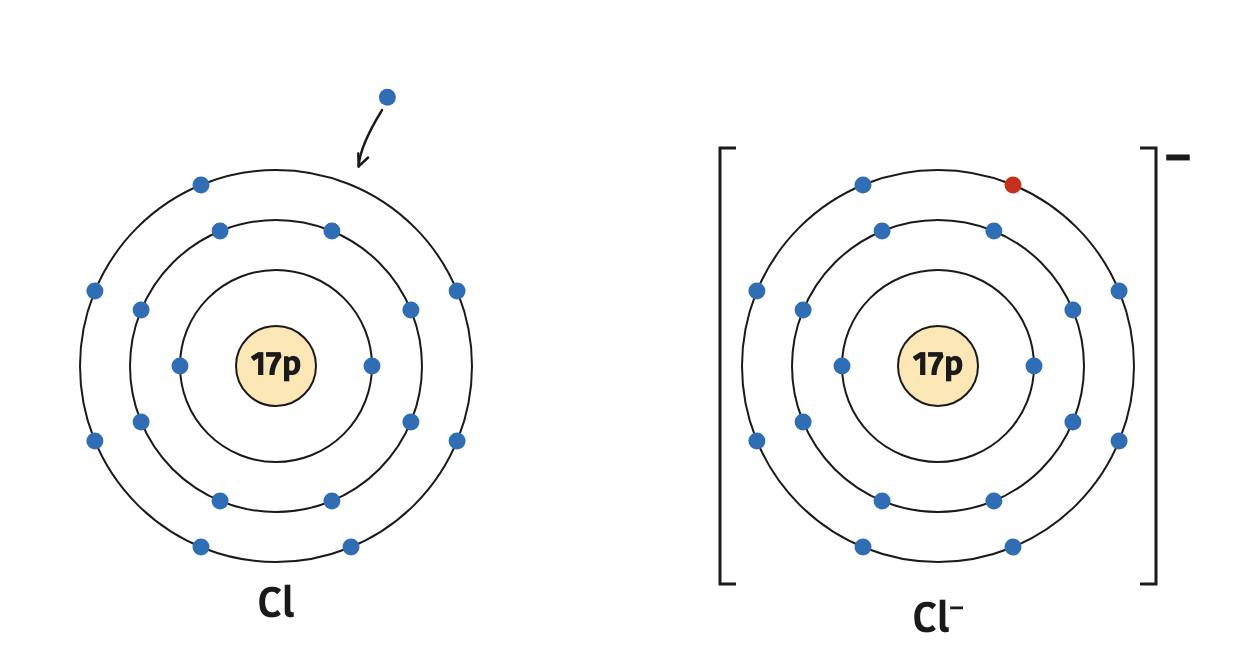
Example 4: how an oxide ion forms. The 8 electrons of an oxygen atom are arranged as 2, 6. It takes in two electrons.
Step 1: Oxygen gains two electrons:
\[ \text{O} + 2e^{-} \rightarrow \text{O}^{--} \]
Step 2: Adding the charges of 8 protons and 10 electrons:
\[ (+8) + (-10) = -2 \]
So the oxide ion \( \text{O}^{--} \) has valency 2. In the same way nitrogen, with electrons arranged as 2, 5, gains three electrons and forms the nitride ion \( \text{N}^{---} \), which has valency 3.
Common Anions and Their Valencies
The table below groups the most common negative ions by valency. Many of them are groups of atoms. Sulphate \( \text{SO}_4^{--} \), for example, is one sulphur atom and four oxygen atoms joined together, and the whole group carries two units of negative charge.
| Ion | Symbol | Valency |
| Fluoride | \( \text{F}^{-} \) | 1 |
| Chloride | \( \text{Cl}^{-} \) | 1 |
| Bromide | \( \text{Br}^{-} \) | 1 |
| Iodide | \( \text{I}^{-} \) | 1 |
| Nitrate | \( \text{NO}_3^{-} \) | 1 |
| Hydroxide | \( \text{OH}^{-} \) | 1 |
| Bicarbonate | \( \text{HCO}_3^{-} \) | 1 |
| Bisulphate | \( \text{HSO}_4^{-} \) | 1 |
| Chlorate | \( \text{ClO}_3^{-} \) | 1 |
| Nitrite | \( \text{NO}_2^{-} \) | 1 |
| Oxide | \( \text{O}^{--} \) | 2 |
| Sulphide | \( \text{S}^{--} \) | 2 |
| Sulphate | \( \text{SO}_4^{--} \) | 2 |
| Carbonate | \( \text{CO}_3^{--} \) | 2 |
| Nitride | \( \text{N}^{---} \) | 3 |
| Phosphate | \( \text{PO}_4^{---} \) | 3 |
How the Names of Ions Work
The name of an ion tells you a good deal about it. The tables above follow a few patterns:
- A positive ion made from one metal atom usually keeps the metal's name: the sodium ion \( \text{Na}^{+} \), the calcium ion \( \text{Ca}^{++} \).
- Where a metal forms two ions, the name ending in -ous is the lower valency and the name ending in -ic is the higher one: ferrous \( \text{Fe}^{++} \) and ferric \( \text{Fe}^{+++} \), cuprous \( \text{Cu}^{+} \) and cupric \( \text{Cu}^{++} \).
- A negative ion made from one non-metal atom has a name ending in -ide: chloride, oxide, sulphide, nitride. Hydroxide \( \text{OH}^{-} \) also ends in -ide, even though it is a group of two atoms.
- A group ion containing oxygen often has a name ending in -ate or -ite. Nitrate \( \text{NO}_3^{-} \) has one more oxygen atom than nitrite \( \text{NO}_2^{-} \).
Chlorine and chloride are not the same thing. A chlorine atom is neutral, and chlorine gas is poisonous. Table salt contains the chloride ion \( \text{Cl}^{-} \), which behaves quite differently. In the same way, nitrate and nitrite are two different ions.
Cations and Anions Side by Side
| Feature | Cation | Anion |
| Electrons | lost | gained |
| Charge | positive | negative |
| Particles | more protons than electrons | more electrons than protons |
| Usually formed by | metals | non-metals |
| Examples | \( \text{Na}^{+} \), \( \text{Mg}^{++} \), \( \text{Al}^{+++} \) | \( \text{Cl}^{-} \), \( \text{O}^{--} \), \( \text{N}^{---} \) |
For both kinds of ion, the valency is simply the number of charges. This process of forming ions is also what lets atoms of metals and non-metals join together to make compounds.
The full lesson is waiting for you
The notes are free to read in full. A free account opens the rest of the practice, and tracks your progress and confidence score for every subject. Presentations and videos need approval from Learn Yeti.