Chemical Bond
Around us there are millions of compounds: water, common salt, sugar, carbon dioxide and many more. In every compound, atoms of two or more elements stay joined together. Water has the formula H₂O, so each molecule holds two hydrogen atoms and one oxygen atom. Common salt has the formula NaCl, made of sodium and chlorine. Why do these atoms not simply drift apart? Something must be holding them in place. That something is a chemical bond.

Look carefully at the four models. In H₂, two atoms of the same element are joined. In H₂O, three atoms of two different elements are joined, with oxygen in the middle and a hydrogen on each side. In O₂, two oxygen atoms are joined by two lines. The NaCl model is different from the rest. Its atoms are not joined by a line at all. Instead, Na carries a plus sign and Cl carries a minus sign. This tells us that atoms are not held together in the same way in every compound.
Chemical bond: the special force that holds the atoms of elements together in a compound.
When elements react with each other to form a compound, this force acts between their atoms. In a molecule of common salt, for example, a chemical bond holds a sodium atom and a chlorine atom together. There are many kinds of chemical bond. Two of the most important are the electrovalent bond, also called the ionic bond, and the covalent bond. The electrovalent bond is the one formed when electrons are given by one atom and taken by another.
Why Atoms Form Bonds
The inert gases helium (He), neon (Ne), argon (Ar), krypton (Kr), xenon (Xe) and radon (Rn) hardly ever react with other elements. The reason is that the outer shell of each of their atoms is already full. Helium has 2 electrons in its outer shell, which is called the duplet state. The other inert gases have 8 electrons in the outer shell, which is called the octet state. Both are stable arrangements.
- Helium (He): 2, with 2 electrons in the outer shell (duplet)
- Neon (Ne): 2, 8, with 8 electrons in the outer shell (octet)
- Argon (Ar): 2, 8, 8, with 8 electrons in the outer shell (octet)
Atoms of all other elements have an incomplete outer shell. They too tend to reach a duplet or an octet, just like an inert gas. To get there, an atom loses, gains or shares electrons, and that is exactly why it takes part in chemical reactions.
Atoms react in order to complete their outer shell, reaching a duplet (2 electrons) or an octet (8 electrons).
How Metal and Non-metal Atoms Become Ions
The atom of a metal usually has 1, 2 or 3 electrons in its outermost shell. Giving these few electrons away is far easier than collecting five or more new ones to make eight. Once they are given away, the full shell underneath becomes the outer shell, so the atom now has an octet or a duplet. Each electron carries a negative charge. When the atom loses electrons, its protons outnumber its electrons and it becomes a positively charged ion.
The atom of a non-metal has 5, 6 or 7 electrons in its outermost shell. It needs only 3, 2 or 1 more to complete an octet, so it takes electrons from another atom. After gaining electrons, it has more electrons than protons and becomes a negatively charged ion.
| Electrons in outer shell | What the atom does | Ion formed | Example |
| 1 (metal) | loses 1 electron | charge +1 | Na → Na⁺ |
| 2 (metal) | loses 2 electrons | charge +2 | Mg → Mg⁺⁺ |
| 3 (metal) | loses 3 electrons | charge +3 | Al → Al³⁺ |
| 6 (non-metal) | gains 2 electrons | charge −2 | O → O⁻⁻ |
| 7 (non-metal) | gains 1 electron | charge −1 | Cl → Cl⁻ |
Losing electrons makes an atom positive, not negative. The electron itself is negative, so removing it leaves extra positive charge behind. An atom becomes a negative ion only when it gains electrons.
Electrovalent Bond
When a metal reacts with a non-metal, the metal atom loses one or more electrons from its outer shell and becomes a positive ion. At the same moment the non-metal atom takes those electrons into its own outer shell and becomes a negative ion. Opposite charges pull on each other, and this force of attraction keeps the two ions together as a molecule. The outermost shell of an atom is called its valence shell.
Electrovalent bond: the chemical bond formed when electrons are transferred from the valence shell of a metal atom to the valence shell of a non-metal atom. It is also called an ionic bond.
Electrovalent compound: a compound formed by electrovalent bonds, for example sodium chloride (NaCl), calcium chloride (CaCl₂) and magnesium oxide (MgO).
In an electrovalent bond, electrons are not shared. They move from one atom to the other: the metal gives, the non-metal takes.
Formation of Sodium Chloride (NaCl)
In sodium chloride, one electron passes between one sodium atom and one chlorine atom. Sodium has the electron configuration 2, 8, 1, so its valence shell holds just one electron. Chlorine has the configuration 2, 8, 7, so its valence shell holds seven. Sodium needs to get rid of one electron and chlorine needs to receive one, so a single transfer satisfies both of them.
Step 1: The sodium atom loses the one electron in its valence shell and becomes a positive sodium ion:
\[ \text{Na} - e^- \rightarrow \text{Na}^+ \]
Na⁺ now has the configuration 2, 8, which is an octet. Step 2: The chlorine atom takes that electron into its outer shell and becomes a negative chloride ion:
\[ \text{Cl} + e^- \rightarrow \text{Cl}^- \]
Cl⁻ now has the configuration 2, 8, 8, also an octet. Step 3: The two oppositely charged ions attract each other and sodium chloride is formed:
\[ \text{Na}^+ + \text{Cl}^- \rightarrow \text{NaCl} \]
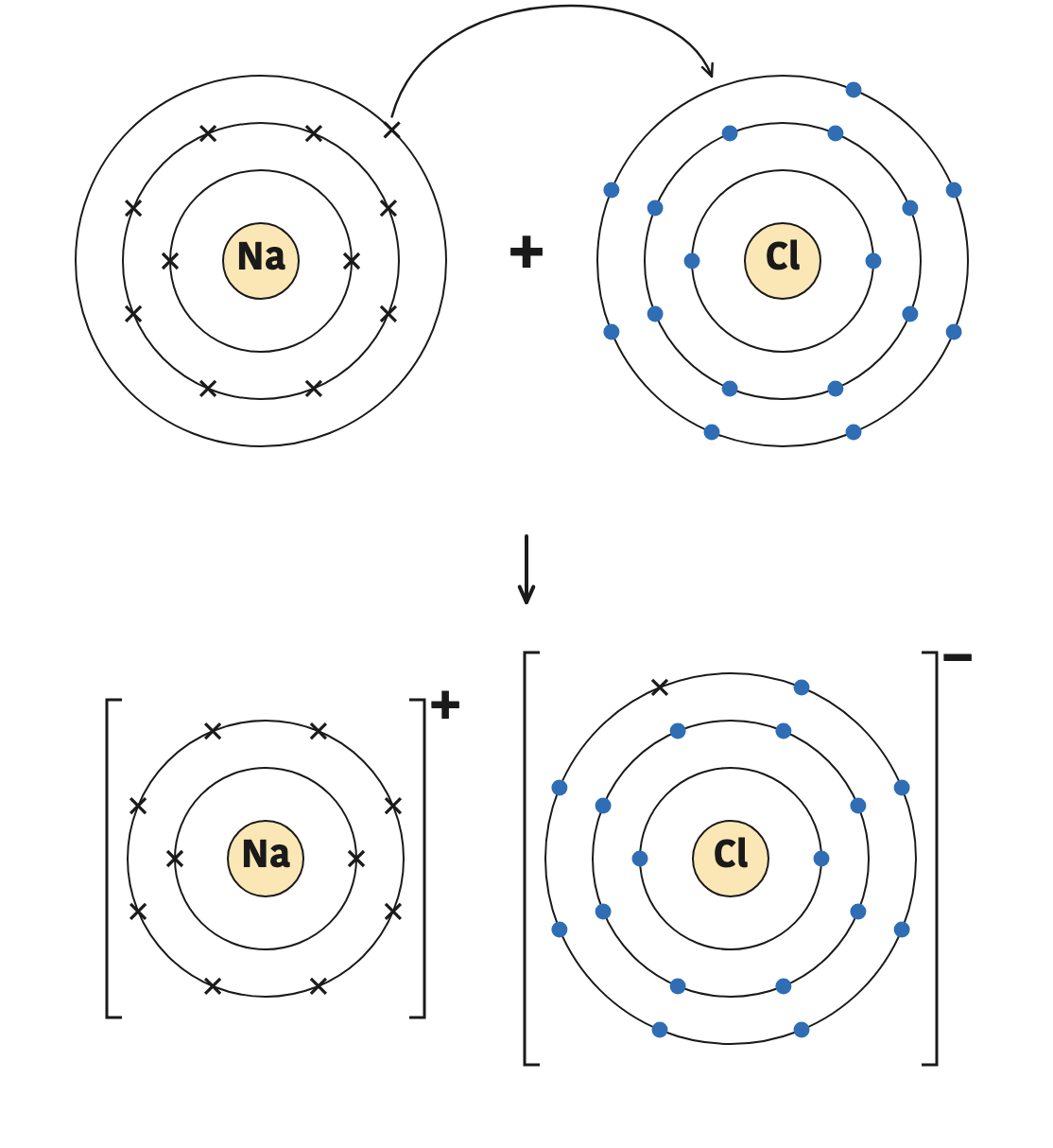
So when the electrovalent bond forms, the atoms of both elements reach an octet. The electron sodium gives up is not lost; it ends up on chlorine. The total number of electrons stays the same.
Formation of Magnesium Oxide (MgO)
In magnesium oxide, magnesium is the metal and oxygen is the non-metal. A magnesium atom has the configuration 2, 8, 2, so there are two electrons in its valence shell. An oxygen atom has the configuration 2, 6, so it has six valence electrons and needs two more for an octet. This time two electrons are transferred, not one.
Step 1: The magnesium atom loses both of its valence electrons and becomes a positive magnesium ion:
\[ \text{Mg} - 2e^- \rightarrow \text{Mg}^{++} \]
Mg⁺⁺ is also written Mg²⁺, and its configuration is 2, 8. Step 2: The oxygen atom takes the two electrons from magnesium and becomes a negative oxide ion:
\[ \text{O} + 2e^- \rightarrow \text{O}^{--} \]
O⁻⁻ is also written O²⁻, and its configuration is 2, 8. Step 3: An electrovalent bond forms between the two oppositely charged ions, giving magnesium oxide:
\[ \text{Mg}^{++} + \text{O}^{--} \rightarrow \text{MgO} \]
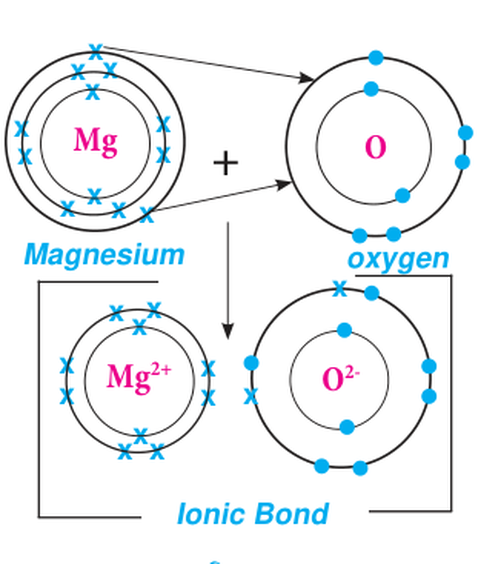
Magnesium gives two electrons and oxygen needs exactly two, so one magnesium atom and one oxygen atom are enough to make MgO. The ions carry charges of +2 and −2, which are equal and opposite, so the compound as a whole has no charge.
Formation of Calcium Chloride (CaCl₂)
Calcium chloride (CaCl₂) is formed by electrovalent bonds between one calcium atom and two chlorine atoms. Calcium has the configuration 2, 8, 8, 2, so it has two valence electrons to give. Each chlorine atom, however, needs only one. A single chlorine cannot take both, so calcium hands one electron to each of two separate chlorine atoms.
Step 1: The calcium atom loses its two valence electrons and becomes a positive calcium ion:
\[ \text{Ca} - 2e^- \rightarrow \text{Ca}^{++} \]
Step 2: One electron goes to the first chlorine atom and the other goes to the second, forming two chloride ions:
\[ 2\text{Cl} + 2e^- \rightarrow 2\text{Cl}^- \]
Step 3: One Ca⁺⁺ ion and two Cl⁻ ions attract one another and calcium chloride is formed:
\[ \text{Ca}^{++} + 2\text{Cl}^- \rightarrow \text{CaCl}_2 \]
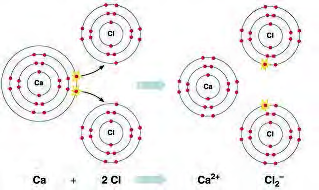
The small 2 in CaCl₂ tells us there are two chlorine atoms for every calcium atom. The +2 charge on Ca⁺⁺ is balanced by the total −2 charge of the two Cl⁻ ions, so the compound has no overall charge.
The Three Compounds Side by Side
The table below brings the three compounds together, showing which atom gave how many electrons and which atom took them. The formula of each compound comes directly from this give and take.
| Compound | Metal (electrons given) | Non-metal (electrons taken) | Ions formed |
| NaCl | Na: 2, 8, 1 (gives 1) | Cl: 2, 8, 7 (takes 1) | Na⁺, Cl⁻ |
| MgO | Mg: 2, 8, 2 (gives 2) | O: 2, 6 (takes 2) | Mg⁺⁺, O⁻⁻ |
| CaCl₂ | Ca: 2, 8, 8, 2 (gives 2) | two Cl: 2, 8, 7 (each takes 1) | Ca⁺⁺, 2Cl⁻ |
The number of electrons given by the metal always equals the number taken by the non-metal, so the finished compound carries no overall charge.
Characteristics of Electrovalent Compounds
Because electrovalent compounds are built from oppositely charged ions, they share a few properties:
- (a) Electrovalent compounds are made of a metal and a non-metal joined together, as in NaCl, where sodium is the metal and chlorine the non-metal.
- (b) Electrovalent compounds dissolve in water. When they dissolve, they separate into positive and negative ions. Salt stirred into water breaks up into Na⁺ and Cl⁻ ions.
- (c) These compounds have high melting and boiling points. The pull between opposite ions is strong, so a lot of heat is needed to separate them. Common salt melts only at about 801 °C.
These properties help us recognise an electrovalent compound. Salt left on a kitchen flame does not melt, yet it dissolves easily in a glass of water. Both facts come from its structure of ions.
The full lesson is waiting for you
The notes are free to read in full. A free account opens the rest of the practice, and tracks your progress and confidence score for every subject. Presentations and videos need approval from Learn Yeti.