Nuclear Stability
At the centre of every atom there is a tiny but heavy part called the nucleus. The nucleus is made of protons and neutrons. A proton carries a positive charge, and a neutron carries no charge at all. When many positive particles are packed into one very small space, they push against each other. So a nucleus is not always calm and settled.
Whether a nucleus is stable depends on the ratio of neutrons to protons inside it, written \( \frac{n^0}{p^+} \). In a light atom the numbers of protons and neutrons are about equal, so \( \frac{n^0}{p^+} = 1 \). As atoms get heavier, this ratio becomes greater than 1. Elements with a large atomic number have unstable nuclei, and the larger the atomic number, the more unstable the nucleus becomes.
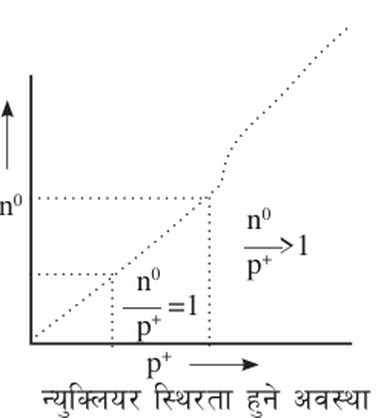
Elements with unstable nuclei are always trying to move from an unstable state to a stable one. To do this, they throw powerful radiation out of the nucleus. This process is called radioactive emission. You can compare it with a person carrying too heavy a load: only after putting some of it down can they stand comfortably.
Nuclear stability: the state in which the balance of protons and neutrons lets a nucleus stay together without breaking apart or giving out radiation.
Radioactive Elements and Radioactive Emission
The nuclei of some atoms with a large atomic number are unstable. To become stable, these atoms give out powerful radioactive radiations called alpha (α), beta (β) and gamma (γ). Such elements are called radioactive elements. Uranium, plutonium and thorium are examples. The atomic number of a radioactive element is usually greater than 83.
Radioactive element: an element that can give out radioactive radiation. Examples are uranium, plutonium and thorium.
Radioactive emission: the process by which a radioactive element gives out radioactive radiation.
Radioactivity was discovered in 1896 by the French scientist Henri Becquerel. He found that uranium salts give out invisible radiation all by themselves. After that, scientists went on to discover many more radioactive elements.
Radioactivity: the property of an unstable nucleus of giving out radiation on its own.
The radiation given out in radioactive emission is extremely harmful to human health. If you ever find an object or place marked with the radiation sign, do not touch it, do not go near it, and tell an adult straight away.
Alpha, Beta and Gamma Radiation
Radioactive emission is of three kinds, because an unstable nucleus can give out three kinds of radiation. Each is named after a Greek letter.
- Alpha (α) radiation: particles made of two protons and two neutrons. They carry a positive charge.
- Beta (β) radiation: tiny particles like electrons, shot out of the nucleus at high speed. They carry a negative charge.
- Gamma (γ) radiation: not a particle but a very powerful invisible ray. It carries no charge.
Nuclear Fission
Nuclear fission is the process in which an unstable atom of an element with a large atomic number breaks into smaller atoms. An atom of uranium or plutonium is struck by a free neutron moving at high speed. Because the neutron has no charge, it can enter the positive nucleus easily. Once hit, the atom splits and atoms of new, smaller elements are formed.
Nuclear fission: the process in which an unstable atom of an element with a large atomic number splits into smaller atoms.
As the unstable atom turns into stable atoms, some mass is lost. The pieces formed together weigh a little less than the atom they came from. That lost mass does not simply vanish: it becomes an enormous amount of energy, given out as alpha (α), beta (β) or gamma (γ) radiation.
For example, when a uranium atom is struck by a fast neutron, it splits. It produces lighter atoms called barium and krypton, three neutrons, and an enormous amount of energy from the lost mass. In words: uranium + neutron → barium + krypton + neutrons + energy (as radiation).
\[ {}_{92}\text{U}^{236} + n^{0} \rightarrow \text{Ba}^{141} + \text{Kr}^{92} + 3n^{0} + 236\ \text{kcal} \]
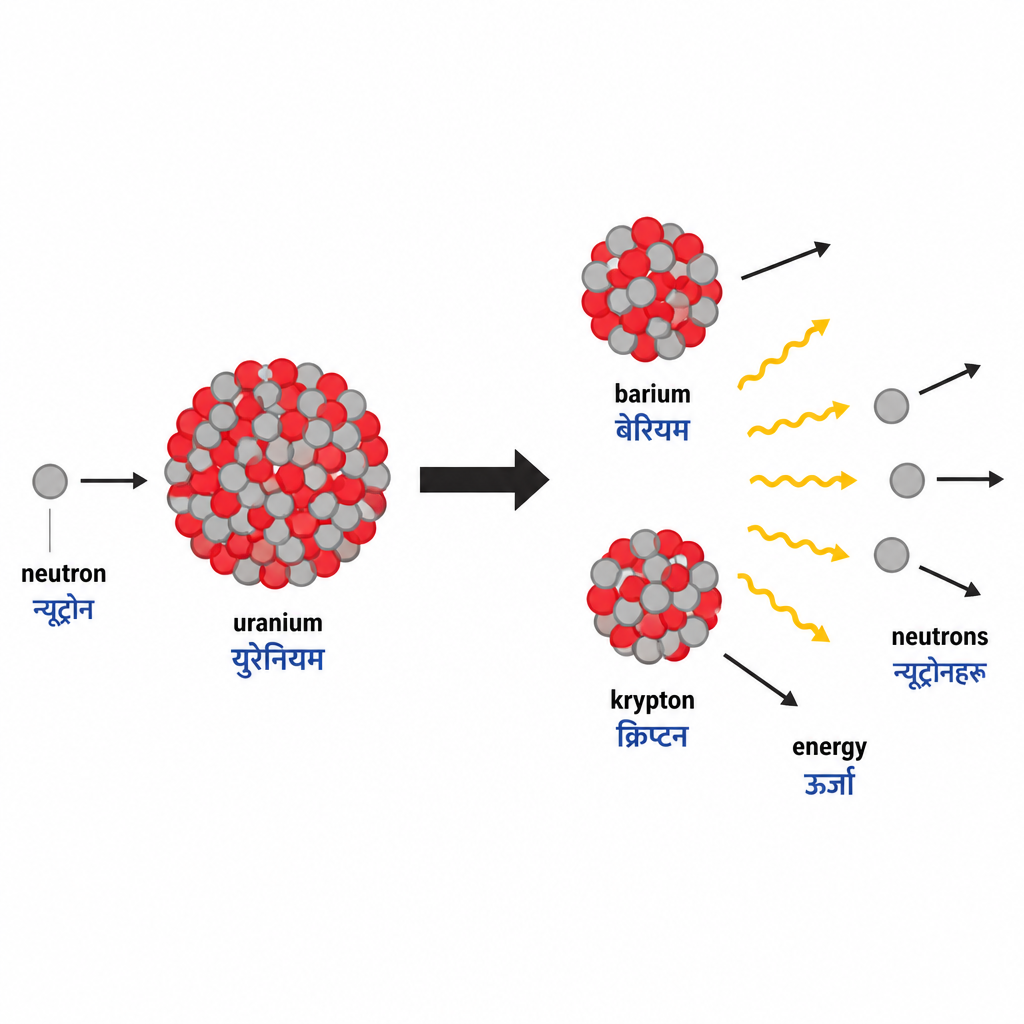
The three neutrons released by one fission can strike other uranium atoms. So one fission can start the next, which is why a small amount of uranium can give out a very large amount of energy.
Nuclear Fusion
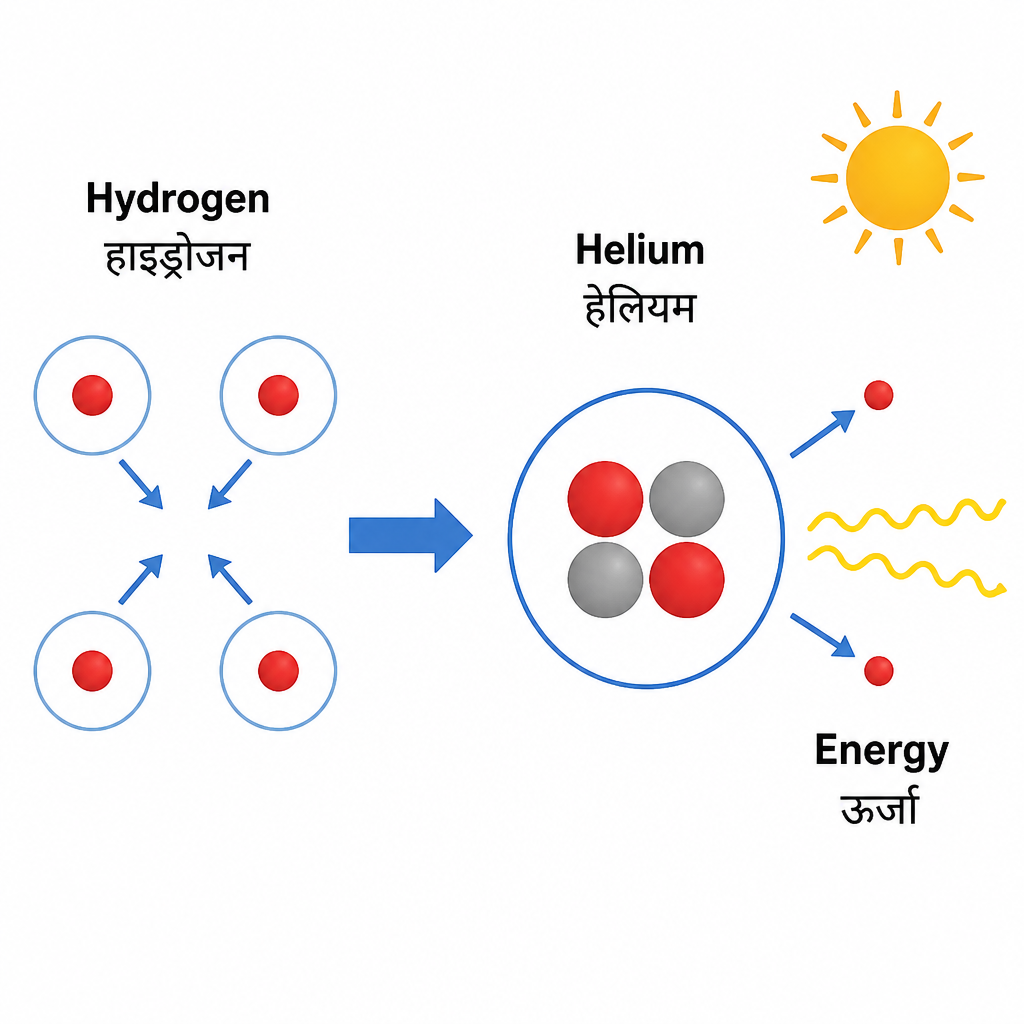
In fission a large atom breaks apart. In fusion, small atoms join together. Nuclear fusion is the process in which atoms of light elements such as hydrogen combine, under extremely high heat and pressure, to form a larger element such as helium, along with energy.
Nuclear fusion: the process in which atoms of light elements combine under extremely high heat and pressure to form a larger element and energy.
This process goes on all the time in the Sun and the stars. They hold huge amounts of hydrogen, and their extremely high heat and pressure make fusion possible. In this reaction four hydrogen atoms combine to form one helium atom and a vast amount of energy. The sunlight and warmth we receive every day come from this energy. In words: hydrogen → helium + energy.
In symbols it is written like this, where E stands for energy:
\[ 4\,{}_{1}\text{H}^{1} \rightarrow {}_{2}\text{He}^{4} + 2\,{}_{1}e^{0} + E \]
Fission and Fusion Compared
| Basis | Nuclear fission | Nuclear fusion |
| What happens | A large atom splits | Small atoms join |
| Elements used | Heavy ones such as uranium and plutonium | Light ones such as hydrogen |
| What starts it | A fast moving neutron | Extremely high heat and pressure |
| Where it happens | Artificially, in nuclear reactors | In the Sun and the stars |
| Example | Uranium → barium + krypton | Hydrogen → helium |
Many students mix up fission and fusion. Fission means splitting; fusion means joining. Both give out energy, so the release of energy alone cannot tell them apart.
Atomic Energy or Nuclear Energy
Atomic energy or nuclear energy: the energy produced by a nuclear reaction.
Energy can be produced artificially from nuclear fission. Fusion, however, needs such extreme heat and pressure that energy cannot be obtained from it artificially. So the atomic energy people use comes from fission.
Electricity from a Nuclear Reactor
Nuclear reactors are built to produce heat from nuclear reactions. Electricity is obtained from a reactor in this order:
- Step 1: Fission takes place inside the reactor and gives out heat.
- Step 2: This heat boils water and turns it into steam.
- Step 3: The steam drives a steam engine.
- Step 4: The steam engine turns a generator.
- Step 5: The generator produces a large amount of electricity.
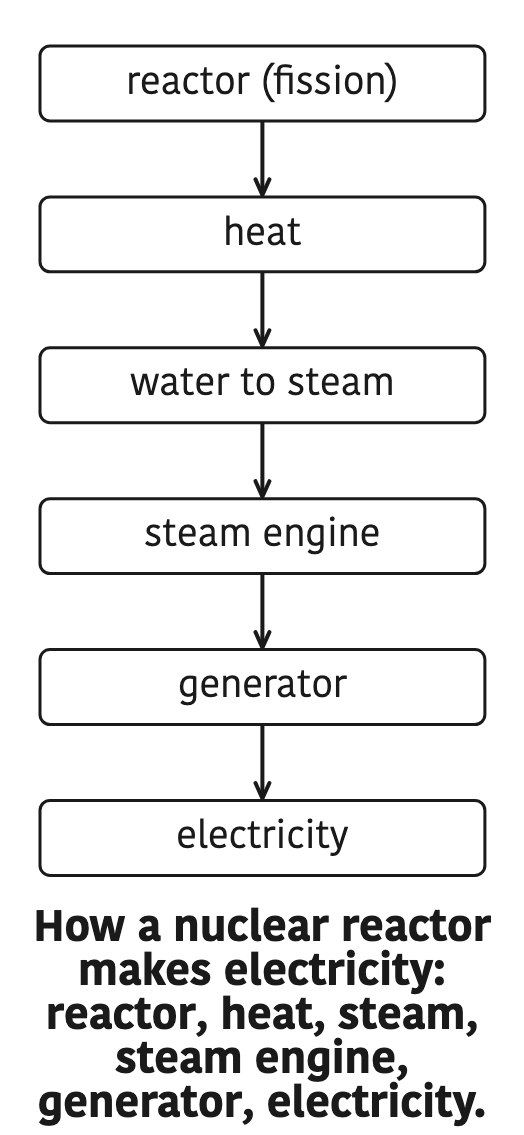
Electricity is made this way mostly in developed countries, because a reactor needs a great deal of money, advanced technology and strict safety.
Uses of Atomic Energy
Atomic energy is not used only to make electricity. The radiation from nuclear reactions has several other uses:
- To produce large amounts of electricity in nuclear reactors.
- To sterilise drinking water, food and medical instruments, which means killing the germs in them.
- To treat various diseases such as cancer.
Risks of Atomic Energy
The same power that can light a city can also destroy one. Nuclear energy can be used to make nuclear weapons, and these can be misused. Also, if radiation leaks from a reactor while nuclear energy is being produced, it harms people, animals, plants and the environment for a long time. That is why atomic energy is both useful and dangerous.
Atomic energy is not good or bad in itself. How it is used, and how safely, decides whether it becomes a blessing or a curse for humankind.
The full lesson is waiting for you
The notes are free to read in full. A free account opens the rest of the practice, and tracks your progress and confidence score for every subject. Presentations and videos need approval from Learn Yeti.