Pascal's Law: The Base of Every Hydraulic Machine
A liquid is very hard to squeeze into a smaller volume. Its molecules are already packed close together, with very little space between them. So when a liquid shut inside a closed vessel is pushed at one point, it does not shrink. The push is passed on to every part of the liquid instead. The French mathematician Blaise Pascal stated this behaviour as a law.
Pascal's law: when a force is exerted at a point in an enclosed liquid, the pressure generated is transmitted normally throughout the liquid in all directions.
Pressure is the force acting on a unit area, written \( P = \frac{F}{A} \). Force F is measured in newton (N), area A in square metre (m²) and pressure P in pascal (Pa), where \( 1\ \text{Pa} = 1\ \text{N/m}^2 \). Turn the formula round and it reads \( F = P \times A \). This tells us something powerful: the same pressure pressing on a bigger area gives a bigger force. Hydraulic brakes, hydraulic lifts and hydraulic presses are all manufactured on this idea. Each of them is a hydraulic machine.
A Model Made from Two Syringes
You can watch a hydraulic machine work using two syringes of different thickness, a piece of saline pipe and some water. The mouths of the two syringes are joined by the saline pipe. Each syringe is filled with water a little more than halfway, so that each piston still has room to move outwards. The water now forms one unbroken body of liquid, running from the face of one piston, through the pipe, to the face of the other.
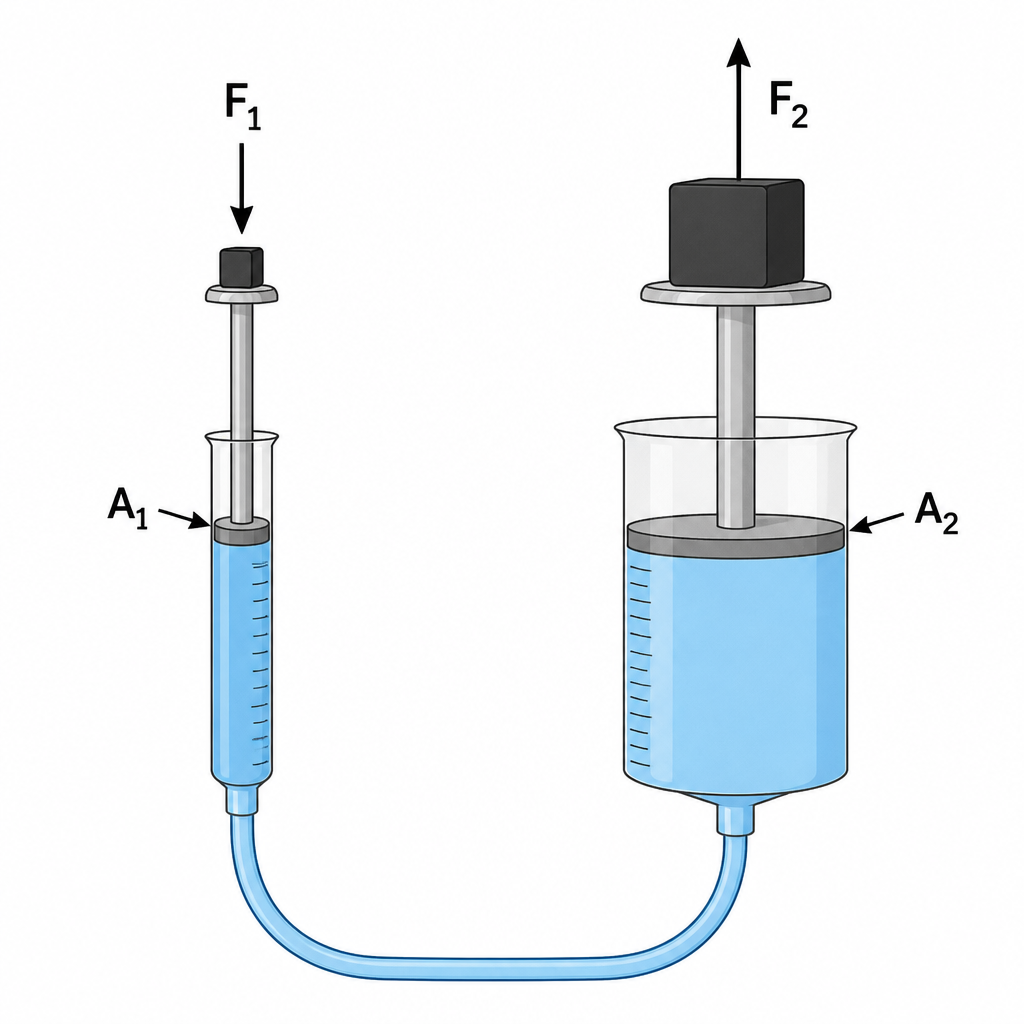
Place a small weight on the piston of the thin syringe and a heavier object on the piston of the thick syringe. The small weight pushes the thin piston down, water flows along the pipe into the thick syringe, and the heavier object rises. A light weight has lifted a heavy one. This works only because water cannot be squeezed. The whole of the push travels through it to the other piston instead of being used up in squashing the water.
Now keep adding weight on the thick piston. At first it still rises. Then a point comes where the weight on the large piston becomes equal to the greatest weight the small piston can lift. Now neither piston moves, because the two are balanced. Compare the two weights at this moment and you find that the weight on the large piston is several times the weight on the small one. How many times depends only on how many times larger the area of the large piston is than the area of the small piston.
What Is a Hydraulic Machine?
Hydraulic machine: a force-multiplying device based on Pascal's law. A small force applied on a small piston produces a much larger force on a large piston, through a liquid enclosed between them.
The word hydraulic comes from the Greek word for water, but most real machines use oil, which keeps the moving parts smooth and free from rust. The syringe model is a hydraulic machine in its simplest form. The machine does not make force out of nothing. It takes the pressure produced by a small force on a small area and lets that same pressure act on a much bigger area, where it becomes a much bigger force.
The Backhoe: A Hydraulic Machine That Digs
The excavator, also called a backhoe, is the yellow digging machine seen at road works and building sites. It is a hydraulic machine used for digging. Its long bending arm and toothed bucket are moved by hydraulic cylinders and pistons. The shiny rods sliding out of the cylinders on the arm are piston rods, and the black flexible pipes running along the arm carry the fluid to those cylinders.
When the backhoe digs, these things happen in order:
- The driver works the controls, and a small piston pushes on the fluid.
- The pushed fluid travels along the black flexible pipes into the large cylinders on the arm.
- The pressure acts on the large pistons, so the driver's small force is magnified into a very large force.
- The upper part of the machine bends towards the ground along with the backhoe, the bucket sinks into the ground, and the soil is dug.
No driver could push a steel bucket into hard, stony soil with the strength of his arms. The hydraulic system multiplies the driver's effort many times over. That is how one person sitting in a cabin can do the work of dozens of people with spades.
Construction of a Hydraulic Machine
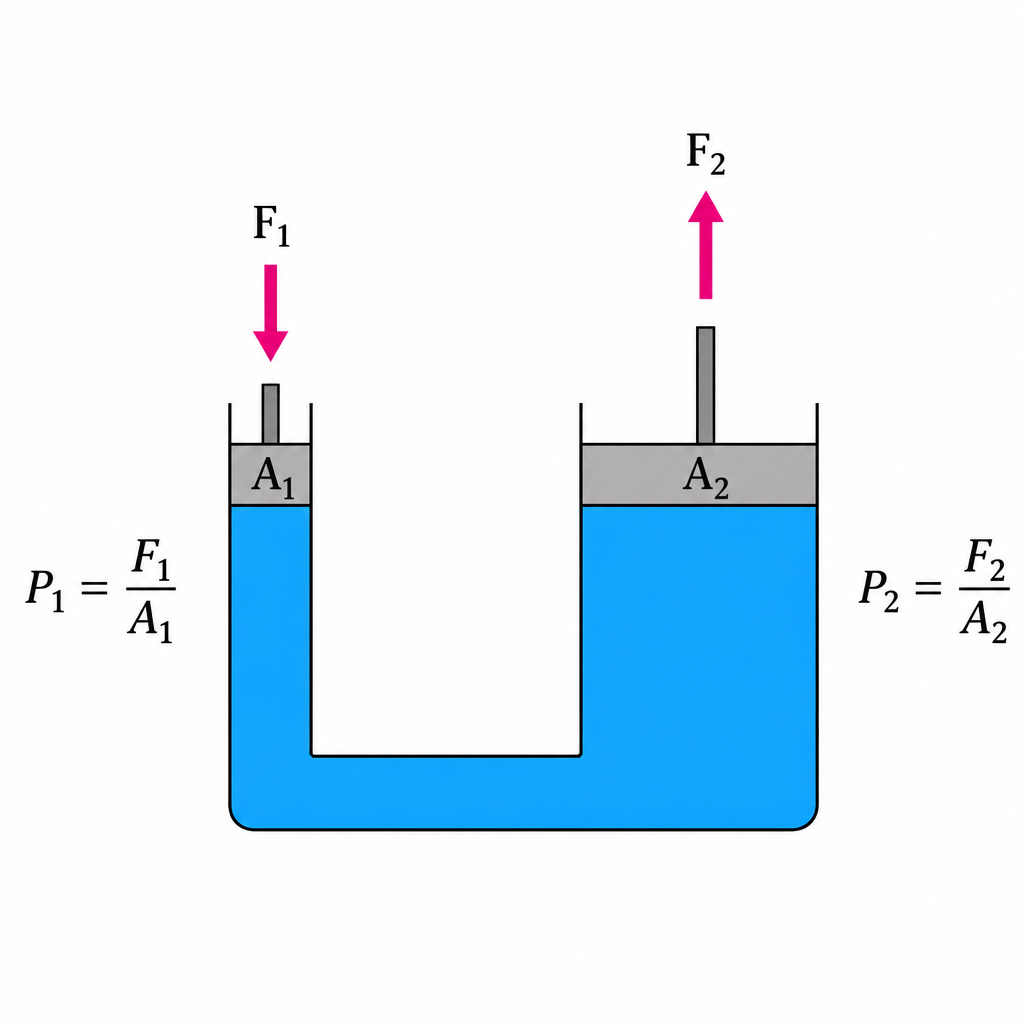
Every hydraulic machine, however large, is built on the same plan. At least two cylinders with different cross-sectional areas are connected so that liquid can flow from one to the other. A piston is fitted into each cylinder so tightly that the liquid inside does not leak.
Cross-sectional area: the area of the flat face you would see if a cylinder were cut straight across. For a piston, it is the area of the flat face that presses on the liquid.
- A small cylinder with a small piston of cross-sectional area \( A_1 \). The force is applied here.
- A large cylinder with a large piston of cross-sectional area \( A_2 \). The multiplied force is obtained here.
- A pipe or passage joining the two cylinders at the bottom.
- An incompressible liquid, usually oil, filling the cylinders and the passage completely.
Incompressible liquid: a liquid whose volume does not decrease when pressure is applied to it. Because it cannot be squeezed, it passes the pressure on in full.
Input force \( F_1 \): the force applied on the small piston of a hydraulic machine.
Output force \( F_2 \): the outward force produced on the large piston when the input force is applied on the small piston.
Two conditions must hold for the machine to work well. First, the liquid must not leak, because liquid escaping past a piston carries the pressure away with it. Second, the space must be filled with liquid, not gas. A gas can be squeezed into a smaller volume, so much of the push on the small piston would be spent squeezing the gas, and far less would reach the large piston.
Working Mechanism: The Force Equation
A hydraulic machine creates the conditions for Pascal's law to apply. When force \( F_1 \) is applied on the small piston of area \( A_1 \), it produces pressure on the surface of that piston. The incompressible liquid in the cylinders transmits this pressure perpendicularly and equally in all directions, so the same pressure reaches the underside of the large piston. There it acts on the bigger area \( A_2 \) and pushes the large piston outwards with force \( F_2 \). The link between \( F_1 \) and \( F_2 \) is worked out below.
Step 1: The pressure produced on the surface of the small piston is:
\[ P_1 = \frac{F_1}{A_1} \]
Step 2: The pressure acting on the surface of the large piston is:
\[ P_2 = \frac{F_2}{A_2} \]
Step 3: By Pascal's law the pressure is transmitted equally, so the two pressures are equal:
\[ P_1 = P_2 \]
Step 4: Putting the expressions from Steps 1 and 2 in place of \( P_1 \) and \( P_2 \):
\[ \frac{F_1}{A_1} = \frac{F_2}{A_2} \]
Step 5: Multiplying both sides by \( A_2 \) to get \( F_2 \) on its own:
\[ F_2 = F_1 \left( \frac{A_2}{A_1} \right) \]
Read in words, this equation says that the force acting on the larger piston is \( \frac{A_2}{A_1} \) times \( F_1 \). Here \( \frac{A_2}{A_1} \) is the ratio of the area of the larger piston to the area of the smaller piston. So output force equals input force multiplied by this area ratio.
The pressure is the same on both pistons. The force is not. The liquid passes pressure on unchanged, and force is pressure multiplied by area, so the piston with the bigger area gets the bigger force. Writing \( P_2 \) larger than \( P_1 \) in an answer is wrong.
Why the Output Force Is Always Larger
In the factor \( \frac{A_2}{A_1} \), a bigger number is divided by a smaller number, because \( A_2 \) belongs to the large piston. So this factor is always more than 1, and \( F_2 \) always comes out bigger than \( F_1 \). Suppose the cross-sectional area of the large piston is twice the cross-sectional area of the small piston. Then \( \frac{A_2}{A_1} = 2 \), and the force exerted on the small piston becomes double when it is transferred to the large piston. A push of 50 N on the small piston gives 100 N on the large one.
| Area ratio \( A_2/A_1 \) | Input force \( F_1 \) | Output force \( F_2 \) |
| 2 | 50 N | 100 N |
| 10 | 50 N | 500 N |
| 25 | 50 N | 1250 N |
| 100 | 50 N | 5000 N |
The more times larger the large piston's area is than the small piston's, the more times the force is multiplied.
A hydraulic machine multiplies force, not energy. The volume of liquid that leaves the small cylinder is the same volume that enters the large one, and because the large cylinder is wider, that volume raises the large piston only a short way. If the large piston has 25 times the area of the small one, pushing the small piston down 25 cm lifts the large piston by only 1 cm. More force is paid for with less distance.
The full lesson is waiting for you
The notes are free to read in full. A free account opens the rest of the practice, and tracks your progress and confidence score for every subject. Presentations and videos need approval from Learn Yeti.