How a hydraulic machine multiplies force
A hydraulic machine is made of two cylinders joined by a pipe and filled with a liquid, usually oil. Each cylinder has a piston that fits so tightly that no air can get in and no oil can leak out. One piston is small and the other is large. When the small piston is pushed, it creates pressure in the oil. Pascal's law says that pressure applied to a liquid shut in a container is passed on equally in all directions. So exactly the same pressure pushes up on the large piston.
Hydraulic machine: a machine in which a liquid shut inside connected cylinders passes pressure from a small piston to a large piston, so that a small force on the small piston produces a large force on the large piston.
Pressure is force divided by area. The pressure on the two pistons is the same, but the large piston has a bigger area, so the force on it is bigger. If \( F_1 \) is the force on the small piston of area \( A_1 \), and \( F_2 \) is the force on the large piston of area \( A_2 \), then:
\[ \frac{F_1}{A_1} = \frac{F_2}{A_2} \]
Rearranged, this gives the force that the large piston receives:
\[ F_2 = F_1 \times \frac{A_2}{A_1} \]
If the large piston has twice the cross-sectional area of the small one, the force is doubled. If it has twenty times the area, the force becomes twenty times larger. Hydraulic machines are built in many designs, shapes and sizes, depending on the job they have to do, but every one of them works on this same idea. Four of them are studied here: the hydraulic lift, the hydraulic brake, the hydraulic jack and the hydraulic press.
Same pressure on both pistons, bigger area, bigger force. That is the whole secret of every hydraulic machine.
Hydraulic lift
Hydraulic lift: a hydraulic machine that raises a heavy load, such as a patient in a dentist's chair or a car in a garage, when a small force is applied to its small piston.
A dentist's chair is a hydraulic lift. The dentist presses a pedal with one foot. The pedal is connected to the small piston, so the light push of the foot presses on the oil. That force is amplified at the big piston under the seat, and the seat, with the patient on it, rises easily. In this way the dentist sets the chair at whatever height the treatment needs.
In a garage, a mechanic often has to work underneath a car. A hydraulic car lift does this job. Here the small force does not come from a foot. A compressor pushes compressed air into the small cylinder, and the air pushes the oil inward. The oil carries the pressure to the big pistons on the other side, which hold up the platform, and the car resting on the platform is lifted. A hydraulic lift is used wherever heavy objects must be lifted easily.
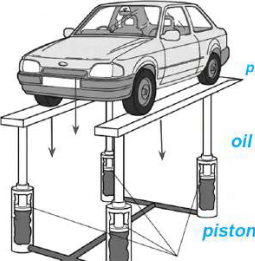
Worked example: force needed to lift a car
In a hydraulic lift, the cross-sectional areas of the small piston and the large piston are \( 0.25 \text{ m}^2 \) and \( 5 \text{ m}^2 \) respectively. Calculate the force required to lift a car of mass 1200 kg using the lift. Take \( g = 9.8 \text{ m/s}^2 \).
Step 1: Writing down the area of the small piston:
\[ A_1 = 0.25 \text{ m}^2 \]
Step 2: Writing down the area of the large piston:
\[ A_2 = 5 \text{ m}^2 \]
Step 3: The upward force on the large piston must equal the weight of the car. Using weight \( W = mg \) with \( m = 1200 \text{ kg} \):
\[ F_2 = mg = 1200 \times 9.8 = 11760 \text{ N} \]
Step 4: Applying Pascal's law, because the pressure on both pistons is the same:
\[ \frac{F_1}{A_1} = \frac{F_2}{A_2} \]
Step 5: Rearranging to get the force on the small piston by itself:
\[ F_1 = F_2 \times \frac{A_1}{A_2} \]
Step 6: Substituting the values:
\[ F_1 = 11760 \times \frac{0.25}{5} \]
Step 7: Since \( 0.25 \div 5 = 0.05 \), multiplying:
\[ F_1 = 11760 \times 0.05 = 588 \text{ N} \]
The force required to lift a car of mass 1200 kg with this lift is 588 N. The large piston has 20 times the area of the small one, so the force is multiplied 20 times. Check it: \( 588 \times 20 = 11760 \), which is the weight of the car.
The force on the large piston is the car's weight in newtons, not its mass in kilograms. Multiply the mass by g first. Putting 1200 straight into the formula gives 60, which has no meaning here.
Hydraulic brake
A vehicle moving at high speed must sometimes be stopped in an instant, and the driver's foot or the rider's hand is not strong enough to do that directly. A hydraulic brake multiplies that small force. It has a master cylinder near the driver and a brake cylinder at each wheel. A pipe joins them, and the pipe is filled with a special type of brake oil. Pistons are fitted in both cylinders so that they are air-tight.
Master cylinder: the cylinder with the small piston, worked by the brake pedal or brake lever, where the driver's force first presses on the brake oil.
Brake cylinder: the cylinder at a wheel whose larger piston is connected to the brake shoes or brake pads and presses them against the wheel.
In a four-wheeled vehicle such as a car, bus or truck, the piston of the master cylinder is connected by a lever to the brake pedal at the driver's foot. Fluid-filled pipes carry the brake oil from the master cylinder to the front wheels and on to the rear wheels.
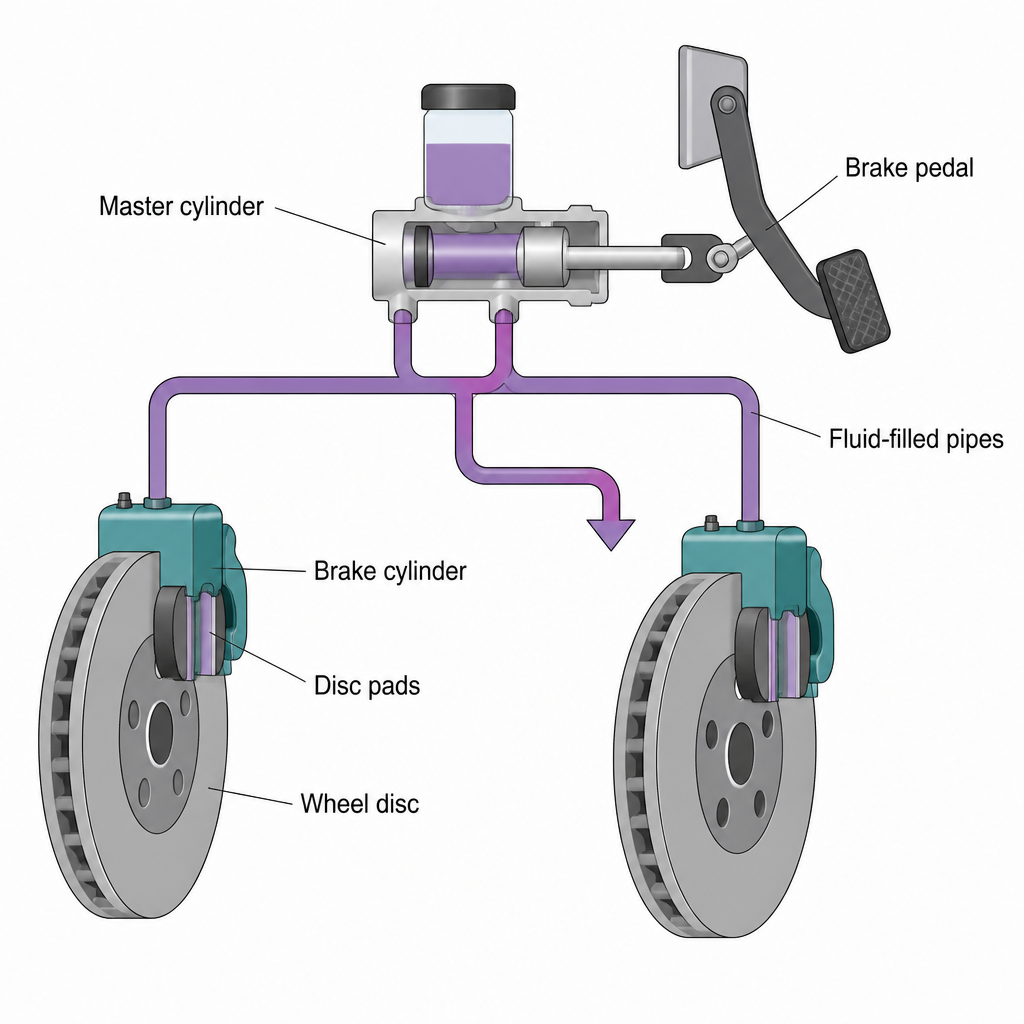
At each wheel, the piston of the brake cylinder is connected to the brake shoes or brake pads. In a disc brake, two pads sit on either side of a metal disc that turns with the wheel. When oil pushes the pistons, the pads close on the disc and grip it.
In a two-wheeled vehicle such as a motorcycle or scooter, the piston of the master cylinder is connected to the brake lever on the handle. When the rider squeezes the lever, the brake pump pushes brake fluid, kept topped up from a small reservoir tank, through the brake hose to the brake caliper at the wheel. Pistons inside the caliper, sealed by piston seals, press the brake pads against the disc.
Whether the vehicle has two wheels or four, the brake works in the same order:
- Step 1: A small force is applied on the small piston of the master cylinder, through the pedal or the lever.
- Step 2: The piston pushes the brake oil and creates pressure in it.
- Step 3: The pressure is transmitted through the oil in the pipe to the brake cylinders at the wheels.
- Step 4: A large force acts on the large pistons of the brake cylinders.
- Step 5: These pistons press the brake shoes or pads against the wheel, and even a vehicle moving at high speed stops in an instant.
Because the pressure spreads equally through all the oil, every wheel connected to the pipes feels the same pressure at the same moment. One press of the pedal brakes all of them together.
Hydraulic jack
Hydraulic jack: a small hydraulic machine, worked by pumping a lever, that lifts trucks, buses, cars and other heavy loads to a certain height above the ground.
Inside a hydraulic jack there is a pumping piston with a small cross-sectional area and a lifting piston with a large cross-sectional area, connected through oil. The load rests on top of the lifting piston. A lever worked by hand moves the pumping piston up and down, and an oil reservoir holds a store of extra oil.
Valve: a part that lets a liquid flow through it in one direction only and closes to stop it flowing back.
Two valves decide where the oil can go. The bottom valve sits between the two pistons and allows oil to flow one way only, from the pumping cylinder into the lifting cylinder. The top valve allows oil to flow only from the oil reservoir into the pumping cylinder. A releasing valve is kept tightened while the load is being lifted. When it is opened afterwards, the oil can return to the reservoir and the load comes down.
One lift with a jack goes like this:
- Step 1: The releasing valve is tightened.
- Step 2: The lever is pushed down. The upper valve closes and the lower valve opens. The force on the small pumping piston drives oil into the lifting cylinder, and the load on the lifting piston is pushed a little higher.
- Step 3: The lever is pulled up. The high pressure under the lifting piston closes the bottom valve, so the load does not sink back. The top valve opens and oil from the reservoir fills the cylinder of the pumping piston.
- Step 4: In the next stage of pumping, the lever is pushed down again and the load is pushed up again.
- Step 5: By pushing the lever up and down again and again, the load is raised to the required height.
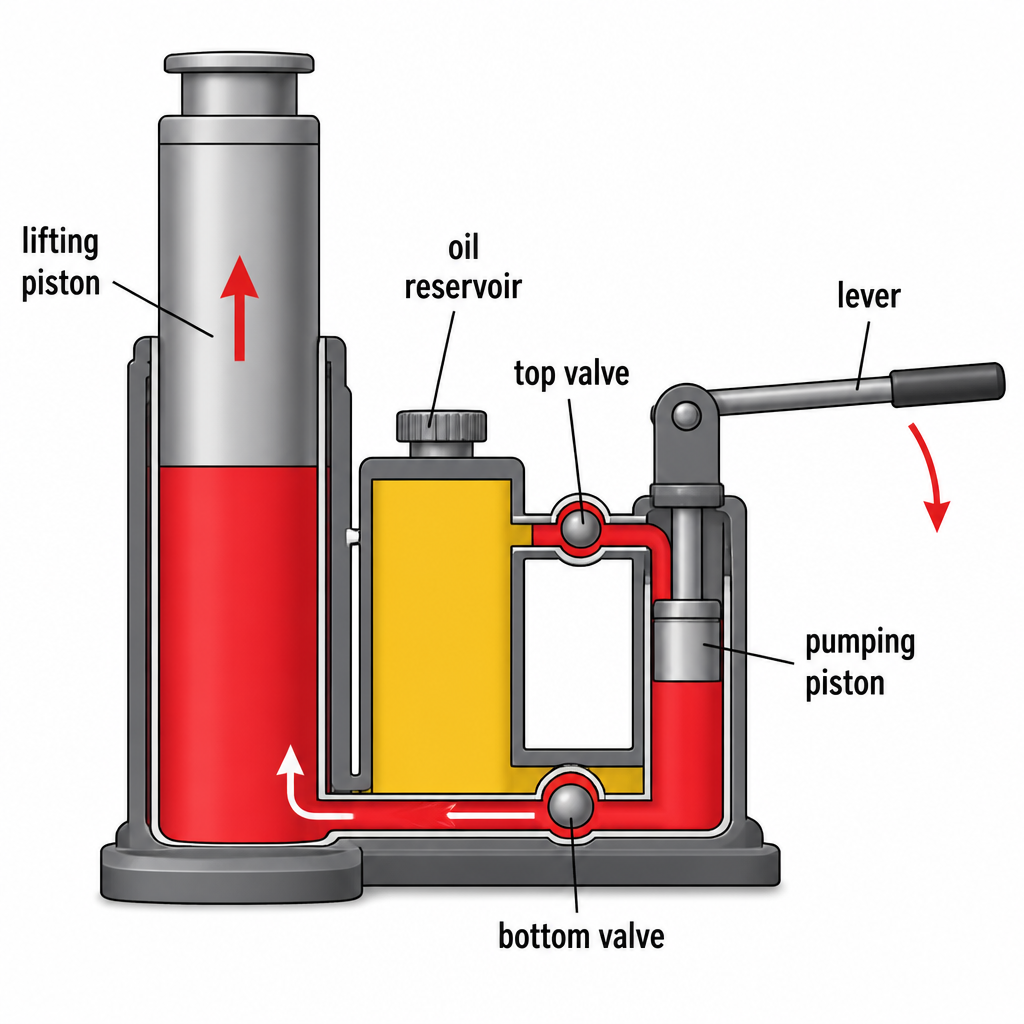
The pumping piston is small, so each stroke sends only a little oil across, and the load rises only a little each time. That is why the lever must be worked many times. In return, each push needs only a small force, and one person can raise a whole vehicle.
Hydraulic press
Hydraulic press: a hydraulic machine that squeezes an object between its large piston and a rigid support with a very large force, produced by applying a small force to its small piston.
The object to be pressed is placed between the large piston and a rigid support fixed above the piston. When a small force is applied to the small piston, the large piston rises and pushes the object hard against the support. The support cannot move, so the object is squeezed between the two.
A hydraulic press is used to:
- fit mechanical parts of vehicles tightly together
- bend metal sheets
- make holes in metal sheets
- pack paper, cotton and straw by compressing them into tight bundles
Worked example: force produced by a hydraulic press
The small piston of a hydraulic press has an area of \( 0.02 \text{ m}^2 \) and the large piston has an area of \( 0.8 \text{ m}^2 \). A force of 150 N is applied on the small piston. Find the force with which the press squeezes a bundle of cotton.
Step 1: Writing down the force on the small piston:
\[ F_1 = 150 \text{ N} \]
Step 2: Writing down the area of the small piston:
\[ A_1 = 0.02 \text{ m}^2 \]
Step 3: Writing down the area of the large piston:
\[ A_2 = 0.8 \text{ m}^2 \]
Step 4: Using Pascal's law, rearranged to give the force on the large piston:
\[ F_2 = F_1 \times \frac{A_2}{A_1} \]
Step 5: Substituting the values:
\[ F_2 = 150 \times \frac{0.8}{0.02} \]
Step 6: Since \( 0.8 \div 0.02 = 40 \), multiplying:
\[ F_2 = 150 \times 40 = 6000 \text{ N} \]
The press squeezes the cotton with a force of 6000 N, forty times the force applied by hand.
The four machines compared
| Machine | Where the small force goes in | What the large force does | Where it is used |
| Hydraulic lift | A pedal on the small piston, or compressed air from a compressor | Raises the big piston and the load on it | Dentist's chair, car lift in a garage |
| Hydraulic brake | The brake pedal or the brake lever on the master cylinder | Presses the brake shoes or pads against the wheels | Stopping four-wheeled and two-wheeled vehicles |
| Hydraulic jack | A hand lever on the pumping piston, worked again and again | Pushes the lifting piston up a little at every stroke | Lifting trucks, buses and cars |
| Hydraulic press | The small piston | Squeezes an object between the large piston and a rigid support | Fitting vehicle parts, bending and punching metal sheets, packing paper, cotton and straw |
The four machines look nothing alike, yet each one has a small piston where a small force goes in and a large piston where a large force comes out, joined by a liquid that carries the same pressure to both.
The full lesson is waiting for you
The notes are free to read in full. A free account opens the rest of the practice, and tracks your progress and confidence score for every subject. Presentations and videos need approval from Learn Yeti.