Solids, Liquids and Gases All Exert Pressure
Push your thumb into a soft sponge and the sponge sinks under it. Now take your thumb away and rest a brick on the same sponge. The sponge sinks again, although nobody is pushing, because the brick's own weight presses on the surface below it. A push spread over a surface like this is called pressure. Solids, liquids and gases can all produce it.
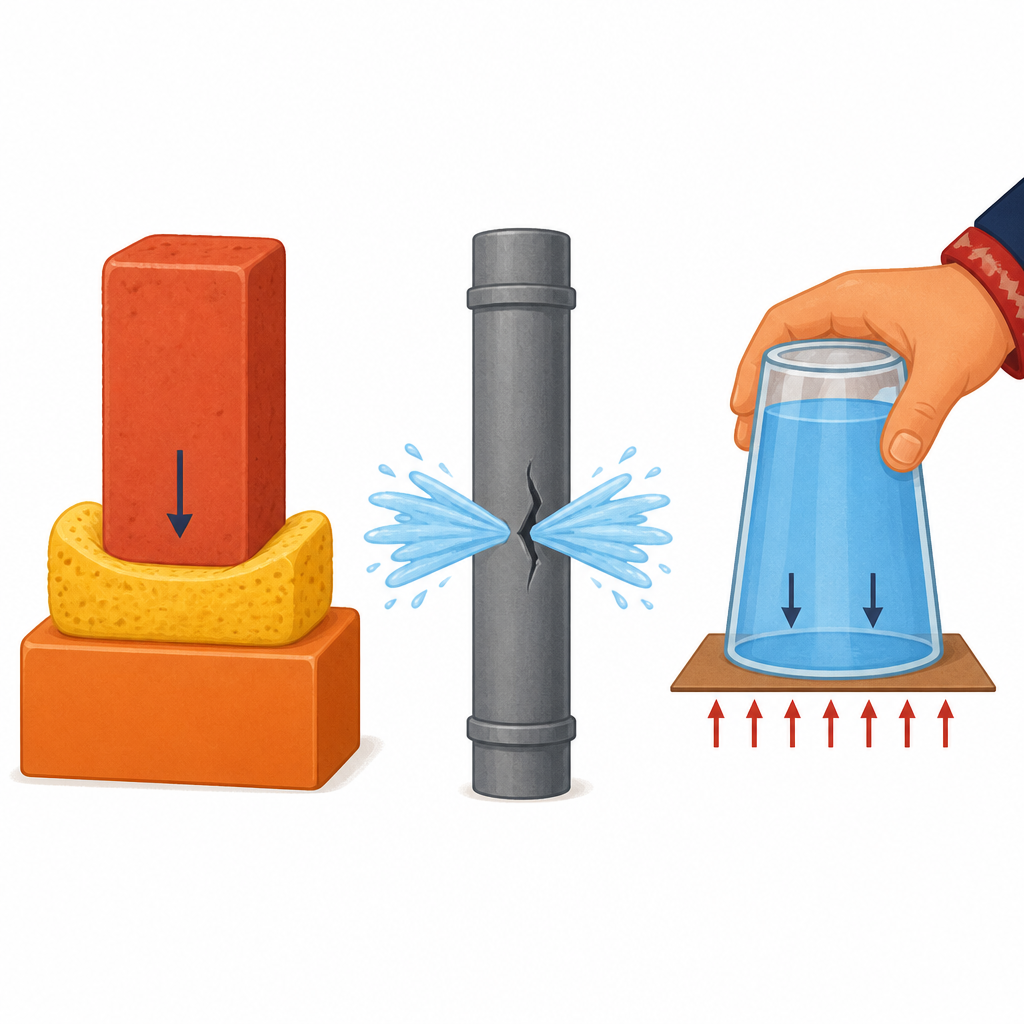
A solid exerts pressure because of its weight. The brick resting on foam pushes down on the part of the foam directly under it, and that part is squeezed flatter than the foam around it.
A liquid exerts pressure on the walls of whatever holds it. Water flowing through a pipe pushes outward on the pipe's wall at every point. If the wall is weak and cannot withstand this pressure, the pipe cracks. The water then bursts out with great force, spraying on both the right and the left side of the crack.
A gas exerts pressure too. Fill a glass to the brim with water, lay a stiff card or postcard over its mouth, hold the card in place and turn the glass upside down. Now take your hand away from the card. The card does not fall, even though the weight of the water is pressing down on it. The air underneath pushes the card upward hard enough to hold both the card and the water in place. This upward push of the air is atmospheric pressure.
In all three examples something presses on a surface. Liquids and gases press on the walls of objects at right angles to those walls. A force that acts at right angles to a surface is called a normal force, and it is this normal force that produces the pressure of a liquid or a gas.
Thrust and Pressure
To measure pressure we need two things: how hard a surface is pushed, and how much surface that push is spread over.
Thrust: a force acting perpendicular to the surface of an object. Its SI unit is the newton (N).
Pressure: the thrust acting per unit area of an object. Its SI unit is the pascal (Pa), which is the same as newton per square metre (N/m²).
\[ P = \frac{F}{A} \]
In this formula \( P \) is the pressure, \( F \) is the thrust in newtons and \( A \) is the area in square metres. Dividing newtons by square metres gives N/m², and this unit is named the pascal after the scientist Blaise Pascal:
\[ 1\ \text{Pa} = 1\ \text{N/m}^2 \]
The formula also shows how pressure changes. The same thrust spread over a large area gives a small pressure, and pressed onto a small area it gives a large pressure. That is why a brick stood on its narrow end sinks deeper into foam than the same brick laid flat.
Example: A brick of weight 30 N lies flat on a sponge. The face touching the sponge has an area of 0.02 m². Find the pressure the brick exerts on the sponge.
Step 1: The brick's weight presses at right angles on the sponge, so it is the thrust. Writing the formula for pressure:
\[ P = \frac{F}{A} \]
Step 2: Putting in \( F = 30\ \text{N} \) and \( A = 0.02\ \text{m}^2 \):
\[ P = \frac{30\ \text{N}}{0.02\ \text{m}^2} \]
Step 3: Dividing 30 by 0.02:
\[ P = 1500\ \text{N/m}^2 = 1500\ \text{Pa} \]
If the same brick is stood on its end, the area touching the sponge is only 0.005 m² and the pressure becomes \( \frac{30\ \text{N}}{0.005\ \text{m}^2} = 6000\ \text{Pa} \). The thrust has not changed, but the pressure is four times as great because the area is four times smaller.
Thrust and pressure are different quantities. Thrust is a force and is measured in newtons (N). Pressure is the thrust on each unit of area and is measured in pascals (Pa or N/m²). A pressure written in newtons, or a thrust written in pascals, is wrong.
Fluids and the Pressure They Exert
Fluid: a substance that can flow easily. Liquids and gases are both fluids.
Like solids, fluids exert pressure, but not only downward. Water in a bucket presses on the bottom of the bucket and also on every wall around it. Make a small hole low down in the side of a plastic bottle full of water and a jet shoots out sideways. The water was pressing on that wall all along. The hole only lets us see it.
A fluid also presses on the surfaces of any object placed in it. Try pushing an inflated balloon down into a tub of water. The water pushes up on the balloon's surface, and you can feel this upward force against your hand. The more of the balloon you push under, the harder you have to press.
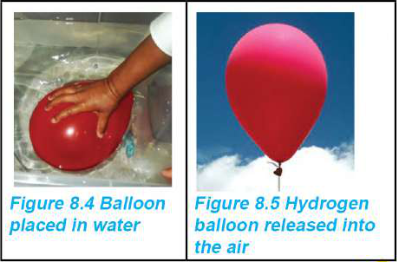
Air behaves in the same way. A balloon filled with hydrogen or helium flies upward when it is released, because the air around it exerts an upward force on it. Air becomes less dense as height increases, so this upward force grows weaker the higher the balloon goes. The balloon rises until it reaches a height where the upward force of the air is equal to its weight, and there it floats.
Transmission of Pressure
Transmission of pressure: the passing on of pressure, created at one point in a substance, to the other parts of that substance.
Whether pressure can travel through a substance depends on how its molecules are arranged and whether they are free to move.
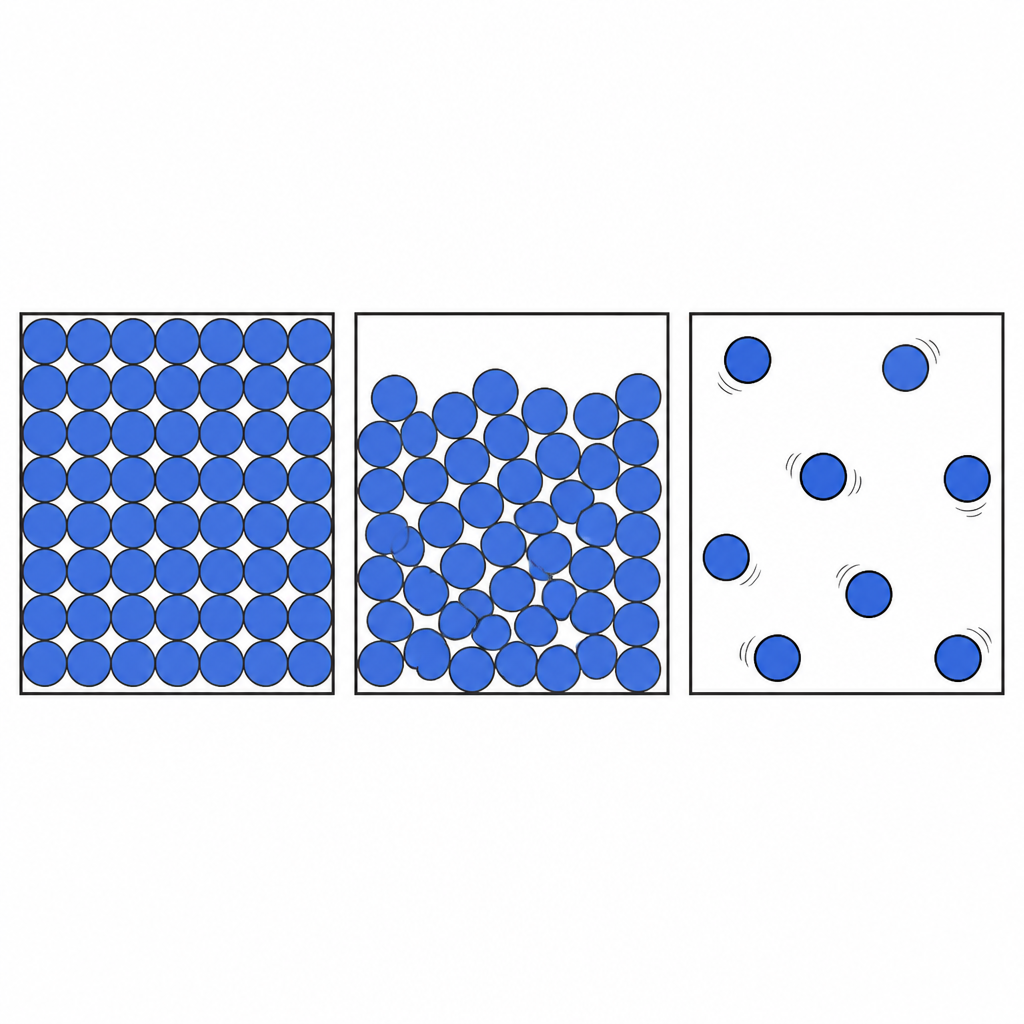
In a solid the molecules are packed very close to one another. A solid has a definite shape and a definite volume, and its molecules do not move about or change their positions. So when a force is applied to one side of a solid object, the pressure it creates is not transmitted throughout the object.
In liquids and gases the molecules are able to move. Because of this, pressure applied at one point of a fluid kept in a closed container is passed on through the fluid.
| State of matter | Molecules | Can the molecules move? | Is pressure transmitted? |
| Solid | Packed very close, in fixed places | No | No, not throughout the solid |
| Liquid | Close together, with very small gaps | Yes | Yes, uniformly in all directions |
| Gas | Far apart, with large gaps | Yes | Yes, once compressed enough, but less effectively than a liquid |
Why a Liquid Passes Pressure On
A simple experiment with two syringes shows the difference between a liquid and a gas. Fill one syringe with water and leave the other one empty, so that it holds only air. Close the nozzle of each with a finger and try to push its piston in.
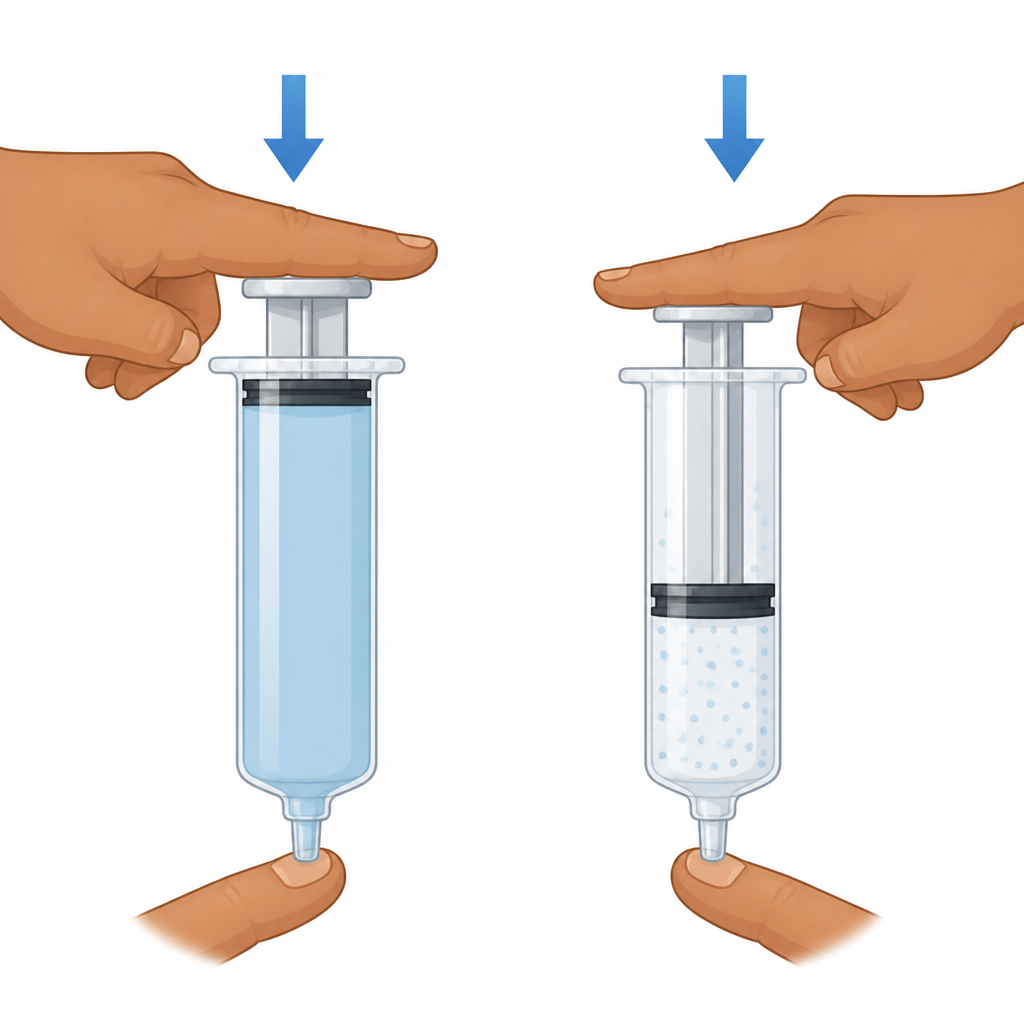
Use only syringes with no needle fitted. A needle can pierce the skin, and pressing hard on the piston can drive it into your finger.
However hard you push, the piston of the water-filled syringe does not move in. The water inside cannot be compressed. The piston of the air-filled syringe goes in easily at first. As the air inside gets compressed, pushing becomes harder and harder, until the piston stops moving, just as it did with water.
The reason lies in the gaps between molecules. The spaces between the molecules of a liquid are very small, so pressure from outside cannot push the molecules any closer together. A liquid in a closed vessel therefore does not shrink when it is pressed. Since it cannot give way by shrinking, the pressure applied at any point of the liquid is passed on uniformly in all directions.
You use this every morning. When you squeeze a tube of toothpaste near its bottom end, the paste comes out of the mouth at the top. Your fingers never touched the paste near the mouth. The pressure made by squeezing the tube was transmitted through the paste to the mouth.
Pressure in Gases
In a gas the spaces between molecules are much larger than in a liquid. Pressing on a gas pushes its molecules closer together, and its volume becomes smaller. So part of the push is first used up in squeezing the gas. Once the gas is compressed it does pass pressure on, but not as effectively as a liquid does.
A balloon full of air shows this. Squeeze one part of it in your hand and the parts outside your fingers bulge out on every side. The pressure from your hand has reached every part of the balloon through the compressed air inside.
For a gas to pass pressure on the way a liquid does, it must first be compressed sufficiently.
Pascal's Law
Fill a polythene bag with water and close its mouth by gripping it tightly in your fist. Make fine holes all around the lower part of the bag with a pin. Now squeeze the top of the bag. Thin streams of water shoot out of every hole, not just the lowest ones. As the water level falls, move your fist lower and tighten your grip, and the streams keep coming from all the holes.
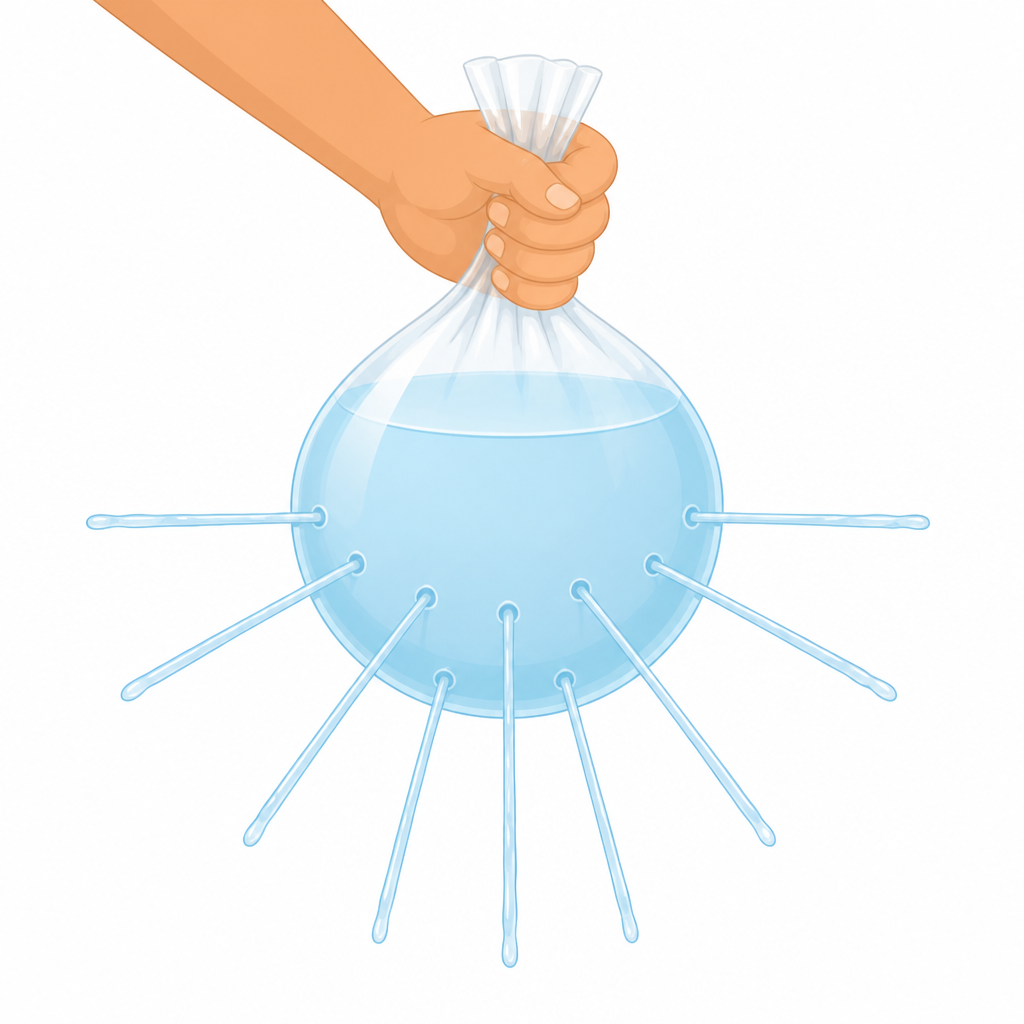
Squeezing with the fist creates pressure in the water at the top of the bag. This pressure travels through the water to every part of the bag's wall. Each stream leaves its hole at right angles to the surface of the bag at that point. So the pressure created at one point of the enclosed water has been transmitted normally in all directions.
The French mathematician Blaise Pascal stated this as a law in 1653, and it is called Pascal's law after him.
Pascal's law: When a force is exerted at a point in an enclosed liquid, the pressure generated is transmitted normally throughout the liquid in all directions.
Each part of the law matters. Enclosed means the liquid is shut in, so it cannot escape when it is pushed. Normally means at right angles to every surface the liquid touches, which is why the streams leave the bag straight out from its surface. Throughout the liquid in all directions means the pressure reaches every part of the liquid, up, down and sideways, and not only the part in front of the push.
Verifying Pascal's Law
Pascal's law can be checked with a round vessel that has four pistons, A, B, C and D, fitted into openings around it. The vessel is filled with liquid. Let the cross-sectional area of piston A be \( a_1 \), of B be \( a_2 \), of C be \( a_3 \) and of D be \( a_4 \).
Piston A is pushed inward with a force \( F_1 \). This creates a pressure \( \frac{F_1}{a_1} \) on the liquid at piston A. At once the other three pistons move outward. The push given at A has reached B, C and D through the liquid.
To stop pistons B, C and D moving out, inward forces must be applied to them: \( F_2 \) on B, \( F_3 \) on C and \( F_4 \) on D. When these forces are measured and each is divided by the area of its own piston, the results are found to be equal:
\[ \frac{F_1}{a_1} = \frac{F_2}{a_2} = \frac{F_3}{a_3} = \frac{F_4}{a_4} \]
Each fraction is the pressure at one piston. Since all four are equal, the pressure created at one point of a liquid in a closed vessel is transmitted equally everywhere. A larger piston needs a larger force to hold it back, but the pressure on it is exactly the same as on a small one.
Example: In such a vessel a force of 0.2 N is applied to piston A, whose area is 0.02 m². Piston B has an area of 0.05 m². What force is needed to hold piston B still?
Step 1: Finding the pressure created at piston A:
\[ \frac{F_1}{a_1} = \frac{0.2\ \text{N}}{0.02\ \text{m}^2} = 10\ \text{Pa} \]
Step 2: By Pascal's law the same pressure reaches piston B:
\[ \frac{F_2}{a_2} = 10\ \text{Pa} \]
Step 3: Multiplying this pressure by the area of piston B:
\[ F_2 = 10\ \text{Pa} \times 0.05\ \text{m}^2 = 0.5\ \text{N} \]
So a force of 0.5 N holds piston B still. Every piston in the vessel feels a pressure of 10 Pa, whatever its size.
Uses of Pascal's Law
Because a liquid passes pressure on equally to every part of itself, machines can be built that use an enclosed liquid to carry a push from one place to another. These are called hydraulic machines, and they are all based on Pascal's law. Examples are:
- hydraulic brakes, which help stop cars, buses and motorcycles
- hydraulic lifts, which raise vehicles in a repair workshop
- hydraulic presses, which squeeze cotton into bales or press metal sheets into shape
The full lesson is waiting for you
The notes are free to read in full. A free account opens the rest of the practice, and tracks your progress and confidence score for every subject. Presentations and videos need approval from Learn Yeti.