Pushing an Empty Bottle into Water
Take an empty plastic bottle and screw the cap on tightly so that no water can get in. Drop it into a bucket of water. It does not sink. It sits on the surface. Now press it down with your hand. You will feel the bottle pushing back against your palm. The deeper you push, the harder it pushes back, and this push keeps growing until the whole bottle is under the water. Take your hand away and the bottle shoots straight back up to the surface.
This raises a real puzzle. Let go of the same bottle in the air and it drops to the floor, because gravity pulls it down. Gravity does not stop working when the bottle touches water, so the bottle still has its weight there. Yet it stays up. Something must be pushing it upward, and that something is the water. Water, like every liquid and every gas, pushes upward on anything placed in it.
What Upthrust Is
Upthrust: the net upward force acting on an object when it is partially or completely immersed in a fluid (a liquid or a gas). Its SI unit is the newton (N).
Fluid: any substance that can flow. All liquids and all gases are fluids, so water, oil and air all exert upthrust.
Upthrust is also called buoyant force. Notice the word net in the definition. A fluid presses on an object from every direction: from the sides, from above and from below. When all of these pushes are added together, most of them cancel out, and what is left over points upward. That leftover upward push is the upthrust. Every fluid exerts upthrust, but not every fluid pushes equally hard. The size of the upthrust depends on the density of the fluid. Water is far denser than air, so water gives a much larger upthrust than air does. This is why an empty bottle falls through air but floats on water.
Weight and Upthrust: Two Forces Pulling Opposite Ways
Any object in a fluid is acted on by two forces at the same time. Its weight, caused by gravity, pulls it downward. The upthrust of the fluid pushes it upward. Because the two forces act in opposite directions, the upthrust always works against the weight, reducing it or cancelling it completely. A tennis ball held under water in a beaker has both: gravity pulls it down while the water pushes it up. A balloon with a small load tied to its string shows the same pair in air: the upthrust of the air acts upward on the balloon, and the weight of the balloon and its load acts downward. What the object actually does depends on which of the two forces is bigger.
| Which force is bigger | What the object does | Example |
| \( W > U \) | It sinks or falls | A bottle full of water put in a bucket; an empty bottle let go in air |
| \( U > W \) | It rises | An empty capped bottle released from under the water |
| \( U = W \) | It floats | An empty capped bottle resting on the water surface |
Now the bottle makes sense. In air, the weight of the bottle (W) is greater than the tiny upthrust of the air (U). The upthrust cannot cancel the pull of gravity, so the bottle falls. When the bottle is forced completely under water, the upthrust becomes greater than its weight, so as soon as you let go it is pushed back up and comes out of the water. As it rises and its top pokes out, less of the bottle is under the surface and the upthrust gets smaller. It settles at the point where the upthrust is exactly equal to its weight. There it floats.
A floating object has not lost its weight. It floats because the upthrust on it has become exactly equal to its weight, so the two forces balance.
A Bucket in a Well
Fill the same bottle with water, cap it and put it back in the bucket. This time it sinks. The water inside has made the bottle much heavier, and the upthrust can no longer balance its weight. A bucket lowered into a well behaves the same way. At first the empty bucket floats for a while. As water pours into it, its weight increases until the upthrust of the well water cannot cancel the downward pull of gravity, and the bucket sinks.
Pulling the full bucket back up shows upthrust from the other side. While the bucket is still under the water, the upthrust is pushing it upward, so its weight inside the water is less than its actual weight. The rope needs less force than the bucket's actual weight. The moment the bucket comes out into the air, that help is gone. The upthrust of the air is negligible compared with the upthrust of water, so the force needed to pull the bucket suddenly increases. This is why a bucket full of water is easy to pull while it is inside the well water and feels heavy as soon as it is out.
The bucket does not lose any mass in the water. It has the same amount of matter in the water and in the air. It only feels lighter in the water because the water around it is pushing it upward.
Upthrust in Air
Air is a fluid too, so it exerts upthrust on everything in it, including you and the chair you are sitting on. For small objects this upthrust is very small. A plastic bottle or a bucket takes up only a little space in the air, so the upthrust of the air on it is tiny and we usually ignore it. That does not mean the upthrust of air can always be ignored. A large object that takes up a great deal of space in the air, such as an aeroplane, experiences a large upthrust. A balloon filled with a light gas rises and can even carry a small load, because the upthrust of the air on it is greater than the weight of the balloon and its load together.
Why Upthrust Pushes Upward
To see where upthrust comes from, picture a cube held completely under water. Water presses on all six faces of the cube, and on each face it pushes straight inward, at right angles to that face. A liquid exerts this normal pressure on an immersed object from all sides. Look at the side faces first. The left face and the right face are at the same depth, so the water pushes on them with equal forces in opposite directions, and the two cancel. The front face and the back face cancel in exactly the same way. Only the top face and the bottom face are left.
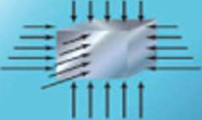
The top and bottom faces are not at the same depth. Pressure in a liquid increases as you go deeper, and the lower surface of the cube is deeper than its upper surface. So the pressure on the lower surface is greater, and the upward force on it is greater than the downward force on the upper surface. If \( F_1 \) is the downward force on the upper surface and \( F_2 \) is the upward force on the lower surface, the resultant force is:
\[ U = F_2 - F_1 \]
Because \( F_2 \) is always bigger than \( F_1 \), this resultant force always points upward. That is why the direction of upthrust is upward, never sideways and never downward.
Upthrust exists because the lower surface of an immersed object is deeper than its upper surface, and deeper means greater pressure.
Real Weight and Apparent Weight
Upthrust can be measured with a spring balance. Tie a small stone with a thread and hang it from the hook of the balance. Held in the air, the balance shows the weight of the stone. Now lower the stone into a beaker of water until it is completely covered, without letting it touch the bottom or the sides. The reading goes down. The stone has not lost any part of itself. The water is pushing it up, so the spring now has less to hold.
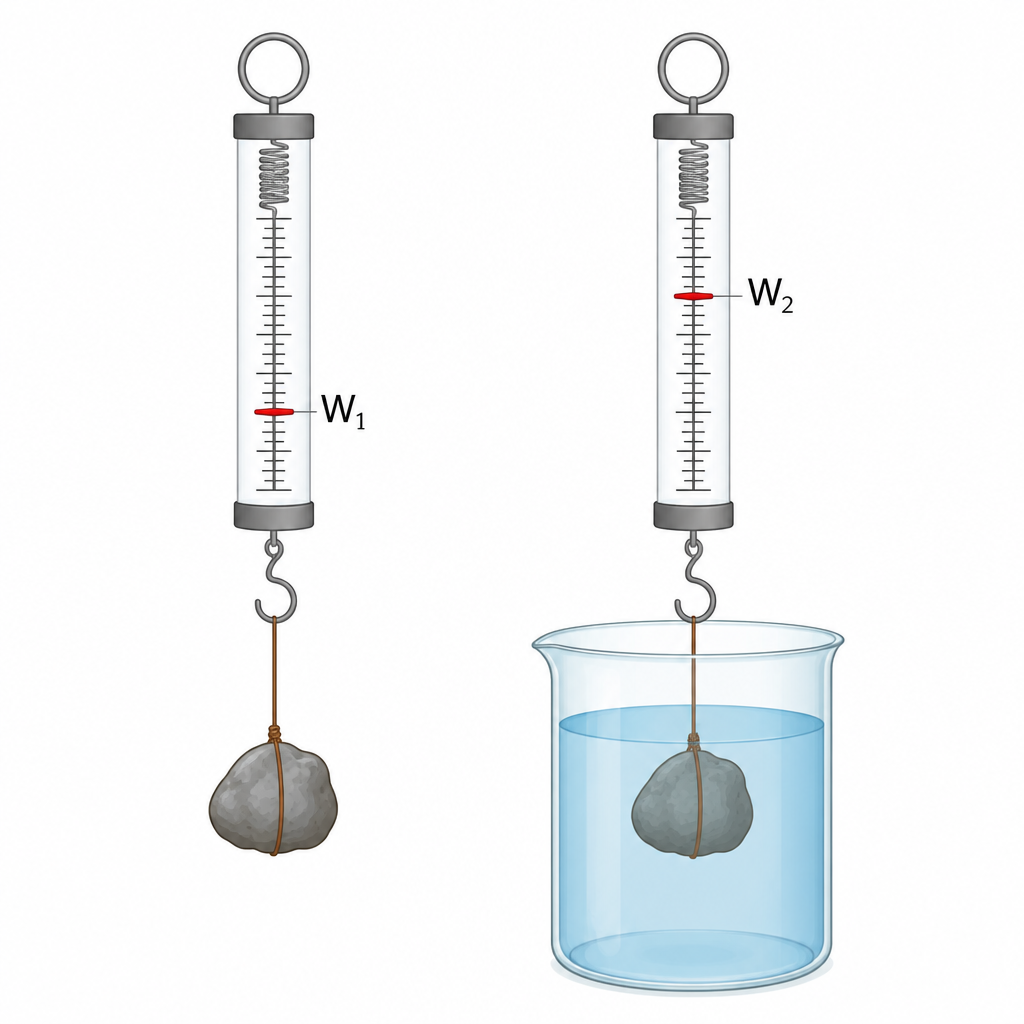
Real weight (\( W_1 \)): the weight of an object measured in air. It is also called the actual weight.
Apparent weight (\( W_2 \)): the weight of an object measured while it is inside a liquid. It is less than the real weight because of the upthrust acting on the object.
The amount by which the reading drops is exactly the upthrust, because the upthrust is the part of the weight the spring no longer has to hold. So the upthrust on an object immersed in a liquid is given by:
\[ U = W_1 - W_2 \]
In words: upthrust equals real weight minus apparent weight. All three quantities are forces, so all three are measured in newtons (N).
Apparent weight is smaller than real weight, but the mass of the stone has not changed. Lift it out of the water and the balance shows the real weight again.
Working Out Upthrust
Example 1. A stone hanging from a spring balance weighs 5 N in air. When it is completely under water, the balance reads 3 N. Find the upthrust on the stone. Here the real weight is \( W_1 = 5\ \text{N} \) and the apparent weight is \( W_2 = 3\ \text{N} \).
Step 1: Writing the formula for upthrust:
\[ U = W_1 - W_2 \]
Step 2: Putting in the two weights:
\[ U = 5\ \text{N} - 3\ \text{N} \]
Step 3: Subtracting the apparent weight from the real weight:
\[ U = 2\ \text{N} \]
The water pushes up on the stone with a force of 2 N.
Example 2. A metal block weighs 12 N in air. When it is completely under water, the water exerts an upthrust of 4.5 N on it. What will the spring balance read while the block is in the water?
Step 1: Rearranging \( U = W_1 - W_2 \) to find the apparent weight:
\[ W_2 = W_1 - U \]
Step 2: Putting in the real weight and the upthrust:
\[ W_2 = 12\ \text{N} - 4.5\ \text{N} \]
Step 3: Subtracting:
\[ W_2 = 7.5\ \text{N} \]
The balance reads 7.5 N. The block still has its real weight of 12 N. The water is simply carrying 4.5 N of it, so the spring holds only the rest.
The full lesson is waiting for you
The notes are free to read in full. A free account opens the rest of the practice, and tracks your progress and confidence score for every subject. Presentations and videos need approval from Learn Yeti.