Why Do Some Things Sink and Others Float?
Drop a coin into a bucket of water and it goes straight to the bottom. Drop a dry leaf or a plastic bottle cap and it stays on top. Pour a little cooking oil on water and it spreads as a thin layer on the surface. Every day we see some things sink and others float, and two questions come up naturally. First, why does an object sink or float at all? Second, oil floats because it is less dense than water, but can something made of iron, which is much denser than water, ever float on water?
A useful first rule is about density. If an object is less dense than the liquid it is placed in, the object floats. Wood, cork and oil float on water for this reason. But simply comparing densities does not settle whether an object floats or sinks. Iron is almost eight times as dense as water, and yet huge iron ships float on the sea every day. To understand why, we have to look at the forces acting on the object and at how much liquid it pushes aside.
Shape Matters: Aluminium Foil in Water
A simple experiment shows that shape can decide whether something floats. Take two pieces of aluminium foil of equal area. Because they are cut from the same foil and are the same size, they have the same mass and the same weight. Squeeze one into a tight ball and leave the other as a flat sheet. Now place both gently in a beaker filled more than half with water.
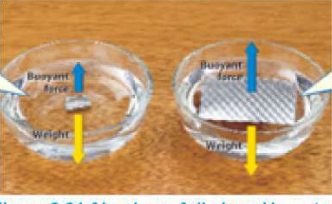
The ball sinks and the sheet floats. The two pieces are made of the same metal and weigh the same, so the difference must come from their shape. Squeezing the foil into a ball reduces its surface area, and the ball can push aside only a little water. The upthrust depends on the volume of water displaced, so the upthrust on the ball stays smaller than its weight, and the ball sinks. The flat sheet is spread over a larger area. It displaces more water, so the upthrust on it is larger, and when the upthrust becomes equal to its weight the sheet floats.
Now look at the density. Aluminium has a density of 2700 kg/m³, which is 2.7 times the density of water. Judged by density alone, every piece of aluminium should sink. The floating sheet shows that density is not the only thing that matters. Whether an object floats or sinks in a liquid depends on the density of its material and also on its shape. The shape decides how much liquid the object can displace, and so it decides the resultant force acting on the object when it is placed in the liquid.
Density alone does not decide floating. The shape of an object decides how much liquid it pushes aside, and that decides the upthrust.
Two Forces on a Floating Object
An object placed in a liquid has two forces acting on it along the same line but in exactly opposite directions. Its weight pulls it downward. The upthrust, also called the buoyant force, pushes it upward. The upthrust depends on the volume of liquid the object displaces, and by Archimedes' principle it is equal to the weight of that displaced liquid. Comparing these two forces tells us what the object will do:
- If the weight is greater than the upthrust, the resultant force points downward and the object sinks.
- If the upthrust is greater than the weight, the resultant force points upward and the object rises towards the surface.
- If the upthrust exactly cancels the weight, the resultant force is zero and the object floats.
So a floating object is not an object with no force on it. It is an object on which two equal and opposite forces balance each other. Every example that follows is about how this balance is made and how it is broken.
The Law of Floatation
A floating object may float with only part of it below the surface, like a wooden log, or it may float completely below the surface, like a fish resting in the middle of a pond. When it floats partly submerged, only the submerged part displaces liquid. The object sinks just far enough for that part to push aside liquid whose weight matches the weight of the whole object. This is stated as the law of floatation.
Law of floatation: For an object to float in a liquid, the weight of the object must be equal to the weight of the liquid it displaces.
Condition for floating: weight of object = weight of liquid displaced
The same law explains why one object floats at different depths in different liquids. In a denser liquid, a small volume of liquid already weighs as much as the object, so the object sinks less and floats higher. In a less dense liquid, the object has to sink deeper to push aside enough liquid. The rule works in air as well, as balloons show.
For a floating object, what is equal is the WEIGHT of the displaced liquid and the weight of the object, not their volumes. The volume of liquid displaced equals the volume of the object only when the object is completely under the surface.
Floating in a Liquid: Ships Made of Iron
A solid block of iron dropped in water goes straight down. Its volume is small and solid, so even when it is fully under water it cannot displace a volume of water whose weight equals its own weight. The upthrust stays less than the weight, and the block sinks. Beat the same iron into the shape of a bowl and things change. The bowl encloses empty space and takes up a much larger volume. As it settles into the water it pushes aside more and more water, until the displaced water weighs as much as the bowl. Then it floats.

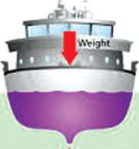
A ship uses exactly this idea on a large scale. Its hull is made wide, long and deep, so a large volume of the ship lies below the waterline. For example, to stop a ship weighing 50000 tons from sinking, its hull must be big enough to displace 50000 tons of water. Only then does the upthrust equal the ship's weight. That is why iron sinks in water but a ship made of iron floats on it.
The same ship floats at different levels in different water. Sea water has salt dissolved in it, so it is denser than river water. When a ship sails from the sea into a river, it has to displace a larger volume of the less dense river water to get the same upthrust. So in the river the ship sits lower in the water than it did at sea.
Boats and Their Load
A boat floats for the same reason as a ship: while it floats, the weight of the water it displaces equals its own weight. When people climb in, the boat's weight increases. Its lower part slowly sinks a little further, it displaces extra water, and both the volume and the weight of the displaced water increase. By Archimedes' principle the upthrust equals the weight of displaced water, so the upthrust rises too. This extra upthrust supports the weight of the people who got on.


This cannot go on without limit. Once the water level reaches the top edge of the boat, the boat cannot displace any more water, so the upthrust cannot grow any further. If still more weight is added, the weight becomes greater than the upthrust and the boat sinks. This is why every boat has a maximum number of passengers it may carry.
A hole in the bottom of a floating boat sinks it for a similar reason. Water pours in through the hole and keeps adding to the boat's weight. The boat settles lower and lower. Once the water outside reaches the rim, no extra upthrust is possible, and because the water flowing in keeps increasing the weight, the boat sinks. The same idea is used in a submarine, where water is let in on purpose.
Never board a boat that is already full, and never let more people on than the boat is allowed to carry. An overloaded boat can sink suddenly.
Using the Law of Floatation: A Worked Example
The law of floatation turns into simple arithmetic. A boat of mass 400 kg floats on a lake. Take the density of water as 1000 kg/m³. What volume of water does the boat displace, and what volume does it displace after two passengers of 60 kg each get in?
Step 1: By the law of floatation, the weight of water displaced equals the weight of the boat. Gravity acts the same on both, so their masses are equal too. The mass of water displaced is:
\[ m = 400\ \text{kg} \]
Step 2: Density is mass per unit volume, so the volume is found by dividing mass by density:
\[ V = \frac{m}{d} \]
Step 3: Putting in the values for the empty boat:
\[ V = \frac{400}{1000} = 0.4\ \text{m}^3 \]
Step 4: Adding the two passengers to the mass of the boat:
\[ m = 400 + 2 \times 60 = 520\ \text{kg} \]
Step 5: Dividing the new mass by the density of water:
\[ V = \frac{520}{1000} = 0.52\ \text{m}^3 \]
So the empty boat displaces 0.4 m³ of water and the loaded boat displaces 0.52 m³. When the passengers get in, the boat settles lower until it has pushed aside an extra 0.12 m³ of water. That water has a mass of 120 kg, exactly the mass of the two passengers.
Submarines and Fish
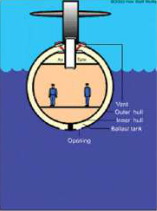
A submarine is built so that it can float visibly on the surface and can also stay inside the water. Its volume stays the same, but it changes its own weight. Between its inner hull and outer hull are ballast tanks.
- To dive, the ballast tanks are filled with sea water. The submarine's weight increases, its weight becomes greater than the upthrust, and it goes deeper into the water.
- To surface, compressed air blows the water out of the tanks. The weight decreases, the upthrust becomes greater than the weight, and the submarine floats back to the surface.
- To stay at one depth, the amount of water in the tanks is adjusted until the weight and the upthrust are equal.
Fish also use Archimedes' principle to float and sink in water, but in a different way. A submarine changes its weight, while a fish changes the volume of its body. Inside the body of many fish is a swim bladder, which is an air sac.
Swim bladder: An air sac inside the body of a fish, which the fish fills or empties to rise or sink in water.
- When the swim bladder is filled with air, the fish's body volume increases, it displaces more water, the upthrust increases, and the fish rises towards the surface.
- When the fish empties its swim bladder, its body volume and the upthrust on it both decrease, and the fish goes deeper.
A submarine keeps its volume and changes its weight. A fish keeps its weight and changes its volume. Both are controlling the balance between weight and upthrust.
Hydrometer and Lactometer
Hydrometer: A device used to measure the relative density of liquids.
A hydrometer is made of glass. At the bottom is a wide bulb filled with heavy metal, and the bulb is joined to a thin tube marked with a scale. The liquid displaced by the heavy bulb gives it the upthrust it needs, and the heavy metal at the bottom keeps it upright, so the hydrometer floats vertically on the surface of the liquid. The reading is taken at the mark on the tube where the liquid surface meets it.
The law of floatation explains how it works. The hydrometer always has the same weight, so it must always displace the same weight of liquid. A liquid of high density exerts more upthrust, so in such a liquid only a small part needs to go under and the hydrometer floats higher. If the density of the liquid is low, the hydrometer sinks further to displace enough liquid.
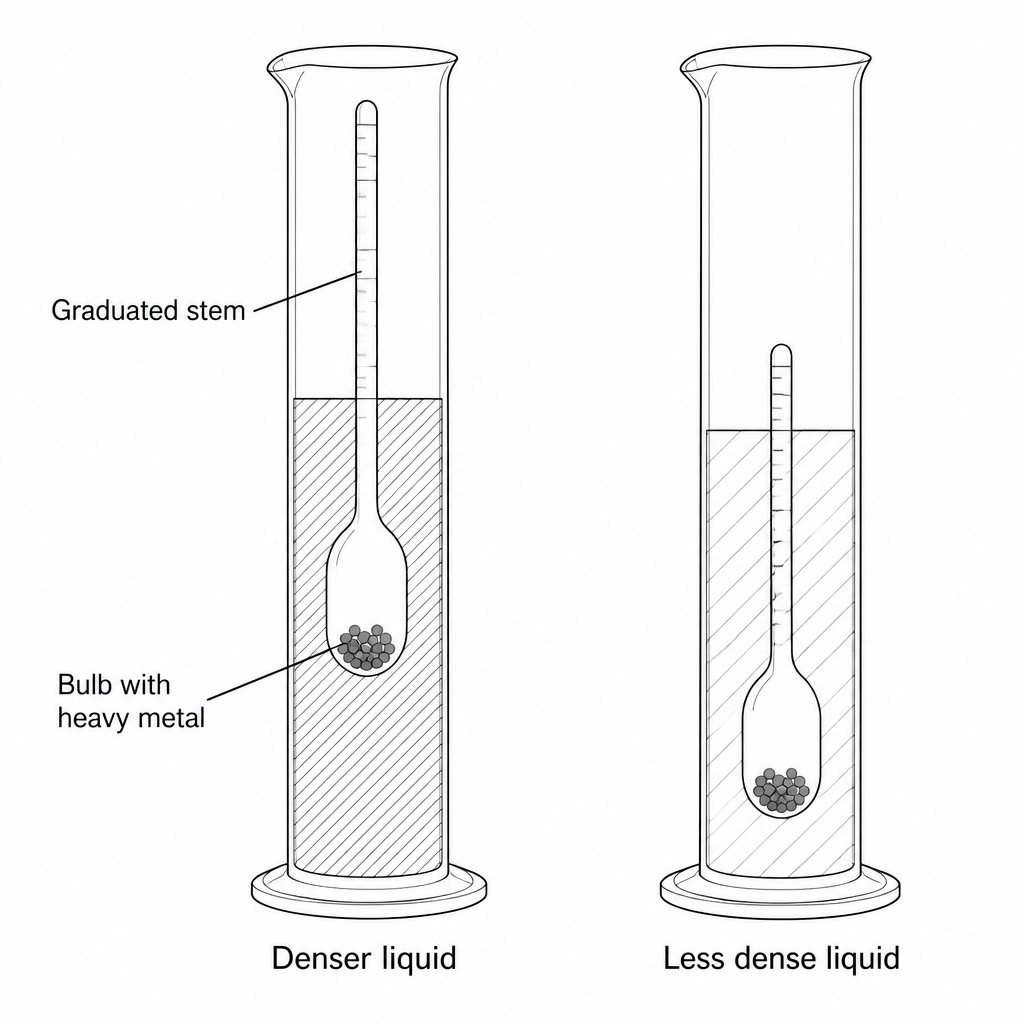
Lactometer: A type of hydrometer used to test how much water has been mixed into milk.
Pure milk is denser than water. When water is mixed into milk, the density of the mixture falls. In pure milk a lactometer floats fairly high, while in watered milk it sinks further. If the whole narrow stem of the lactometer goes under, the milk is far less dense than pure milk should be, which means a lot of water has been mixed into it.

Floating in the Atmosphere: Helium Balloons
Objects can float in gases as well as in liquids. Just as in water, there is upthrust in air, and it is this upthrust that lets objects fly or float in the air. But the density of air is much less than that of water, so the upthrust air exerts on an object is much less than the upthrust water would exert on it. That is why we hardly notice it. It matters for objects that are very light for their size.

Why does a balloon filled with helium float in the air? Air is denser than helium. A helium-filled balloon displaces a large volume of air, and the weight of that displaced air is the upthrust on the balloon. If this upthrust is greater than the weight of the balloon, the balloon flies upwards. A hydrogen balloon rises in the same way.
A released balloon does not rise for ever. As the altitude increases, the density of air decreases, and this makes the upthrust on the balloon decrease. At a certain height the weight of the balloon equals the upthrust, and the balloon floats there in the air. Also, at a certain height the pressure inside and outside the balloon becomes unbalanced. The volume of the balloon keeps increasing until it finally bursts.
A balloon filled with ordinary air behaves differently. The air inside it has about the same density as the air around it, and the rubber adds extra weight, so its weight is more than the upthrust and it drifts down to the ground.
Hot Air Balloons
Like hydrogen or helium balloons, hot air balloons also fly in the air. The density of the air inside a hot air balloon is less than the density of the surrounding air. Because such a balloon displaces a large amount of air, the upthrust on it becomes greater than its weight, and it rises. When the balloon reaches its maximum altitude, the weight of the displaced air, which is the upthrust, balances the weight of the balloon. Then the balloon floats in the air.
The balloon's rising and falling is controlled by changing the temperature of the air inside it with a burner:
- Burner on: the flame heats the air inside the balloon, the density of that air decreases, and the balloon flies upwards.
- Burner off: the air inside cools and its density increases. When the air is cold enough, the weight of the balloon becomes greater than the upthrust, and the balloon sinks in the air, which means it comes down to the ground.
Sink, Float or Rise at a Glance
Every example above asks the same question: which is bigger, the weight or the upthrust? The only difference is what gets changed to shift the balance.
| Example | What changes | Result |
| Aluminium foil | Shape (ball or sheet) | Ball sinks, sheet floats |
| Iron and ship | Shape of the hull | Block sinks, ship floats |
| Boat with passengers | Load | Sits lower, sinks once water reaches the rim |
| Submarine | Weight (water in ballast tanks) | Dives or surfaces |
| Fish | Volume (air in swim bladder) | Rises or goes deeper |
| Hydrometer, lactometer | Density of the liquid | Floats higher in a denser liquid |
| Helium balloon | Air density with height | Rises, then floats at one height |
| Hot air balloon | Temperature of air inside | Rises, floats or descends |
The full lesson is waiting for you
The notes are free to read in full. A free account opens the rest of the practice, and tracks your progress and confidence score for every subject. Presentations and videos need approval from Learn Yeti.