Weighing an Object Inside a Liquid
Hang a stone from a spring balance and read its weight. Now lower the same stone slowly into a beaker of water, without letting it touch the bottom. The reading falls. The stone has not lost any part of itself, and its mass is exactly what it was. What has changed is that the water is now pushing the stone upward, so the spring balance only has to hold up what is left. This upward push that a liquid or a gas gives to an object placed in it is called upthrust.
Upthrust: the upward force that a fluid exerts on an object that is partly or completely immersed in it. It is also called buoyant force. Being a force, it is measured in newtons (N).
The weight measured in air is the actual weight, \( W_1 \). The smaller reading shown while the object is in the liquid is the unreal weight, often called the apparent weight, \( W_2 \). The difference between the two is the upthrust:
\[ U = W_1 - W_2 \]
Why does this force point upward? Pressure in a liquid increases with depth. On a cube held under water, the pushes on the four side faces are equal and opposite, so they cancel out. The bottom face is deeper than the top face, so the water pushes up on the bottom harder than it pushes down on the top. That leftover upward push is the upthrust.
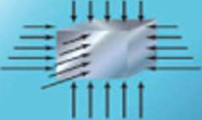
Upthrust is not always the same size. The same stone feels a different upthrust in a different liquid, or when a different amount of it is under the surface. Two things decide how big the upthrust is: the density of the liquid, and the volume of liquid the object pushes aside.
Factor 1: Density of the Liquid
Density: the mass of a substance in a unit volume of it. Density = mass ÷ volume, or \( \rho = \frac{m}{V} \). Water has a density of 1 g/cm³, which is 1000 kg/m³.
Hang one stone from a spring balance and dip it fully, first in water and then in edible oil. The two readings are different. The stone weighs less in water than in edible oil. A lower reading means a bigger upward push, so water gives the stone more upthrust than edible oil does. The density of edible oil is 0.90 g/cm³ and the density of water is 1 g/cm³. Water is the denser liquid, and it is the one that pushes up harder.
| Liquid | Density | Spring balance reading | Upthrust on the stone |
| Edible oil | 0.90 g/cm³ | Higher | Smaller |
| Water | 1 g/cm³ | Lower | Greater |
So when one object is immersed first in a liquid of lower density and then in a liquid of higher density, the denser liquid exerts the greater upthrust. Upthrust is directly proportional to the density of the liquid:
\[ \text{Upthrust} \propto \text{density of liquid} \]
For the same object, the denser the liquid, the bigger the upthrust.
Why an Egg Floats in Salt Water
Put a raw egg in a glass filled more than half with tap water, and it sinks to the bottom. Now stir salt into that water, a little at a time. The egg slowly lifts and starts to float. The egg has not changed; the water has. Salt water has a higher density than tap water, so it exerts a greater upthrust, and that upthrust is now enough to hold the egg up. This is why the egg sinks in tap water but floats in salt water.
The same rule explains several everyday observations:
- An iron ball sinks in water but floats on the surface of mercury. Mercury is so dense (13.6 g/cm³, denser even than iron) that the upthrust it gives is very large.
- Swimming is easier in seawater than in river water, because salty seawater is denser and pushes the body up more strongly.
- A ship sinks less deep in seawater than in river water. Seawater gives more upthrust, so the ship needs to push aside less water to be held up.
Factor 2: Volume of Liquid Displaced
Displaced liquid: when an object goes into a liquid, it pushes some of the liquid aside to make room for itself. The liquid pushed aside is the displaced liquid. Its volume is equal to the volume of the part of the object that is under the surface.
Hang a metal cylinder from a spring balance and lower it into water a little at a time. In air it reads 150 N. With a small part under water it reads 140 N, with a large part under water it reads 130 N, and fully under water it reads 120 N. The more of the cylinder that goes into the water, the more water it displaces, and the lower the reading falls.
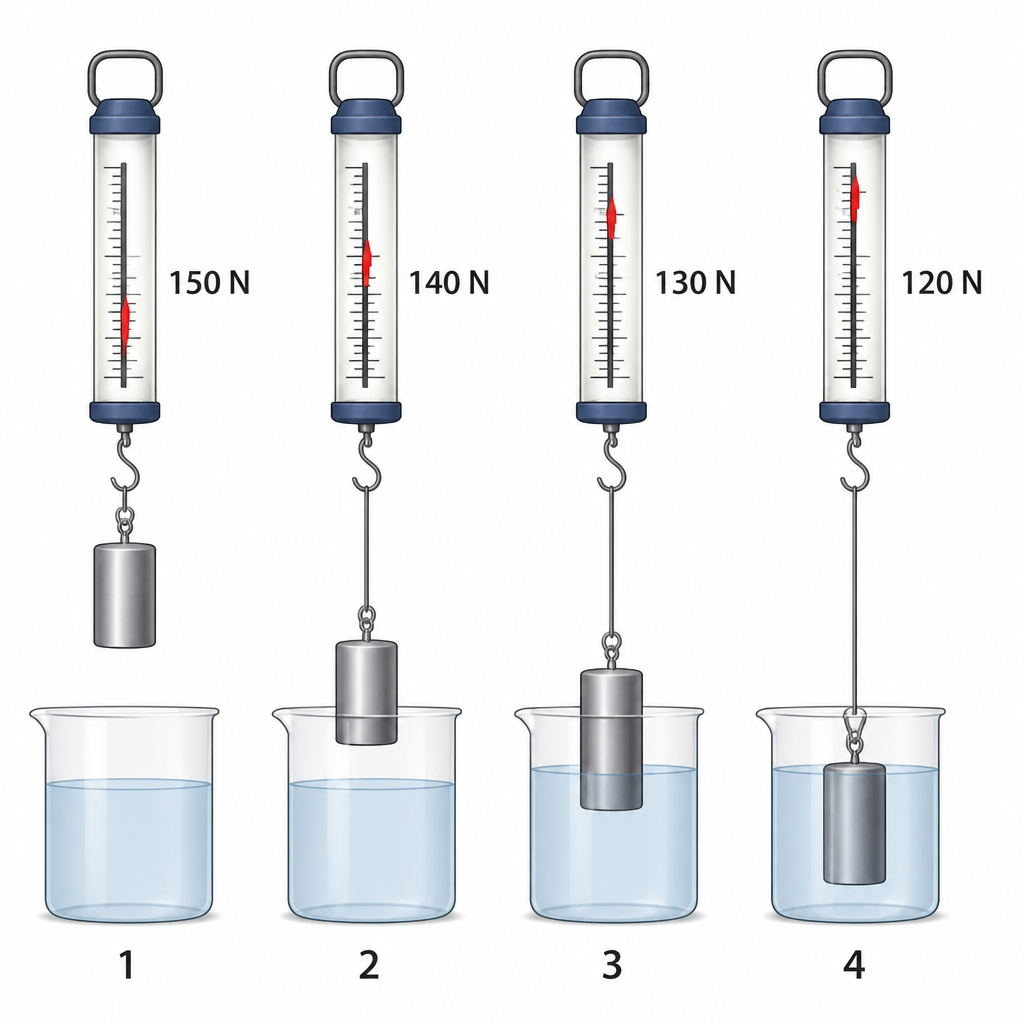
The upthrust at each stage is the reading in air minus the reading at that stage:
| Stage | Part of cylinder under water | Balance reading | Upthrust |
| 1 | None (in air) | 150 N | 0 N |
| 2 | A small part | 140 N | 150 N - 140 N = 10 N |
| 3 | A large part | 130 N | 150 N - 130 N = 20 N |
| 4 | The whole cylinder | 120 N | 150 N - 120 N = 30 N |
As the immersed volume grows, the upthrust grows with it, and once the object is completely immersed the upthrust is at its maximum. Lower the fully immersed cylinder deeper still, and the reading stays at 120 N. A fully immersed object cannot push aside any more water than its own volume, so going deeper does not increase the upthrust.
It is wrong to think that a fully immersed object gets more upthrust the deeper it goes. As long as the volume of liquid displaced stays the same, the upthrust stays the same.
Same Volume, Same Upthrust
Take two cubes of exactly the same size: one of aluminium, with a density of 2.7 g/cm³, and one of steel, with a density of 7.8 g/cm³. The steel cube is far heavier. Yet when both are fully immersed in water, each pushes aside the same volume of water, so each feels the same upthrust. Upthrust does not depend on what the object is made of or how heavy it is. It depends on the liquid the object pushes aside.
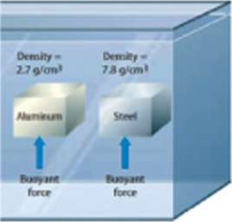
So when an object is partly or completely immersed in a liquid, the upthrust on it is directly proportional to the volume of liquid displaced. When the immersed volume increases, the upthrust increases too:
\[ \text{Upthrust} \propto \text{volume displaced} \]
A heavier object does not get more upthrust. Two objects of equal volume, fully immersed, feel the same upthrust however different their weights are.
Big Bottles and Big Balloons
Try pushing two sealed, watertight plastic bottles under water, one big and one small. The big bottle displaces more water than the small one, so it feels more upthrust. That is why you have to push much harder to hold the big bottle under. Your own hands can feel the difference.
Upthrust is not only a liquid's push; a gas pushes up too. Of two balloons filled with helium gas, one large and one small, the large balloon displaces more air. So the air gives the large balloon a greater upthrust.
Archimedes' Principle
We now know what makes upthrust bigger or smaller. How big it is exactly was worked out by Archimedes, a Greek mathematician born in 287 BC. His principle gives the relationship between the upthrust on an object placed in a fluid and the weight of the fluid it displaces.
Archimedes' principle: when an object is partly or completely immersed in a liquid, the upthrust on it is equal to the weight of the liquid displaced by it. The principle is true not only for liquids but for all fluids.
Fluid: a substance that can flow. All liquids and all gases are fluids.
In plain words: the upward push on an object is exactly as large as the weight of the fluid that had to move out of its way. A bigger object pushes aside more water, so it gets more push. In a denser liquid, the same volume pushed aside weighs more, so the push is bigger there too. Both factors above fit inside this one principle.
Checking the Principle with a Eureka Can
Eureka can: a can with a spout on its side. When it is filled with water up to the spout and an object is lowered in, all the water the object displaces runs out through the spout and can be collected in a separate beaker.
To test the principle, a stone is hung from a spring balance and weighed in air. It is then lowered completely into a eureka can filled with water up to the spout, and weighed again. The water that runs out of the spout is caught in a beaker that was weighed empty beforehand. The weight of the beaker with the water, minus the weight of the empty beaker, gives the weight of the displaced water.
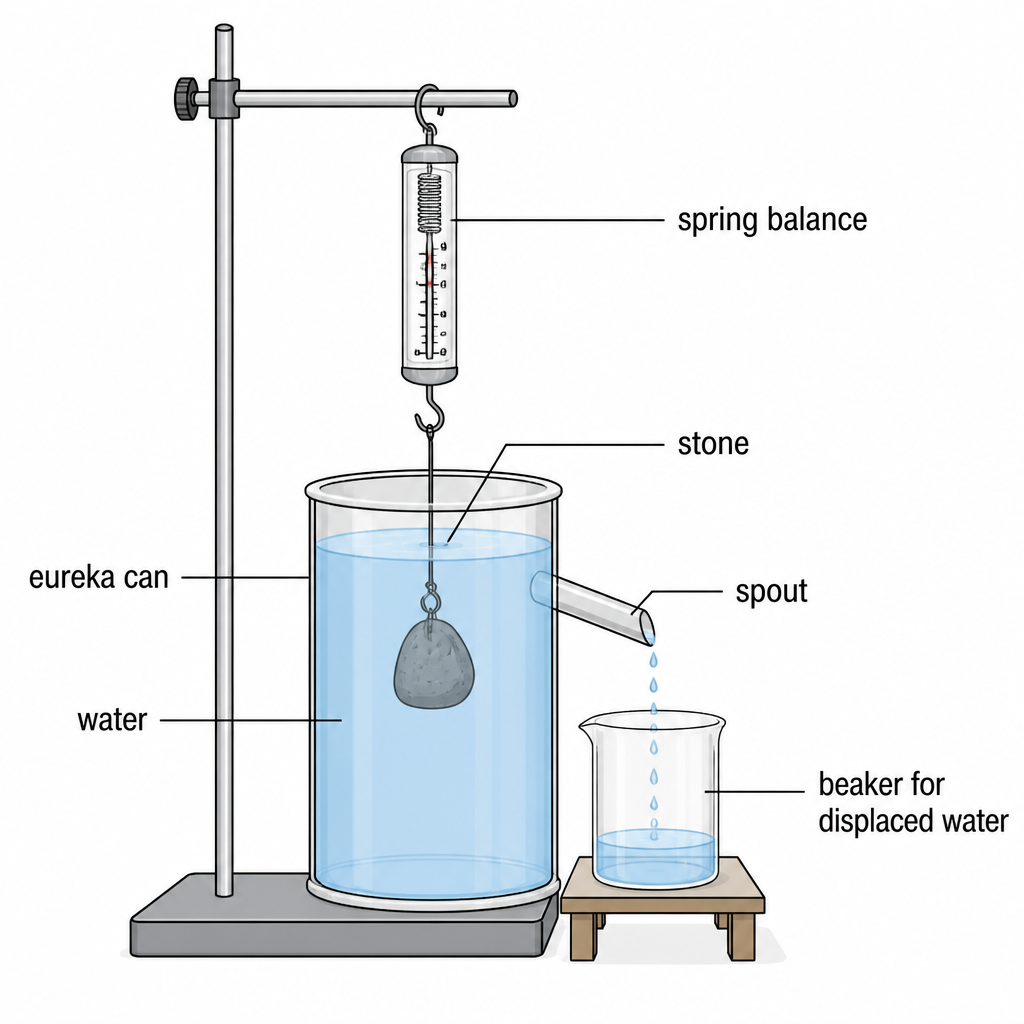
Here is how the readings from one such test work out.
Step 1: The weight of the stone in air is:
\[ W_1 = 10\ \text{N} \]
Step 2: The weight of the stone when fully immersed in water is:
\[ W_2 = 6\ \text{N} \]
Step 3: Subtracting the weight in water from the weight in air gives the upthrust:
\[ U = 10\ \text{N} - 6\ \text{N} = 4\ \text{N} \]
Step 4: Weighing the displaced water collected in the beaker gives:
\[ W = 4\ \text{N} \]
The upthrust on the stone, 4 N, and the weight of the water it displaced, 4 N, are equal. This shows that the upthrust on an object immersed in water equals the weight of the water it displaces, which is exactly what Archimedes' principle states.
Upthrust in Terms of Volume and Density
Archimedes' principle can be turned into a formula for upthrust.
Step 1: By Archimedes' principle, upthrust equals the weight W of the liquid displaced:
\[ U = W \]
Step 2: Weight is mass times acceleration due to gravity, so:
\[ U = mg \]
Step 3: Since density is \( \rho = \frac{m}{V} \), the mass of the displaced liquid is:
\[ m = V\rho \]
Step 4: Putting this mass into the formula from Step 2:
\[ U = V\rho g \]
Here \( V \) is the volume of liquid displaced (in m³), \( \rho \) is the density of the liquid (in kg/m³), and \( g \) is the acceleration due to gravity (9.8 m/s²). With these units, \( U \) comes out in newtons.
The formula U = Vρg holds both factors at once: a bigger ρ gives a bigger U, and a bigger V gives a bigger U. The object's own weight does not appear in it anywhere.
When density is in kg/m³, the volume must be in m³. Divide a volume in cm³ by 1000000 to change it to m³, or the answer comes out a million times too big.
Worked Example: One Stone, Two Liquids
A stone of volume 200 cm³ is fully immersed first in water and then in edible oil. Taking the density of water as 1000 kg/m³, the density of edible oil as 900 kg/m³ and g = 9.8 m/s², find the upthrust in each case.
Step 1: The stone is fully immersed, so the volume displaced is the stone's own volume. Changing it to cubic metres:
\[ V = \frac{200}{1000000}\ \text{m}^3 = 0.0002\ \text{m}^3 \]
Step 2: Putting the values for water into \( U = V\rho g \):
\[ U = 0.0002 \times 1000 \times 9.8 \]
Step 3: Multiplying gives the upthrust in water:
\[ U = 1.96\ \text{N} \]
Step 4: Putting the values for edible oil into the same formula:
\[ U = 0.0002 \times 900 \times 9.8 \]
Step 5: Multiplying gives the upthrust in oil:
\[ U = 1.764\ \text{N} \]
Same stone, same volume, yet 1.96 N in water and only 1.764 N in oil. The formula confirms what the spring balance showed: the denser liquid gives the bigger upthrust.
Float or Sink: What Decides It
An object in a liquid has two forces on it: its own weight pulling down, and the upthrust pushing up. The upthrust depends on the volume of liquid displaced and, by Archimedes' principle, equals the weight of that liquid. So whether an object floats or sinks is decided by comparing its weight with the upthrust, which depends on the volume of liquid it displaces. In tap water the egg's weight was more than the upthrust, so it sank; in salt water the upthrust could hold its weight, so it floated.
The full lesson is waiting for you
The notes are free to read in full. A free account opens the rest of the practice, and tracks your progress and confidence score for every subject. Presentations and videos need approval from Learn Yeti.