The Lengths Inside a Square Based Pyramid
A square based pyramid stands on a square. From each side of that square a triangle rises, and the four triangles meet at one point at the top called the vertex. To find how much space a pyramid takes up, we must know which of its lengths is which. The volume formula uses only one of them, and the others are often the road that leads to it.
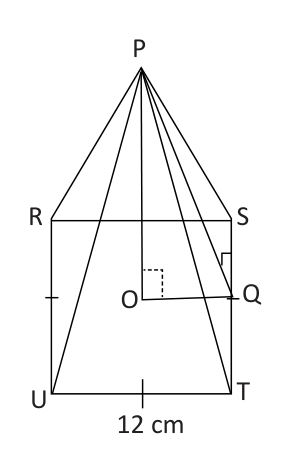
- Side of base \( (a) \): one edge of the square base, such as UT.
- Vertical height \( (h) \): the straight line from the vertex down to the centre of the base, such as PO. It meets the base at a right angle.
- Slant height \( (l) \): the line from the vertex down the middle of a triangular face to the midpoint of a base edge, such as PQ.
- Lateral edge: the line from the vertex to a corner of the base, such as PT. All four lateral edges are equal.
The vertical height of a pyramid is the perpendicular distance from its vertex to its base. This is the height used in the volume formula.
The slant height of a square based pyramid is the height of one of its triangular faces, measured from the vertex to the midpoint of a base edge.
Since triangle POQ has its right angle at O, Pythagoras theorem links these three lengths:
\[ l^2 = h^2 + \left(\frac{a}{2}\right)^2 \]
In the pyramid above the base side is 12 cm, so \( OQ = 6 \) cm. If the slant height PQ is 10 cm, then \( h^2 = 100 - 36 = 64 \), and the vertical height is 8 cm. In the same way, triangle PQT has its right angle at Q, and that gives the lateral edge:
\[ PT^2 = l^2 + \left(\frac{a}{2}\right)^2 \]
Two surface area results are needed alongside the volume. The four triangles together make the lateral surface, and adding the square base gives the total surface:
\[ \text{LSA} = 2al \]
\[ \text{TSA} = a^2 + 2al \]
Reading a Pyramid Diagram
A pyramid drawn on flat paper hides some of its lines, so diagrams use a few signs. A dashed line lies inside the solid or behind it. A small square at a corner marks a right angle. Small ticks on the base edges mean those edges are equal, which tells you the base is a square. When a length is written away from the solid, an arrow points to the line it belongs to.
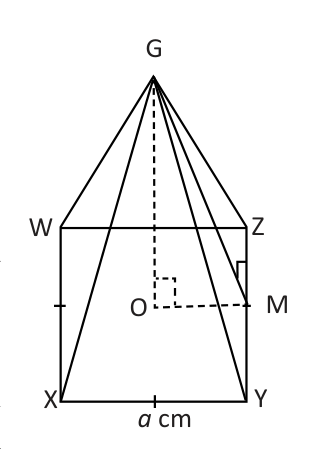
In this diagram O is the centre of the base and M is the midpoint of YZ, so \( OM = \frac{a}{2} \). The four lateral edges GW, GX, GY and GZ all run from the same vertex to the corners of the same square, so they are equal to one another.
Filling a Cube from a Pyramid
Make two open containers from card paper: a square based pyramid and a cube. Give them the same square base and the same height. A cube is as tall as its side, so the pyramid must also be as tall as the cube's side a. Leave the base of the pyramid and the top of the cube open, so that both can hold sand or flour.
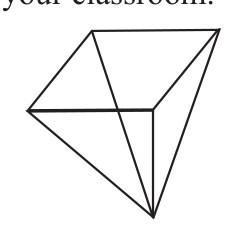
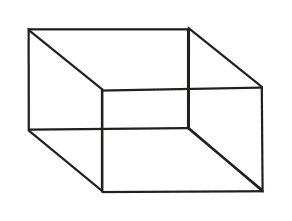
First guess how many times the pyramid must be filled and poured to fill the cube. Then fill the pyramid, pour it into the cube and count. The cube becomes full after exactly three pourings. So three pyramids of sand take up the same space as one cube. Writing V for the volume of the pyramid and \( a^3 \) for the volume of the cube:
\[ 3 \times V = a^3 \]
Dividing both sides by 3, and writing \( a^3 \) as \( a^2 \times a \), shows what each part means. Here \( a^2 \) is the area of the square base and the last a is the height:
\[ V = \frac{1}{3} \times a^2 \times a \]
The same thing happens with any pyramid and any box that share its base and its height. Three pyramids always fill the box, so the height does not have to equal the base side. In general, a pyramid holds one third of the box built on the same base up to the same height.
A pyramid holds one third of the box that has the same base and the same height.
The Volume Formula
The volume of a pyramid is the space it takes up. It equals one third of the area of its base multiplied by its vertical height.
\[ V = \frac{1}{3} \times A \times h \]
For a square based pyramid the base area is \( A = a^2 \), where a is the side of the base, so the formula becomes:
\[ V = \frac{1}{3} \times a^2 \times h \]
Volume is measured in cubic units, such as \( \text{cm}^3 \), \( \text{m}^3 \) or cubic inches. When a question asks how much water a container holds, the answer is often wanted in litres, and \( 1000 \text{ cm}^3 \) make 1 litre.
The h in the volume formula is always the vertical height. If a question gives the slant height, find h first from \( l^2 = h^2 + \left(\frac{a}{2}\right)^2 \). Do not drop the \( \frac{1}{3} \) either: without it you have found the volume of the box, which is three times too big.
Example: Volume from the Base and the Height
Find the volume of the square based pyramid below. The side of its base is 16 cm and its vertical height is 6 cm.
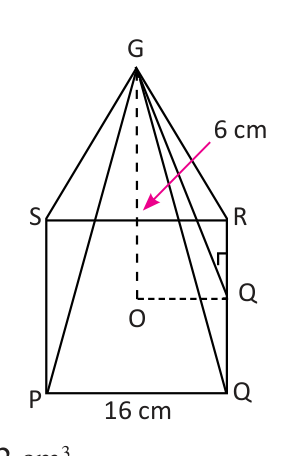
Step 1: Here \( a = 16 \) cm and \( h = 6 \) cm. Finding the area of the base:
\[ A = a^2 = 16^2 = 256 \text{ cm}^2 \]
Step 2: Putting the base area and the height into the volume formula:
\[ V = \frac{1}{3} \times 256 \times 6 \]
Step 3: Since \( \frac{1}{3} \times 6 = 2 \), multiplying 256 by 2:
\[ V = 512 \text{ cm}^3 \]
A box on the same base with the same height would hold \( 256 \times 6 = 1536 \text{ cm}^3 \), which is exactly three times as much as the pyramid.
Example: From the Volume to the Lateral Surface
The volume of a square based pyramid is \( 384 \text{ cm}^3 \) and the side of its base is 12 cm. Find its lateral surface area. The lateral surface needs the slant height, the slant height needs the vertical height, and the vertical height comes from the volume. So we work in that order.
Step 1: Putting the known values into the volume formula:
\[ 384 = \frac{1}{3} \times 12^2 \times h \]
Step 2: Since \( 12^2 = 144 \) and one third of 144 is 48, the equation becomes:
\[ 384 = 48 \times h \]
Step 3: Dividing both sides by 48 gives the vertical height:
\[ h = \frac{384}{48} = 8 \text{ cm} \]
Step 4: Half of the base side is 6 cm, so the right angled triangle gives the square of the slant height:
\[ l^2 = 8^2 + 6^2 = 64 + 36 = 100 \]
Step 5: Taking the square root:
\[ l = 10 \text{ cm} \]
Step 6: Using the lateral surface area formula \( \text{LSA} = 2al \):
\[ \text{LSA} = 2 \times 12 \times 10 = 240 \text{ cm}^2 \]
Example: From the Total Surface Area to the Volume
The total surface area of a square based pyramid is \( 96 \text{ cm}^2 \) and the side of its base is 6 cm. Find its volume. This time the chain runs the other way: the total surface area gives the slant height, the slant height gives the vertical height, and then the volume follows.
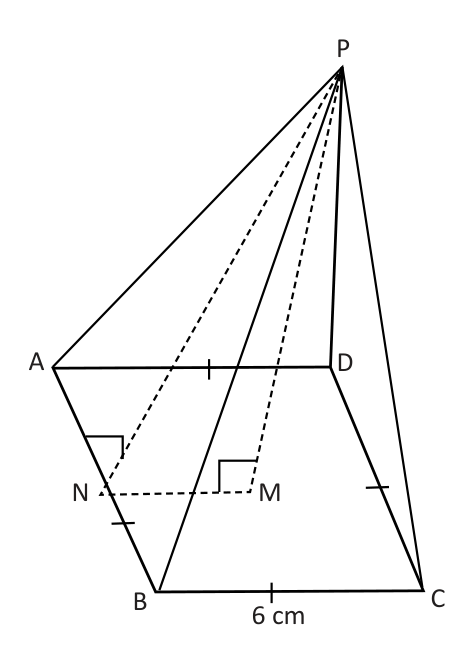
Step 1: Putting the values into the total surface area formula \( \text{TSA} = a^2 + 2al \):
\[ 96 = 6^2 + 2 \times 6 \times l \]
Step 2: Since \( 6^2 = 36 \), subtracting 36 from both sides:
\[ 60 = 12 \times l \]
Step 3: Dividing both sides by 12 gives the slant height:
\[ l = \frac{60}{12} = 5 \text{ cm} \]
Step 4: In triangle PMN the right angle is at M and \( NM = 3 \) cm, so by Pythagoras theorem:
\[ 5^2 = h^2 + 3^2 \]
Step 5: Subtracting 9 from 25:
\[ h^2 = 16 \]
Step 6: Taking the square root gives the vertical height:
\[ h = 4 \text{ cm} \]
Step 7: Putting the base side and the vertical height into the volume formula:
\[ V = \frac{1}{3} \times 6^2 \times 4 = 48 \text{ cm}^3 \]
The 5 cm slant height never went into the volume formula. It was only the stepping stone between the surface area and the vertical height.
Working Backwards to the Base
Sometimes the volume and the height are known and the base is missing. A pyramid shaped paperweight has a volume of \( 300 \text{ cm}^3 \) and a vertical height of 9 cm. Find the side of its square base.
Step 1: Putting the values into the volume formula:
\[ 300 = \frac{1}{3} \times a^2 \times 9 \]
Step 2: Since \( \frac{1}{3} \times 9 = 3 \), the equation becomes:
\[ 300 = 3a^2 \]
Step 3: Dividing both sides by 3:
\[ a^2 = 100 \]
Step 4: Taking the square root gives the side of the base:
\[ a = 10 \text{ cm} \]
When the area of the base is given instead of its side, there is nothing to square. A pyramid whose base area is \( 81 \text{ cm}^2 \) and whose height is 10 cm holds \( \frac{1}{3} \times 81 \times 10 = 270 \text{ cm}^3 \).
Which Formula Does a Question Want?
Real problems rarely say "find the volume". They describe an object and a job, and you decide which measurement that job needs.
| The problem asks | What it means | Formula |
| How much water a pyramid shaped pot holds | Volume | \( \frac{1}{3}a^2h \) |
| How much cloth a pyramid tent needs | Lateral surface, since a tent has no cloth floor | \( 2al \) |
| How much land a tower stands on | Area of the base | \( a^2 \) |
| How much paper wraps a pyramid chocolate | Total surface | \( a^2 + 2al \) |
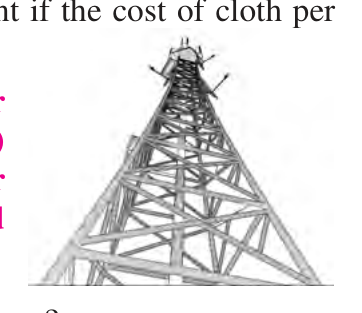
For the tower, only the base side is needed. If its slant height and vertical height are known, half the base side comes from the right angled triangle \( l^2 = h^2 + \left(\frac{a}{2}\right)^2 \), and doubling it gives the side.
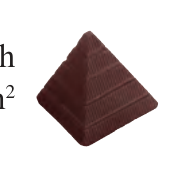
If the total surface area of such a chocolate is known together with its base side, the work of the last example runs again: the total surface area gives the slant height, and the slant height gives the vertical height.
The full lesson is waiting for you
The notes are free to read in full. A free account opens the rest of the practice, and tracks your progress and confidence score for every subject. Presentations and videos need approval from Learn Yeti.