Cones Around Us
Think of an ice cream cone, a paper birthday cap, a clown's hat or the tip of a sharpened pencil. Each has a round rim at one end, and a curved surface that narrows steadily until it ends at one sharp point. The ice cream cone and the birthday cap differ in colour, size and material, but their shape is exactly the same. A solid with this shape is called a cone.
Cone: a solid with a circular base and one curved surface that rises from the edge of the base and meets at a single point. That point is called the vertex.
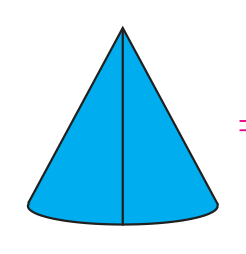
A closed cone has two surfaces: the flat circular base at the bottom and the curved surface above it. A birthday cap has no base at all, so it is only the curved surface. Cut the cap straight from its tip down to its rim with scissors and spread it on a table. It does not become a triangle, and it does not become a circle. It lies flat as a shape like one slice cut from a round pizza.
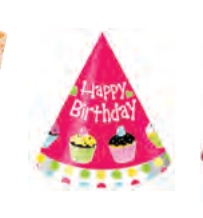
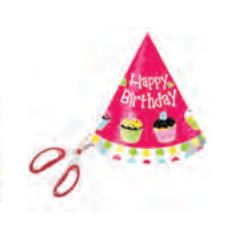
When the curved surface of a cone is cut and spread on a flat surface, it becomes a sector.
From a Sector to a Cone
Sector: the part of a circle enclosed by two radii and the arc between them.
If opening a cap gives a sector, the reverse must also work: bending a sector gives a cone. Draw a circle with centre O on a piece of paper. Draw an angle AOB at the centre and cut out the sector AOB. Now bend it round until the edges OA and OB meet. The centre O becomes the vertex of the cone, and the arc AB curls round to become the rim of the circular base.
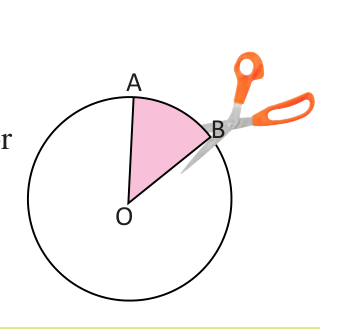
This simple folding tells us two facts that the whole topic depends on:
- The arc AB becomes the circumference of the base. If the base has radius \( r \), the arc has length \( 2 \pi r \).
- The radius OA of the sector becomes the distance from the vertex down the surface to the rim. This distance is the slant height of the cone.
Arc of the sector that makes the cone = circumference of the base = \( 2 \pi r \)
Radius, Height and Slant Height
In the cone below, A is the vertex and O is the centre of the circular base. B and C are points on the rim of the base. OB is the radius of the base, written \( r \). The line AO, joining the vertex to the centre of the base, is the vertical height, written \( h \), and it is perpendicular to the base. The lines AB and AC run from the vertex down the sloping surface to the rim. Each is a slant height, written \( l \).
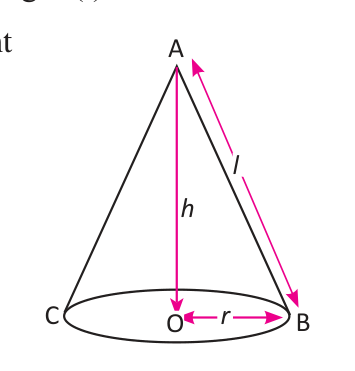
Vertical height: the perpendicular distance from the vertex to the centre of the base, \( h \).
Slant height: the straight distance from the vertex, along the curved surface, to the rim of the base, \( l \).
In triangle AOB, the angle at O is a right angle. So AB is the hypotenuse, and Pythagoras theorem connects the three lengths.
Step 1: Applying Pythagoras theorem in right-angled triangle AOB:
\[ AB^2 = AO^2 + OB^2 \]
Step 2: Writing \( l \) for AB, \( h \) for AO and \( r \) for OB:
\[ l^2 = h^2 + r^2 \]
Step 3: Taking the square root of both sides:
\[ l = \sqrt{h^2 + r^2} \]
The slant height is the square root of the sum of the squares of the height and the radius. Being the hypotenuse, \( l \) is always longer than both \( h \) and \( r \).
The same relation can be rearranged, so any two of the three lengths give the third: \( h = \sqrt{l^2 - r^2} \) and \( r = \sqrt{l^2 - h^2} \). For example, if \( l = 13 \) cm and \( r = 5 \) cm, then \( h = \sqrt{169 - 25} = \sqrt{144} = 12 \) cm.
The vertical height \( h \) and the slant height \( l \) are different lengths. The vertical height goes straight down through the inside of the cone; the slant height runs down the sloping outside. The surface area formulas need \( l \), not \( h \).
Curved Surface Area of a Cone
Curved surface area (CSA): the area of the sloping curved surface of a cone only, leaving out the base.
How much paper makes a birthday cap? How much cloth covers a conical tent that has no floor? Both questions ask for a curved surface area. To find a formula for it, take a paper cone, cut it along one slant line and spread it out. The flat shape is a sector whose radius is the slant height \( l \) and whose arc is as long as the circumference of the base, \( 2 \pi r \).
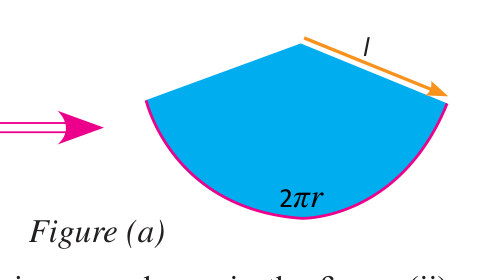
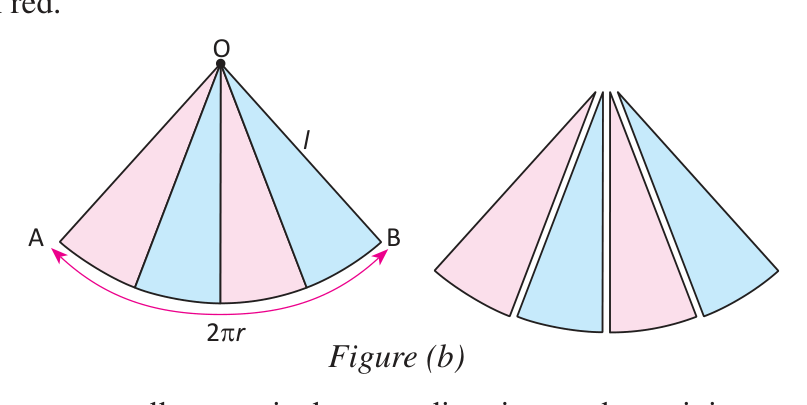
Next, cut this sector from its centre O into four equal smaller sectors. Colour two of them, alternately, so the pieces are easy to tell apart. Each piece carries one quarter of the arc, that is \( \frac{2 \pi r}{4} = \frac{\pi r}{2} \).
Now fit the pieces together: two pointing up and the other two pointing down, each one slotting between its neighbours. The top edge is made of two arcs, so it is \( \pi r \) long. The bottom edge is also two arcs, so it too is \( \pi r \). The slanting sides are the slant height \( l \). The shape is very nearly a parallelogram. The more pieces the sector is cut into, the thinner they become, the flatter each little arc looks and the more upright the sides stand. In the end the shape is a rectangle of length \( \pi r \) and breadth \( l \).
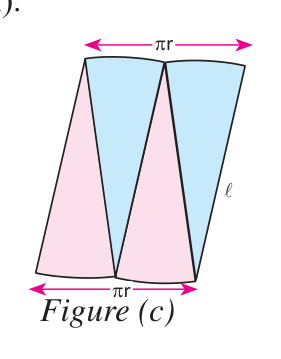
Step 1: The curved surface area equals the area of this shape, which is length × breadth. With length \( \pi r \) and breadth \( l \):
\[ \text{CSA} = \pi r \times l \]
Step 2: Writing the product in short:
\[ \text{CSA} = \pi r l \]
The formula can be checked another way. The area of a sector is \( \frac{1}{2} \) × arc × radius. Here the arc is \( 2 \pi r \) and the radius is \( l \), so the area is \( \frac{1}{2} \times 2 \pi r \times l = \pi r l \), the same answer.
Total Surface Area of a Cone
Total surface area (TSA): the area of the circular base added to the curved surface area of a cone.
A solid wooden cone, or a closed conical container, also has its base. Opened out completely, it shows two pieces: the sector of the curved surface and the circle of the base. The base is a circle of radius \( r \), so its area is \( \pi r^2 \).
Step 1: Adding the area of the base to the curved surface area:
\[ \text{TSA} = \pi r^2 + \pi r l \]
Step 2: Taking out \( \pi r \), which is common to both terms:
\[ \text{TSA} = \pi r (r + l) \]
| Quantity | Formula |
| Slant height | \( l = \sqrt{h^2 + r^2} \) |
| Area of base | \( \pi r^2 \) |
| Curved surface area | \( \pi r l \) |
| Total surface area | \( \pi r (r + l) \) |
Which formula to use depends on whether the object has a base. A cap, a tent with no floor and a funnel are open, so only their curved surface area counts. A solid cone or a closed container needs the total surface area. Unless a question says otherwise, take \( \pi = \frac{22}{7} \).
An area is always written in square units, cm² or m². A radius, a height, a slant height and a circumference are lengths, so they are written in plain cm or m.
Example 1: Base Area and Curved Surface Area
In the cone below, the vertical height PO is 12 cm and the slant height PQ is 13 cm. Find the area of its base and its curved surface area.
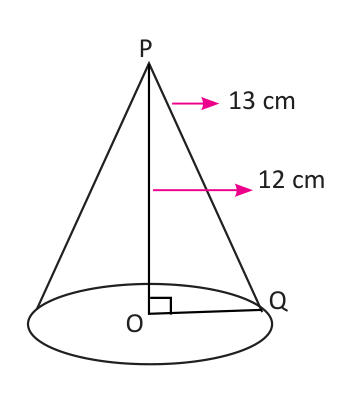
Here \( h = 12 \) cm and \( l = 13 \) cm. Both formulas need the radius \( r \), so it must be found first, from right-angled triangle POQ.
Step 1: PQ is the hypotenuse of right-angled triangle POQ, so by Pythagoras theorem:
\[ PQ^2 = PO^2 + OQ^2 \]
Step 2: Putting in the known lengths:
\[ 13^2 = 12^2 + r^2 \]
Step 3: Squaring, and moving 144 to the other side:
\[ r^2 = 169 - 144 = 25 \]
Step 4: Taking the square root gives the radius:
\[ r = 5 \text{ cm} \]
Step 5: Putting \( r = 5 \) into the area of the base:
\[ \pi r^2 = \frac{22}{7} \times 5^2 = \frac{550}{7} \]
Step 6: Dividing, to two decimal places, the area of the base is:
\[ \pi r^2 \approx 78.57 \text{ cm}^2 \]
Step 7: Putting \( r = 5 \) and \( l = 13 \) into the curved surface area:
\[ \pi r l = \frac{22}{7} \times 5 \times 13 = \frac{1430}{7} \]
Step 8: Dividing, to two decimal places, the curved surface area is:
\[ \pi r l \approx 204.29 \text{ cm}^2 \]
So the base has an area of about 78.57 cm² and the curved surface an area of about 204.29 cm². Notice that the vertical height of 12 cm never went into an area formula. Its only job was to help find the radius.
Example 2: Total Surface Area from Diameter and Height
Find the total surface area of a cone whose base has a diameter of 12 cm and whose vertical height is 8 cm.
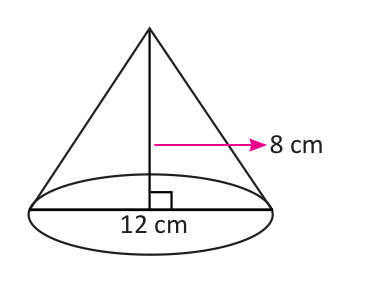
Step 1: Halving the diameter to get the radius:
\[ r = \frac{d}{2} = \frac{12}{2} = 6 \text{ cm} \]
The question gives the diameter, not the radius. Putting 12 straight in as \( r \) makes every later answer far too large.
Step 2: Putting \( h = 8 \) and \( r = 6 \) into the slant height relation:
\[ l^2 = h^2 + r^2 = 8^2 + 6^2 \]
Step 3: Adding the squares:
\[ l^2 = 64 + 36 = 100 \]
Step 4: Taking the square root gives the slant height:
\[ l = 10 \text{ cm} \]
Step 5: Putting \( r = 6 \) and \( l = 10 \) into the total surface area:
\[ \text{TSA} = \frac{22}{7} \times 6 \times (6 + 10) \]
Step 6: Simplifying the bracket, then multiplying and dividing:
\[ \text{TSA} = \frac{2112}{7} \approx 301.71 \text{ cm}^2 \]
So the total surface area of the cone is about 301.71 cm².
Example 3: Using the Sum of Radius and Slant Height
The radius of the base and the slant height of a cone add up to 64 cm. Its total surface area is 2816 cm². Find its curved surface area.
Here \( r + l = 64 \) cm and the TSA is 2816 cm². The key is to notice that the total surface area formula \( \pi r (r + l) \) already contains \( r + l \). The sum can be put in directly, leaving only \( r \) unknown.
Step 1: Writing the total surface area formula:
\[ \pi r (r + l) = 2816 \]
Step 2: Putting \( \pi = \frac{22}{7} \) and \( r + l = 64 \):
\[ \frac{22}{7} \times r \times 64 = 2816 \]
Step 3: Moving the other numbers across to leave \( r \) alone:
\[ r = \frac{2816 \times 7}{22 \times 64} \]
Step 4: Simplifying, since \( 22 \times 64 = 1408 \) and \( 2816 \div 1408 = 2 \):
\[ r = 2 \times 7 = 14 \text{ cm} \]
Step 5: Putting \( r = 14 \) back into \( r + l = 64 \) to find the slant height:
\[ l = 64 - 14 = 50 \text{ cm} \]
Step 6: Putting both values into the curved surface area:
\[ \pi r l = \frac{22}{7} \times 14 \times 50 \]
Step 7: Cancelling 14 with 7 and multiplying \( 22 \times 2 \times 50 \):
\[ \pi r l = 2200 \text{ cm}^2 \]
So the curved surface area is 2200 cm². A quick check: the base has area \( \frac{22}{7} \times 14^2 = 616 \) cm², and \( 616 + 2200 = 2816 \) cm², which is exactly the total surface area we were given.
Example 4: Circumference from the Two Areas
A cone has a total surface area of 1320 cm² and a curved surface area of 704 cm². Find the circumference of its base.
Total surface area is the base plus the curved surface, so the difference between the two areas is the area of the base alone. The base area gives the radius, and the radius gives the circumference.
Step 1: Total surface area is area of base plus curved surface area, so:
\[ 1320 = \pi r^2 + 704 \]
Step 2: Subtracting 704 from both sides leaves the base area:
\[ \pi r^2 = 1320 - 704 = 616 \]
Step 3: Putting \( \pi = \frac{22}{7} \) and making \( r^2 \) the subject:
\[ r^2 = \frac{616 \times 7}{22} = 196 \]
Step 4: Taking the square root gives the radius:
\[ r = 14 \text{ cm} \]
Step 5: Putting \( r = 14 \) into the circumference of a circle:
\[ C = 2 \pi r = 2 \times \frac{22}{7} \times 14 \]
Step 6: Cancelling 14 with 7 and multiplying \( 2 \times 22 \times 2 \):
\[ C = 88 \text{ cm} \]
So the circumference of the base of the cone is 88 cm.
The areas in the question are in cm², but a circumference is a length. The answer is 88 cm, not 88 cm².
The full lesson is waiting for you
The notes are free to read in full. A free account opens the rest of the practice, and tracks your progress and confidence score for every subject. Presentations and videos need approval from Learn Yeti.