Cost from Quantity and Rate
You already know how to find the area of a floor, the area of the four walls of a room, and the volume of a cuboid, a cylinder or a pyramid. In daily life those numbers are rarely the final answer. A house owner wants to know what the painting will cost. A farmer wants to know how many litres a tank will store. A school wants to know what a fence round its garden will cost. Turning a measurement into money is called cost estimation.
Cost estimation: working out the total cost of a job before it is done, by measuring the quantity it needs (an area, a volume, a length or a number of days) and multiplying that quantity by the rate.
Rate: the price of one unit of the quantity, such as Rs. 30 per square foot, Rs. 420 per litre or Rs. 1500 per worker per day.
Writing \( T \) for the total cost, \( Q \) for the quantity and \( R \) for the rate, every costing problem rests on one rule:
\[ T = Q \times R \]
The job decides which quantity you measure. Paint covers a surface, so painting needs an area. Water fills the space inside, so a tank needs a volume. A wire runs round the edge, so fencing needs a perimeter. The table sets this out.
| Job | What is measured | Unit of the rate |
| Painting walls and ceiling | Area | per square foot or per square metre |
| Carpeting a floor | Area of the floor | per square foot or per square metre |
| Filling a tank with water | Volume, changed into litres | per litre |
| Fencing a garden | Perimeter × number of rounds | per metre |
| Paying workers | Number of workers × number of days | per worker per day |
The unit of the quantity must match the unit of the rate. If the area is in square feet, the rate must be per square foot.
The Area to Paint in a Room
A room is a cuboid with length \( l \), breadth \( b \) and height \( h \). When a room is painted, the four walls and the ceiling get paint. The floor is walked on, so it gets tiles or a carpet instead of paint.
Two opposite walls are each \( l \times h \), and the other two are each \( b \times h \). Together the four walls make \( 2lh + 2bh = 2h(l+b) \). The ceiling is the same size as the floor, \( l \times b \). So the area of the four walls and the ceiling is:
\[ A = 2h(l+b) + lb \]
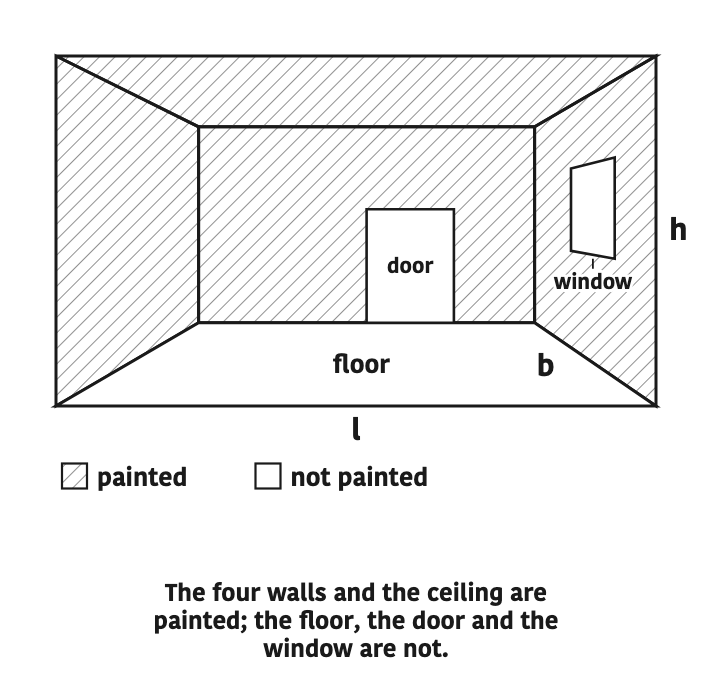
Doors and windows do not get wall paint, so their area is taken away. If \( A_1 \) is the area of the doors and \( A_2 \) the area of the windows, the area to be painted is:
\[ A = 2h(l+b) + lb - (A_1 + A_2) \]
Do not use the whole surface formula of a cuboid, \( 2(lb + bh + lh) \). It counts the floor as well, and the floor is not painted. The floor area is used only for carpet or tiles.
Choosing the Cheaper Quotation
Quotation: a written list, given before a job starts, of the rates a worker or company will charge for each part of the job.
A room is 14 ft long, 12 ft wide and 10 ft high. It has one door 3 ft wide and 6.6 ft high, and one window 6 ft × 4 ft. Two painters have given different quotations. Under the first, the house owner buys the paint and materials. Under the second, the painter brings everything.
| Item | First quotation (owner buys the paint) | Second quotation (painter brings everything) |
| Primer on walls and ceiling | Rs. 7 per sq. ft | Rs. 14 per sq. ft |
| Painting walls and ceiling | Rs. 5 per sq. ft | Rs. 30 per sq. ft |
| Enamel on door and window | Rs. 12 per sq. ft | Rs. 24 per sq. ft |
| Paint to be bought | 7.2 litres at Rs. 420 per litre | included in the rates |
Step 1: Finding the area of the door:
\[ A_1 = 3 \times 6.6 = 19.8 \text{ ft}^2 \]
Step 2: Finding the area of the window:
\[ A_2 = 6 \times 4 = 24 \text{ ft}^2 \]
Step 3: Putting \( l = 14 \), \( b = 12 \) and \( h = 10 \) into the formula, and taking away the door and window:
\[ \begin{aligned} A_3 &= 2h(l+b) + lb - (A_1 + A_2) \\ &= 2 \times 10 \times 26 + 168 - 43.8 \\ &= 688 - 43.8 \\ &= 644.2 \text{ ft}^2 \end{aligned} \]
Step 4: Costing each item under the first quotation: the primer, the enamel on the door and window, the wall paint, and the paint to be bought:
\[ \begin{aligned} T_1 &= 7 \times 644.2 = \text{Rs. } 4509.4 \\ T_2 &= 12 \times 43.8 = \text{Rs. } 525.6 \\ T_3 &= 5 \times 644.2 = \text{Rs. } 3221 \\ T_4 &= 7.2 \times 420 = \text{Rs. } 3024 \end{aligned} \]
Step 5: Adding the four costs of the first quotation:
\[ \begin{aligned} T &= 4509.4 + 525.6 + 3221 + 3024 \\ &= \text{Rs. } 11280 \end{aligned} \]
Step 6: Costing the primer, the enamel and the wall paint under the second quotation (no paint is bought separately here):
\[ \begin{aligned} T_1 &= 14 \times 644.2 = \text{Rs. } 9018.8 \\ T_2 &= 24 \times 43.8 = \text{Rs. } 1051.2 \\ T_3 &= 30 \times 644.2 = \text{Rs. } 19326 \end{aligned} \]
Step 7: Adding the three costs of the second quotation:
\[ \begin{aligned} T &= 9018.8 + 1051.2 + 19326 \\ &= \text{Rs. } 29396 \end{aligned} \]
The first quotation costs Rs. 11,280 and the second costs Rs. 29,396. So the first is cheaper, and it saves \( 29396 - 11280 = \) Rs. 18,116. The owner has to buy the paint under the first quotation, but every rate in it is much lower, so the total still comes out far smaller.
When comparing two quotations, compare the totals, not single rates. One quotation may carry an extra cost, such as buying the paint, so decide only after adding every part.
How Much Water a Tank Holds
Capacity: the greatest amount of liquid a container or tank can hold, usually given in litres. It equals the inner volume of the container.
Water fills the empty space inside a tank, so we first find the volume from the inner measurements and then change it into litres. Two facts do the changing:
\[ 1 \text{ m}^3 = 1000 \text{ l} \]
\[ 1 \text{ ft}^3 = 28.317 \text{ l} \]
Example: a water tank with a square base has an inner length of 3 m and a height of 4 m. How much water can it hold?
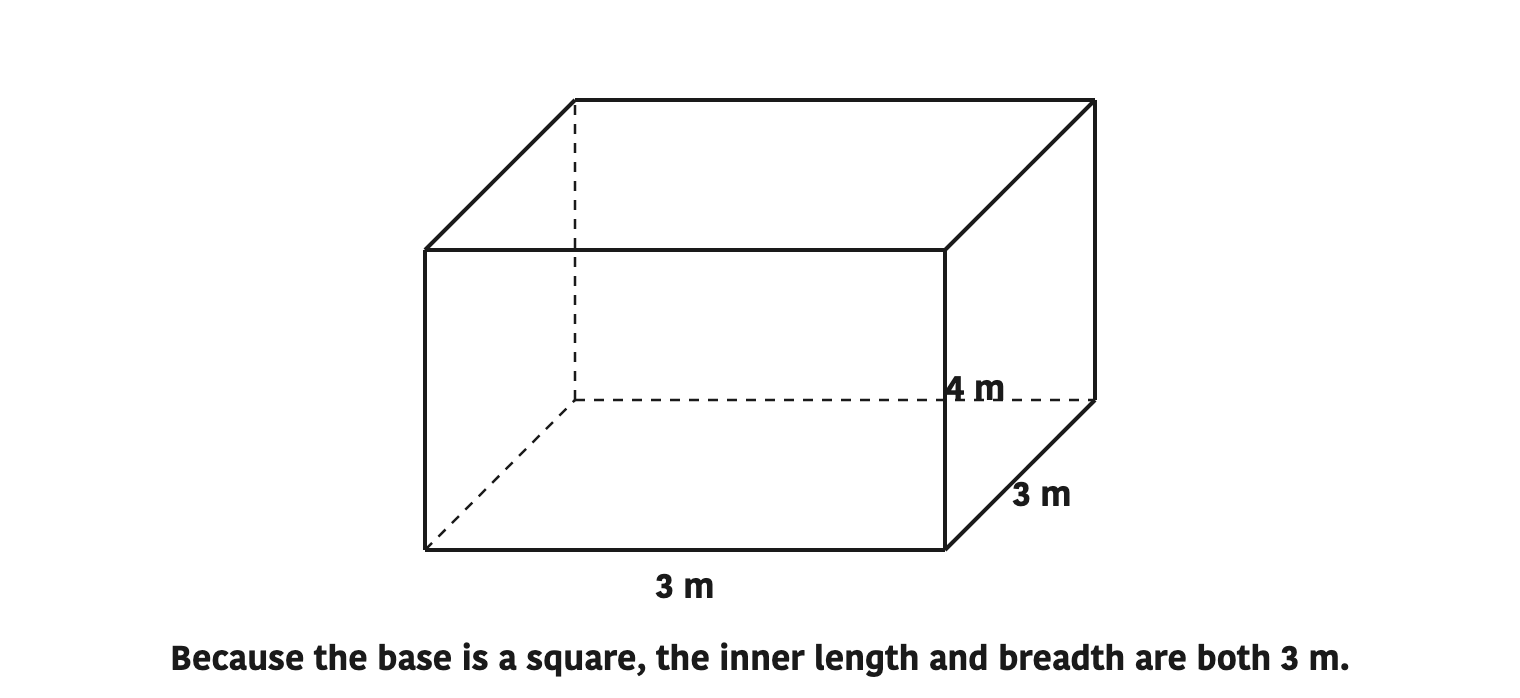
Step 1: The base is a square, so \( l = b = 3 \) m. Finding the area of the base:
\[ A = l^2 = 3^2 = 9 \text{ m}^2 \]
Step 2: Multiplying the base area by the height gives the volume of the tank:
\[ V = A \times h = 9 \times 4 = 36 \text{ m}^3 \]
Step 3: The volume of the tank is the volume of water it holds. Since \( 1 \text{ m}^3 = 1000 \text{ l} \), changing to litres:
\[ 36 \times 1000 = 36000 \text{ l} \]
So the tank can hold at most 36,000 litres of water. If water were sold at a rate per litre, multiplying 36,000 by that rate would give the cost of filling the tank.
For capacity, always use the inner measurements. The outer measurements include the thickness of the walls, where no water can go.
Cost of Planting Grass on a Quadrilateral Land
NICE is a piece of land shaped like a quadrilateral. The distance between corners N and C, a diagonal, is 40 m. The perpendicular from corner E to NC is EG = 10 m, and the perpendicular from corner I to NC is IS = 15 m.
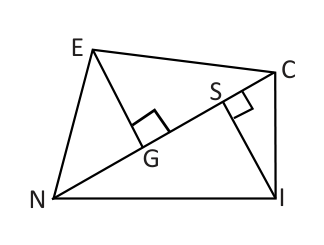
The diagonal NC is the common base of both triangles. Triangle NEC has area \( \frac{1}{2} \times d \times p_1 \) and triangle NIC has area \( \frac{1}{2} \times d \times p_2 \). Adding them gives the formula for the area of the quadrilateral:
\[ A = \frac{1}{2} \times d \times (p_1 + p_2) \]
Here \( d \) is the diagonal and \( p_1 \), \( p_2 \) are the perpendiculars drawn to it. Now the job: a male worker levels the ground in 2 days and is paid Rs. 1500 per day. After that a female worker plants dubo grass (Bermuda grass) and is paid Rs. 70 per square metre. What does the whole plantation cost?
Step 1: Putting \( d = 40 \), \( p_1 = 10 \) and \( p_2 = 15 \) into the formula to find the area:
\[ \begin{aligned} A &= \frac{1}{2} \times 40 \times (10 + 15) \\ &= 20 \times 25 \\ &= 500 \text{ m}^2 \end{aligned} \]
Step 2: The planting wage depends on area, so multiplying the area by the rate:
\[ 70 \times 500 = \text{Rs. } 35000 \]
Step 3: The levelling wage depends on days, so multiplying the daily wage by the number of days:
\[ 1500 \times 2 = \text{Rs. } 3000 \]
Step 4: Adding both wages for the total cost:
\[ 35000 + 3000 = \text{Rs. } 38000 \]
The total cost of the dubo plantation is Rs. 38,000.
One job can have two kinds of wage: by area (per square metre) and by time (per day). Multiply each by its own quantity, then add.
Carpeting and Painting a Room
A rectangular room is 14 ft long, 12 ft wide and 10 ft high. It has two square windows of side 3 ft and two doors of 6 ft × 2 ft. The floor is to be carpeted at Rs. 300 per square foot, and the four walls and ceiling, excluding the doors and windows, are to be painted at Rs. 30 per square foot. Later the painting rate rises by one third.
The formula for the area of the four walls and ceiling is \( A = 2h(l+b) + lb \).
Step 1: The carpet covers the floor, so finding the floor area:
\[ l \times b = 14 \times 12 = 168 \text{ ft}^2 \]
Step 2: Multiplying the floor area by the carpet rate:
\[ 300 \times 168 = \text{Rs. } 50400 \]
Step 3: Finding the area of the two doors and the two windows:
\[ \begin{aligned} A_1 &= 2 \times (6 \times 2) = 24 \text{ ft}^2 \\ A_2 &= 2 \times 3^2 = 18 \text{ ft}^2 \end{aligned} \]
Step 4: Finding the area of the four walls and ceiling, then taking away the doors and windows:
\[ \begin{aligned} A &= 2h(l+b) + lb - A_1 - A_2 \\ &= 20 \times 26 + 168 - 24 - 18 \\ &= 520 + 126 \\ &= 646 \text{ ft}^2 \end{aligned} \]
Step 5: Multiplying the painted area by the rate:
\[ 30 \times 646 = \text{Rs. } 19380 \]
Step 6: A rise of one third adds one third of the old rate to the old rate. The new rate is:
\[ 30 + \frac{1}{3} \times 30 = 30 + 10 = 40 \]
Step 7: Finding the total cost at the new rate:
\[ 40 \times 646 = \text{Rs. } 25840 \]
Step 8: Subtracting the old cost from the new cost to find the increase:
\[ 25840 - 19380 = \text{Rs. } 6460 \]
So the total cost rises by Rs. 6,460. There is a quick check: the rate went up by Rs. 10, so the cost goes up by \( 10 \times 646 = 6460 \). When the rate rises by one third, the cost also rises by exactly one third, because the area stays the same.
If the area is in square feet but the rate is per square metre, change one into the other's unit before multiplying. \( 1 \text{ m}^2 \approx 10.764 \text{ ft}^2 \). Multiplying without converting gives an answer that is badly wrong.
Painting Pillars Topped with Pyramids
There are two pillars at the gate of a stadium. Each pillar is a square based prism with a base of 4 ft × 4 ft and a height of 10 ft. On top of each pillar sits a square based pyramid with the same base and a height of 2 ft. The pillars and pyramids are to be painted at Rs. 95 per square foot.
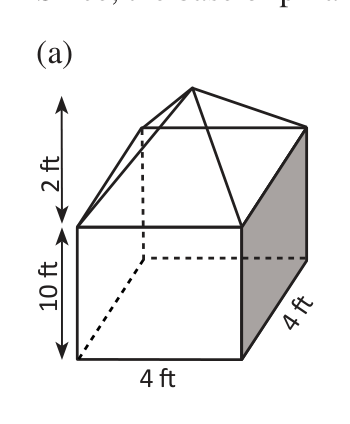
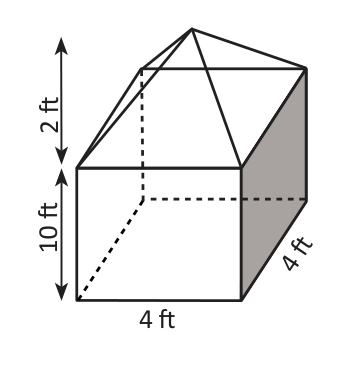
Slant height: the distance from the top vertex of a pyramid to the midpoint of one edge of its base. It is the height of each triangular face.
The vertical height \( h \) of the pyramid, the distance \( \frac{a}{2} \) from the centre of the base to the middle of an edge, and the slant height \( l \) form a right angled triangle in which \( l \) is the hypotenuse. By Pythagoras' theorem:
\[ l = \sqrt{h^2 + \left(\frac{a}{2}\right)^2} \]
Lateral surface area: the area of the side faces of a solid only, leaving out its base and its top.
The lateral surface of the prism is the perimeter of its base, \( P = 4a \), times its height \( h_1 \). A square based pyramid has four equal triangles, each of area \( \frac{1}{2} \times a \times l \). So:
\[ A_1 = P \times h_1 = 4a \times h_1 \]
\[ A_2 = 4 \times \frac{1}{2} \times a \times l = 2al \]
Here \( h_1 = 10 \) ft is the height of the pillar, \( h_2 = 2 \) ft is the height of the pyramid and \( a = 4 \) ft.
Step 1: Finding the slant height of the pyramid:
\[ \begin{aligned} l &= \sqrt{2^2 + \left(\frac{4}{2}\right)^2} \\ &= \sqrt{4 + 4} = \sqrt{8} \\ &\approx 2.83 \text{ ft} \end{aligned} \]
Step 2: Finding the lateral surface of one prism:
\[ A_1 = 4 \times 4 \times 10 = 160 \text{ ft}^2 \]
Step 3: Finding the lateral surface of one pyramid:
\[ A_2 = 2 \times 4 \times 2.83 = 22.64 \text{ ft}^2 \]
Step 4: Adding the two for one pillar with its pyramid:
\[ A_1 + A_2 = 160 + 22.64 = 182.64 \text{ ft}^2 \]
Step 5: Doubling for the two pillars:
\[ A = 2 \times 182.64 = 365.28 \text{ ft}^2 \]
Step 6: Multiplying the total area by the rate \( R = 95 \) for the total cost:
\[ T = 95 \times 365.28 = \text{Rs. } 34701.6 \]
Painting both pillars with their pyramids costs Rs. 34,701.60.
Why are the bases not added? The bottom of the pillar stands on the ground, the top of the pillar is covered by the pyramid, and the base of the pyramid rests on the pillar. None of these can be seen, so none of them is painted. For painting, only the side faces that show are counted.
A Method for Any Costing Problem
Whether the problem is about a room, a tank, a piece of land or a pillar, the order of thinking is the same:
- Step 1: Decide what the job needs: a surface (area), a space inside (volume) or an edge (perimeter).
- Step 2: Name the shape or solid and choose the formula that fits it.
- Step 3: Remove the parts that are not worked on, such as doors, windows, the floor and hidden bases.
- Step 4: Make the unit of the quantity match the unit of the rate; for water, change the volume into litres.
- Step 5: Multiply the quantity by the rate.
- Step 6: Add the cost of every part, such as wages and materials, to get the total.
Most mistakes in cost estimation are not in the arithmetic. They are in deciding what to count and what to leave out.
The full lesson is waiting for you
The notes are free to read in full. A free account opens the rest of the practice, and tracks your progress and confidence score for every subject. Presentations and videos need approval from Learn Yeti.