Parts of a Square-Based Pyramid
A pyramid is a solid whose base is a polygon and whose other faces are triangles meeting at a single point at the top. When the base is a square, the solid is a square-based pyramid. The four triangles standing on the four sides of the square are its lateral faces, and the point where they meet is the apex, also called the vertex.
In the pyramid below, ABCD is the square base and P is the apex. O is the centre of the base and lies directly below P. M is the midpoint of the side BC. Four lengths describe a pyramid like this, and each one has its own letter.
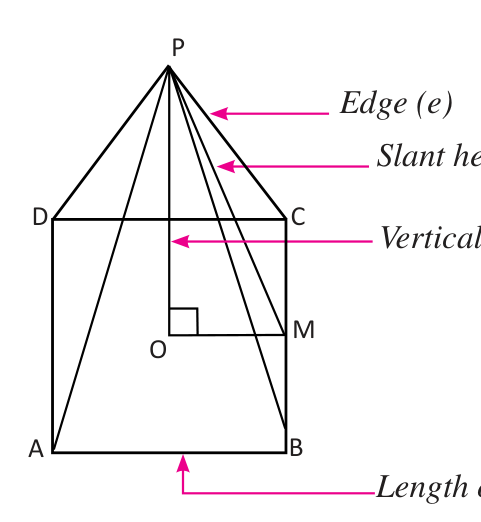
Length of base, a: the length of one side of the square base. In the figure it is AB.
Slant height, l: the distance from the apex to the midpoint of a side of the base, measured along a triangular face. In the figure it is PM. It is the height of each triangular face.
Vertical height, h: the perpendicular distance from the apex straight down to the centre of the base. In the figure it is PO.
Edge, e: the slanting line where two triangular faces meet, joining the apex to a corner of the base. In the figure it is PC.
Two right-angled triangles sit inside the pyramid, and they tie these four lengths together. The first is triangle POM, with its right angle at O. Its sides are h, OM and l. Since O is the centre of the square, OM is half a side, so \( OM = \frac{a}{2} \). Here l is the hypotenuse, so Pythagoras' theorem gives:
\[ l^2 = h^2 + \left(\frac{a}{2}\right)^2 \]
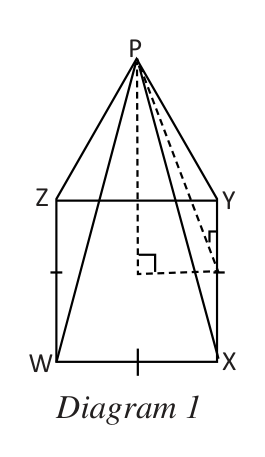
The second is triangle PMC, which lies in the face PBC. Its right angle is at M, because in the isosceles triangle PBC the line from the apex to the midpoint of the base side is perpendicular to that side. Its sides are l, \( MC = \frac{a}{2} \) and the edge e, which is the hypotenuse:
\[ e^2 = l^2 + \left(\frac{a}{2}\right)^2 \]
In either relation, knowing two lengths gives the third. Because the slant height is the hypotenuse of triangle POM, it is always longer than the vertical height h and longer than half a side, \( \frac{a}{2} \). The edge e is longer still.
Opening a Pyramid into Its Net
Take a paper model of a square-based pyramid, cut it along its four slanting edges and press it flat on the table. The flat shape you get is the net of the pyramid. The net lays every face out side by side, so the whole surface can be counted one piece at a time.
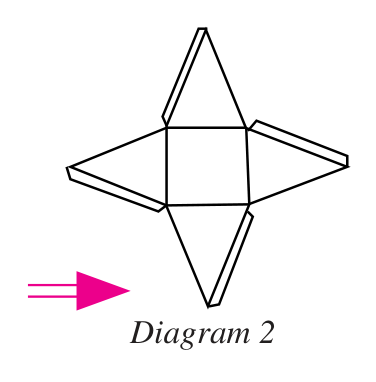
Net: a flat shape made of all the faces of a solid laid out in one plane, which folds up to make that solid again.
Looking at the net tells us three things about the surface:
- (a) The pyramid has four triangular faces, one on each side of the square.
- (b) All four triangles have the same area. Each has base a, and because the apex is directly above the centre of the base, each has the same height l. So the four faces are congruent isosceles triangles.
- (c) The surface is made of two kinds of shape: one square of area \( a^2 \) and four triangles, each of area \( \frac{1}{2} \times a \times l \).
Area of the Square Base
The base is a square of side a. The area of a square is its side multiplied by itself, so the area of the base, A, is:
\[ A = a^2 \]
The letter l stands for the slant height, not the side of the base. The area of the base is always \( a^2 \), never \( l^2 \).
Lateral Surface Area
Lateral surface area (LSA): the total area of the triangular faces of a pyramid, leaving out the base.
The formula comes straight out of the net.
Step 1: The area of any triangle is:
\[ \frac{1}{2} \times \text{base} \times \text{height} \]
Step 2: Each face stands on a side of the base, so its base is a, and its height is the slant height l. One triangular face therefore has area:
\[ \frac{1}{2} \times a \times l \]
Step 3: Adding the four equal faces together:
\[ \text{LSA} = 4 \times \frac{1}{2} \times a \times l \]
Step 4: Simplifying, since \( 4 \times \frac{1}{2} = 2 \):
\[ \text{LSA} = 2al \]
The lateral surface area of a square-based pyramid is \( 2al \), where a is the side of the base and l is the slant height.
The vertical height h does not appear in \( 2al \). The height of a triangular face is the slant height l, which lies on the face itself. If a question gives h, find l first from \( l^2 = h^2 + \left(\frac{a}{2}\right)^2 \).
Total Surface Area
Total surface area (TSA): the area of the whole outside of the pyramid, which is the base together with all the lateral faces.
Counting the square and all four triangles of the net gives the whole surface:
\[ \text{TSA} = A + \text{LSA} \]
\[ \text{TSA} = a^2 + 2al \]
Both terms share the factor a. Taking it outside gives a shorter form:
\[ \text{TSA} = a(a + 2l) \]
Both forms give the same number, and the factorised one is quicker for checking an answer. An area is a length multiplied by a length, so it is measured in square units: when the lengths are in cm, every area is in \( \text{cm}^2 \).
Example 1: Surface Areas from the Side and Slant Height
Question: A square-based pyramid has base side 6 cm and slant height 5 cm. Find its lateral surface area and its total surface area.
Here \( a = 6 \text{ cm} \) and \( l = 5 \text{ cm} \). Both lengths the formulas need are given, so they go straight in.
Step 1: Finding the area of the square base:
\[ A = a^2 = 6^2 = 36 \text{ cm}^2 \]
Step 2: Putting a and l into the formula for the lateral surface area:
\[ \text{LSA} = 2al = 2 \times 6 \times 5 = 60 \text{ cm}^2 \]
Step 3: Adding the base to the four faces to get the total surface area:
\[ \text{TSA} = 36 + 60 = 96 \text{ cm}^2 \]
Check: \( a(a + 2l) = 6 \times (6 + 10) = 96 \), which agrees. So the lateral surface area is 60 cm² and the total surface area is 96 cm².
Example 2: When the Edge Is Given
Question: A square-based pyramid has base side 10 cm and edge 13 cm. Find its total surface area.
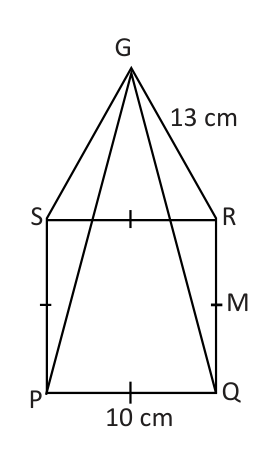
Here \( a = 10 \text{ cm} \) and \( e = 13 \text{ cm} \). The formula \( 2al \) needs the slant height, but the question gives the edge instead, so l must first be found from the right-angled triangle GMR.
Step 1: Writing the relation between the edge and the slant height:
\[ e^2 = l^2 + \left(\frac{a}{2}\right)^2 \]
Step 2: Substituting \( e = 13 \) and \( a = 10 \):
\[ 13^2 = l^2 + \left(\frac{10}{2}\right)^2 \]
Step 3: Squaring the numbers:
\[ 169 = l^2 + 25 \]
Step 4: Subtracting 25 from both sides:
\[ l^2 = 144 \]
Step 5: Taking the positive square root, since a length is positive:
\[ l = 12 \text{ cm} \]
Step 6: Finding the area of the base:
\[ A = 10^2 = 100 \text{ cm}^2 \]
Step 7: With the slant height known, finding the lateral surface area:
\[ \text{LSA} = 2 \times 10 \times 12 = 240 \text{ cm}^2 \]
Step 8: Adding the two areas:
\[ \text{TSA} = 100 + 240 = 340 \text{ cm}^2 \]
So the total surface area of the pyramid is 340 cm².
Example 3: Working Back from the Total Surface Area
Question: A square-based pyramid has total surface area 144 cm² and slant height 5 cm. Find its vertical height and the length of its edge.
Here \( \text{TSA} = 144 \text{ cm}^2 \) and \( l = 5 \text{ cm} \). Both h and e need the base side a, so a is found first.
Step 1: Putting the known values into the total surface area formula:
\[ 144 = a^2 + 2 \times a \times 5 \]
Step 2: Simplifying and moving every term to one side, which gives a quadratic equation:
\[ a^2 + 10a - 144 = 0 \]
Step 3: Splitting the middle term, because \( 18 \times 8 = 144 \) and \( 18 - 8 = 10 \):
\[ a^2 + 18a - 8a - 144 = 0 \]
Step 4: Taking the common factor out of each pair:
\[ a(a + 18) - 8(a + 18) = 0 \]
Step 5: Taking \( (a + 18) \) out as a common factor:
\[ (a + 18)(a - 8) = 0 \]
Step 6: Either \( a + 18 = 0 \), giving \( a = -18 \), or \( a - 8 = 0 \), giving \( a = 8 \). A length cannot be negative, so \( a = -18 \) is rejected and:
\[ a = 8 \text{ cm} \]
Step 7: For the vertical height, writing the relation between the slant height and the vertical height:
\[ l^2 = h^2 + \left(\frac{a}{2}\right)^2 \]
Step 8: Substituting \( l = 5 \) and \( \frac{a}{2} = 4 \), and squaring:
\[ 25 = h^2 + 16 \]
Step 9: Subtracting 16 from both sides and taking the positive square root:
\[ h^2 = 9 \]
\[ h = 3 \text{ cm} \]
Step 10: For the edge, substituting into the relation between the edge and the slant height:
\[ e^2 = 5^2 + 4^2 = 25 + 16 = 41 \]
Step 11: Taking the positive square root:
\[ e = \sqrt{41} \text{ cm} \]
So the vertical height is 3 cm and the edge is \( \sqrt{41} \text{ cm} \). Since 41 is not a perfect square, the answer is left as a square root.
Example 4: Slant Height and Vertical Height from the Lateral Surface Area
Question: A square-based pyramid has base side 12 cm and lateral surface area 240 cm². Find its slant height and its vertical height.
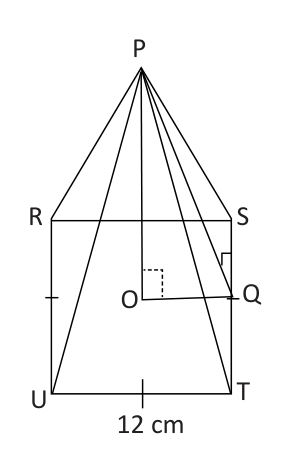
Here \( a = 12 \text{ cm} \) and \( \text{LSA} = 240 \text{ cm}^2 \). The only unknown in the lateral surface area formula is l, so l is found first.
Step 1: Putting the known values into \( \text{LSA} = 2al \):
\[ 240 = 2 \times 12 \times l \]
Step 2: Dividing both sides by \( 2 \times 12 = 24 \):
\[ l = \frac{240}{24} = 10 \text{ cm} \]
Step 3: For the vertical height, substituting \( l = 10 \) and \( \frac{a}{2} = 6 \) into the relation for triangle POQ:
\[ 10^2 = h^2 + 6^2 \]
Step 4: Squaring the numbers:
\[ 100 = h^2 + 36 \]
Step 5: Subtracting 36 from both sides:
\[ h^2 = 64 \]
Step 6: Taking the positive square root:
\[ h = 8 \text{ cm} \]
So the slant height is 10 cm and the vertical height is 8 cm. The slant height came out longer than the vertical height, exactly as it must.
All the Formulas Together
| Quantity | Formula |
| Area of the base | \( A = a^2 \) |
| One triangular face | \( \frac{1}{2}al \) |
| Lateral surface area | \( 2al \) |
| Total surface area | \( a^2 + 2al \) |
| Total surface area, factorised | \( a(a + 2l) \) |
| Slant height and vertical height | \( l^2 = h^2 + \left(\frac{a}{2}\right)^2 \) |
| Edge and slant height | \( e^2 = l^2 + \left(\frac{a}{2}\right)^2 \) |
Which formula to start from depends on what the question gives you:
- Given a and l: use \( 2al \) and \( a^2 + 2al \) directly.
- Given a and e: find l first from \( e^2 = l^2 + \left(\frac{a}{2}\right)^2 \).
- Given a and h: find l first from \( l^2 = h^2 + \left(\frac{a}{2}\right)^2 \).
- Given an area and one length: put the values into the formula and solve for the unknown. If a quadratic appears, factorise it and reject the negative root.
The full lesson is waiting for you
The notes are free to read in full. A free account opens the rest of the practice, and tracks your progress and confidence score for every subject. Presentations and videos need approval from Learn Yeti.