Solids You Already Know
A pyramid is easiest to understand when it stands beside the solids you have met before. A cylinder has two equal circular faces joined by one curved surface. A prism has two equal, parallel end faces, such as two triangles, joined by rectangles, and its cross-section stays the same along its whole length. A sphere is round in every direction, like a volleyball, and a hemisphere is exactly half of a sphere, shaped like a bowl. The formulas used with these solids are collected in the table below, where r is the radius and h is the height.
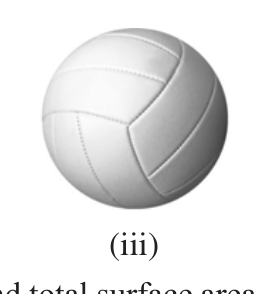
| Solid | Measurement | Formula |
| Cylinder | Curved surface area | \( 2\pi rh \) |
| Cylinder | Total surface area | \( 2\pi r(r + h) \) |
| Prism | Volume | Area of base × length |
| Sphere | Surface area | \( 4\pi r^2 \) |
| Sphere | Volume | \( \frac{4}{3}\pi r^3 \) |
| Hemisphere | Total surface area | \( 3\pi r^2 \) |
| Hemisphere | Volume | \( \frac{2}{3}\pi r^3 \) |
For instance, a cylinder of radius 7 cm and height 10 cm has curved surface area \( 2 \times \frac{22}{7} \times 7 \times 10 = 440 \) cm². A sphere and a hemisphere with equal radii have surface areas \( 4\pi r^2 \) and \( 3\pi r^2 \), so their ratio is 4 : 3. Every one of these solids has either a curved surface or two matching end faces. A pyramid has neither. It stands on a single flat base, and its sides slope inward until they meet at one point at the top.
Making a Pyramid from a Net
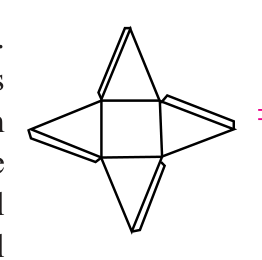
A net is a flat shape that folds up into a solid. The net of a square based pyramid is a square with one triangle standing on each of its four sides, so it looks like a four-pointed star. The thin strips along some edges are flaps left for glue. When the four triangles are folded up along the sides of the square, their tips rise above the square and come together at one point. Glue the flaps, and the flat paper has become a solid pyramid.
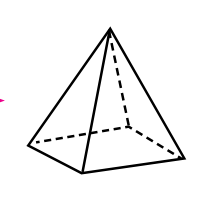
Now hold the model and count. It has 5 surfaces: 1 square at the bottom and 4 triangles around it. It has 5 vertices: the 4 corners of the square and 1 point at the top where the triangles meet. It has 8 edges: 4 around the base and 4 running up to the top point. Each triangle stands on one side of the square, and all of them lean inward to join at the same vertex.
What Is a Pyramid?
Look at pyramids made of paper, glass or wood and the same three things appear in every one. Each has a base that is a polygon, such as a triangle, a rectangle, a square or a hexagon. Every other surface is a triangle, and these triangular surfaces are called lateral surfaces. All the lateral surfaces meet at one common vertex.
Pyramid: a three dimensional solid object having a polygonal base and one common vertex to its lateral surfaces.
Lateral surface: any triangular surface of a pyramid other than its base; one side of it is a side of the base and its top corner is the common vertex.
When the common vertex sits directly above the centre of the base, the pyramid is called a right pyramid. If a right pyramid has a regular polygon as its base, meaning all the sides of the base are equal, then all its lateral surfaces are congruent. The vertical line dropped from the vertex to the base is perpendicular to the surface of the base, and its length is the vertical height of the pyramid.
Every pyramid = one polygonal base + triangular lateral surfaces + one common vertex where they all meet.
Pyramids Named by Their Base
The lateral surfaces of every pyramid are triangles, so they cannot tell one pyramid from another. A pyramid is therefore named after the shape of its base: a triangular based pyramid has a triangle for its base, a square based pyramid has a square, and so on. In the four pyramids below, look at the small marks on the sides of each base. Sides carrying the same mark are equal.
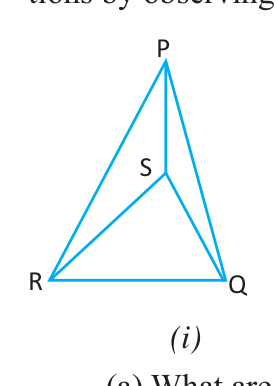
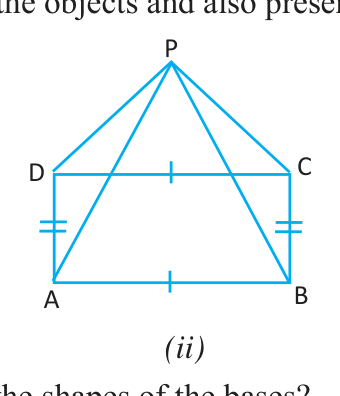
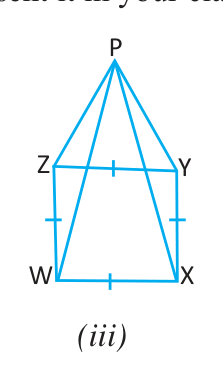
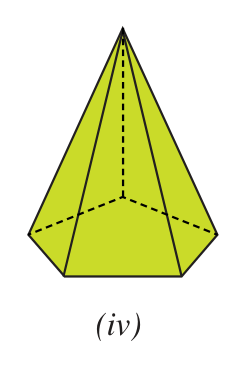
| Shape of base | Lateral surfaces | Total surfaces | Vertices | Edges |
| Triangle (PQRS) | 3 | 4 | 4 | 6 |
| Rectangle (PABCD) | 4 | 5 | 5 | 8 |
| Square (PWXYZ) | 4 | 5 | 5 | 8 |
| Hexagon | 6 | 7 | 7 | 12 |
The table shows a pattern. A pyramid has as many lateral surfaces as its base has sides, because one triangle stands on each side. It has one more vertex than its base has corners, because the common vertex at the top is added. Now look at which surfaces are congruent. The base of PWXYZ is a square, so all four lateral surfaces are congruent. In PABCD, AB = DC and AD = BC, but AB is not equal to BC. So the opposite surfaces PAB and PDC are congruent, PAD and PBC are congruent, but PAB and PBC are not. A right pyramid on an equilateral triangle or a regular hexagon also has all its lateral surfaces congruent.
Parts of a Pyramid
Take a right pyramid PABCD whose base ABCD is a square of side a. O is the centre of the base, the point where the diagonals of the square cross. M is the midpoint of the side BC. The four main measurements of the pyramid are written e, l, h and a.
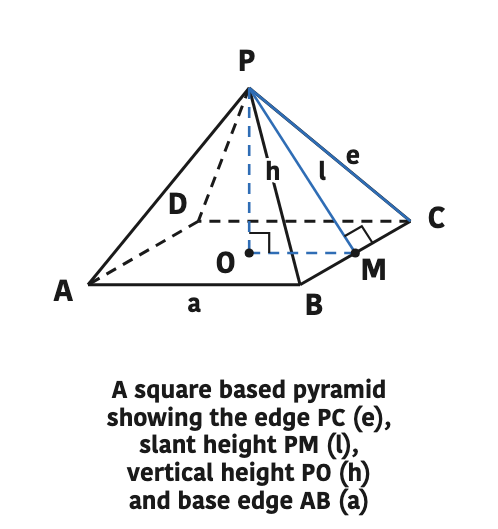
Vertical height, h: the perpendicular distance from the vertex of the pyramid to its base. In the figure it is PO.
Slant height, l: the distance from the vertex to the midpoint of a side of the base, which is the height of one lateral surface. In the figure it is PM.
Edge, e: the line segment joining the vertex to a corner of the base. In the figure it is PC.
Length of edge of base, a: the length of one side of the base. In the figure it is AB.
These measurements sit inside two right angled triangles. PO stands straight up from the base, so it makes a right angle with every line on the base that passes through O, including OM. So in triangle POM, ∠POM = 90°. In a right pyramid PB = PC, so triangle PBC is isosceles, and the line from the top of an isosceles triangle to the midpoint of its base is perpendicular to that base. So in triangle PMC, ∠PMC = 90°. Two lengths matter as well. O is the centre of the square and M is the midpoint of BC, so OM is parallel to AB and half as long: \( OM = \frac{1}{2}AB = \frac{1}{2}a \). Because M is the midpoint of BC, \( MC = \frac{1}{2}BC = \frac{1}{2}a \) too.
The slant height is not the edge. The edge PC runs from the vertex to a corner of the base, while the slant height PM runs only to the middle of a side. And the slant height lies along a sloping face, while the vertical height PO runs straight down inside the pyramid to the centre of the base.
Relation Between Slant Height and Vertical Height
Lift triangle POM out of the pyramid and look at it on its own. Its sides are the vertical height h, half the base edge \( \frac{a}{2} \), and the slant height l. The right angle is at O, so the Pythagoras theorem applies.
Step 1: Applying the Pythagoras theorem in the right angled triangle POM:
\[ (PM)^2 = (PO)^2 + (OM)^2 \]
Step 2: Putting in the letters, since PM = l, PO = h and \( OM = \frac{1}{2}AB = \frac{1}{2}a \):
\[ l^2 = h^2 + \left(\frac{a}{2}\right)^2 \]
The slant height is the hypotenuse of triangle POM, so it is always longer than the vertical height.
Relation Between Edge and Slant Height
Now look at triangle PMC, which is half of the lateral surface PBC. Its sides are the slant height l, half the base edge \( \frac{a}{2} \), and the edge e. The right angle is at M.
Step 1: Applying the Pythagoras theorem in the right angled triangle PMC:
\[ (PC)^2 = (PM)^2 + (MC)^2 \]
Step 2: Putting in the letters, since PC = e, PM = l and \( MC = \frac{1}{2}BC = \frac{1}{2}a \):
\[ e^2 = l^2 + \left(\frac{a}{2}\right)^2 \]
The two relations can also be joined. Replacing \( l^2 \) by \( h^2 + \left(\frac{a}{2}\right)^2 \) brings in the square of \( \frac{a}{2} \) twice, and \( \frac{a^2}{4} + \frac{a^2}{4} = \frac{a^2}{2} \). So the edge can be found straight from the vertical height:
\[ e^2 = h^2 + \frac{a^2}{2} \]
This also shows that in a right pyramid h < l < e always: the vertical height is the shortest of the three and the edge is the longest.
Both relations add the square of half the base edge, \( \frac{a}{2} \), not the whole edge a. OM and MC are each only half a side. Using a instead gives an answer that is far too large.
Worked Examples
Example 1: A square based pyramid has a base edge of 12 cm and a vertical height of 8 cm. Find its slant height and its edge.
Step 1: Writing what is given: a = 12 cm, so \( \frac{a}{2} = 6 \) cm, and h = 8 cm. The relation for slant height is:
\[ l^2 = h^2 + \left(\frac{a}{2}\right)^2 \]
Step 2: Substituting h = 8 and \( \frac{a}{2} = 6 \):
\[ l^2 = 8^2 + 6^2 = 64 + 36 = 100 \]
Step 3: Taking the positive square root, because a length cannot be negative:
\[ l = \sqrt{100} = 10 \text{ cm} \]
Step 4: Using the edge relation with l = 10 and \( \frac{a}{2} = 6 \):
\[ e^2 = 10^2 + 6^2 = 100 + 36 = 136 \]
Step 5: Taking the square root:
\[ e = \sqrt{136} \approx 11.66 \text{ cm} \]
So the slant height is 10 cm and the edge is about 11.66 cm. Notice that 8 < 10 < 11.66, which is h < l < e as expected.
Example 2: A square based pyramid has an edge of 13 cm and a base edge of 10 cm. Find its slant height and its vertical height.
Step 1: Here a = 10 cm, so \( \frac{a}{2} = 5 \) cm, and e = 13 cm. Rearranging the edge relation to make \( l^2 \) the subject:
\[ l^2 = e^2 - \left(\frac{a}{2}\right)^2 \]
Step 2: Substituting e = 13 and \( \frac{a}{2} = 5 \):
\[ l^2 = 13^2 - 5^2 = 169 - 25 = 144 \]
Step 3: Taking the positive square root:
\[ l = \sqrt{144} = 12 \text{ cm} \]
Step 4: Rearranging the slant height relation to make \( h^2 \) the subject:
\[ h^2 = l^2 - \left(\frac{a}{2}\right)^2 \]
Step 5: Substituting l = 12 and \( \frac{a}{2} = 5 \):
\[ h^2 = 144 - 25 = 119 \]
Step 6: Taking the square root:
\[ h = \sqrt{119} \approx 10.91 \text{ cm} \]
So the slant height is 12 cm and the vertical height is about 10.91 cm.
Example 3: A square based pyramid has a slant height of 17 cm and a vertical height of 15 cm. Find the length of the edge of its base.
Step 1: Rearranging the slant height relation to make \( \left(\frac{a}{2}\right)^2 \) the subject:
\[ \left(\frac{a}{2}\right)^2 = l^2 - h^2 \]
Step 2: Substituting l = 17 and h = 15:
\[ \left(\frac{a}{2}\right)^2 = 289 - 225 = 64 \]
Step 3: Taking the square root gives half the base edge:
\[ \frac{a}{2} = 8 \]
Step 4: Multiplying both sides by 2 gives the whole base edge:
\[ a = 16 \text{ cm} \]
The 8 that comes out of the square root is half the base edge. The question asks for the whole edge, so the answer is 16 cm only after multiplying by 2.
The full lesson is waiting for you
The notes are free to read in full. A free account opens the rest of the practice, and tracks your progress and confidence score for every subject. Presentations and videos need approval from Learn Yeti.