The parts of a cone and how they are linked
A cone has a flat circular base, and from it a curved surface rises and closes at a single point called the vertex. An ice cream cone, a birthday cap and the tip of a sharpened pencil all have this shape. The cones studied here are right circular cones: the vertex sits directly above the centre of the base. Three lengths describe such a cone completely.
Vertical height (h): the straight distance from the vertex down to the centre of the base. This line meets the base at a right angle.
Slant height (l): the distance from the vertex to any point on the edge of the base, measured along the curved surface.
Radius of the base (r): the distance from the centre of the circular base to its edge. It is half of the diameter.
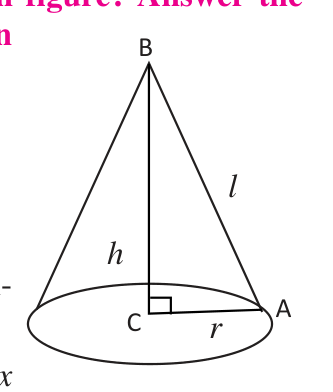
In the cone above, the vertical height BC stands straight up from the centre C, the radius CA lies flat along the base, and the slant height BA runs down the side. These three lines form triangle BCA with its right angle at C. The slant height BA is opposite the right angle, so it is the hypotenuse. Pythagoras theorem therefore links the three measurements of every right circular cone:
\[ l^2 = h^2 + r^2 \]
Any two of the three lengths give the third. A cone with radius 6 cm and vertical height 8 cm has slant height \( l = \sqrt{8^2 + 6^2} = \sqrt{100} = 10 \) cm. A cone with slant height 25 cm and radius 7 cm has vertical height \( h = \sqrt{25^2 - 7^2} = \sqrt{576} = 24 \) cm. Being the hypotenuse, the slant height is always the longest of the three.
A figure often marks the full width of the base, from one edge through the centre to the other edge. That length is the diameter. Halve it to get r before putting it into any cone formula.
Volume of a cylinder: where the cone formula begins
The volume of a solid is the amount of space it fills. Volume is measured in cubic units such as cubic centimetres (cm³) and cubic metres (m³). The cylinder is the easiest solid to start from. Stack equal circular layers one on top of another up to the height h and you have a cylinder, so the space it fills is the area of one layer multiplied by the height:
\[ V = A \times h = \pi r^2 h \]
Here A is the area of the circular base, \( A = \pi r^2 \). For example, a cylindrical tin of radius 7 cm and height 10 cm holds \( \frac{22}{7} \times 7^2 \times 10 = 1540 \) cm³. The formula for a cone is built directly from this one.
Three cones fill one cylinder
Make a cylinder and a cone from chart paper so that they match in two ways: the same radius of base and the same vertical height. In the pair below, the radius and the height of both are marked a, so neither is bigger than the other in these two measurements.
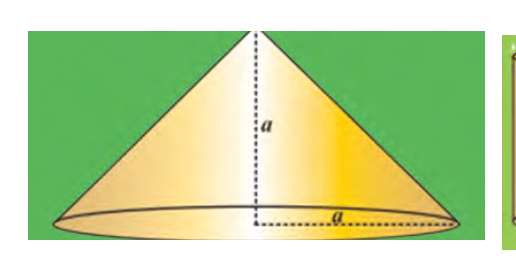
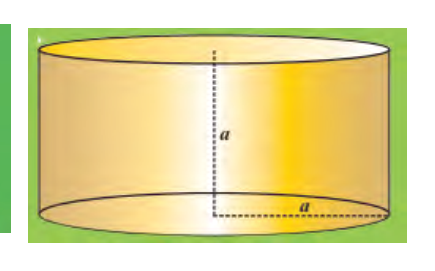
Fill the cone to the brim with sand or dry soil and empty it into the cylinder. Fill it again and keep count. The first coneful covers only the bottom part of the cylinder. The second brings the level higher. After the third coneful the cylinder is full, level with its top. As long as the base and the height match, it always takes three, never two and never four.
So a cone holds exactly one third of the cylinder with the same base and the same height. That one fact gives the formula.
Step 1: The volume of the cylinder with the same base and height is base area times height:
\[ A \times h \]
Step 2: The cone holds one third of that, so the volume of the cone is:
\[ V = \frac{1}{3} \times A \times h \]
Step 3: Replacing the base area A by the area of a circle, \( \pi r^2 \):
\[ V = \frac{1}{3}\pi r^2 h \]
Volume of a cone: the space a cone encloses. For a cone with base radius r and vertical height h, \( V = \frac{1}{3}\pi r^2 h \) cubic units. This is one third of the volume of a cylinder with the same base and the same height.
When the base area A is already known, use \( V = \frac{1}{3} \times A \times h \) directly. There is no need to find r first.
The one third rule compares a cone only with a cylinder of the same radius and the same height. If either measurement is different, the rule does not apply.
Finding the volume from radius and height
Question: find the volume of a cone whose base diameter is 12 cm and vertical height is 8 cm.
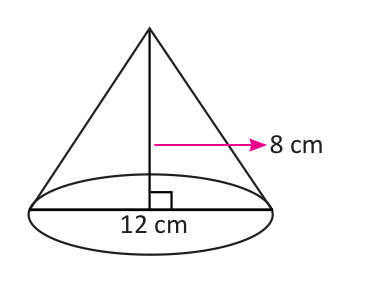
Here the diameter is 12 cm, the vertical height h is 8 cm, and the volume V is to be found.
Step 1: Halving the diameter to get the radius:
\[ r = \frac{12}{2} = 6 \text{ cm} \]
Step 2: Writing the formula for the volume of a cone:
\[ V = \frac{1}{3}\pi r^2 h \]
Step 3: Putting in r = 6 and h = 8:
\[ V = \frac{1}{3} \times \pi \times 6^2 \times 8 \]
Step 4: Since \( 6^2 = 36 \) and \( \frac{1}{3} \times 36 = 12 \), multiplying 12 by 8:
\[ V = 96\pi \text{ cm}^3 \]
Step 5: Taking \( \pi = \frac{22}{7} \) to get a decimal:
\[ V = 96 \times \frac{22}{7} \approx 301.71 \text{ cm}^3 \]
Unless a decimal is asked for, the answer can be left as 96π cm³. The unit is cubic centimetres because a volume is a length times a length times a length.
Example: when the slant height is given
Question: a cone has vertex M. The line MA from the vertex to the centre A of the base is 24 cm, and the line MN from the vertex to a point N on the edge is 26 cm. Find its volume.
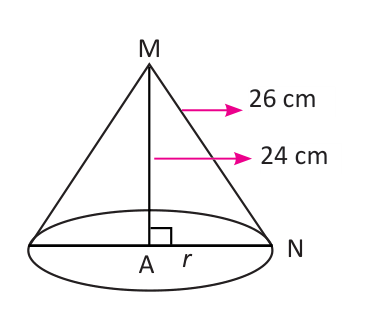
Here h = 24 cm and l = 26 cm. The radius is not given, but the right angle at A makes triangle MAN a right-angled triangle, so the radius can be found first.
Step 1: Applying Pythagoras theorem in triangle MAN, where MN is the hypotenuse:
\[ AN = \sqrt{MN^2 - MA^2} \]
Step 2: Putting in the two lengths:
\[ r = \sqrt{26^2 - 24^2} \]
Step 3: Squaring and subtracting:
\[ r = \sqrt{676 - 576} = \sqrt{100} \]
Step 4: This gives r = 10 cm. Putting r = 10 and h = 24 into the volume formula:
\[ V = \frac{1}{3} \times \frac{22}{7} \times 10^2 \times 24 \]
Step 5: Dividing 24 by 3 to get 8, then multiplying:
\[ V = \frac{22 \times 100 \times 8}{7} = \frac{17600}{7} \]
Step 6: Dividing by 7:
\[ V \approx 2514.29 \text{ cm}^3 \]
The h in \( \frac{1}{3}\pi r^2 h \) is the vertical height. Putting the slant height 26 cm in its place here gives about 2723.81 cm³, which is wrong. When a slant height is given, use it to find h or r first.
Example: finding the volume from the curved surface area
Question: the curved surface area of a cone is 1158.3 cm² and its slant height is 19.5 cm. Find its volume.
Here the curved surface area is 1158.3 cm² and l = 19.5 cm. Neither r nor h is given. The curved surface area \( \pi r l \) contains r, so r comes first, then h from Pythagoras, and only then the volume.
Step 1: Writing the curved surface area formula with the given values:
\[ \frac{22}{7} \times r \times 19.5 = 1158.3 \]
Step 2: Making r the subject:
\[ r = \frac{1158.3 \times 7}{22 \times 19.5} \]
Step 3: Working out the top and the bottom:
\[ r = \frac{8108.1}{429} = 18.9 \text{ cm} \]
Step 4: Finding the height from \( h = \sqrt{l^2 - r^2} \). Since \( 19.5^2 = 380.25 \) and \( 18.9^2 = 357.21 \), their difference is 23.04, so the height is:
\[ h = \sqrt{23.04} = 4.8 \text{ cm} \]
Step 5: Putting r = 18.9 and h = 4.8 into the volume formula:
\[ V = \frac{1}{3} \times \frac{22}{7} \times 18.9^2 \times 4.8 \]
Step 6: Since \( \frac{1}{3} \times 4.8 = 1.6 \) and \( 357.21 \times 1.6 = 571.536 \):
\[ V = \frac{22}{7} \times 571.536 \]
So the volume is about \( 1796.26 \text{ cm}^3 \). The route to remember: from the curved surface area to r, from r and l to h, and from r and h to V.
Example: when radius and height are in a ratio
Question: the radius of the base and the height of a cone are in the ratio 5 : 12, and its volume is 314.86 cm³. Find its curved surface area and total surface area.
A ratio of 5 : 12 does not give the lengths themselves, only how big one is compared with the other. So both are written using one unknown x: the radius is 5x and the height is 12x. The volume then gives an equation in x alone.
Step 1: Putting r = 5x and h = 12x into \( V = \frac{1}{3}\pi r^2 h \), with \( (5x)^2 = 25x^2 \):
\[ \frac{22 \times 25x^2 \times 12x}{3 \times 7} = 314.86 \]
Step 2: Simplifying, since \( 22 \times 25 \times 12 = 6600 \) and \( \frac{6600}{21} = \frac{2200}{7} \):
\[ \frac{2200x^3}{7} = 314.86 \]
Step 3: Making \( x^3 \) the subject:
\[ x^3 = \frac{314.86 \times 7}{2200} \approx 1.002 \]
Step 4: Taking the cube root, which comes to 1.0006 and rounds to:
\[ x \approx 1 \]
So the radius is \( 5 \times 1 = 5 \) cm and the height is \( 12 \times 1 = 12 \) cm. The tiny 0.0006 is left over only because the volume 314.86 cm³ was itself a rounded number.
Step 5: Finding the slant height by Pythagoras:
\[ l = \sqrt{12^2 + 5^2} = \sqrt{169} \]
Step 6: This gives l = 13 cm. The curved surface area, from \( \pi r l \):
\[ \pi r l = \frac{22}{7} \times 5 \times 13 \]
Step 7: The total surface area, from \( \pi r (r + l) \), where \( r + l = 5 + 13 = 18 \):
\[ \pi r (r + l) = \frac{22}{7} \times 5 \times 18 \]
Working these out, the curved surface area is \( \frac{1430}{7} \approx 204.29 \text{ cm}^2 \) and the total surface area is \( \frac{1980}{7} \approx 282.86 \text{ cm}^2 \).
Working backwards from the volume
Sometimes the volume is known and a length is missing. Multiplying both sides of the formula by 3 and dividing by the base area sets the height free:
\[ h = \frac{3V}{\pi r^2} \]
Question: a cone holds 616 cm³ and the radius of its base is 7 cm. Find its height.
Step 1: Finding the area of the base:
\[ \pi r^2 = \frac{22}{7} \times 7^2 = 154 \text{ cm}^2 \]
Step 2: Putting V = 616 and the base area into the rearranged formula:
\[ h = \frac{3 \times 616}{154} \]
Step 3: Dividing:
\[ h = \frac{1848}{154} = 12 \text{ cm} \]
Another kind of problem changes the shape without changing the amount of material. When solid cones are melted and made into one new cone, or when a solid is dropped into water and pushes some of it out, the volume stays the same. Such problems are solved by writing "volume before = volume after".
Melting, recasting and immersing never change the volume.
Question: two solid cones of the same height h have base radii 3 cm and 4 cm. They are melted and made into one cone of the same height. Find its radius R.
Step 1: Adding the two volumes and taking out the common \( \frac{1}{3}\pi h \):
\[ \frac{1}{3}\pi h(9 + 16) = \frac{25}{3}\pi h \]
Step 2: Setting the new cone's volume equal to this total:
\[ \frac{1}{3}\pi R^2 h = \frac{25}{3}\pi h \]
Step 3: Cancelling \( \frac{1}{3}\pi h \) from both sides:
\[ R^2 = 25 \]
So R = 5 cm. The height cancelled from both sides, which is why it never needed a value.
How radius and height change the volume
In \( \frac{1}{3}\pi r^2 h \) the radius is squared but the height is not. So the two measurements affect the volume differently. Doubling the height while keeping the radius only doubles the volume. Doubling the radius while keeping the height makes the volume \( 2^2 = 4 \) times as much. Doubling both makes it \( 2^2 \times 2 = 8 \) times as much.
| Change | Volume becomes |
| Height doubled, radius the same | 2 times |
| Radius doubled, height the same | 4 times |
| Radius tripled, height the same | 9 times |
| Radius and height both doubled | 8 times |
Cones to practise on
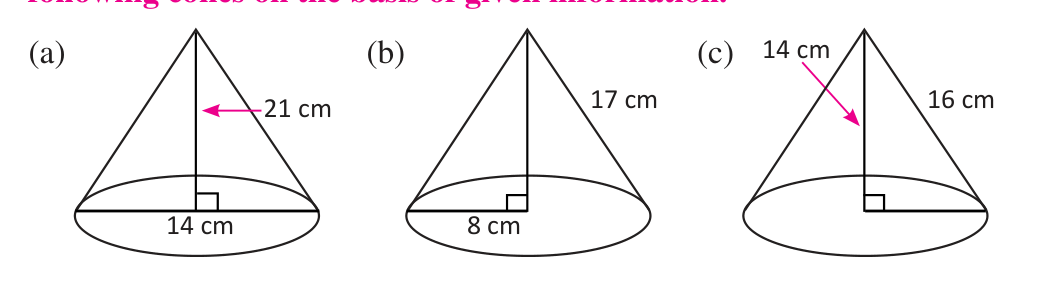
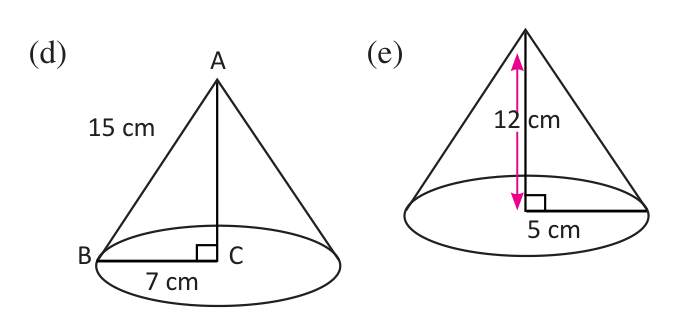
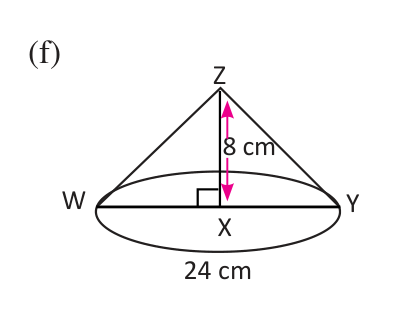
Each cone below gives two of the three lengths r, h and l. For each one, first find the missing length from \( l^2 = h^2 + r^2 \), then find the curved surface area, the total surface area and the volume. Read each measurement carefully: some mark the diameter and some the radius, some the vertical height and some the slant height.
- Cone (a): base diameter 14 cm, vertical height 21 cm.
- Cone (b): base radius 8 cm, slant height 17 cm.
- Cone (c): vertical height 14 cm, slant height 16 cm.
- Cone (d): slant height AB = 15 cm, base radius BC = 7 cm.
- Cone (e): vertical height 12 cm, base radius 5 cm.
- Cone (f): base diameter WY = 24 cm, vertical height ZX = 8 cm.
All the cone formulas in one place
These five formulas are needed again and again in cone problems. Only the volume formula uses the vertical height h; both surface formulas use the slant height l.
| Quantity | Formula |
| Slant height | \( l = \sqrt{h^2 + r^2} \) |
| Area of base | \( \pi r^2 \) |
| Curved surface area | \( \pi r l \) |
| Total surface area | \( \pi r (r + l) \) |
| Volume | \( \frac{1}{3}\pi r^2 h \) |
The full lesson is waiting for you
The notes are free to read in full. A free account opens the rest of the practice, and tracks your progress and confidence score for every subject. Presentations and videos need approval from Learn Yeti.