Solids Built from Two or More Solids
Look around a classroom or a market and you will find many objects that are not a single cylinder, cone or sphere. A circus tent has straight round walls and a pointed roof. An ice cream in a cone has a round scoop sitting on a pointed wafer. A sharpened pencil has a long round body and a pointed tip. Each of these is made by joining two simple solids.
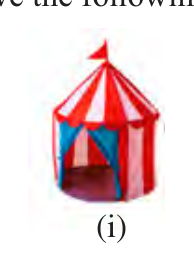
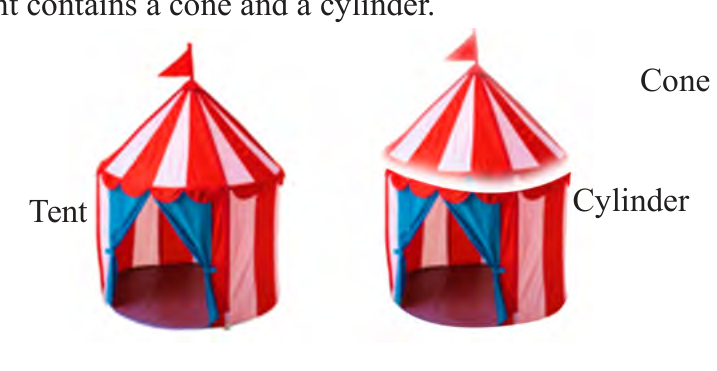
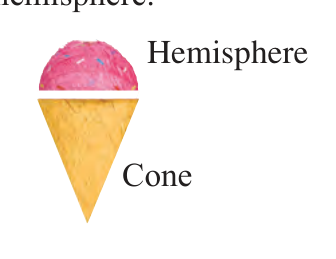
The roof of the tent is a cone and its walls are a cylinder. Both parts have the same circular edge where they meet. An ice cream works the same way: the scoop on top is a hemisphere, which is half of a sphere, and the wafer below it is a cone.
A sharpened pencil is a cylinder with a cone at its tip. In every one of these objects the parts are three dimensional solids you already know how to measure one at a time. A solid made this way has its own name.
A combined solid object is a solid made of two or more three dimensional solids joined together. Example: a tent, made of a cylinder and a cone.
What Changes When Two Solids Are Joined
Picture a solid cone and a solid hemisphere of the same radius lying apart on a table. Each has a flat circular face. Now press them together so that the two circles meet exactly. Those circles are now inside the object. You cannot touch them, you cannot paint them, and water poured over the solid never reaches them.
This gives the two rules the whole topic rests on. The volume of a combined solid is the sum of the volumes of its parts, because joining the parts neither adds space nor removes it. Surface area behaves differently: only the faces still on the outside count, so the hidden joining faces are left out.
Volume: add the volumes of all the parts. Surface area: add only the outer surfaces, and leave out every face where two solids meet.
The total surface area (TSA) of a combined solid is the area of all its outer faces, flat and curved together. Faces hidden where the solids are joined are not included.
Some combined solids keep a flat face on the outside, such as the floor of a tent or the flat end of a pencil. For these, the total surface area is the curved or side surfaces plus that flat base. Others, such as an ice cream or two cones joined base to base, have no flat face left at all, so their total surface area is only their curved surfaces. This is why the total surface area and the lateral (side) surface area are equal for some combined solids and not for others.
The slant height (l) of a cone or a pyramid is the length measured along its sloping surface from the top vertex to the edge of the base. For a cone it is found from \( l = \sqrt{h^2 + r^2} \), where h is the vertical height and r the radius.
Cylinder and Cone
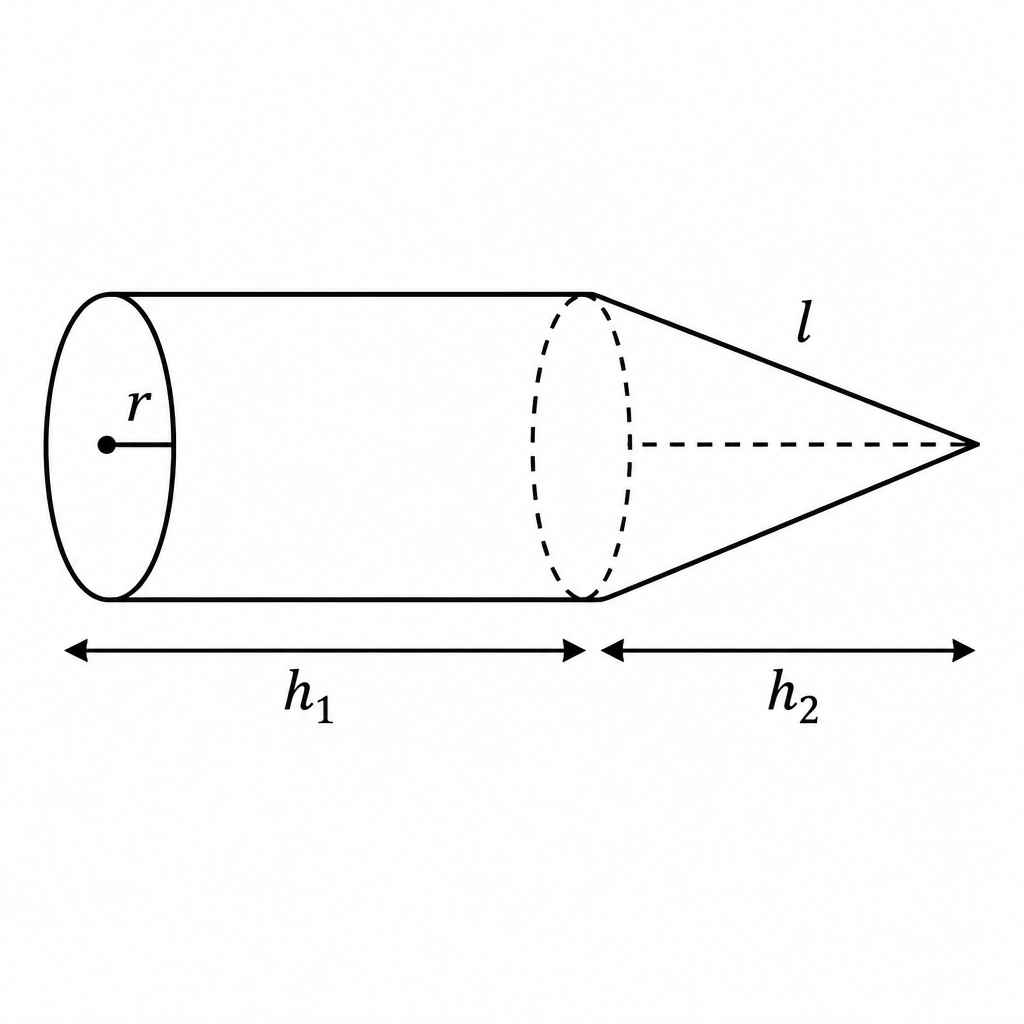
Take a cylinder with a cone fixed to one end, like a pencil. Call the common radius \( r \), the height of the cylinder \( h_1 \), the vertical height of the cone \( h_2 \) and the slant height of the cone \( l \). The outside of this solid has three pieces:
- the flat circular base at the free end of the cylinder: \( \pi r^2 \)
- the curved surface of the cylinder: \( 2\pi r h_1 \)
- the curved surface of the cone: \( \pi r l \)
Adding the three pieces gives the total surface area:
\[ \text{TSA} = \pi r^2 + 2\pi r h_1 + \pi r l \]
Taking \( \pi r \) out as a common factor:
\[ \text{TSA} = \pi r (r + 2h_1 + l) \]
The circle where the cone meets the cylinder is inside the solid. Do not add a second \( \pi r^2 \) for it. The only flat face on the outside is the free end of the cylinder.
The volume is the volume of the cylinder plus the volume of the cone:
\[ V = \pi r^2 h_1 + \frac{1}{3}\pi r^2 h_2 \]
Taking \( \pi r^2 \) out of both terms:
\[ V = \pi r^2 \left(h_1 + \frac{1}{3} h_2\right) \]
Example 1: A pencil is a cylinder of radius 7 cm and length 39 cm, with a cone 24 cm high at its tip. Find the total surface area and the volume of the pencil. Take \( \pi = \frac{22}{7} \).
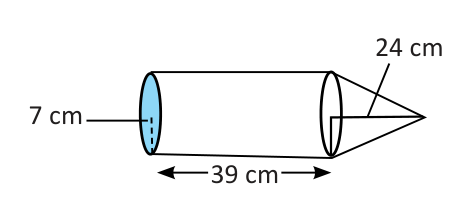
Here \( r = 7 \) cm, \( h_1 = 39 \) cm and \( h_2 = 24 \) cm.
Step 1: Finding the slant height of the cone with Pythagoras' theorem, because the cone's curved surface needs \( l \):
\[ l = \sqrt{24^2 + 7^2} = \sqrt{625} = 25 \text{ cm} \]
Step 2: Substituting into \( \text{TSA} = \pi r (r + 2h_1 + l) \). Since \( \frac{22}{7} \times 7 = 22 \), this becomes:
\[ \text{TSA} = 22 \times (7 + 78 + 25) \]
Step 3: Adding inside the bracket, then multiplying:
\[ \text{TSA} = 22 \times 110 = 2420 \text{ cm}^2 \]
Step 4: Substituting into \( V = \pi r^2 (h_1 + \frac{1}{3} h_2) \):
\[ V = \frac{22}{7} \times 7^2 \times \left(39 + \frac{1}{3} \times 24\right) \]
Step 5: Since \( \frac{22}{7} \times 49 = 154 \) and \( \frac{1}{3} \times 24 = 8 \), multiplying out:
\[ V = 154 \times 47 = 7238 \text{ cm}^3 \]
So the pencil has a total surface area of 2420 cm² and a volume of 7238 cm³.
Cone and Hemisphere
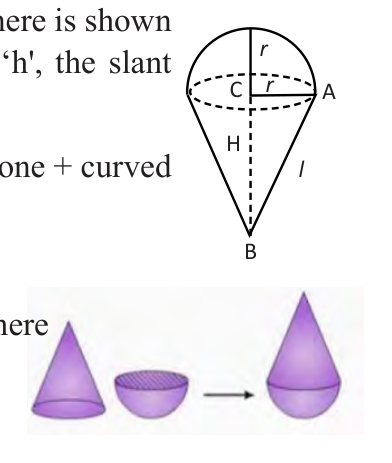
Here the cone and the hemisphere share the radius \( r \). Let the vertical height of the cone be \( h \) (marked H in the diagram) and its slant height be \( l \). Once they are joined, no flat face is left outside. The outside is the curved surface of the cone and the curved surface of the hemisphere. The curved surface of a hemisphere is half that of a sphere, which is \( 2\pi r^2 \). So:
\[ \text{TSA} = \pi r l + 2\pi r^2 = \pi r (l + 2r) \]
The volume of a hemisphere is \( \frac{2}{3}\pi r^3 \), half of the sphere's \( \frac{4}{3}\pi r^3 \). Adding the cone:
\[ V = \frac{1}{3}\pi r^2 h + \frac{2}{3}\pi r^3 \]
Because \( \frac{2}{3}\pi r^3 = \frac{1}{3}\pi r^2 \times 2r \), the factor \( \frac{1}{3}\pi r^2 \) comes out of both terms:
\[ V = \frac{1}{3}\pi r^2 (h + 2r) \]
Surface area formulas use the slant height \( l \), and volume formulas use the vertical height \( h \). If a question gives only one of them, find the other with \( l^2 = h^2 + r^2 \) before you substitute.
Example 2: An ice cream has a circular top of radius 21 cm. The cone and the hemisphere of ice cream on it have a total volume of 32340 cm³. Find:
- (a) the height of the conical part;
- (b) the total surface area.
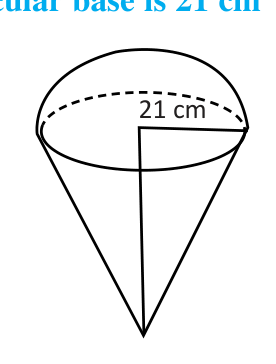
Step 1: Putting \( V = 32340 \) and \( r = 21 \) into \( V = \frac{1}{3}\pi r^2 (h + 2r) \). Since \( \frac{1}{3} \times \frac{22}{7} \times 441 = 462 \) and \( 2r = 42 \):
\[ 32340 = 462 (h + 42) \]
Step 2: Dividing both sides by 462:
\[ h + 42 = 70 \]
Step 3: Subtracting 42 from both sides:
\[ h = 28 \text{ cm} \]
Step 4: Finding the slant height, which the surface area needs:
\[ l = \sqrt{28^2 + 21^2} = \sqrt{1225} = 35 \text{ cm} \]
Step 5: Substituting into \( \text{TSA} = \pi r (l + 2r) \). Since \( \frac{22}{7} \times 21 = 66 \):
\[ \text{TSA} = 66 \times (35 + 42) \]
Step 6: Multiplying:
\[ \text{TSA} = 66 \times 77 = 5082 \text{ cm}^2 \]
So the cone is 28 cm high and the whole ice cream has a total surface area of 5082 cm².
Cylinder and Hemisphere
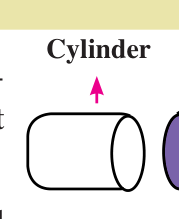
Now fix a hemisphere to one end of a cylinder, like a pillar with a dome on top. Let the radius be \( r \) and the height of the cylindrical part be \( h \). The outside has three pieces: the flat base of the cylinder, the curved surface of the cylinder and the curved surface of the hemisphere.
\[ \text{TSA} = \pi r^2 + 2\pi r h + 2\pi r^2 \]
The two \( r^2 \) terms combine, because \( \pi r^2 + 2\pi r^2 = 3\pi r^2 \):
\[ \text{TSA} = 2\pi r h + 3\pi r^2 \]
The volume is the cylinder plus the hemisphere:
\[ V = \pi r^2 h + \frac{2}{3}\pi r^3 \]
\[ V = \pi r^2 \left(h + \frac{2}{3} r\right) \]
Example: A solid pillar is a cylinder of radius 7 cm and height 10 cm, with a hemisphere of the same radius on top. Find its total surface area and volume.
Step 1: Curved surface of the cylinder, \( 2\pi r h \):
\[ 2 \times \frac{22}{7} \times 7 \times 10 = 440 \text{ cm}^2 \]
Step 2: The flat base and the hemisphere together, \( 3\pi r^2 \):
\[ 3 \times \frac{22}{7} \times 7^2 = 462 \text{ cm}^2 \]
Step 3: Adding the two parts for the total surface area:
\[ \text{TSA} = 440 + 462 = 902 \text{ cm}^2 \]
Step 4: Substituting into \( V = \pi r^2 (h + \frac{2}{3} r) \). Since \( \frac{22}{7} \times 49 = 154 \) and \( \frac{2}{3} \times 7 = \frac{14}{3} \):
\[ V = 154 \times \left(10 + \frac{14}{3}\right) \]
Step 5: Adding inside the bracket, \( 10 + \frac{14}{3} = \frac{44}{3} \), then multiplying:
\[ V = \frac{6776}{3} \approx 2258.67 \text{ cm}^3 \]
Cone and Cone
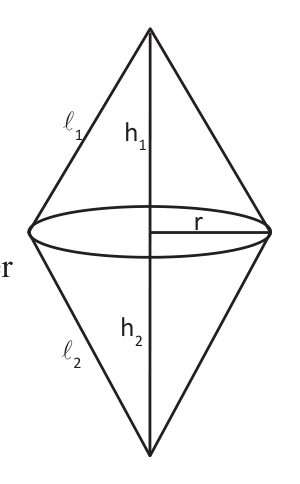
Two cones can be joined along a common circular base, one pointing up and one pointing down. They share the radius \( r \). The upper cone has vertical height \( h_1 \) and slant height \( l_1 \), and the lower cone has vertical height \( h_2 \) and slant height \( l_2 \). The two bases are pressed together inside, so the outside is only the two curved surfaces:
\[ \text{TSA} = \pi r l_1 + \pi r l_2 = \pi r (l_1 + l_2) \]
Adding the two cone volumes and taking out \( \frac{1}{3}\pi r^2 \):
\[ V = \frac{1}{3}\pi r^2 h_1 + \frac{1}{3}\pi r^2 h_2 \]
\[ V = \frac{1}{3}\pi r^2 (h_1 + h_2) \]
The volume needs only \( h_1 + h_2 \), the length of the solid from one tip to the other. The two heights are not needed separately.
Example 3: Two cones share a circular base of diameter 6 cm, and the solid is 20 cm long from tip to tip. Find its volume.
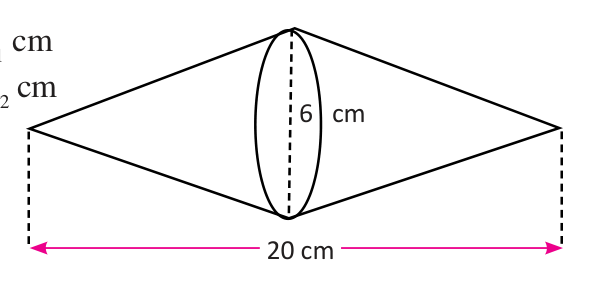
Step 1: Halving the diameter to get the radius:
\[ r = \frac{6}{2} = 3 \text{ cm} \]
Step 2: The full length is the two heights together:
\[ h_1 + h_2 = 20 \text{ cm} \]
Step 3: Substituting into \( V = \frac{1}{3}\pi r^2 (h_1 + h_2) \):
\[ V = \frac{1}{3} \times \frac{22}{7} \times 3^2 \times 20 \]
Step 4: Multiplying the numerators, \( 22 \times 9 \times 20 = 3960 \), over \( 3 \times 7 = 21 \):
\[ V = \frac{3960}{21} \approx 188.57 \text{ cm}^3 \]
A measurement across the whole circle is a diameter. Halve it before using it as \( r \). Using 6 cm instead of 3 cm here would make the volume four times too big.
Prism and Pyramid
A square based pyramid can stand on a square based prism with the same base, like the top of a stupa or the cap of a tower. Let the side of the square base be \( a \), the height of the prism \( h_1 \), the vertical height of the pyramid \( h_2 \) and the slant height of the pyramid \( l \). The base has area \( A = a^2 \) and perimeter \( p = 4a \).
The outside is the square base at the bottom, the four rectangular side faces of the prism and the four triangular faces of the pyramid. The top of the prism is covered by the pyramid, so it is not counted.
The lateral surface area of a prism or a pyramid is the area of its side faces only, leaving out the base and the top. For a prism it is \( p \times h \), the perimeter of the base times the height. For a square based pyramid it is \( 2al \).
Each triangular face of the pyramid has base \( a \) and height \( l \), so its area is \( \frac{1}{2} a l \). Four such faces make \( 2al \). Adding the base, the prism's sides and the pyramid's sides:
\[ \text{TSA} = a^2 + p \times h_1 + 2al \]
The volume is the prism plus the pyramid, and a pyramid holds one third of a prism with the same base and height:
\[ V = A h_1 + \frac{1}{3} A h_2 \]
\[ V = a^2 \left(h_1 + \frac{1}{3} h_2\right) \]
The slant height of the pyramid comes from a right angled triangle inside it. The vertical height \( h_2 \) is one side, half the base \( \frac{a}{2} \) is the other, and \( l \) is the hypotenuse:
\[ l = \sqrt{h_2^2 + \left(\frac{a}{2}\right)^2} \]
Example 4: A stupa has a lower part shaped like a square based prism and an upper part shaped like a square based pyramid. The side of the base is 2 m, the prism part is 5 m high and the whole stupa is 5.5 m high. Find:
- (a) the volume of the stupa;
- (b) the total surface area of the stupa.
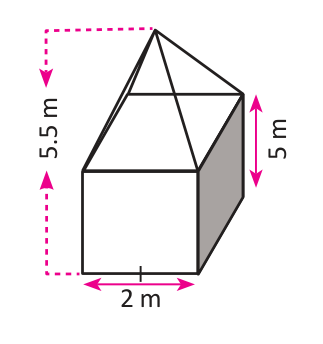
Here \( a = 2 \) m and \( h_1 = 5 \) m. The pyramid's height is the total height minus the prism's: \( h_2 = 5.5 - 5 = 0.5 \) m.
Step 1: Area of the square base:
\[ A = a^2 = 2^2 = 4 \text{ m}^2 \]
Step 2: Volume of the prism part:
\[ V_1 = A \times h_1 = 4 \times 5 = 20 \text{ m}^3 \]
Step 3: Volume of the pyramid part:
\[ V_2 = \frac{1}{3} \times 4 \times 0.5 = \frac{2}{3} \text{ m}^3 \]
Step 4: Adding the two volumes:
\[ V = 20 + \frac{2}{3} \approx 20.67 \text{ m}^3 \]
Step 5: For the surface area, the perimeter of the base:
\[ p = 4a = 4 \times 2 = 8 \text{ m} \]
Step 6: Slant height of the pyramid, with half the base \( \frac{a}{2} = 1 \) m:
\[ l = \sqrt{0.5^2 + 1^2} = \sqrt{1.25} \text{ m} \]
Step 7: Lateral surface of the prism:
\[ p \times h_1 = 8 \times 5 = 40 \text{ m}^2 \]
Step 8: Lateral surface of the pyramid, taking \( \sqrt{1.25} \approx 1.118 \):
\[ 2al = 2 \times 2 \times 1.118 \approx 4.47 \text{ m}^2 \]
Step 9: Adding the base and both lateral surfaces:
\[ \text{TSA} = 4 + 40 + 4.47 = 48.47 \text{ m}^2 \]
So the stupa has a volume of about 20.67 m³ and a total surface area of about 48.47 m².
Two Pyramids: Finding a Missing Height
Every formula in this topic also works backwards. When the volume or the surface area is known, the formula becomes an equation, and solving it gives a missing length. The ice cream question did exactly this for the height of a cone. The same idea works for a solid made of two square based pyramids joined base to base.
Example 5: Two square based pyramids of equal height are joined base to base. Each base has side 6 cm and the total volume is 96 cm³. Find the height of each pyramid.
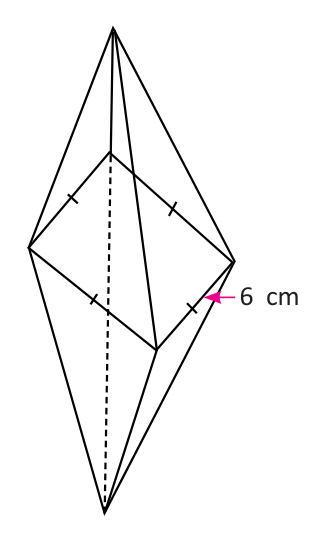
Step 1: Writing the total volume, calling each pyramid's height \( h \):
\[ V = \frac{1}{3} a^2 h + \frac{1}{3} a^2 h = \frac{2}{3} a^2 h \]
Step 2: Substituting \( V = 96 \) and \( a^2 = 36 \):
\[ 96 = \frac{2}{3} \times 36 \times h = 24h \]
Step 3: Dividing both sides by 24:
\[ h = \frac{96}{24} = 4 \text{ cm} \]
Each pyramid is 4 cm high, so the whole solid measures 8 cm from tip to tip.
All the Formulas Together
Take \( \pi = \frac{22}{7} \) unless a question says otherwise. For a cone, \( l = \sqrt{h^2 + r^2} \); for a square based pyramid, \( l = \sqrt{h^2 + (\frac{a}{2})^2} \).
- Cylinder and cone: \( \text{TSA} = \pi r(r + 2h_1 + l) \), \( V = \pi r^2 (h_1 + \frac{1}{3}h_2) \)
- Cone and hemisphere: \( \text{TSA} = \pi r(l + 2r) \), \( V = \frac{1}{3}\pi r^2 (h + 2r) \)
- Cylinder and hemisphere: \( \text{TSA} = 2\pi r h + 3\pi r^2 \), \( V = \pi r^2 (h + \frac{2}{3} r) \)
- Cone and cone: \( \text{TSA} = \pi r(l_1 + l_2) \), \( V = \frac{1}{3}\pi r^2 (h_1 + h_2) \)
- Square prism and pyramid: \( \text{TSA} = a^2 + 4a h_1 + 2al \), \( V = a^2 (h_1 + \frac{1}{3}h_2) \)
These are not five new formulas to memorise. Each one is the formulas of its parts added together, with the hidden faces left out. If you forget one, split the solid into its parts and build it again.
The full lesson is waiting for you
The notes are free to read in full. A free account opens the rest of the practice, and tracks your progress and confidence score for every subject. Presentations and videos need approval from Learn Yeti.