Lifting a Load the Easy Way
Heavy goods are loaded onto a truck and unloaded from it along a slanting plank, not by lifting them straight up. A cement sack, a gas cylinder or a drum lifted vertically demands a force equal to its whole weight, all at once. Rolled or slid along a sloping plank, the same load needs a much smaller force. There is a price for the smaller force: the load must travel a longer distance along the slope.
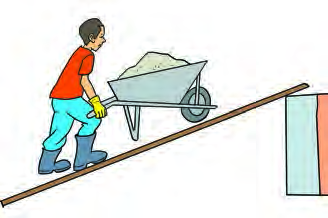
An inclined plane is a device with a sloping surface used to raise a heavy load to a higher place easily.
The inclined plane is a simple machine. Its job is to multiply force: we apply a small effort along a long sloping path, and that work raises the load through a short vertical height. Wherever a heavy thing must go up, a slope appears: a staircase, a warehouse ramp and an uphill mountain road are all inclined planes at work.
Velocity Ratio of an Inclined Plane
On an inclined plane the effort travels the whole slant length, AB = l, while the load travels only the vertical height of the plane, BC = h. Velocity ratio is the distance moved by the effort divided by the distance moved by the load. For an inclined plane it is therefore the length of the plane divided by its height:
\[ VR = \frac{l}{h} \]
The slant length of an inclined plane is always longer than its height, so its velocity ratio is always greater than 1. The larger the velocity ratio, the smaller the effort needed to raise the load.
Same Height, Different Steepness
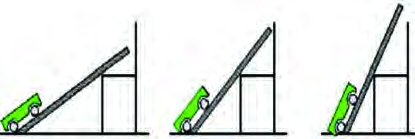
Keep the height fixed and make the inclined plane longer, and the angle it makes with the ground keeps falling. The longer the plane, the greater the distance through which the effort acts, so the machine multiplies the force more and the work becomes easier. In other words, lengthening the plane at a fixed height increases both the velocity ratio and the mechanical advantage. A short steep path demands a large force; a long gentle path needs only a small one.
Roads built on steep mountain land are given many hairpin bends so that the road becomes longer. Making the road longer for the same climb makes the slope gentler, and the force from a vehicle's engine can then pull a heavy weight uphill easily. A winding road is a long road, but that extra length is exactly what lets a small force do the climbing.

The Wedge
In daily life we watch a knife cut fruit, a curved vegetable cutter slice vegetables and an axe split firewood. Every one of these tools is an example of a wedge. The sharp edge that does the cutting is formed by two inclined planes meeting.
A wedge is a device that is thick and broad at one end while its two inclined faces narrow down to a sharp edge at the other. It is built on the principle of the inclined plane, so it is counted as a special form of the inclined plane.
When a wedge has entered an object, friction acts over a part equal to the wedge's width, so that width is the load distance. As the wedge sinks in, the distance from where the force is applied down to the buried part is the effort distance. When the wedge is driven fully into the object, its width equals the load distance and its length equals the effort distance. On an inclined plane the load moves up the slope; in a wedge the sloping surface itself moves into the object and forces it apart on both sides, but the principle is the same.
Velocity Ratio of a Wedge
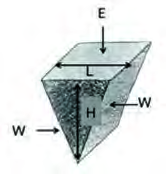
A wedge is broad and thick on one side, while on the other its two inclined planes meet in a sharp edge. That sharp part makes it easy to work against friction, the load, in the direction needed. When the wedge does its full work, the distance moved by the effort equals the wedge's depth H, and the distance moved by the load equals the thickness L of its broad part, the head. So the velocity ratio of a wedge is:
\[ VR = \frac{H}{L} \]
The deeper the wedge (large H) and the thinner its head (small L), the larger the velocity ratio. That is why a knife or an axe with a fine sharp edge cuts with so little force.
The Screw
In daily life a screw joins pieces of wood, a jack screw lifts a heavy load, and a nut and bolt clamp metal sheets together. On a screw, a sharp thread formed by two inclined planes joined together is wound round and round in a spiral. A screw is therefore called a spiral inclined plane.
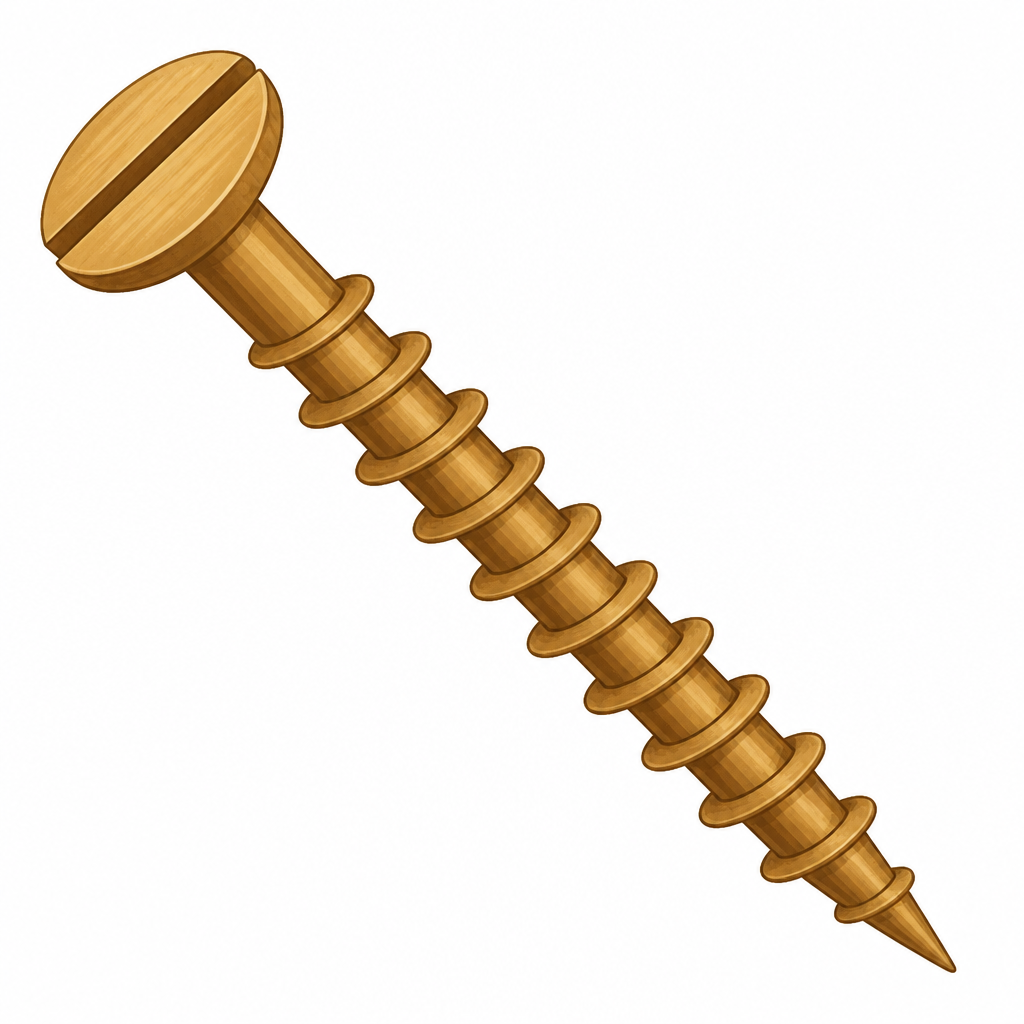
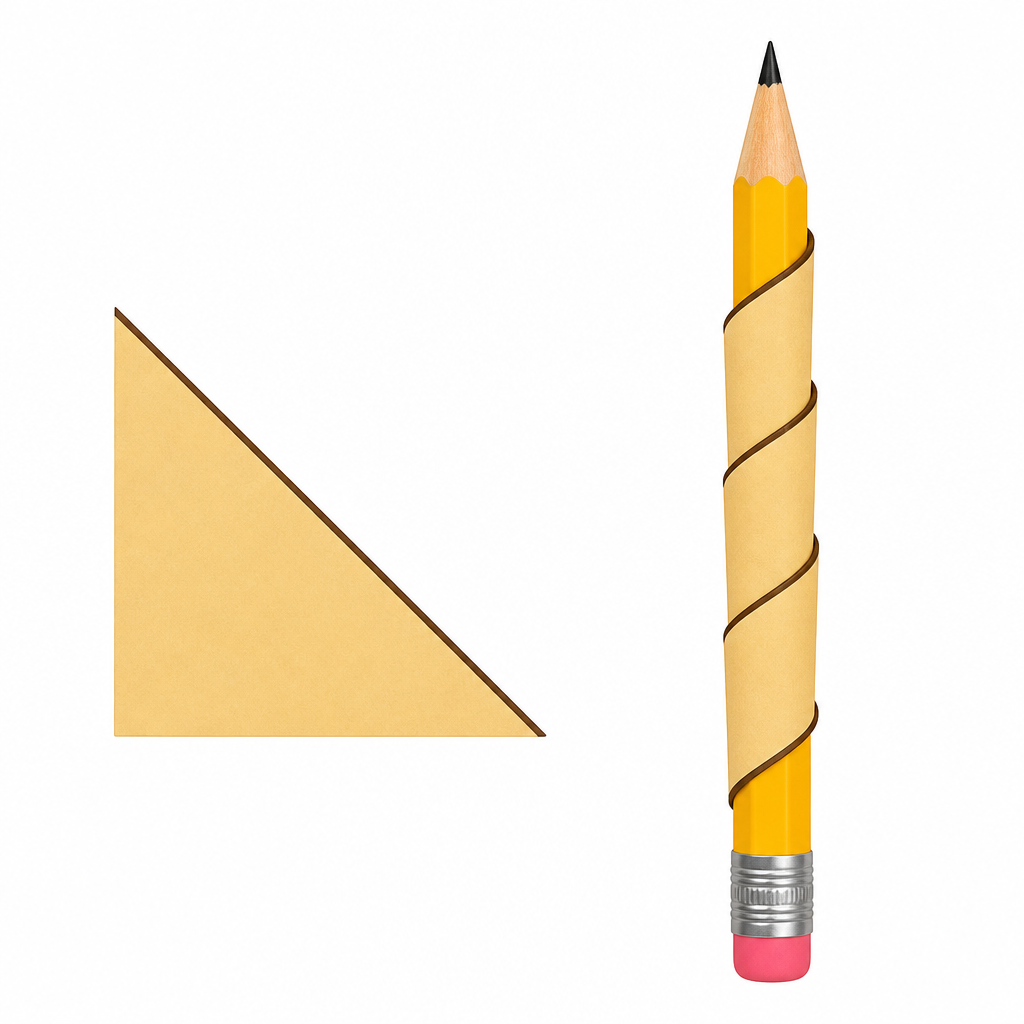
A screw is a simple machine made by winding an inclined plane round a cylindrical object shaped like a nail. The screw too is a special form of the inclined plane.
On a screw, the part between two neighbouring threads is called the pitch. One complete turn of the screw drives it into the object through a distance equal to one pitch.
Velocity Ratio of a Screw
Turn a screw whose head has radius R through one complete turn and the effort travels round a circle. The effort distance is therefore the circumference of that circular path, which is \( 2\pi R \). The load distance is the pitch P, the distance the screw sinks into the object. So the velocity ratio of a screw is:
\[ VR = \frac{2\pi R}{P} \]
The mechanical advantage of a screw depends on its pitch. The smaller the pitch, the distance between two threads, the easier the work becomes. With a small pitch the screw advances only a little in each turn, so a small force is enough. This is the secret of a jack screw lifting a whole vehicle: a large R and a small P together make the velocity ratio very large.
The Three Formulas at a Glance
| Machine | Effort distance | Load distance | Velocity ratio |
| Inclined plane | slant length l | height h | VR = l/h |
| Wedge | depth H | head thickness L | VR = H/L |
| Screw | circumference 2πR | pitch P | VR = 2πR/P |
The full lesson is waiting for you
The notes are free to read in full. A free account opens the rest of the practice, and tracks your progress and confidence score for every subject. Presentations and videos need approval from Learn Yeti.