The Wheel and Axle: A Lever That Keeps Turning
In a wheel and axle, a wheel of large radius and an axle of small radius are fixed on the same axis. When the wheel makes one full turn, the axle also makes exactly one turn, but the two do not travel equal distances. While the effort moves through the circumference of the wheel, the load moves only through the circumference of the axle. So the velocity ratio of a wheel and axle is the ratio of the circumference of the wheel to the circumference of the axle.
If the radius of the wheel is R and the radius of the axle is r, then:
\[ VR = \frac{2\pi R}{2\pi r} = \frac{R}{r} \]
So the ratio of the two radii alone fixes the velocity ratio. The greater the difference between the wheel and the axle, the larger the velocity ratio becomes.
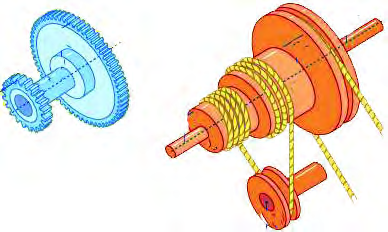
A wheel and axle is also called a continuous lever, because just as in a lever the load and the effort act on two sides of the axis, and the machine works continuously as it turns through 360 degrees.
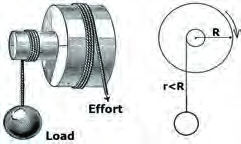
The centre of the axis can be taken as the fulcrum F of this lever. As the machine turns, the effort point A, where the rope wound on the wheel leaves the wheel, and the load point B, where the rope carrying the load leaves the axle, keep changing continuously. An ordinary lever lifts once and stops, but a wheel and axle keeps working for as long as it turns.
A Machine Magnifies Force or Speeds Up Work
A machine can also be used to lift a load in a shorter time, that is, to work faster. When the load moves through a greater distance than the effort in the same time, the machine increases the speed of the work. When the effort is applied at the axle of a wheel and axle, the wheel turns fast, which is how thread winds quickly onto a reel. This is a machine multiplying speed.
The exact opposite also happens. When the effort moves through a greater distance than the load in the same time, the machine magnifies the applied force. The small force a driver applies at the steering wheel is magnified enough to change the direction of the wheels of a very heavy vehicle. Increasing the diameter of the steering wheel increases the distance the effort moves, so trucks are given larger steering wheels than cars to magnify the force even more.
Complex Machines as Combinations of Simple Machines
Tasks of a complex nature cannot be done by one simple machine alone. Engines installed in factories carry out complicated jobs, big trucks haul heavy loads, and a bulldozer digs out roads. To do such work, several simple machines are joined and used together. A machine built this way lets us work faster, more easily and with less force.
A machine made by combining two or more simple machines is called a complex machine.
A crane is a good example: a lever and a pulley work together in it, which is why a crane can lift very heavy loads easily. Many of the machines around us are combinations of simple machines in the same way:
| Complex machine | Simple machines combined in it |
| Crane | Lever and pulley |
| Bicycle | Wheel and axle, lever, screw |
| Sewing machine | Wheel and axle, lever, wedge (the needle), screw |
Output Work and Input Work
When a pulley lifts a load, two different amounts of work are being done at the same time: the work we do on the machine by pulling the rope, and the work the machine does by raising the load. These two are given separate names.
The work obtained from a machine is its output work. Output work means the work done by the load in the machine.
Written mathematically: \( \text{Output work} = \text{Load} \times \text{Load distance} \)
The work done on a machine is its input work. Input work means the work done by the effort on the machine.
Written mathematically: \( \text{Input work} = \text{Effort} \times \text{Effort distance} \)
Efficiency
When the ratio of the work obtained from a machine to the work done on it is expressed as a percentage, it tells us what percent of the energy we spent was used in doing real work. It also tells us what percent of the energy was changed into other forms. For example, if that ratio comes to 75%, then 75% of the total energy used in pulling the machine was put to good use, and the remaining 25% was changed by friction into heat, sound and other forms of energy. The efficiency of that machine is then 75%.
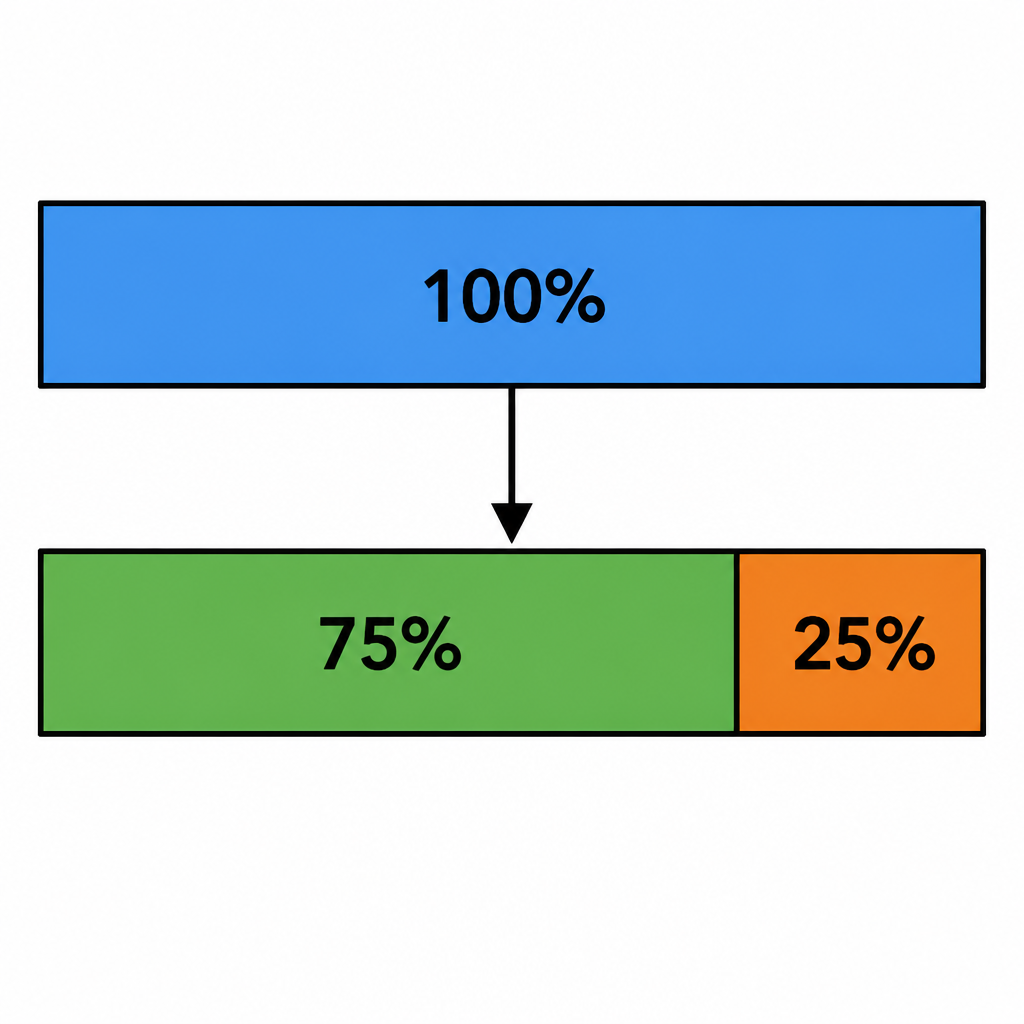
The ratio of the output work of a machine to its input work is called its efficiency. Efficiency is expressed as a percentage.
Mathematically: \( \text{Efficiency} = \frac{\text{Output work}}{\text{Input work}} \times 100\% \)
Output work is load times load distance, and input work is effort times effort distance. When the division is rearranged, the ratio of load to effort gives the mechanical advantage MA, and the ratio of effort distance to load distance gives the velocity ratio VR. So the efficiency formula can also be written like this:
\[ \eta = \frac{MA}{VR} \times 100\% \]
In the formula, MA goes on top and VR below. Writing it upside down, dividing VR by MA, gives an efficiency above 100%. No real machine can ever have an efficiency above 100%, so an answer like that is a sign the formula has been flipped.
Why Efficiency Is Never 100 Percent
In simple machines the output work is always less than the input work. For the efficiency to be 100 percent, the whole of the input work would have to be turned into output work. But friction between the moving parts of the machine changes part of the input work into heat and sound. Because of this, the efficiency of a simple machine is always below 100 percent.
Because friction increases the effort needed, in a real machine the mechanical advantage MA is always less than the velocity ratio VR.
Friction cannot be removed completely, but it can be reduced. Applying oil or grease to a machine reduces friction and raises its efficiency a little. This is why we oil a bicycle chain.
The Perfect Machine
An imaginary machine whose input work and output work are equal, so that its efficiency is 100 percent, is called a perfect machine.
In a perfect machine the mechanical advantage and the velocity ratio are also equal, and none of the input work is lost. In practice, however, a frictionless machine is impossible, so a perfect machine cannot exist in real life. It is only an imaginary standard we compare real machines against.
The full lesson is waiting for you
The notes are free to read in full. A free account opens the rest of the practice, and tracks your progress and confidence score for every subject. Presentations and videos need approval from Learn Yeti.