Machines that make work easier by turning
A kite reel is used to wind the string while flying a kite. A handle is turned to open a door, and pedals are turned to ride a bicycle. All three devices share one structure. When the large outer part is turned by hand, the small inner part joined to it turns along with it. Turning the big ring of the kite reel winds the string onto the thin rod at its centre, and turning a door handle makes the small shaft inside pull the latch. All of these are examples of the wheel and axle, and all of them make work easier.
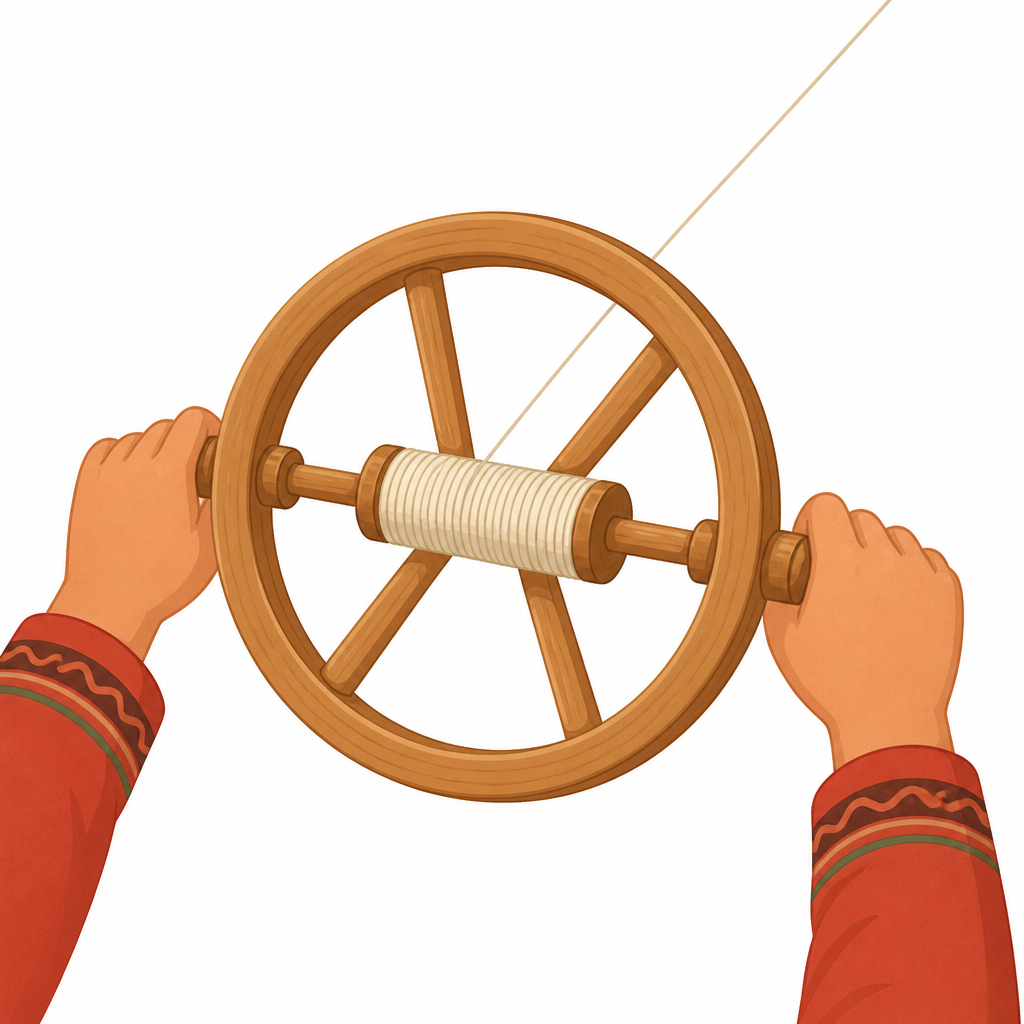
What is a wheel and axle?
A simple machine made by joining a cylinder of larger radius, called the wheel, to a cylinder of smaller radius, called the axle, so that both turn together about the same axis, is called a wheel and axle.
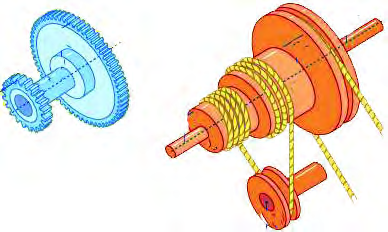
A rope is wound around the circumference of the wheel, and a load is hung from another rope wound on the axle. Pulling the wheel's rope turns the wheel, the axle turns with it, and the axle's rope lifts the load. When effort is applied at the wheel to raise a load hanging on the axle, the applied force is magnified, so a small effort can lift a large load.
Velocity ratio: R/r
When a wheel and axle makes one full turn about its axis, each cylinder winds or unwinds a length of rope equal to its own circumference. The wheel is large, so its circumference is long, and the axle is small, so its circumference is short. Therefore, while the effort covers a distance equal to the circumference of the wheel, the load covers a distance equal only to the circumference of the axle.
The velocity ratio is the distance covered by the effort divided by the distance covered by the load. For a wheel and axle this equals the circumference of the wheel divided by the circumference of the axle.
If the radius of the wheel is R and the radius of the axle is r, the circumference of the wheel is \( 2\pi R \) and the circumference of the axle is \( 2\pi r \). Therefore the velocity ratio is:
\[ \text{VR} = \frac{2\pi R}{2\pi r} = \frac{R}{r} \]
So the ratio of the radius of the wheel to the radius of the axle gives the value of the velocity ratio. The velocity ratio can be found simply by measuring the two radii, without even running the machine.
The larger the radius of the wheel and the smaller the radius of the axle, the greater the velocity ratio.
Example: The wheel of a kite reel has a radius of 30 cm and its axle has a radius of 5 cm. Let us find its velocity ratio.
Step 1: The velocity ratio is the ratio of the radius of the wheel to the radius of the axle. Putting in the values:
\[ \frac{R}{r} = \frac{30\ \text{cm}}{5\ \text{cm}} \]
Step 2: Dividing:
\[ \frac{30}{5} = 6 \]
The velocity ratio of this reel is 6, which means the effort covers 6 times more distance than the load.
The continuous lever
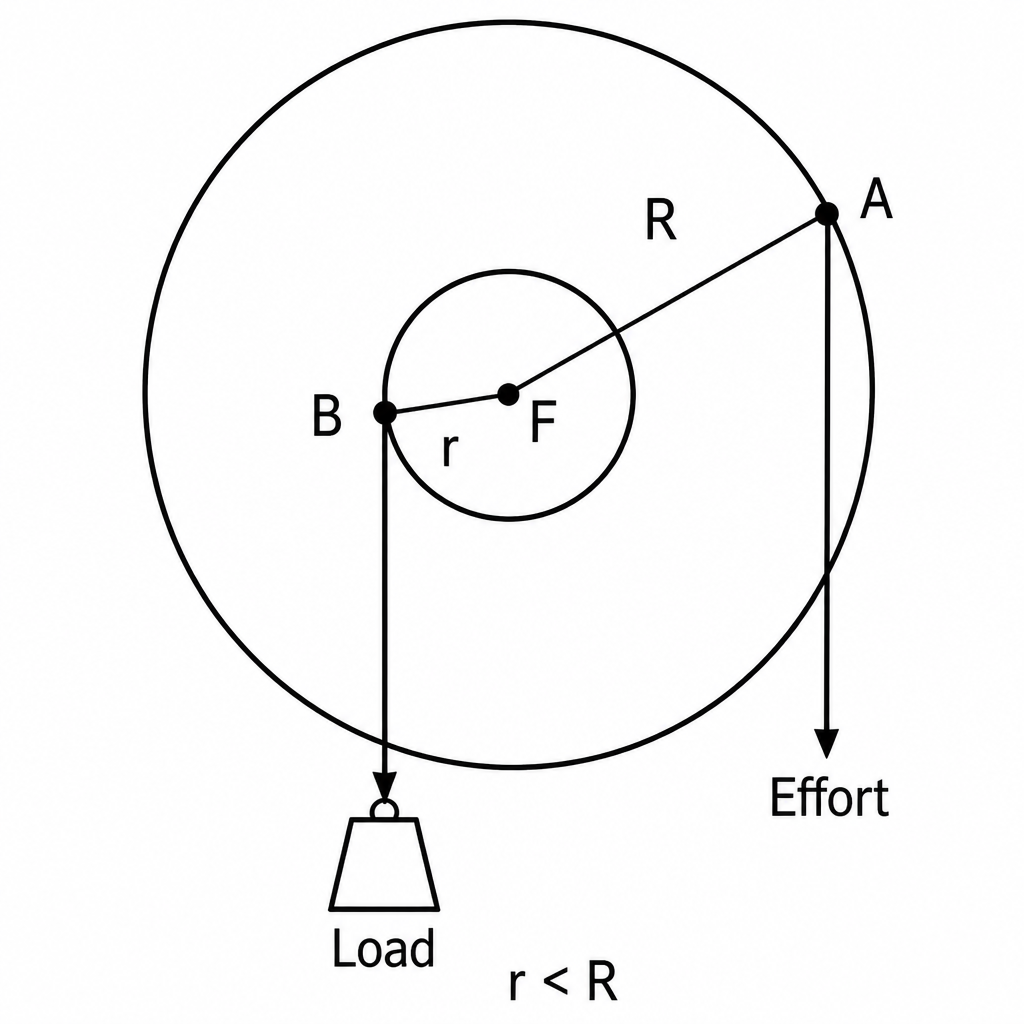
Because its load and effort lie on two sides of the axis just as in a lever, and it keeps working continuously through full 360° turns, the wheel and axle is also called a continuous lever.
The centre lying on its axis can be taken as the fulcrum F. In an ordinary lever the points where the effort and the load act stay fixed, but a wheel and axle works while turning, so the effort point A, where the rope wound on the wheel touches it, and the load point B, where the rope hanging the load touches the axle, keep changing continuously. Acting at a new pair of points every moment, it turns through 360° and works without stopping.
Faster work or a magnified force?
With a simple machine a load can be raised in a short time, that is, quickly. If in the same time the load covers more distance than the effort covers, the machine increases the speed of the work. For example, when the effort is applied from the axle side of a wheel and axle such as a kite reel, the load covers more distance than the effort in the same time. In this case the speed of the work increases, which is why the string winds onto the reel very quickly.
Exactly the opposite happens when, in the same time, the effort covers more distance than the load covers. Then the machine magnifies the applied force. For example, the force a driver applies on the steering wheel is magnified, and the direction of the wheels of a very heavy vehicle changes. This is the secret of how the small force of a driver's hands can turn a vehicle weighing several tonnes.

When the diameter of the steering wheel increases, the effort distance also increases, so the force is magnified even more. That is why the steering wheels of heavy trucks are made larger than the steering wheel of a car.
| Where the effort is applied | Which distance is greater | Result | Example |
| From the axle side | The distance the load covers | The work becomes faster | Winding string on a kite reel |
| At the wheel | The distance the effort covers | The force is magnified | Turning a steering wheel |
The velocity ratio and the mechanical advantage are not the same thing. The velocity ratio comes from the ratio of the radii, while the mechanical advantage comes from dividing the load by the effort. When writing the ratio, always put the large wheel radius R on top and the small axle radius r below. Writing it upside down gives an answer smaller than 1, which is wrong.
The full lesson is waiting for you
The notes are free to read in full. A free account opens the rest of the practice, and tracks your progress and confidence score for every subject. Presentations and videos need approval from Learn Yeti.