Simple Machines Around Us
An axe splits wood. A rotating knob opens a door. At a well, a rope passed over a pulley pulls water up. Each of these is a simple machine, a tool that makes everyday work easier. A simple machine helps in one of two ways: it lets a small force do a big job, or it changes the direction of the force so the job becomes convenient. Among them, the most familiar machine that changes the direction of a force is the pulley. You can find one at a village well and at every large building under construction.



What a Pulley Is
A pulley is a round wheel of wood, plastic or metal that can rotate freely on its own axis. A groove is cut around its rim so that a rope can sit in it.
The rope sits in the groove of the pulley. A load hangs on one end of the rope and the effort is applied on the other end. To lift a hanging weight without a pulley, we must pull the rope upward. With a pulley, the same weight rises when we pull the rope downward. The pulley makes the work convenient by changing the direction of the force, because when we pull a rope down we can add the weight of our own body to the pull.
Pulleys are used in many places: to draw water from a well, to carry construction materials to the upper floors while tall buildings are being built, and to hoist a flag up a pole. Wherever a load has to be sent upward, a pulley is useful.
Types of Pulley Systems
Pulley systems are of three kinds: fixed, movable and combined. To tell them apart, watch where the pulley wheel itself stays while the load rises.
A fixed pulley is a pulley that stays at one fixed place and rotates on its axis there. It is used to change the direction of the force.
A movable pulley is a pulley that changes its position along with the load. A movable pulley cannot change the direction of the force.
A combined pulley is a pulley system that contains both kinds of wheels. A combined pulley has at least one movable wheel and one fixed wheel.
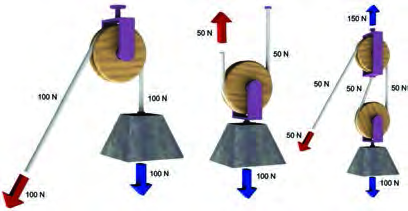
As the number of wheels in a pulley system is increased, the same work can be done with less and less force. When more work is done with less force, the machine is said to be economical. Therefore pulley systems with many wheels are more economical.
| Type of pulley | Position | Changes direction of force | Example |
| Fixed pulley | Stays at one fixed place | Yes | The pulley at a well |
| Movable pulley | Moves along with the load | No | The moving wheel of a lifting rig |
| Combined pulley | Has both fixed and movable wheels | Yes | The pulley blocks of cranes and lifts |
Velocity Ratio
In any simple machine, the ratio of the velocity of effort to the velocity of load is called the velocity ratio of that machine. The load and the effort take the same time to cover their distances, so the velocity ratio can just as well be found from the ratio of the distances they cover.
The velocity ratio of a simple machine is the ratio of the velocity of the effort to the velocity of the load.
\[ \text{VR} = \frac{\text{effort distance}}{\text{load distance}} \]
Effort distance means how far the rope end being pulled has moved from its starting position.
Load distance means how high the load has risen from its starting position.
The velocity ratio of a pulley comes out in exactly the same way. In a single movable pulley the load is supported by two segments of rope. When the load rises 1 m, each of the two segments must shorten by one metre, so the effort end of the rope moves 2 m. The effort covers double the distance the load covers, so the velocity ratio of a single movable pulley is 2.
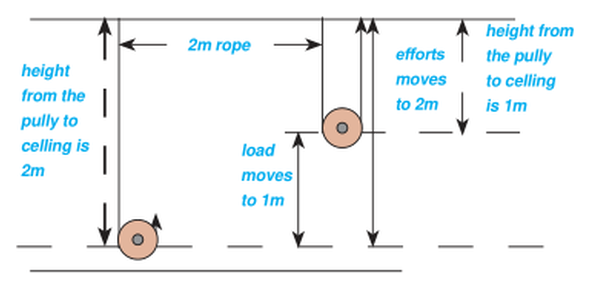
In a single fixed pulley the load distance and the effort distance are equal, so its velocity ratio is 1. Here only one segment of the rope supports the load. The more segments that support the load, the more times farther the effort must be pulled.
The velocity ratio (VR) of a pulley system equals the number of rope segments used to support the load.
The velocity ratio is a ratio of two velocities, so it has no unit.
Mechanical Advantage
The mechanical advantage of a simple machine is the ratio of the load it lifts to the effort applied on it.
\[ \text{MA} = \frac{\text{Load}}{\text{Effort}} \]
For example, if lifting a 200 N load with a pulley needs a force of 50 N, the mechanical advantage is \( \frac{200\ \text{N}}{50\ \text{N}} = 4 \). This means that with this pulley a force of 50 N can lift a load 4 times as large. In a pulley system the mechanical advantage grows as the number of wheels grows, because the same load rises with less and less effort.
The mechanical advantage is a ratio of two forces, so it also has no unit.
Many students write a unit such as newton (N) or metre (m) after the mechanical advantage or the velocity ratio. Both are ratios, so neither has any unit.
Friction and the Single Fixed Pulley
If friction in a single fixed pulley is negligible, the load and the effort are equal, so its mechanical advantage is usually one. Because of friction, however, the force applied on the pulley can even be greater than the load, and then the mechanical advantage becomes less than one. Even when its mechanical advantage is one or less, a fixed pulley still changes the direction of the force. Pulling the rope downward through a pulley is easier than lifting the load straight up, and that is why wells and flag poles still use a single fixed pulley.
The full lesson is waiting for you
The notes are free to read in full. A free account opens the rest of the practice, and tracks your progress and confidence score for every subject. Presentations and videos need approval from Learn Yeti.