Tools that make daily work easier
Every day we do many different jobs. Water has to be drawn from a well, doors have to be opened, firewood has to be split, heavy goods have to be carried up to a higher place, and sometimes a nut has to be tightened. Doing these jobs with bare hands is very hard, so we use tools to make them easy. The screwdriver, the pulley, the wheel and axle, the tongs, the jack that lifts a car, the sickle and the axe are all tools used in household work.
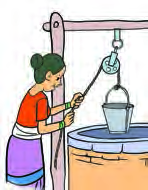
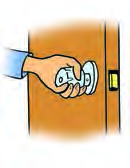
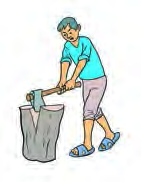
These tools share one feature. They need no electricity, no diesel and no petrol to run. Human force alone is enough to operate them. Their construction is simple too, so they are easy to make and easy to use.
What a simple machine is
Devices like these do not do the work by themselves. We still do the work, but the device lets the same job be finished with less force, in less time and in a more convenient way. Because they share this quality, they are given one common name.
A device of simple construction that is used to get our work done easily, quickly and conveniently is called a simple machine.
A simple machine needs no fuel of any kind. Human force alone can operate it.
The four types of simple machine
On the basis of their construction, simple machines are of four types. Every one of them can be met in daily life.
- The lever: a strong rod resting on a support, used to raise or prise up a heavy load.
- The pulley: a turning wheel with a groove for a rope round its rim, like the wheel used to draw water from a well.
- The wheel and axle: a large wheel and a thin rod that turn together, like the knob of a door.
- The inclined plane: a sloping surface used to move a heavy load up to a higher place, like a plank laid up to the back of a truck.
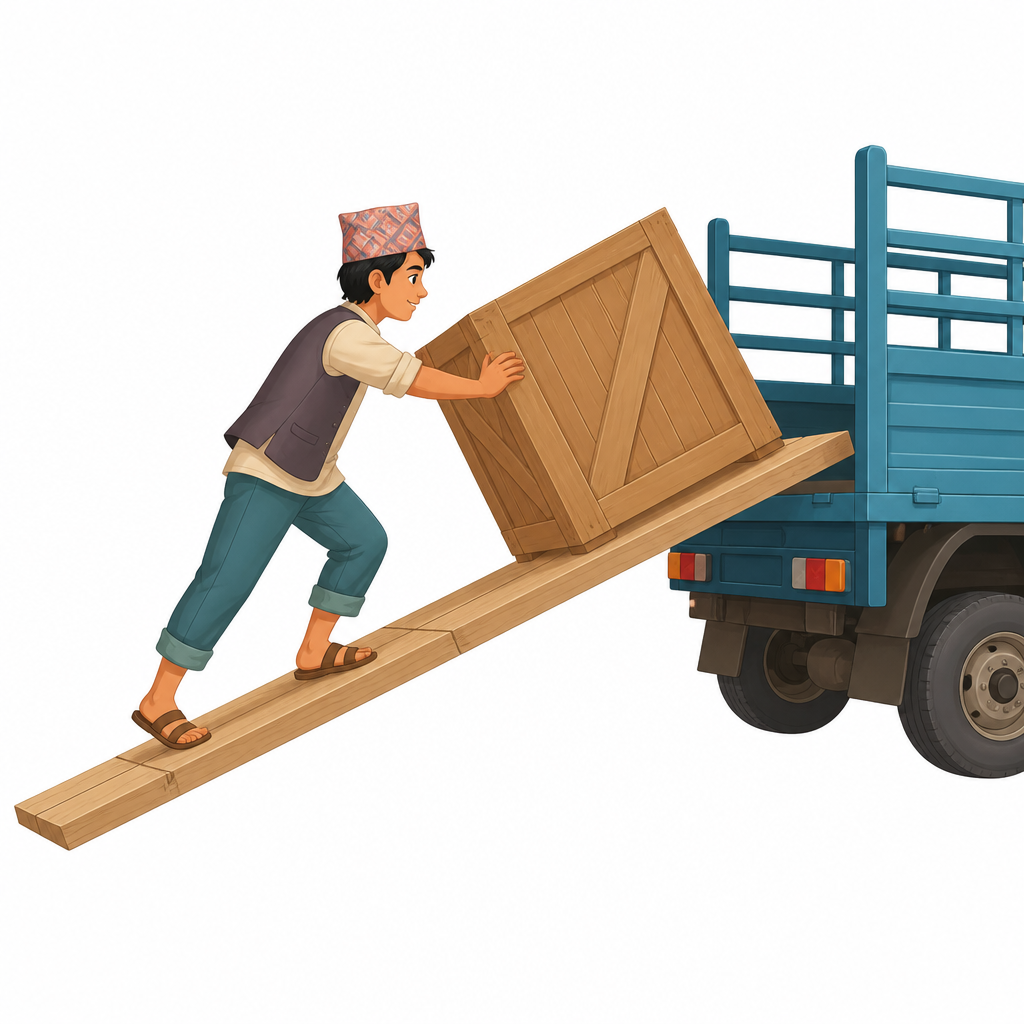
The screw and the wedge are special forms of the inclined plane itself. The thread of a screw is a sloping surface wound round a rod, and a wedge, like the edge of an axe, is also built from sloping surfaces. That is why these two are not counted as separate types.
A simple machine can increase force
Using a simple machine, force can be increased. A strong rod resting on a triangular support makes a lever. A load of 600 N sits 5 m from the support, and on the other side a force of 400 N is applied 10 m from the support. Here the weight that has to be raised is called the load, and the force we apply is called the effort.
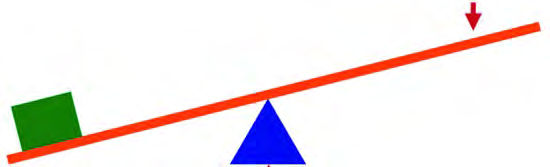
Here an effort of 400 N has raised a load of 600 N. In other words, the load lifted is 1.5 times the force used to lift it. Raising a large weight with a small force is the great advantage of a simple machine.
Mechanical Advantage (MA)
The number that measures how many times a simple machine has multiplied our force is its mechanical advantage.
The ratio of the load to the effort when work is done with any simple machine is called the mechanical advantage (MA) of that machine.
\[ \text{MA} = \frac{\text{Load}}{\text{Effort}} \]
Let us work out the mechanical advantage of the lever above.
Step 1: Putting the load 600 N and the effort 400 N into the formula:
\[ \text{MA} = \frac{600\ \text{N}}{400\ \text{N}} \]
Step 2: Dividing the two numbers:
\[ \text{MA} = 1.5 \]
Mechanical advantage is a ratio of two forces. When we divide, the newton on the top and the newton on the bottom cancel each other. So mechanical advantage has no unit.
Velocity Ratio (VR)
While a simple machine works, the load and the effort both move, but they do not always move equal distances. On a lever the end where the effort acts is farther from the support, so that end moves faster and farther than the end carrying the load. Comparing the two movements gives us the second important number.
The ratio of the velocity of the effort to the velocity of the load in any simple machine is called the velocity ratio (VR) of that machine.
\[ \text{VR} = \frac{\text{Velocity of effort}}{\text{Velocity of load}} \]
When a machine works, the load and the effort move together, so both take the same time to cover their distances. When the times are equal, the ratio of the velocities is exactly the ratio of the distances. So we can also write \( \text{VR} = \frac{\text{effort distance}}{\text{load distance}} \).
On the same lever the effort acts 10 m from the support and the load sits 5 m from it. When the lever turns a little, the effort end covers twice the distance the load end covers. For example, while the effort moves 10 cm down, the load rises only 5 cm. So:
\[ \text{VR} = \frac{10\ \text{cm}}{5\ \text{cm}} = 2 \]
Velocity ratio is a ratio of two velocities, so it too has no unit.
The same two formulas for every machine
These two formulas do not belong to one machine only. Whether it is a lever, a pulley, a wheel and axle or an inclined plane, the mechanical advantage and the velocity ratio of every kind of simple machine are found from these same formulas. The table below places the two side by side.
| Point | Mechanical advantage (MA) | Velocity ratio (VR) |
| Ratio of what | Load and effort (two forces) | Velocity of effort and velocity of load (two velocities) |
| Formula | Load ÷ Effort | Velocity of effort ÷ Velocity of load |
| Other form | None | Effort distance ÷ Load distance |
| Unit | None | None |
| Value in the lever example | 1.5 | 2 |
Many students write a unit after mechanical advantage or velocity ratio. Both are ratios, so neither has any unit. Writing MA = 1.5 N or VR = 2 m/s makes the answer wrong.
The full lesson is waiting for you
The notes are free to read in full. A free account opens the rest of the practice, and tracks your progress and confidence score for every subject. Presentations and videos need approval from Learn Yeti.