Current and Potential Difference Go Together
Put one cell in a torch and the bulb glows dimly. Put two cells in and the same bulb glows brighter. The reason is that adding a cell raises the potential difference (V) across the bulb. When the potential difference goes up, the current (I) flowing through the bulb's filament goes up too, and a bigger current makes the bulb brighter.
Potential difference is measured with a voltmeter, in volts (V). Current is measured with an ammeter, in amperes (A). An ammeter is connected in series, so that all the current passes through it. A voltmeter is connected in parallel, across the two ends of the conductor whose potential difference we want.
Never connect an ammeter in parallel across a conductor, and never put a voltmeter in series. Connected the wrong way round, the readings are wrong and the ammeter can be damaged.
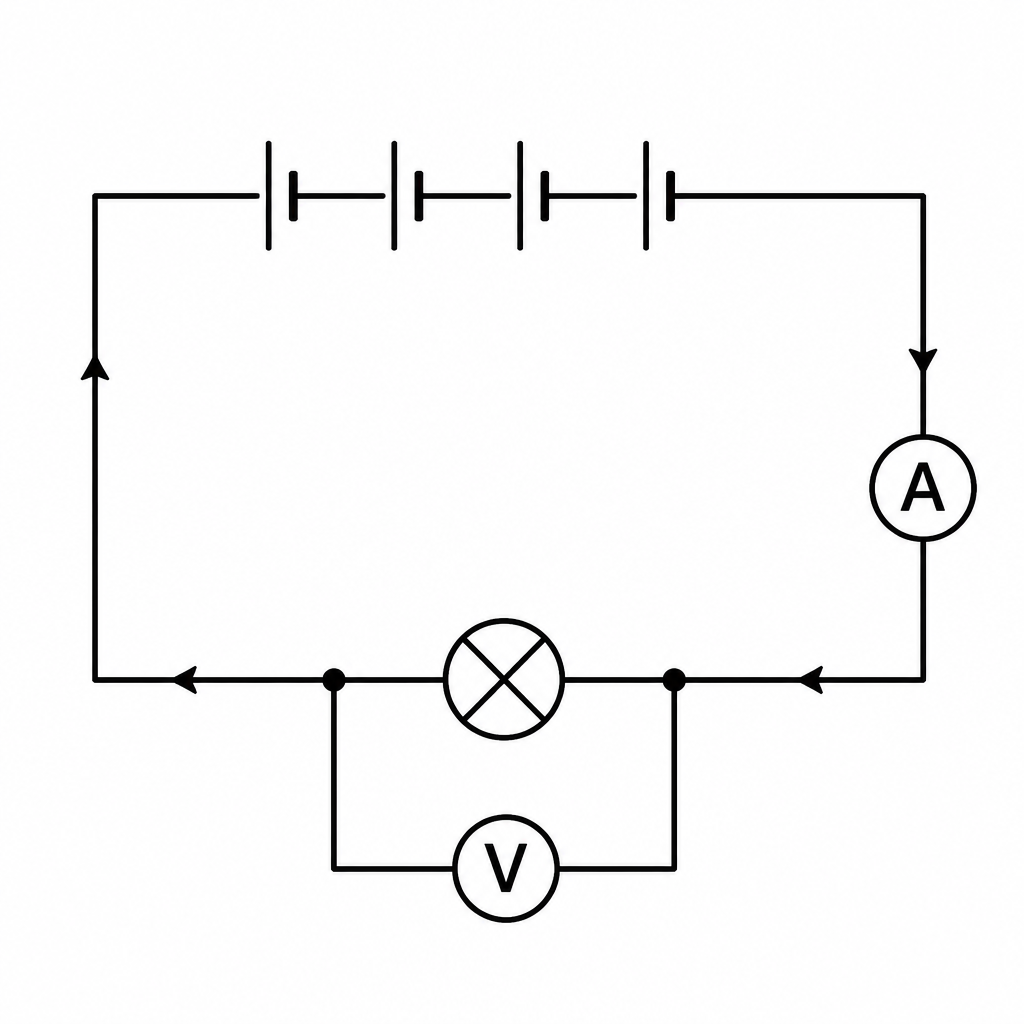
If we build this circuit and measure V and I with one cell, then two, three and four cells, a striking pattern appears. When V doubles, I roughly doubles. When V triples, I triples. Dividing V by I gives nearly the same number every time.
Ohm's Law
The German physicist George Simon Ohm discovered that changing the potential difference across a conductor changes the current flowing through it. His finding is called Ohm's law.
Ohm's law: when the temperature and other physical conditions stay constant, the current (I) through a conductor is directly proportional to the potential difference (V) across its two ends.
In symbols, if the potential difference across a conductor is V and the current through it is I, then:
\[ I \propto V \]
Proportional means that when one grows, the other grows in the same ratio. So the ratio of V to I stays the same:
\[ \frac{V}{I} = \text{constant} \]
This constant is called the resistance (R) of the conductor. So, as long as the physical conditions do not change:
\[ \frac{V}{I} = R \]
The same law can be written three ways: \( R = \frac{V}{I} \), \( V = IR \) and \( I = \frac{V}{R} \). Put the quantity you want to find on its own on one side.
Ohm's law holds only when the temperature stays constant. If a conductor such as a bulb filament gets very hot, its resistance rises and V/I no longer stays constant.
The Graph of Current Against Potential Difference
When the potential difference (V) is plotted on the x-axis and the matching current (I) on the y-axis, the points lie on a straight line that starts at the origin (0, 0). A straight line through the origin is exactly what proportional looks like on a graph. When V is zero, I is zero too, so the line begins at the origin.
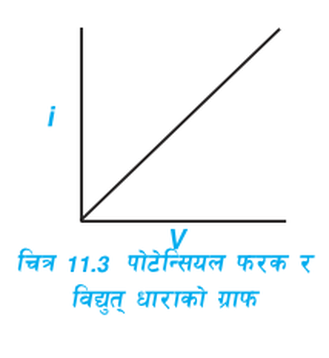
At every point on the line V/I has the same value, and that value is the resistance R. The slope of the line is tied to this ratio. With V on the x-axis the slope is I/V, and R is its reciprocal. If the axes are swapped, with V on the y-axis and I on the x-axis, the slope is V/I, which is R directly. Either way, a conductor with more resistance lets less current through for the same potential difference.
Electric Resistance
Take two copper wires of the same length, one thick and one very thin, and connect each to the same source. Charge flows through the thick wire easily. The thin wire holds the flow back more strongly.
Electric resistance: the property of a conductor by which it opposes the flow of charge through it when a current is set up in it.
Where does resistance come from? The moving charges (electrons) inside a conductor keep bumping into the atoms of the conductor. These collisions slow the charges down, and that is what resistance is. The more collisions there are, the greater the resistance.
The Ohm, Unit of Resistance
The SI unit of resistance is the ohm, named in honour of George Simon Ohm and his discovery. Its symbol is the Greek letter omega, Ω. So 40 Ω is read as forty ohms.
Putting V = 1 V and I = 1 A into \( R = \frac{V}{I} \) gives:
\[ 1\ \Omega = \frac{1\ \text{V}}{1\ \text{A}} \]
One ohm: a conductor has a resistance of 1 Ω when a potential difference of 1 V across its ends produces a current of 1 A through it.
Writing the Ohm in Base Units
The ohm is not a base unit. It can be built from the base units of mass, length, time and current. To see how, we break V and I down into simpler quantities one step at a time.
Step 1: Potential difference is energy per charge, and current is charge per time:
\[ R = \frac{V}{I} = \frac{\text{energy}/\text{charge}}{\text{charge}/\text{time}} \]
Step 2: Energy (work) is force times displacement, and the two charges combine:
\[ R = \frac{\text{force} \times \text{displacement}}{\text{charge}^2/\text{time}} \]
Step 3: Replacing force by \( m \times a \), displacement by s, and charge by \( Q = I \times t \), the bottom becomes \( \frac{(It)^2}{t} = I^2 t \):
\[ R = \frac{m \times a \times s}{I^2 \times t} \]
Step 4: Replacing acceleration by \( a = \frac{v}{t} = \frac{s}{t^2} \):
\[ R = \frac{m \times s^2}{I^2 \times t^3} \]
Step 5: Replacing each symbol by its base unit (mass in kg, displacement in m, current in A, time in s):
\[ \Omega = \frac{\text{kg} \times \text{m}^2}{\text{A}^2 \times \text{s}^3} \]
\[ \Omega = \text{kg}\,\text{m}^2\,\text{A}^{-2}\,\text{s}^{-3} \]
The ohm contains the kilogram (mass), the metre (length), the second (time) and the ampere (current). Because it is made by combining base units, the ohm is a derived unit.
The Formula Triangle
When you know any two of V, I and R, the formula triangle helps you find the third. V sits in the top part of the triangle, and I and R sit side by side in the bottom part. Cover the quantity you want with your hand, and the positions of the other two show the formula.
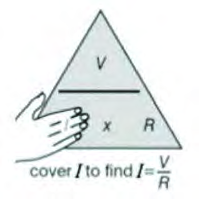
- Cover I: V is over R, so \( I = \frac{V}{R} \).
- Cover R: V is over I, so \( R = \frac{V}{I} \).
- Cover V: I and R sit side by side, so \( V = I \times R \).
Worked Examples
Example 1: An immersion rod used for heating water has a resistance of 40 Ω. It is plugged into a socket with a potential difference of 220 V. What current flows through it?
Step 1: Writing down what is given: potential difference V = 220 V and resistance R = 40 Ω.
Step 2: Current is wanted, so Ohm's law is used in this form:
\[ I = \frac{V}{R} \]
Step 3: Putting in the values:
\[ I = \frac{220\ \text{V}}{40\ \Omega} \]
Step 4: Dividing 220 by 40:
\[ I = 5.5\ \text{A} \]
So a current of 5.5 A flows through the immersion rod.
Household 220 V electricity can kill. Switch an immersion rod on only after it is in the water, and never touch the plug with wet hands. School experiments are always done with low-voltage dry cells, never with the mains.
Example 2: A torch bulb carries a current of 0.25 A when the potential difference across it is 3 V. Find the resistance of the bulb.
Step 1: Resistance is wanted, so Ohm's law is used in this form:
\[ R = \frac{V}{I} \]
Step 2: Putting in V = 3 V and I = 0.25 A:
\[ R = \frac{3\ \text{V}}{0.25\ \text{A}} = 12\ \Omega \]
Example 3: A current of 2 A flows through a wire of resistance 6 Ω. What is the potential difference across the wire?
Step 1: Potential difference is wanted, so Ohm's law is used in this form:
\[ V = I \times R \]
Step 2: Multiplying I = 2 A by R = 6 Ω:
\[ V = 2\ \text{A} \times 6\ \Omega = 12\ \text{V} \]
Every answer needs its unit: current in A, potential difference in V, resistance in Ω. A number without its unit is an incomplete answer.
Factors Affecting Resistance
The resistance of a conductor depends on its length, its thickness, its temperature and the material it is made of. All four change how often the moving charges collide with atoms.
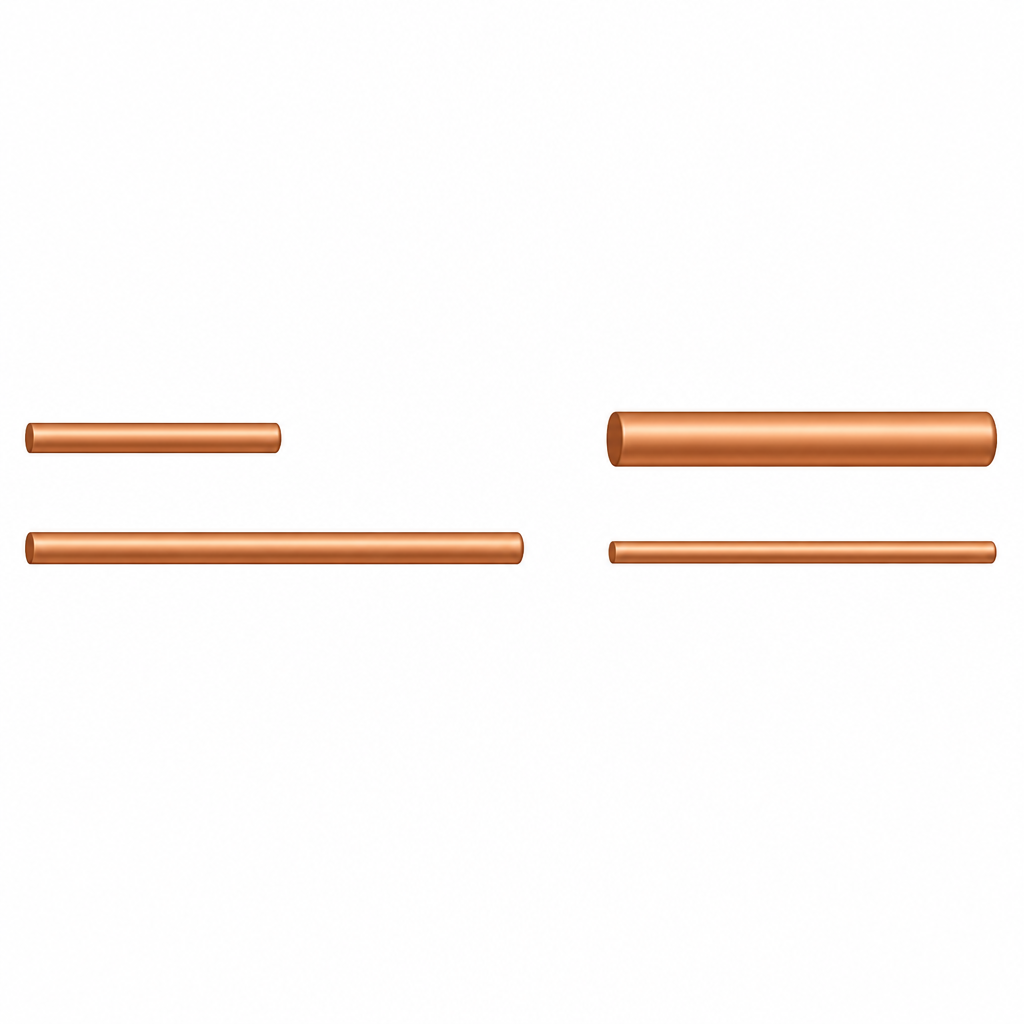
- (a) Length: of two wires of equal thickness, the longer one has more resistance, because charges travelling a longer path meet more atoms.
- (b) Thickness: a thin wire has more resistance than a thick one, because the charges have a narrower path to flow through.
- (c) Temperature: when the temperature of a conducting wire rises, its resistance rises, because hot atoms vibrate more and collisions become more frequent.
- (d) Material: resistance depends on what the conductor is made of. Of a copper wire and a nichrome wire of the same shape and size, the nichrome wire has more resistance.
| Factor | What happens to resistance | Example |
| Length | Longer means more resistance | A long wire resists more than a short one |
| Thickness | Thicker means less resistance | A thin wire resists more than a thick one |
| Temperature | Hotter means more resistance | A hot wire resists more than a cold one |
| Material | Depends on the substance | Nichrome resists more than copper |
This is why house wiring is made of copper: its resistance is low, so current flows easily. The heating coils of heaters and irons are made of nichrome, because its high resistance makes the coil hot.
Although a conductor's resistance changes with its conditions, for any one fixed set of physical conditions \( \frac{V}{I} = R \) stays a constant.
The full lesson is waiting for you
The notes are free to read in full. A free account opens the rest of the practice, and tracks your progress and confidence score for every subject. Presentations and videos need approval from Learn Yeti.