Every appliance carries a power rating
At home we run many kinds of electrical appliances. A heater, an iron, a rice cooker and an electric jug all turn electrical energy into heat. Lights, televisions and fans use electrical energy too. They do not all use it at the same rate. Some appliances change a lot of energy every second, and others change very little.
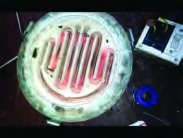
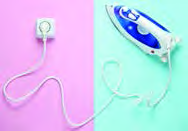
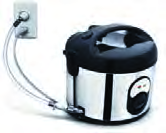
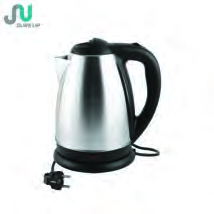
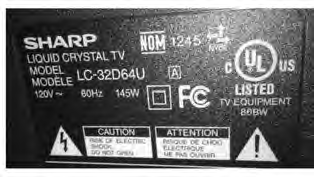
The electrical energy an appliance changes in one second is its electric power, P, measured in watts (W). The maker prints this power on a sticker or plate on the back or underneath every appliance. The television plate below shows 145 W. That means the television uses 145 joules of electrical energy every second while it is on. Working out an electricity bill always begins by reading this printed power.
Electricity consumption
The amount of electrical energy that is changed into other forms while an appliance is used is called electricity consumption. A lamp gives light and heat, a fan gives motion, a heater gives heat. The electrical energy spent in each case is the consumption. The electricity meter in a house measures the consumption of all its appliances together.
Electricity consumption: the amount of electrical energy changed into other forms when electrical appliances are used.
The kilowatt hour: the unit of consumption
The SI unit of energy is the joule (J). But the energy used in a home is so large that writing it in joules gives huge numbers. A heater uses millions of joules in just one hour. So a much bigger unit, the kilowatt hour (kWh), is used when electricity is bought and sold. It is called the commercial unit of electricity consumption.
One kilowatt hour (1 kWh): the amount of electrical energy changed when an appliance of power 1 kilowatt is used for 1 hour. In everyday speech, 1 kWh is called 1 unit.
To find how many joules make 1 kWh, change kilowatts to watts and hours to seconds. Remember 1 kW = 1000 W and 1 h = 3600 s.
\[ 1\ \text{kWh} = 1000\ \text{W} \times 1\ \text{h} \]
\[ 1\ \text{kWh} = 1000\ \text{W} \times 3600\ \text{s} \]
\[ = 3.6 \times 10^{6}\ \text{J} = 3.6\ \text{MJ} \]
One unit of electricity is 1 kWh, and 1 kWh is 3.6 million joules, that is \( 3.6 \times 10^{6} \) J.
Energy used depends on power and time
Power is the energy used each second. So the longer an appliance runs, the more energy it uses. The energy an appliance changes is its power multiplied by the time it is used.
\[ E = P \times t \]
Here E is the energy changed, P is the electric power and t is the time. If P is written in kilowatts and t in hours, E comes out directly in kWh, which is units. For example, a 2 kW heater run for 3 hours uses \( 2 \times 3 = 6 \) kWh, or 6 units. The same heater run for only half an hour uses \( 2 \times 0.5 = 1 \) unit.
Consumption of several appliances: P × n × t
A house may have more than one appliance of the same kind, such as four bulbs or two fans. If one appliance has power P in kilowatts (kW), is used for time t in hours (h), and there are n such appliances, their electricity consumption is:
\[ E = P \times n \times t \quad (\text{kWh}) \]
For example, three 10 W LED bulbs lit for 4 hours a day: first change 10 W to 0.01 kW. The daily consumption is then \( 0.01 \times 3 \times 4 = 0.12 \) kWh.
Before multiplying, change power from watts to kilowatts by dividing by 1000, and time from minutes to hours by dividing by 60. Putting 900 W in as 900 makes the answer 1000 times too big. For an appliance used only once a week, divide the weekly time by 7 to get the daily time.
The electricity meter and its readings
Every house has an electricity meter (kWh meter) fitted where the supply line enters. All the energy used by every appliance in the house passes through it. The number on its display tells the total kWh used since the meter was fitted. The meter below shows 12345.6 kWh.
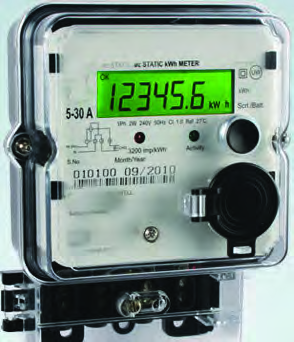
Electricity meter: the instrument that measures and shows, in kilowatt hours, the electrical energy used by all the appliances in a house.
A meter reading never goes down; it only keeps rising. So to find one month's consumption, subtract last month's reading from this month's reading.
Example: a house meter read 12230.4 kWh last month and 12345.6 kWh this month. If the rate is Rs. 10 per unit, what is the bill?
Step 1: Subtracting last month's reading from this month's reading:
\[ 12345.6 - 12230.4 = 115.2\ \text{units} \]
Step 2: Multiplying the units by the rate per unit:
\[ 115.2 \times 10 = \text{Rs. } 1152 \]
So that month's electricity bill is Rs. 1152.
How the monthly bill is calculated
Electricity bill: the money paid for the units of electricity used in a given period. It is found by multiplying the units used by the rate charged per unit.
\[ \text{Bill} = \text{units} \times \text{rate} \]
Even without looking at the meter, the monthly bill can be worked out from a list of the household appliances. The work is done in this order:
- Write each appliance's power P in kilowatts.
- Write how many of it there are (n) and how many hours a day it is used (t).
- Find each appliance's daily consumption with \( P \times n \times t \).
- Add them all to get the total daily consumption of the house.
- Multiply the daily total by 30 to get the monthly consumption.
- Multiply the monthly consumption by the rate per unit to get the monthly bill.
A whole house: worked example
A house uses six 15 W CFLs for 5 hours a day, four 7 W LED bulbs for 6 hours a day, two 1 kW heaters for 2 hours a day, a 900 W rice cooker for 50 minutes a day and an 800 W iron for 30 minutes a week. What is its monthly electricity consumption? If 1 unit costs Rs. 10, what is the monthly bill?
First put every figure into the right units in a table:
| Appliance | Power (P) | Number (n) | Daily time (t) |
| CFL | 15 W = 15/1000 kW | 6 | 5 h |
| LED | 7 W = 7/1000 kW | 4 | 6 h |
| Heater | 1 kW | 2 | 2 h |
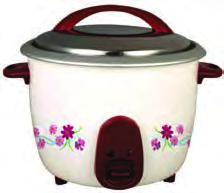
| Rice cooker | 900 W = 9/10 kW | 1 | 50 min = 5/6 h |
| Iron | 800 W = 8/10 kW | 1 | 30 min a week = 0.5/7 h a day |
Step 1: Daily consumption of the CFLs, using P × n × t:
\[ \frac{15}{1000} \times 6 \times 5 = 0.45\ \text{kWh} \]
Step 2: Daily consumption of the LED bulbs:
\[ \frac{7}{1000} \times 4 \times 6 = 0.168\ \text{kWh} \]
Step 3: Daily consumption of the heaters:
\[ 1 \times 2 \times 2 = 4\ \text{kWh} \]
Step 4: Daily consumption of the rice cooker:
\[ \frac{9}{10} \times 1 \times \frac{5}{6} = 0.75\ \text{kWh} \]
Step 5: Daily consumption of the iron:
\[ \frac{8}{10} \times 1 \times \frac{0.5}{7} = 0.057\ \text{kWh} \]
Step 6: Adding the daily consumption of all the appliances:
\[ 0.45 + 0.168 + 4 + 0.75 + 0.057 = 5.425\ \text{kWh} \]
Step 7: Multiplying by 30 for the monthly consumption:
\[ 5.425 \times 30 = 162.75\ \text{units} \]
Step 8: Multiplying by the rate of Rs. 10 per unit for the monthly bill:
\[ 162.75 \times 10 = \text{Rs. } 1627.5 \]
So the house uses 162.75 units a month and its monthly electricity bill is Rs. 1627.5.
Write kWh or units after a consumption and Rs. before a bill. A number without its unit is an incomplete answer.
Which appliance uses the most?
In the example, 4 of the house's 5.425 daily units were used by the two heaters alone. Six CFLs and four LEDs together used less than 1 unit. Heating appliances have high power, so they use many units even in a short time. If a 7 W LED gives as much light as a 15 W CFL, the LED uses less than half the energy. Because consumption is P × n × t, there are three ways to lower a bill: choose appliances of lower power, switch off the ones not needed, and use them for less time.
To lower a bill, reduce P, n or t.
The full lesson is waiting for you
The notes are free to read in full. A free account opens the rest of the practice, and tracks your progress and confidence score for every subject. Presentations and videos need approval from Learn Yeti.