Electricity in Our Homes
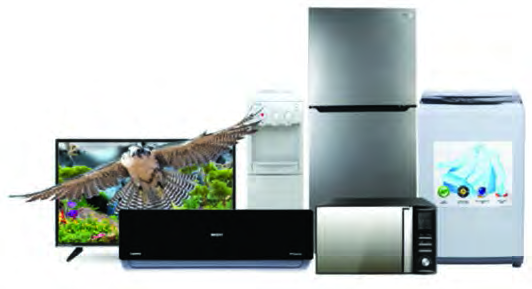
When you switch on a light, turn on a fan, watch television or cook rice in a rice cooker, you are using electricity. Electricity is now the main source of energy in homes, schools, offices and factories. It is carried from the place where it is produced all the way to our homes through conducting wires.
Inside the house, every appliance is joined to the household electric circuit by conducting wires. Each appliance has two separate wires running to it. Electricity reaches the appliance along one wire and returns along the other, so an appliance joined by only one wire will not work.

Appliances Change Electrical Energy into Other Forms
An appliance does not simply use electricity up. Every appliance we use changes electrical energy into some other form of energy that we need. The table below gives some examples.
| Appliance | Electrical energy is changed into |
| Bulb | Light energy (and a little heat) |
| Heater, iron, rice cooker | Heat energy |
| Fan, washing machine | Kinetic energy (motion) |
| Radio, speaker | Sound energy |
| Television | Light and sound energy |
Appliances do not all convert energy equally fast. The rate at which energy is converted is different for different appliances. A bulb used for light and a heater used to warm a room may both run for the same time, yet the heater changes much more electrical energy into heat in a short time than the bulb changes into light.
Why is there a difference? Every appliance puts up some opposition, called resistance, to the electricity passing through it. This resistance is different in different appliances, and it affects how the energy is converted.
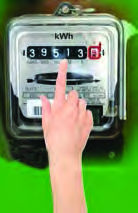
To measure how much electrical energy a house has converted, a meter is fitted in its circuit. From the meter reading, the charge to be paid for the electricity used is calculated.
Electrical appliances are energy converters. How fast an appliance converts energy depends on the resistance it offers to electricity.
What Moves When Current Flows
In the atoms of a metal, the nucleus holds the electrons of the outer shell quite weakly. Because of this, these electrons can easily move from one atom to the next. This is why metals such as copper and aluminium are good conductors.
Free electrons: electrons in the outer shell of metal atoms that can move easily from one atom to another.
Charge can also flow through a liquid. In a solution of an electrolyte, such as salt water, positive ions and negative ions are free to move about.
Ion: an atom or a group of atoms that carries a positive or a negative charge.
Normally these free electrons and ions wander in every direction, so there is no overall flow of charge one way. When a metal wire is joined to a battery, or when the two ends of wires joined to a battery are dipped into the solution, they start to move in one definite direction. This steady movement of free electrons, or of positive and negative ions, is a flow of charge, and a flow of charge produces an electric current.
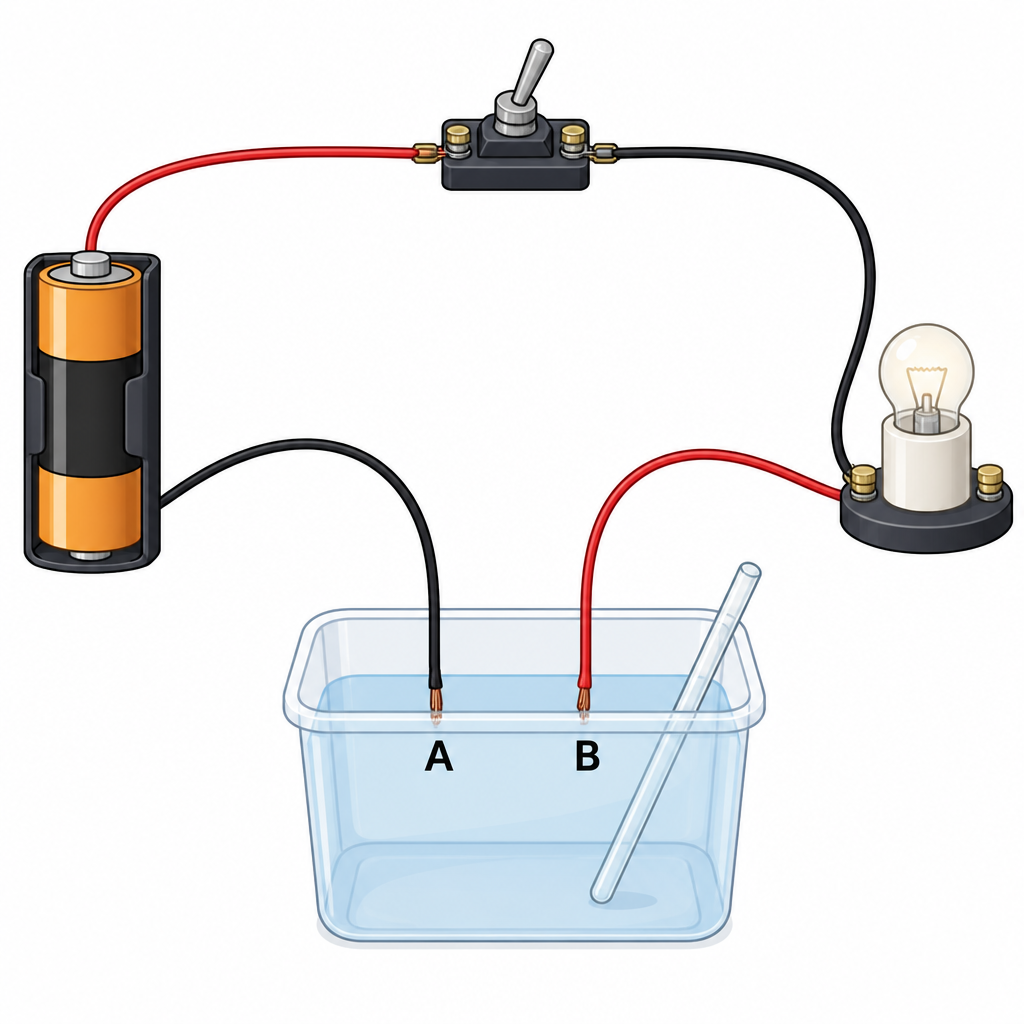
In such a circuit the battery pushes the charge, the conducting wire gives the charge a path, and the ions in the solution carry the charge across the gap between A and B. If any one of these is missing, the bulb stays dark.
Charge and Its Unit, the Coulomb
To talk about current we must be able to say how much charge has flowed. Charge is written with the letter Q.
Coulomb: the SI unit of electric charge. Its symbol is C.
The charge on a single electron is extremely small:
\[ e = 1.6 \times 10^{-19}\ \text{C} \]
One coulomb is the charge of \( 6.24 \times 10^{18} \) electrons. Because one electron carries so little charge, it takes billions of billions of them to make up 1 C.
Electric Current
The flow of water in a pipe can be described by how much water passes a point each second. Electric current is described in the same way. The more charge that passes a point in a wire each second, the larger the current.
Electric current: the rate of flow of positive electric charge, that is, the amount of positive charge flowing through a conductor per unit time. It is written with the letter I.
If a charge Q flows through a conductor in a time t, the current I is the charge divided by the time:
\[ I = \frac{Q}{t} \]
Here I is the current in amperes, Q is the charge in coulombs and t is the time in seconds.
In a metal wire, the particles that really move are electrons, which carry negative charge. When negative charge flows through a conductor, it is treated as the same amount of positive charge flowing in the opposite direction. So even though the definition speaks of positive charge, the same formula gives the current in a metal wire.
More charge in the same time means a bigger current. The same charge in less time also means a bigger current.
Units of Electric Current
The SI unit of electric current is the ampere, with the symbol A. When 1 coulomb of charge flows through a conductor in 1 second, the current is 1 ampere.
One ampere: the current produced when 1 coulomb of charge flows through a conductor in 1 second.
\[ 1\ \text{A} = \frac{1\ \text{C}}{1\ \text{s}} \]
The currents in small devices such as a watch or a calculator are tiny compared with one ampere. So smaller units are also used, the milliampere (mA) and the microampere (µA):
\[ 1\ \text{mA} = 10^{-3}\ \text{A} \]
\[ 1\ \mu\text{A} = 10^{-6}\ \text{A} \]
| Unit | Symbol | In amperes |
| ampere | A | 1 A |
| milliampere | mA | 0.001 A |
| microampere | µA | 0.000001 A |
To change amperes into milliamperes, multiply by 1000, for example \( 0.5\ \text{A} = 500\ \text{mA} \). To change milliamperes into amperes, divide by 1000, for example \( 250\ \text{mA} = 0.25\ \text{A} \).
Going from a big unit to a small unit makes the number bigger. To change 0.04 A into mA you multiply by 1000, you do not divide. The answer is 40 mA, not 0.00004 mA.
Direction of Electric Current
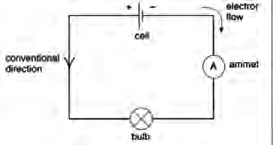
In a circuit with a cell, a bulb and an ammeter, current is shown with arrows. Outside the cell, the arrows start at the positive terminal of the cell, pass through the wire, the ammeter and the bulb, and return to the negative terminal. This is called the direction of electric current.
Direction of electric current: the direction in which positive charge flows is taken as the direction of current. In the circuit outside the cell, it is from the positive terminal to the negative terminal.
In a metal wire, though, the particles actually moving are electrons, and they carry negative charge. Negative charge is attracted towards the positive terminal, so electrons travel from the negative terminal of the cell, through the wire, to the positive terminal. The flow of electrons is therefore opposite to the direction of current. Both describe the same current, because negative charge moving one way has the same effect as an equal positive charge moving the other way.
| Direction of current | Flow of electrons | |
| What is taken to flow | Positive charge | Negative charge (electrons) |
| In the outside circuit | Positive terminal to negative terminal | Negative terminal to positive terminal |
Measuring Current with an Ammeter
Current cannot be seen, so an instrument called an ammeter is used to measure it. In a circuit diagram an ammeter is drawn as a small circle with the letter A inside it. Its scale is marked in amperes or milliamperes.
Ammeter: an instrument that measures the electric current in a circuit. It is connected in series.
Connecting in series means placing the ammeter in the same single path as the rest of the circuit, so that all the current passing through the bulb also passes through the ammeter. An ammeter can only measure the charge that goes through it, so the current has to pass through it.
Joining an ammeter across the two ends of a bulb, as a side path, is wrong. An ammeter always goes inside the path of the circuit, in series.
Worked Example: Finding the Current in a Wire
Question: A charge of 0.2 C flows through a conducting wire in 5 s. Calculate the current in the wire.
Step 1: Writing down the charge given:
\[ Q = 0.2\ \text{C} \]
Step 2: Writing down the time taken:
\[ t = 5\ \text{s} \]
Step 3: Putting the values into \( I = \frac{Q}{t} \) and dividing:
\[ I = \frac{0.2}{5} = 0.04\ \text{A} \]
Step 4: Changing amperes into milliamperes by multiplying by 1000:
\[ I = 0.04 \times 1000 = 40\ \text{mA} \]
So when 0.2 C flows through the wire in 5 s, the current is 0.04 A, which is 40 mA.
Always write the unit, A or mA, with the final answer. A bare 0.04 does not tell anyone what was measured.
The full lesson is waiting for you
The notes are free to read in full. A free account opens the rest of the practice, and tracks your progress and confidence score for every subject. Presentations and videos need approval from Learn Yeti.