Why Water Flows and Why Charge Flows
Picture two plastic bottles. One is filled with water almost to the top, the other only a little way up. If you join them near the bottom with a tube, which way does the water go? It always flows from the bottle with the higher water level to the one with the lower level. The flow does not last for ever, though. As soon as the two levels become equal, the water stops.
What would make the water flow again? Someone would have to lift the water from the low bottle back into the high one. In a house this job is done by a water pump. As long as the pump keeps sending water up, water keeps flowing through the pipe. An electric circuit works the same way. A cell or battery keeps charge flowing round the circuit, just as a pump keeps water flowing round the pipes.
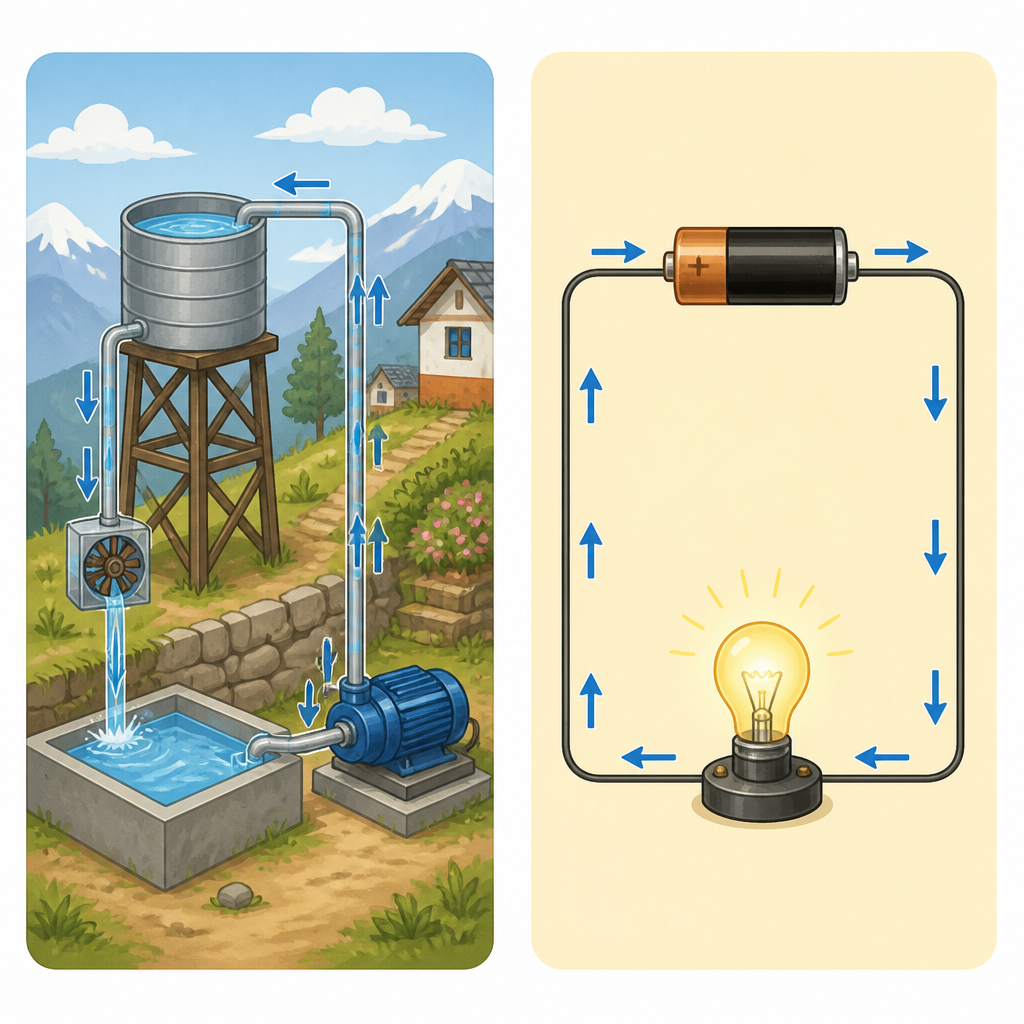
The Pump and the Cell Compared
The work a water pump does and the work a cell does to push charge round a circuit match each other closely. In the table below, the left column is about water and the right column is about charge. Read each row across.
| Water pump | Cell in an electric circuit |
| Water flows from a high place, where its potential is high, to a low place, where its potential is low. | Charge flows from the positive terminal of the source, at high potential, to the negative terminal, at low potential. |
| When the water level is the same at both ends of the pipe, the flow stops. To start it again, a motor must lift water from the low part to the high part. | To keep charge flowing, the chemical energy of the battery must keep one terminal negatively charged (low potential) and the other positively charged (high potential). |
| The work done by the motor gives energy to the water. | The chemical reaction inside the battery gives energy to the charge. |
| When the motor stops supplying energy, the difference in level disappears and the water stops. | When the chemical reaction stops, the two terminals reach the same potential and charge stops flowing. We then say the battery is dead. |
Water needs a difference in level to flow; charge needs a difference in potential to flow. A pump keeps the level difference going, and a cell keeps the potential difference going.
Potential and the Work of a Source
For water to flow through a pipe, one end must be joined to water in a high place and the other end must lie lower. Water held up high stores potential energy. As it runs down, that energy changes into other forms and does work: put a turbine in its path and the turbine spins. In a circuit, as charge passes through the connecting wire and a load such as a bulb, its energy changes into kinetic energy, heat, light or other forms. The thing that makes this work happen is the electric source, such as a battery.
Potential: the ability of an electric source to make each unit of charge flow is called its potential.
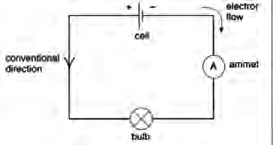
The positive terminal of a battery is at higher potential and the negative terminal is at lower potential. So to get a current in a circuit, one end of the load must be joined to the high potential terminal of the source and the other end to the low potential terminal. If both ends of a bulb were joined to the same terminal, there would be no difference in potential and the bulb would not light.
Electromotive Force (e.m.f.)
Charge needs energy to move through a conductor. Electric sources such as generators, batteries and solar panels supply that energy by changing some other form of energy into electrical energy. A solar panel changes light energy, a generator changes kinetic energy, and a battery changes chemical energy into electrical energy.
Inside a battery a chemical reaction takes place. It makes one terminal the positive terminal, at high potential, and the other the negative terminal, at low potential. Once the two terminals are joined by a conductor, the energy produced this way drives charge all the way round the circuit. The amount of energy the source gives to one coulomb of charge to take it once round the whole circuit is the e.m.f. of that source.
Electromotive force (e.m.f.): the amount of energy a source supplies to make one coulomb of charge flow round an electric circuit.
Despite its name, e.m.f. is not a force. It is energy per coulomb. A dry cell, for example, has 1.5 V printed on it. This means the cell gives 1.5 J of energy to every 1 C of charge it sends round the circuit.
Potential Difference (p.d.)
The e.m.f. sets up a potential difference (p.d.) between the two ends of the load in the circuit. Suppose end A of a bulb is joined to the positive terminal of a battery and end B to the negative terminal. Now A is at a higher potential than B, so positive charge flows from A to B. Because of this potential difference, electrical energy changes into other forms, such as heat and light, as charge passes through the load.
Potential difference (p.d.): the amount of electrical energy converted into other forms when one coulomb of charge flows between two points of a circuit. In everyday speech it is called voltage.
In words, the potential difference equals the energy converted divided by the charge that flows. Using symbols, \( V \) is the potential difference, \( W \) is the energy converted in joules and \( Q \) is the charge in coulombs.
\[ V = \frac{W}{Q} \]
Energy is measured in joules (J) and charge in coulombs (C), so potential difference is measured in joules per coulomb. This unit is called the volt (V).
\[ 1\ \text{V} = 1\ \text{J/C} \]
Measuring e.m.f. and p.d. with a Voltmeter
Both e.m.f. and potential difference are measured with a voltmeter. Both are worked out as energy per coulomb, so both have the same SI unit, the volt.
- To measure e.m.f.: when no charge is flowing in the outside circuit, the potential difference across the battery's terminals equals its e.m.f. So the voltmeter is joined directly across the two terminals of the battery.
- To measure p.d.: the voltmeter is joined across the two ends of the load, so that it is in parallel with the load.
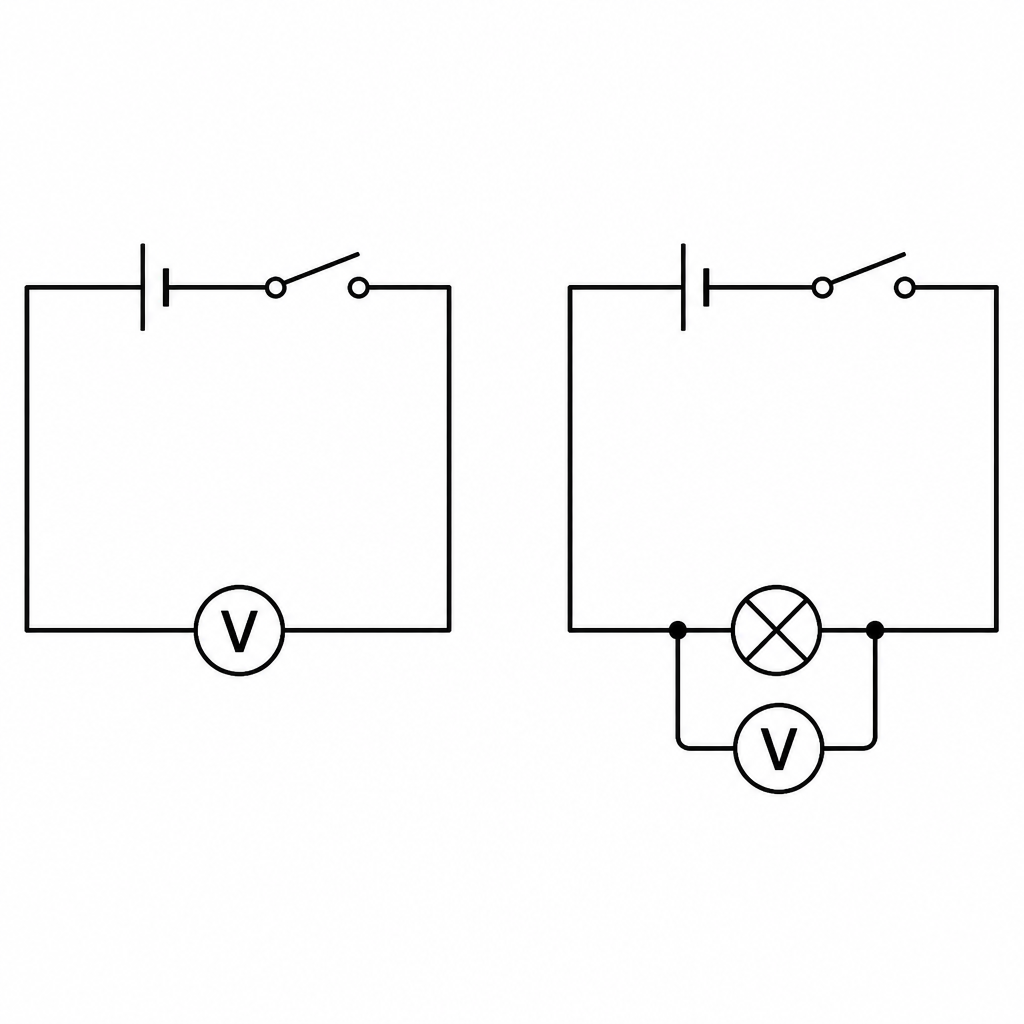
A voltmeter is always connected in parallel with the part being measured, never in series. It is the ammeter that goes in series. Join the voltmeter's + terminal to the side nearer the positive terminal of the source.
Why p.d. Is Less Than e.m.f.
When current flows through a circuit with a load, some energy is used up inside the battery itself. So while current is flowing, the potential difference between the battery's terminals is always less than its e.m.f.
For example, a battery of e.m.f. 3 V may show a potential difference of only 2.5 V between the ends A and B of a bulb while current flows. This means the battery gives 3 J of energy to each coulomb of charge, but only 2.5 J of it turns into heat and light in the bulb outside. The other 0.5 J is used up inside the battery.
e.m.f. is the energy the source gives; p.d. is the energy spent in the load. You cannot spend more than you are given, so while current flows the p.d. is always less than the e.m.f.
Differences Between e.m.f. and p.d.
| Electromotive force (e.m.f.) | Potential difference (p.d.) |
| It is the energy the source supplies to each unit of charge. | It is the energy converted into other forms when each unit of charge flows through the outside circuit. |
| It does not depend on the resistance of the resistors in the outside circuit. | It depends on the resistance of the resistors used in the outside circuit. |
| e.m.f. is the cause of potential difference. | Potential difference is the effect of e.m.f. |
Both quantities are measured in volts and both are read on a voltmeter. The difference lies in what they describe: e.m.f. tells you what the source gives, while p.d. tells you what is spent in one part of the circuit. Without a source there is no p.d., which is why e.m.f. is the cause and p.d. is its effect.
The full lesson is waiting for you
The notes are free to read in full. A free account opens the rest of the practice, and tracks your progress and confidence score for every subject. Presentations and videos need approval from Learn Yeti.