Where Electrical Energy Goes in a Load
Whenever current flows in a circuit, it passes through a load. A load is anything that uses electricity: a bulb, a fan, a heater or a television. Every load has resistance. As the current flows through that resistance, the electrical energy does not disappear. It changes into some other form of energy, such as heat, light, sound or motion. The form it takes depends on what the load was built to do. A fan changes most of it into motion, a lamp into light, and a heater into heat.
Heating effect of electric current: The change of electrical energy into heat energy when a load is used in a circuit is called the heating effect of electric current.
Why a Bulb Gets Hot
You can feel this effect with a very small circuit. Join a torch bulb, two dry cells and a switch with connecting wires. Switch on, let the bulb glow for a while, then switch off and touch the bulb. It is warm. The bulb was made to give light, yet part of the electrical energy has become heat. The reason is the resistance of the thin wire inside the bulb. When current is forced through that resistance, heat is produced.
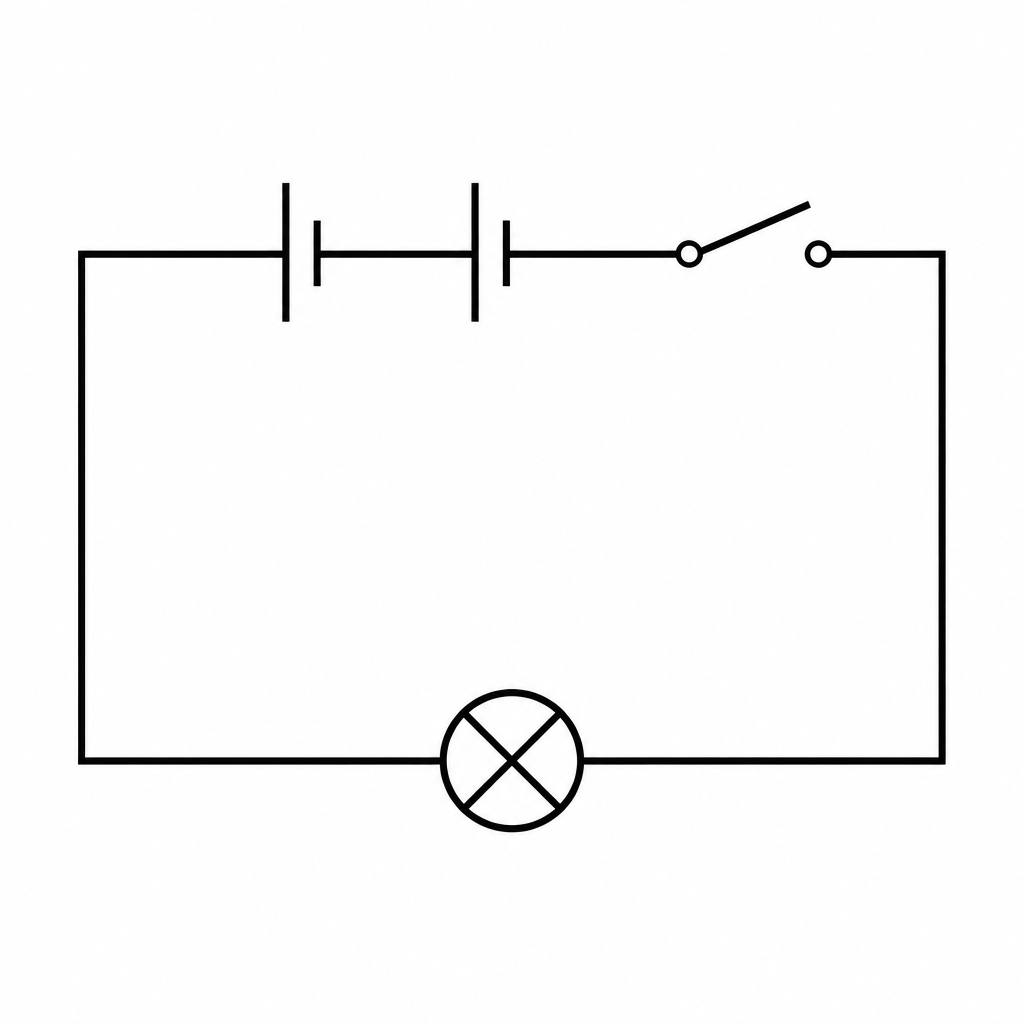
A bulb that has glowed for a long time can be hot enough to burn your skin. Touch it lightly, and only after switching off. Never hold a large household bulb while it is on.
The heat produced in a load depends on the current flowing through it. By using a higher resistance, electrical energy can be turned into heat energy quickly. That is why appliances made to give heat use a wire of deliberately high resistance.
Nichrome and the Heating Element
In an electric heater, the resistance of the wire is what turns electrical energy into heat. This wire is made of nichrome. Nichrome is not a pure metal. It is an alloy, a mixture of nickel and chromium, made so that its electrical resistance is high.
Heating element: The coil of high-resistance wire, such as nichrome, inside a heating appliance that changes electrical energy into heat energy.
Nichrome is chosen for heating elements for three reasons:
- Its electrical resistance is high, so even a short length of wire produces a lot of heat.
- Its melting point is high, so it does not melt even when it glows red hot.
- It does not burn in the presence of oxygen even at temperatures as high as 900 °C, so it lasts a long time.
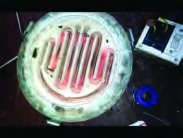
The winding wire that glows red on the plate of a heater is exactly this nichrome heating element. Winding it into a coil fits a long wire into a small space, which gives it even more resistance.
The Filament Bulb
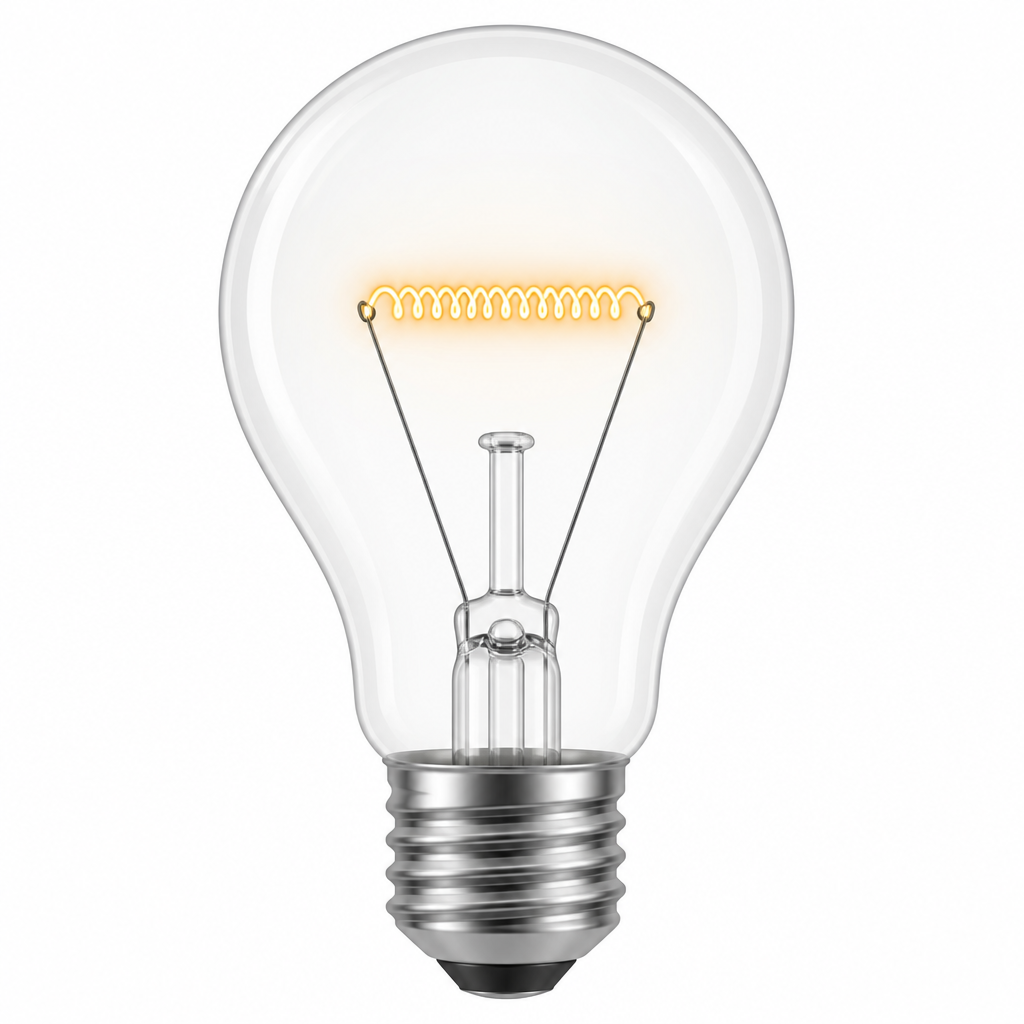
A filament bulb also works by the heating effect. Inside the glass there is a very thin filament made of tungsten. Because the wire is so thin, its resistance is high. When current flows, the filament becomes so hot that it glows white. In this way electrical energy changes into both heat and light. A large share of the energy goes out as heat, which is why these bulbs feel so hot to touch.
Appliances That Use the Heating Effect
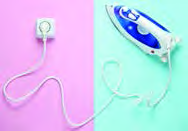
Many appliances at home put the heating effect to work. The electric heater, the immersion rod used to heat water, the iron, the rice cooker and the electric kettle are all examples. Each one has a heating element inside, and each is designed to turn electrical energy into heat on purpose.
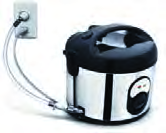
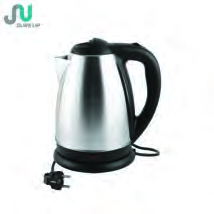
| Appliance | What its heat is used for |
| Electric heater | Warming a room |
| Immersion rod | Heating water when dipped in a bucket |
| Iron | Pressing the creases out of clothes |
| Rice cooker | Cooking rice |
| Electric kettle | Boiling water |
Too Much Current and Overheated Wires
The heating effect also depends on the current flowing in the circuit. The more current, the more heat. Sometimes the potential difference rises suddenly. When that happens, too much current flows through the load, and the connecting wires become extremely hot and can melt. Heat that is useful inside a heater is unwanted and dangerous inside the wiring.
If a wire, plug or socket feels hot or smells of burning, do not touch it. Tell an adult straight away.
Electric Power
Appliances do not all convert electrical energy at the same rate. The label on the back of a television may read 145 W. This means that when the television is working fully, it converts 145 J of electrical energy into other forms every second. The number printed on an appliance in this way is its power.
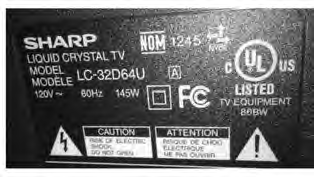
Electric power: The amount of electrical energy an appliance converts in unit time is called the electric power of that appliance.
\[ P = \frac{W}{t} \]
Here \( P \) is the power, \( W \) is the energy converted by the appliance and \( t \) is the time taken. With energy in joules and time in seconds, power is measured in watts (W). An appliance that converts 1 J of energy in 1 s has a power of 1 W. So a 900 W rice cooker converts 900 J every second, while a 10 W LED bulb converts only 10 J.
In the formula, \( W \) stands for work or energy, measured in joules (J). In a rating like 145 W, the W is the watt, the unit of power. The same letter is doing two different jobs, so read the context before deciding which it means.
Deriving P = IV
A potential difference across the two ends of an appliance makes electrons flow, and that is when electrical energy is converted. This lets us write power in terms of current and potential difference.
Potential difference: The work done per unit charge in moving charge between the two ends of an appliance is called the potential difference.
Step 1: Writing the definition of potential difference as a formula:
\[ V = \frac{W}{Q} \]
Step 2: Multiplying both sides by \( Q \) gives the work done by the appliance, which is also the energy it converts:
\[ W = QV \]
Step 3: Putting this into \( P = \frac{W}{t} \):
\[ P = \frac{QV}{t} \]
Step 4: Replacing \( \frac{Q}{t} \) with \( I \), because current is \( I = \frac{Q}{t} \):
\[ P = IV \]
Power equals current multiplied by potential difference: \( P = IV \). With current in amperes (A) and potential difference in volts (V), power comes out in watts (W).
Worked Example: Current in a Rice Cooker
Rohan sees 900 W written on the rice cooker in his kitchen. The potential difference in a household circuit is 220 V. How much current does the rice cooker need? We are given power \( P = 900 \) W and potential difference \( V = 220 \) V.
Step 1: Writing the formula that links power, current and potential difference:
\[ P = IV \]
Step 2: Dividing both sides by \( V \) to make current the subject:
\[ I = \frac{P}{V} \]
Step 3: Substituting the given values and dividing:
\[ I = \frac{900}{220} = 4.09 \text{ A} \]
So while the rice cooker is cooking, a current of 4.09 A flows through its coil.
More Worked Examples
Example A: How much current flows through a 1000 W heater working at 220 V?
Step 1: Putting the values into \( I = \frac{P}{V} \):
\[ I = \frac{1000}{220} = 4.55 \text{ A} \]
This heater draws more current than the 900 W rice cooker, because both work at the same potential difference and the heater has more power.
Example B: An iron takes a current of 5 A at 220 V. What is its power?
Step 1: Multiplying current by potential difference:
\[ P = IV = 5 \times 220 = 1100 \text{ W} \]
Example C: How much energy does a 60 W bulb convert in 10 seconds?
Step 1: Rearranging \( P = \frac{W}{t} \) to find the energy:
\[ W = P \times t \]
Step 2: Substituting the power and the time:
\[ W = 60 \times 10 = 600 \text{ J} \]
The full lesson is waiting for you
The notes are free to read in full. A free account opens the rest of the practice, and tracks your progress and confidence score for every subject. Presentations and videos need approval from Learn Yeti.