The Wave Network Around Us
From the moment we wake up until we fall asleep, waves are all around us. They keep striking our body, although we notice almost none of them. The light from a bulb reaches our eyes as a wave. The warmth the sun gives our skin is energy that waves have carried across space. The programme an FM radio transmitter broadcasts, the signal a mobile phone uses, and the signal a wifi router sends through a house all spread through the air as waves. One thing is common to every example. Each one is carrying energy from one place to another.
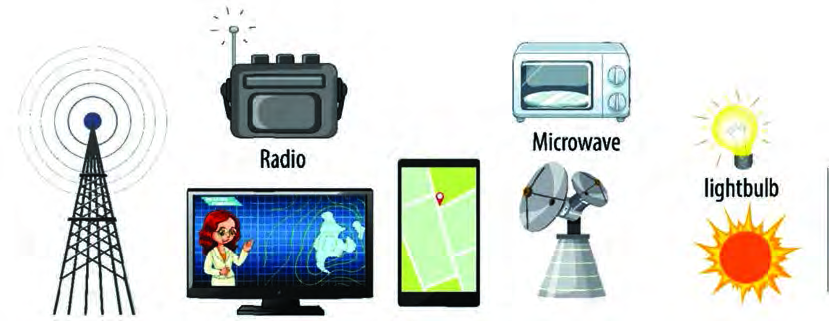
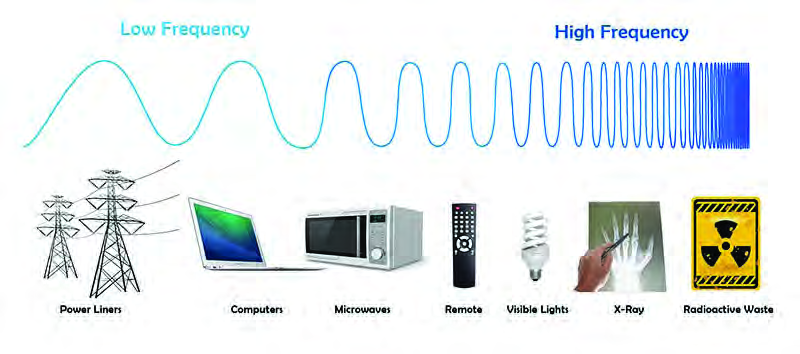
Waves do far more than carry programmes and calls. Security checks use waves to examine objects that may be dangerous, and waves are also used to calculate distance. To examine the inner organs of the human body, doctors use sound waves and X-rays. The scan that shows a baby before birth and the picture that shows a broken bone are both jobs done by waves.
How a Wave Forms on Water
Strike the surface of still water gently and steadily with a finger and watch what happens. The molecules at the surface start to vibrate. As a surface molecule moves down or up, the neighbouring molecules joined to it are pulled down or pushed up as well. In this way energy passes from the molecules that moved first to the other molecules near them, one after another.
Each neighbour that receives this energy also begins to move up and down in its own place. As this chain spreads outward, a wave is produced in the water and energy is transmitted through it. From the point that was struck, a ripple spreads outward as a widening ring. The raised part of the surface is seen travelling across the water, yet the water itself does not flow along with it.
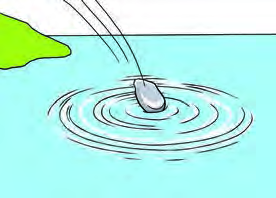
A paper boat placed on the surface makes this fact easy to see. When the ripple reaches it, the boat bobs up and down in its own place. It does not drift to the edge along with the ripple. This shows that the water molecules are only moving up and down where they are. The thing that travels forward is the energy the ripple carries.
A Wave Along a Rope
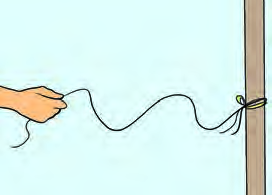
The same story repeats on a rope. Tie one end to a support and move the other end up and down steadily with your hand. The kinetic energy the rope receives from the hand makes the rope's molecules move in the direction the hand moved. Each molecule's motion is copied by the molecule next to it. As this continues, some sections of the rope are seen raised and some pressed down, and these raised and lowered parts keep moving along toward the tied end.
Tie a small piece of ribbon somewhere along the rope and the proof appears again. While the ripple runs forward along the rope, the ribbon only bounces up and down at its own spot. It never travels toward the tied end. The rope's molecules, like the water's, stay in place and vibrate while the disturbance passes through them.
Particles Bob, Energy Moves On
The water and the rope hand us the same conclusion. When a wave passes, the water and the rope do not travel anywhere themselves. Every molecule vibrates up and down about its own place and hands the energy it received to its neighbour. In this relay, energy moves from molecule to molecule and reaches far away. The paper boat and the ribbon are both witnesses to this.
| Observation | Wave in water | Wave in a rope |
| How the vibration starts | A finger strikes the surface steadily | A hand moves one end up and down steadily |
| What moves forward | The ring of the ripple and the raised part of the surface | The raised and lowered parts of the rope |
| What stays in its own place | The water molecules and the paper boat | The rope's molecules and the tied ribbon |
| What is transmitted | Energy | Energy |
Many students think the water itself flows to the edge along with the ripple. It does not. Only the energy moves forward, while the water molecules move up and down where they are. The boat never reaching the edge is the proof.
A wave carries energy forward. The water or the rope stays where it is.
What a Wave Is
A wave does not always need a material like water or a rope. Periodic disturbances in electric and magnetic fields also transmit energy. Sunlight crossing empty space to reach the Earth is an example of exactly this. Whether it happens in water, in a rope, or in these fields, whenever a repeating disturbance carries energy from one place to another, that is a wave.
A wave is a periodic disturbance that transmits energy.
Periodic here means repeating regularly, the way the disturbance repeats when a finger keeps striking the water steadily or a hand keeps moving the rope up and down. A single strike makes one ring, but steady, repeated strikes keep producing wave after wave.
Earthquake waves bring the energy produced when rocks collide deep inside the Earth all the way up to its surface.
The full lesson is waiting for you
The notes are free to read in full. A free account opens the rest of the practice, and tracks your progress and confidence score for every subject. Presentations and videos need approval from Learn Yeti.