Waves Carry Energy
Drop a stone into a still pond. Circular ripples spread outward from the point where the stone fell. A leaf floating on the surface does not travel to the bank with the ripples. It only bobs up and down in its own place. This tells us something important: the water itself does not move forward, only energy does. A disturbance that repeats again and again is called a periodic disturbance, and when such a disturbance carries energy from one place to another, it is called a wave.
Wave: a periodic disturbance that transfers energy from one place to another is called a wave.
Earthquake waves bring the energy produced when rocks collide deep inside the Earth all the way up to its surface. That is why an earthquake far away can still shake our house.
A wave that spreads through the vibration of the particles of a medium such as water, a rope or air is called a mechanical wave. Mechanical waves are of two kinds, depending on how the direction of vibration compares with the direction the wave travels: the longitudinal wave and the transverse wave. Both kinds can be produced, one after the other, on a single slinky spring, which is why the slinky is the best tool for meeting them.
Two Waves on One Slinky
A slinky is a long spring of metal or plastic that stretches and squeezes easily. Place it on a measuring tape spread on the floor and hold one end. Now the hand can move in two different ways: pushing forward and pulling back along the length of the spring, or swinging it left and right. One spring, two different motions, and two different kinds of wave are produced. If a piece of coloured thread is tied to one section of the slinky, it shows clearly which way that part of the medium is vibrating.
Longitudinal Wave
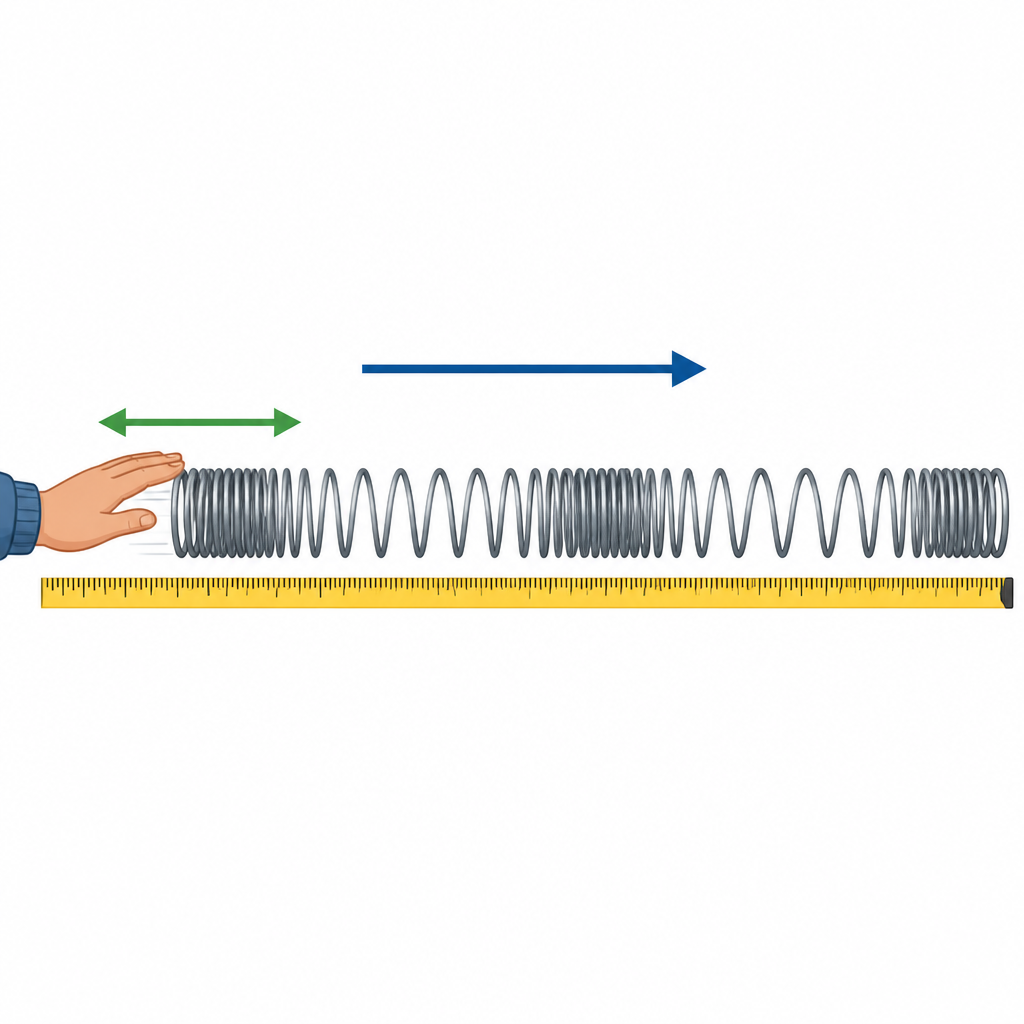
When the slinky is steadily pushed forward and pulled back, the rings in one section slide forward and bunch together, then move back and spread apart, and this keeps repeating. At the same time the wave can be seen travelling forward along the spring. Here the direction in which the wave travels and the direction of the periodic disturbance, that is the vibration, are the same. A wave of this kind is called a longitudinal wave. A sound wave is an example of a longitudinal wave. Longitudinal waves can be created in all three media: solids, liquids and gases. This is why a spoken word can cross the air and reach our ears.
Longitudinal wave: a wave in which the vibration of the particles of the medium is in the same direction as the direction the wave travels.
Transverse Wave
Now swing the slinky steadily left and right. The rings in any one section keep moving right and then left, yet the wave itself is seen travelling forward. Here the direction the wave travels and the direction of vibration are perpendicular to each other. A wave of this kind is called a transverse wave. The waves produced on water and the waves produced on a rope are examples of transverse waves.
Transverse wave: a wave in which the vibration of the particles of the medium is perpendicular to the direction the wave travels.
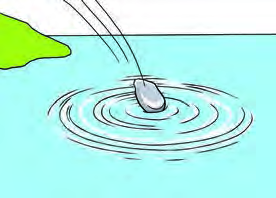
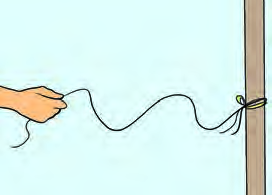
Transverse waves can be created in solid and liquid media but they cannot be created in a gas. The particles of a gas are far apart from one another, so when one particle slips sideways it cannot drag its neighbour along with it. A longitudinal wave, on the other hand, can form in all three media.
Compression and Rarefaction
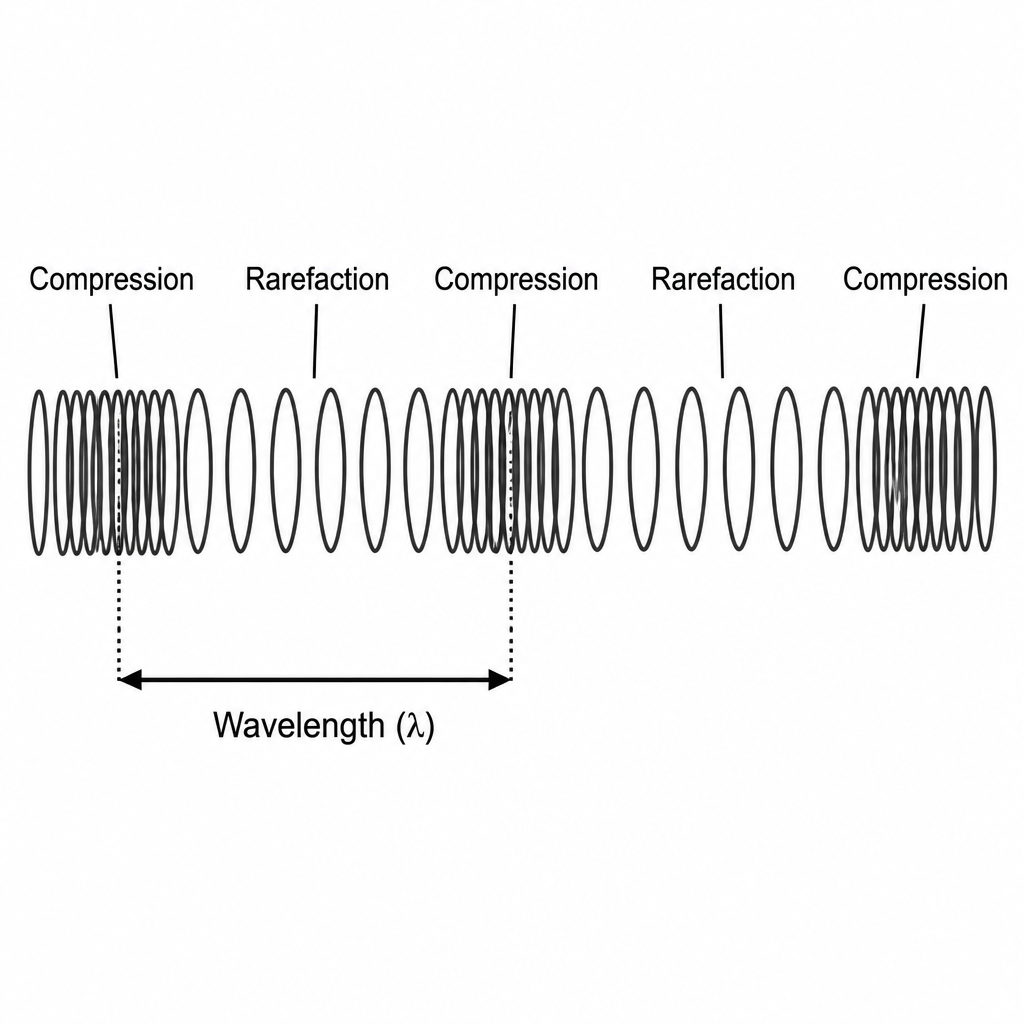
A longitudinal wave travels in the form of compressions and rarefactions. As the wave passes, the section of the medium where the particles are squeezed close together is a compression, and the section where the particles are spread apart is a rarefaction. On a slinky this is easy to see: patches where the rings crowd together and patches where they thin out take turns moving forward.
Compression: the section of the medium where the particles are squeezed together as a longitudinal wave passes.
Rarefaction: the section of the medium where the particles are spread apart as a longitudinal wave passes.
Crest, Trough and Amplitude
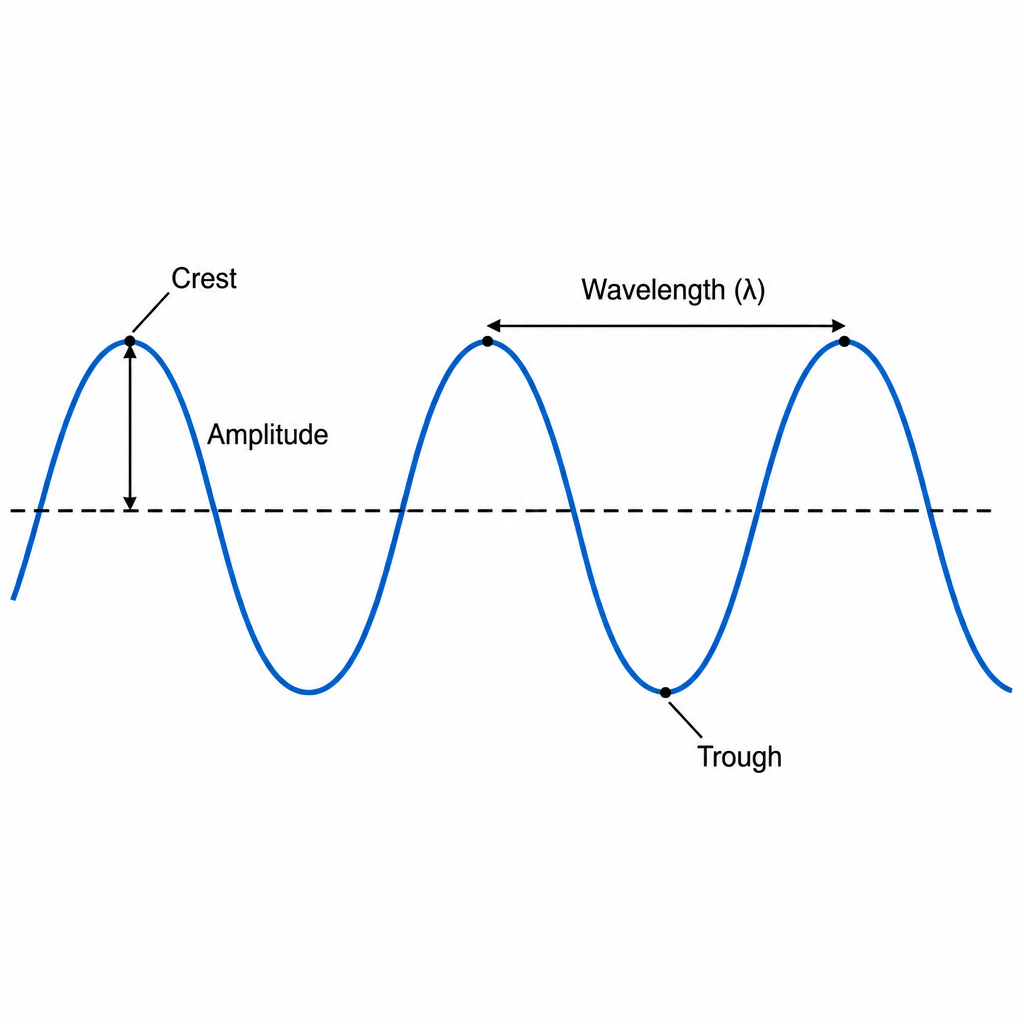
A transverse wave travels in the form of crests and troughs. The part of the wave that rises highest above its middle line is a crest, and the part that dips lowest below it is a trough. The amplitude of a wave is the maximum displacement of the particles of the medium from their rest position, in other words the displacement from the middle line of the wave up to a crest or down to a trough. The larger the amplitude, the more energy the wave carries.
Crest: the part of a transverse wave that rises highest above its middle line.
Trough: the part of a transverse wave that dips lowest below its middle line.
Amplitude: the maximum displacement of the particles of the medium from their rest position, measured from the middle line of the wave to a crest or a trough.
Frequency and Period
As waves travel along a slinky, many wave cycles form one after another and a pulse can be seen moving forward. The number of waves produced per second is the frequency of the wave. The SI unit of frequency is the Hertz. The time taken to produce one full wave is called the period of the wave, and it is written as T.
Frequency: the number of waves produced per second. Its SI unit is the Hertz.
Period: the time taken to produce one complete wave. It is written as T.
\[ f = \frac{\text{number of waves}}{\text{time } (t)} \]
If f waves are produced in 1 s, then the time needed to produce one complete wave is the reciprocal of the frequency:
\[ T = \frac{1}{f} \]
Frequency and period are reciprocals of each other. The higher the frequency, the shorter the period. A wave of frequency 50 Hz does not have a period of 50 s. Its period is 1 divided by 50, which is 0.02 s.
Wavelength
In a longitudinal wave, the wavelength is the distance from the middle of one compression to the middle of the next compression, or from the middle of one rarefaction to the middle of the next rarefaction. In a transverse wave, the wavelength is the distance from one crest to the next crest, or from one trough to the next trough. Wavelength is written with the Greek letter lambda, λ.
Wavelength: the distance between the middles of two neighbouring compressions or rarefactions, or between two neighbouring crests or troughs. It is written as λ.
Wave Velocity
Not all waves travel at the same rate. The rate at which a wave travels depends on the energy received from the source, the medium, the nature of the wave and so on. The distance a wave covers per unit of time is the wave velocity. It can be obtained by multiplying the wavelength by the frequency.
\[ v = f \times \lambda \]
Wave velocity: the distance a wave covers per unit of time. Wave velocity (v) = frequency (f) × wavelength (λ).
When using v = f × λ, put the frequency in Hertz and the wavelength in metres, and the velocity then comes out in m/s. Multiplying without matching the units gives a wrong answer, and an answer written without its unit loses the mark.
The Two Waves Side by Side
| Basis | Longitudinal wave | Transverse wave |
| Direction of vibration | Same as the direction the wave travels | Perpendicular to the direction the wave travels |
| Form of travel | Compressions and rarefactions | Crests and troughs |
| Media it can form in | Solids, liquids and gases, all three | Solids and liquids only, never a gas |
| Examples | A sound wave | Waves on water, waves on a rope |
| Where one wavelength is measured | From the middle of one compression to the middle of the next | From one crest to the next crest |
The full lesson is waiting for you
The notes are free to read in full. A free account opens the rest of the practice, and tracks your progress and confidence score for every subject. Presentations and videos need approval from Learn Yeti.