Two families of waves
We spend the whole day surrounded by waves. The ring of a bell is a wave, a radio signal is a wave, and the light our eyes see is a wave too. But these waves are not all of one nature. Some waves need a medium to travel, and some do not. For the sound of a bell to reach your ear, there must be air between the bell and the ear, yet the light of the Sun crosses empty space, where there is no matter at all, and still arrives at the Earth. On this one basis, whether a wave needs a medium or not, waves are divided into two groups.
A wave that needs a material medium to travel is called a mechanical wave. A sound wave is an example of a mechanical wave.
A wave that needs no medium at all to travel is called an electromagnetic wave. A light wave is an example.
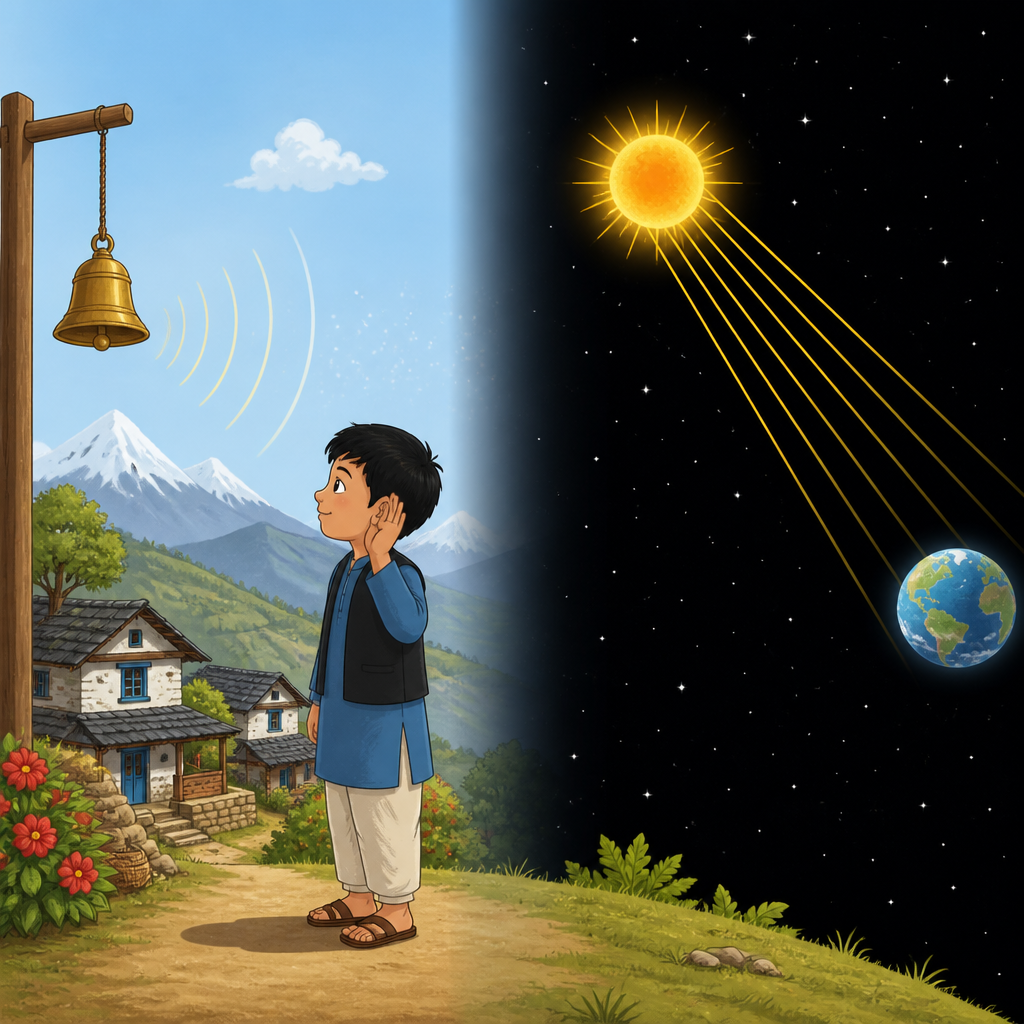
Mechanical waves
A mechanical wave is the transfer of energy through vibration in matter. Strike a bell and the bell shakes. That vibration sets the air beside it vibrating, and the vibration passes from air particle to air particle until it reaches your ear. The bell itself does not travel; only energy travels, in the form of vibration. The matter that vibrates while the energy passes through it is called the medium.
The matter that vibrates while energy passes through it is called the medium. Air, water and iron can all act as a medium for sound waves.
As a mechanical wave travels, its energy keeps being used up in the medium, so the energy of the wave keeps decreasing. This is why a mechanical wave can only travel a limited distance, and that limit depends on the medium. It is also why a sound coming from far away is faint. Along the way, the wave has been spending its energy making the particles of the medium vibrate, and after a certain distance it fades until it cannot be heard at all.
The speed of a mechanical wave is different in solid, liquid and gas mediums. The closer together the particles of a medium sit, the faster a vibration passes from one particle to the next. Particles sit closest in a solid, so sound is fastest in solids, slower in liquids and slowest in gases. For example, under normal conditions the speed of sound is 343 m/s in air, 1481 m/s in water and 5120 m/s in iron.
| Medium | State | Speed of sound |
| Air | Gas | 343 m/s |
| Water | Liquid | 1481 m/s |
| Iron | Solid | 5120 m/s |
Mechanical waves are either longitudinal waves or transverse waves. A sound wave spreading through air is an example of a longitudinal mechanical wave, while a wave spreading across the surface of water is an example of a transverse one.
Films show explosions in space making a huge bang, and that is wrong. Outer space is a vacuum, so sound cannot travel there at all. Sound is a mechanical wave, and without a medium it cannot move one step forward.
Electromagnetic waves
The light coming from the Sun and the other stars passes through the vacuum of outer space and reaches the Earth. Waves that travel without any medium, such as light waves, the infrared waves that carry heat although our eyes cannot see them, and ultraviolet waves, are electromagnetic waves. When you feel the heat of a fire on your face without touching it, infrared waves are doing that work. The method by which electromagnetic waves transfer energy is called radiation.
Radiation is the method by which electromagnetic waves transfer energy without needing any medium.
When these waves travel without a medium, their energy is conserved; none of it is used up on the way. Because of this, electromagnetic waves travel very far, at the speed of light. For example, light waves produced in the Sun travel at \( 3 \times 10^8 \, \text{m/s} \) and reach the Earth in about 8 minutes 20 seconds. Even across that enormous distance between the Sun and the Earth, the light loses no energy on the way, because there is no medium in between to use it up.
Electromagnetic waves are transverse waves, because in them the vibration of the electric field and the magnetic field is perpendicular to the direction in which the wave travels. These waves do not come only from natural sources like the Sun; they can also be produced artificially. A radio transmitter produces radio waves, and an X-ray machine produces X-rays.
Comparing the two kinds of waves
Now place the two groups side by side. Both are called waves, yet in many ways their natures are opposite.
| Basis | Mechanical wave | Electromagnetic wave |
| Medium | Needs a medium to travel | Needs no medium, travels even through a vacuum |
| Energy | Is used up in the medium, so it keeps decreasing | Is conserved when travelling without a medium |
| Distance | Travels only up to a limited distance | Travels very far, at the speed of light |
| Type | Can be longitudinal or transverse | Are transverse only |
| Example | Sound wave | Light, infrared, ultraviolet, X-ray |
The electromagnetic spectrum
The waves carrying brightness from an electric bulb and the waves carrying communication signals from a radio broadcasting station are both electromagnetic waves, yet their frequency and wavelength are different. When all the electromagnetic waves, each with its own frequency, are arranged in order, they form one complete family called a spectrum.
The classification of all electromagnetic waves on the basis of increasing frequency, that is, decreasing wavelength, is called the electromagnetic spectrum.
The waves that make up the electromagnetic spectrum, in order from the longest wavelength to the shortest, are:
- Radio waves
- Microwaves
- Infrared waves
- Light
- Ultraviolet waves
- X-rays
- Gamma rays
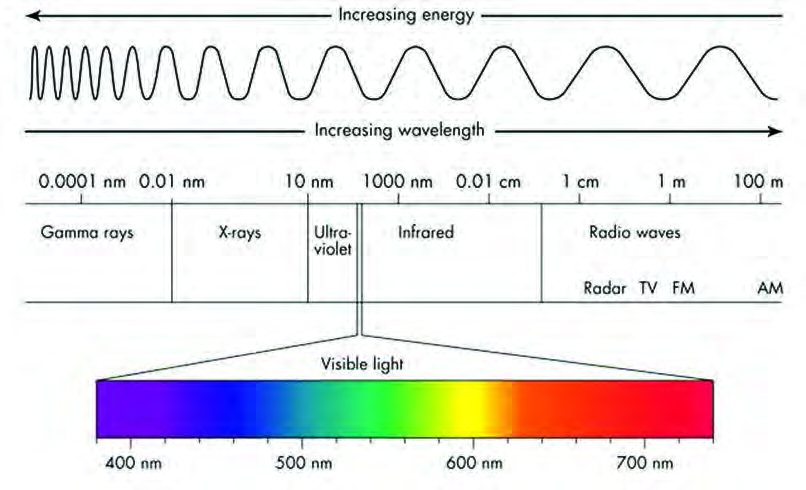
In this whole vast spectrum, the part our eyes can see is tiny. We see only the part with wavelengths from about 400 to 700 nanometres (nm) as light, and inside that narrow band sit all the colours from violet to red. Even within the radio wave region there are waves of different lengths, used for radar, TV, FM and AM broadcasting.
The two ends of the spectrum
At one end of the electromagnetic spectrum sit the radio waves, with the longest wavelength, which means the lowest frequency. At the other end sit the gamma rays, with the shortest wavelength, which means the highest frequency. Rays with short wavelengths, such as gamma rays and X-rays, carry more energy. So in whichever direction the wavelength decreases along the spectrum, the frequency and the energy increase in that same direction.
The shorter the wavelength, the higher the frequency and the greater the energy the wave carries.
The full lesson is waiting for you
The notes are free to read in full. A free account opens the rest of the practice, and tracks your progress and confidence score for every subject. Presentations and videos need approval from Learn Yeti.