Why the screws clung to the tool
A mechanic came to repair a television, opened the back of the set and kept putting the small screws he removed on a rounded metal tool lying beside him. The screws clung to that tool on their own, and they did not fall even when the tool was lifted. When a small piece of wood was placed on the same tool, nothing happened at all. One thing is clear from this. Some force in the tool pulled the screws but did not pull the wood. Screws are made of iron and a piece of wood is not. So whether a thing is pulled or ignored depends on the material it is made of.
That rounded tool has a magnet inside it. Repair workers choose such a tool on purpose, because tiny screws get lost the moment they fall on the floor. The magnet holds the screws and makes the work easy. The rest of this lesson is about the thing that does that holding.
What a magnet is
A magnet is a material that can pull iron and a few other metals towards itself. A magnet builds a region of influence around itself and pulls in the things that come inside that region. When two magnets are brought face to face, sometimes they pull each other and sometimes they push each other away. All of this behaviour together is what makes a magnet a magnet.
Magnet: a material that attracts iron and certain other metals is called a magnet. It produces a magnetic field around itself, attracts unlike poles and repels like poles.
Magnets are used in many kinds of devices. A loudspeaker, an electric motor, the strip that holds a refrigerator door shut, a compass that shows direction and a repair worker's tool all contain magnets. Many things used at home every day have a magnet hidden inside them, even though nothing shows from the outside.
What a magnet pulls and what it leaves alone
A magnet does not pull everything. It attracts things such as iron, nickel and cobalt. Wood, plastic, rubber, paper and glass feel nothing at all from a magnet. There is one more point worth holding on to. Being a metal is not enough for a thing to be pulled. Copper and aluminium are metals too, yet a magnet does not attract them.
Magnetic materials: the things a magnet attracts are called magnetic materials. Iron, nickel and cobalt are examples.
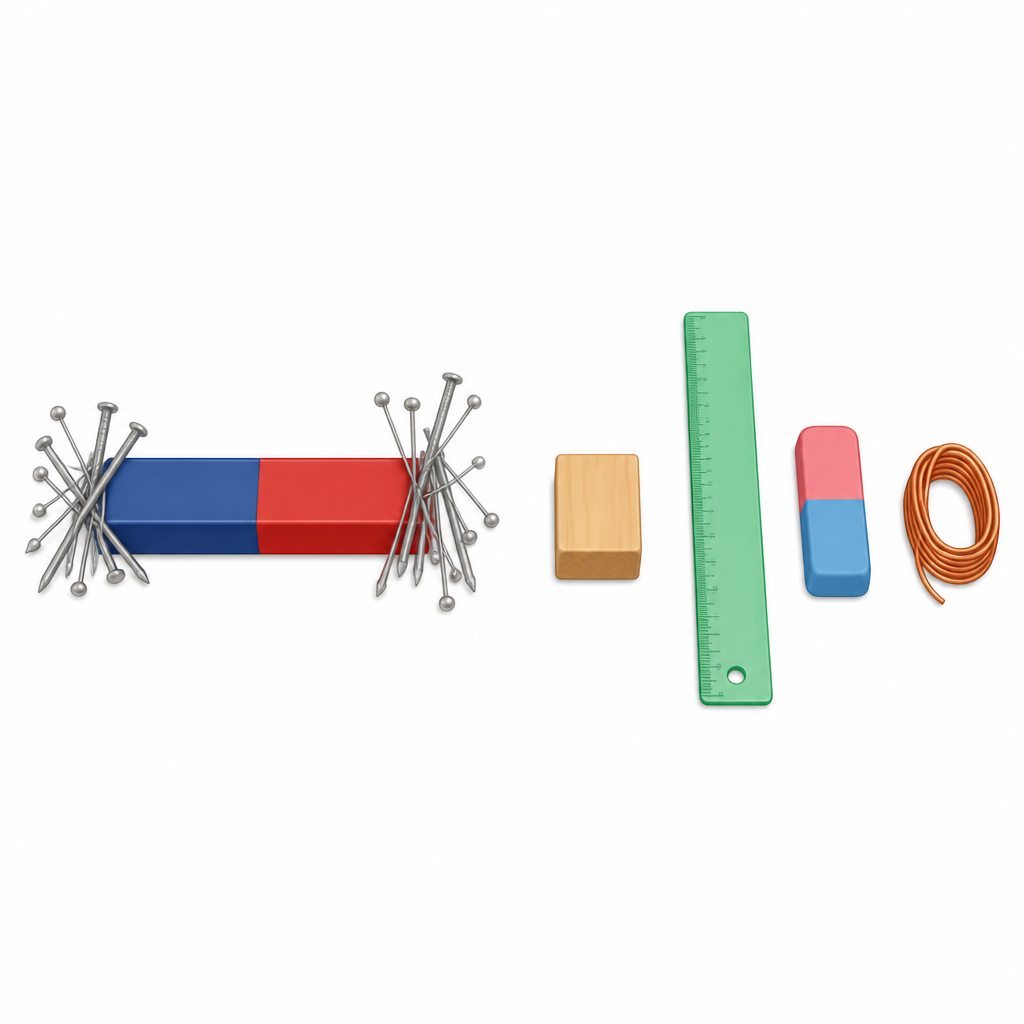
| Object | Made of | Brought near a magnet |
| Nail | Iron | Is pulled |
| Pin | Steel, which contains iron | Is pulled |
| Small disc | Nickel | Is pulled |
| Electric wire | Copper | Is not pulled |
| Ruler | Plastic | Is not pulled |
| Block | Wood | Is not pulled |
A thing that a magnet pulls is not itself a magnet. A nail picked up by a magnet is a magnetic material, not a magnet. Swapping these two words in an answer changes the meaning completely.
The magnetic field around a magnet
Put a pin on the table and bring a magnet slowly towards it from far away. At first nothing at all happens. Once the magnet reaches a certain distance the pin slides or jumps across on its own and sticks to it. Beyond that distance the pin was out of the magnet's reach. The space around a magnet in which its effect can be felt is called the magnetic field.
Magnetic field: the region around a magnet inside which the magnet's effect can be seen on a magnetic material is called the magnetic field.
A magnet attracts only those magnetic materials that lie inside its magnetic field. A strong magnet has a large magnetic field, so it can pull a pin from further away. A weak magnet has a small field, and the pin is pulled only after it comes very close.
The two poles of a magnet
Lay a bar magnet in a heap of pins and lift it out. The pins do not cling evenly all along it. Plenty of pins hang from the two ends and usually nothing stays in the middle. This shows that the pulling power of a magnet is strongest at its two ends. Those two ends of a magnet are called its poles.

Tie a thread round the middle of a bar magnet and hang it so that it can turn freely. After a while it comes to rest, and when it does, the same end always points towards the north. The end that points north is called the north pole and the end that points south is called the south pole. These are the names written on a magnet as the letters N and S.
North pole (N pole): the end of a freely hanging magnet that turns to point towards the north.
South pole (S pole): the end of a freely hanging magnet that turns to point towards the south.
Like poles and unlike poles
What happens when two magnets are brought close depends on which pole faces which. Bring the north pole of one magnet up to the north pole of another and the two try to push apart. The same thing happens when a south pole is brought up to a south pole. In both cases like poles are facing each other. But bring a north pole up to a south pole and the two are drawn together. There unlike poles are facing each other.
Like poles of magnets repel each other and unlike poles attract each other.
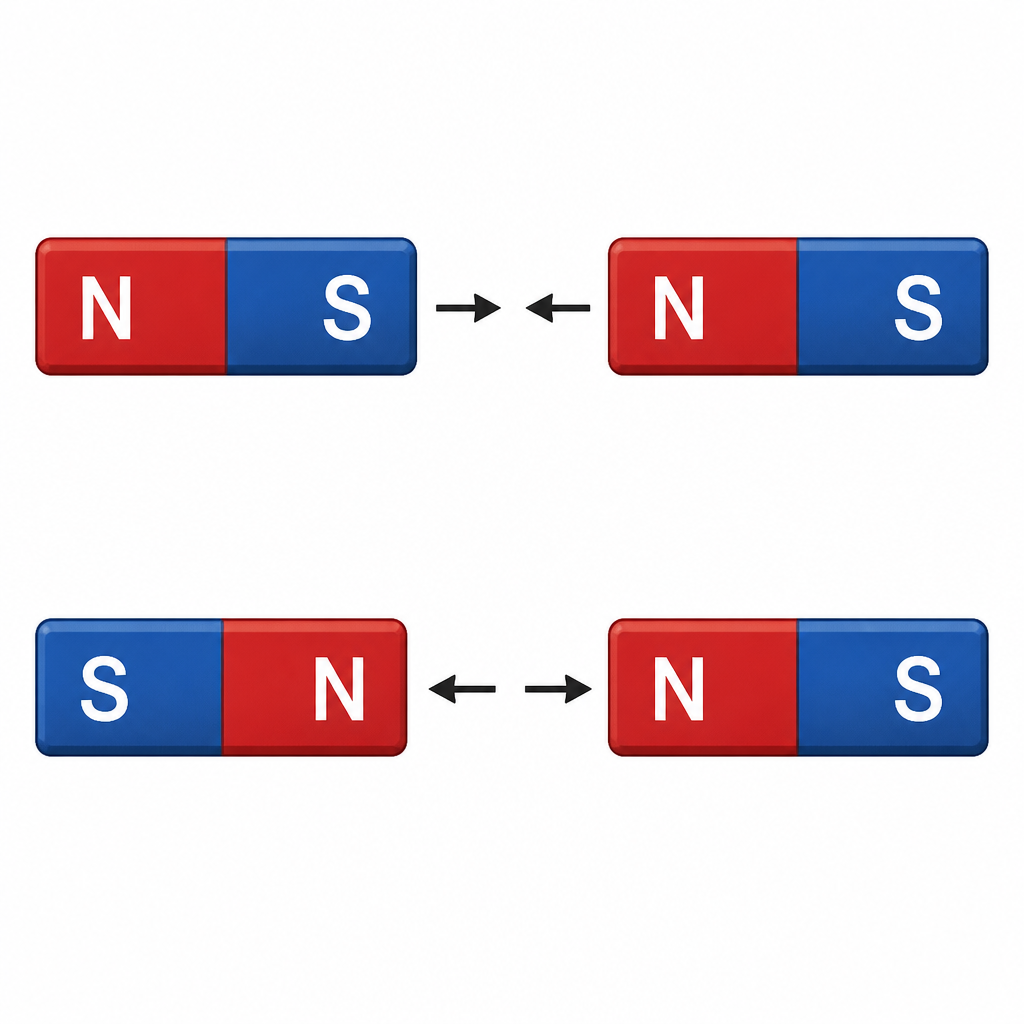
Many students write this rule the wrong way round. Like means the same, and two poles of the same kind never come together, they push apart. Only two different poles come together.
Activity 8.1: Studying a bar magnet
This activity is done to study the magnetic properties of a magnet using bar magnets. The things needed for it are listed below.
- Two bar magnets
- Pins and a nail
- A piece of thread
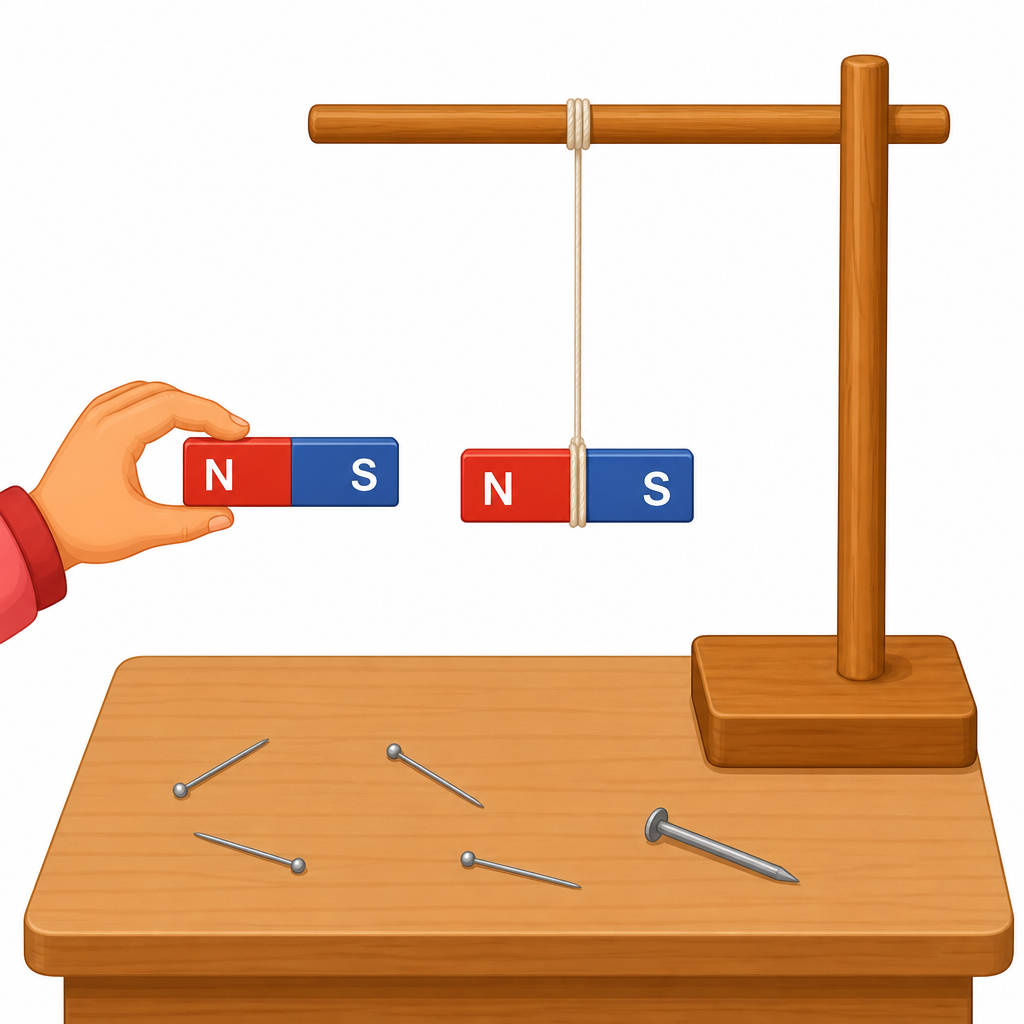
- a) Tie a thread round the middle of a bar magnet and hang it up.
- b) Bring the north pole and then the south pole of the second magnet, one after the other, near the north pole of the hanging magnet.
- c) Bring the pins and the nail close to the magnet.
Do not let the two magnets snap together, and do not let a magnet fall on the floor. A magnet can break when it is banged or dropped.
What the observation table shows
What is seen during the activity has to be written down in a table. When the activity is done properly, the responses come out as shown below.
| What is done | What the magnet does |
| Which way do the poles of the hanging magnet point? | It comes to rest with one end towards the north and the other towards the south. |
| What happens when pins and a nail are brought near the magnet? | The pins and the nail are pulled to the magnet and cling to its ends. |
| What happens when a north pole is brought up to a north pole? | The hanging magnet swings away, that is, they repel. |
| What happens when a south pole is brought up to a north pole? | The hanging magnet swings closer, that is, they attract. |
- a) A freely hanging magnet always comes to rest along the north and south direction.
- b) A magnet attracts iron pins and nails.
- c) Like poles of two magnets repel each other.
- d) Unlike poles of two magnets attract each other.
The magnetic properties together
Put all of these behaviours together and they make up the magnetic properties of a magnet. These are the properties checked when deciding whether a given object is a magnet or not.
Attraction: a magnet pulls magnetic materials such as iron, nickel and cobalt.
Magnetic field: a magnet pulls only those magnetic materials that come inside its field.
Poles: every magnet has two poles, a north pole and a south pole.
Attraction and repulsion: like poles push apart and unlike poles pull together.
The full lesson is waiting for you
The notes are free to read in full. A free account opens the rest of the practice, and tracks your progress and confidence score for every subject. Presentations and videos need approval from Learn Yeti.