When a Magnet Loses Its Power
A bar magnet picks up a fistful of pins today. Handle the same magnet roughly for a year, drop it on the floor again and again, leave it near a fire, and one day it picks up only two or three pins. A little later it picks up none. The magnet itself has not gone anywhere. What has gone is its magnetism.
Demagnetisation is the gradual destroying of the magnetic power of a magnet.

The loss does not happen for no reason. Heat, blows, one kind of electric current and plain old age all take a magnet's power away. All four of them do exactly the same job. They break an order that is hidden inside the metal. Until you know what that order is, the four causes are just four facts to memorise.
The Order of Molecular Magnets Inside
Every molecule of a magnetic material is a complete magnet in itself. Such a molecule is called an elementary or molecular magnet. Just like a big magnet, a molecular magnet has a north pole and a south pole of its own. Even a small piece of iron holds a countless number of them.
An elementary or molecular magnet is a single molecule of a magnetic material which is itself a complete magnet, with a north pole and a south pole of its own.
In an ordinary piece of iron these molecular magnets face every direction at random. Because they attract one another, they settle into small closed groups in which the north pole of one sits against the south pole of the next. The pull of one cancels the pull of its neighbour. That is why the piece of iron shows no magnetism at all on the outside.
Now suppose those molecular magnets are turned so that they lie parallel in a fixed order, with all their north poles facing the same way. Their pulls no longer cancel. They add together. One end of the bar then behaves as a north pole and the other end as a south pole, and the bar has become a magnet.
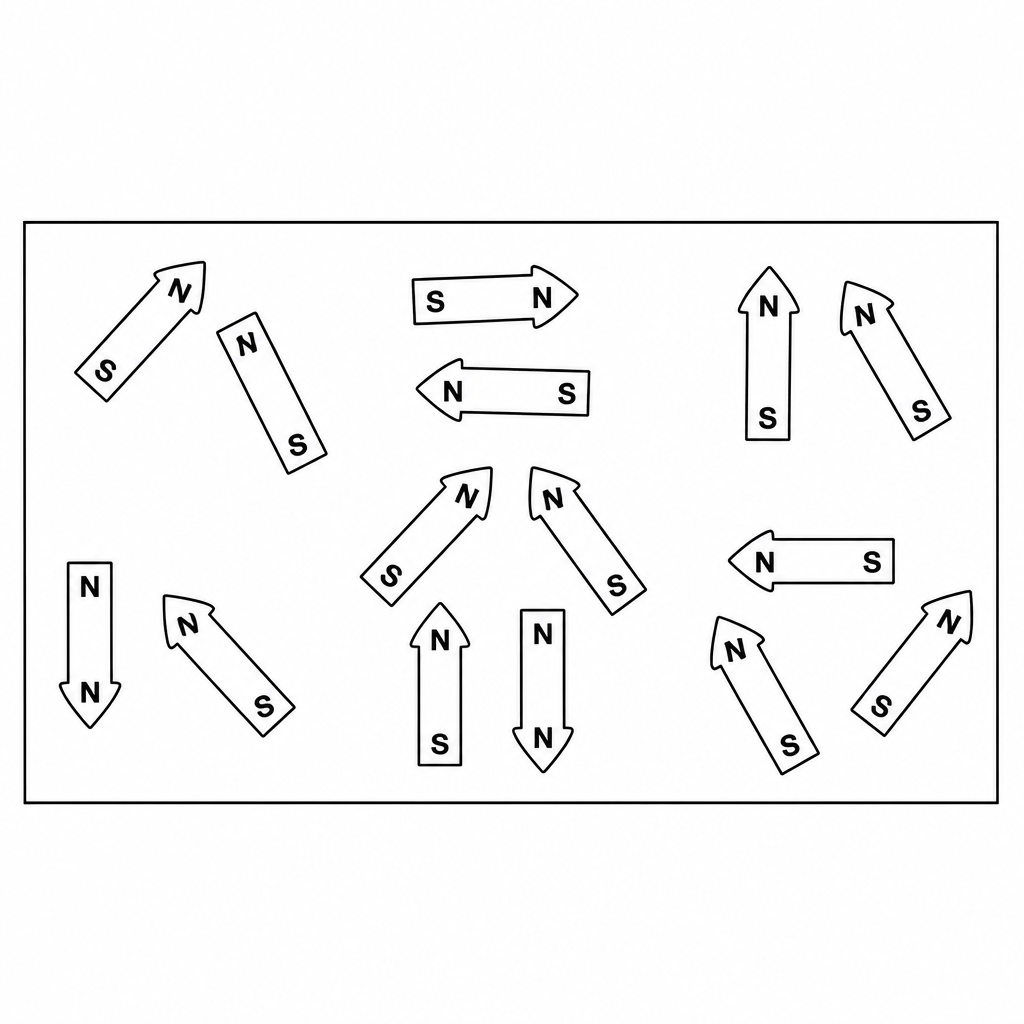
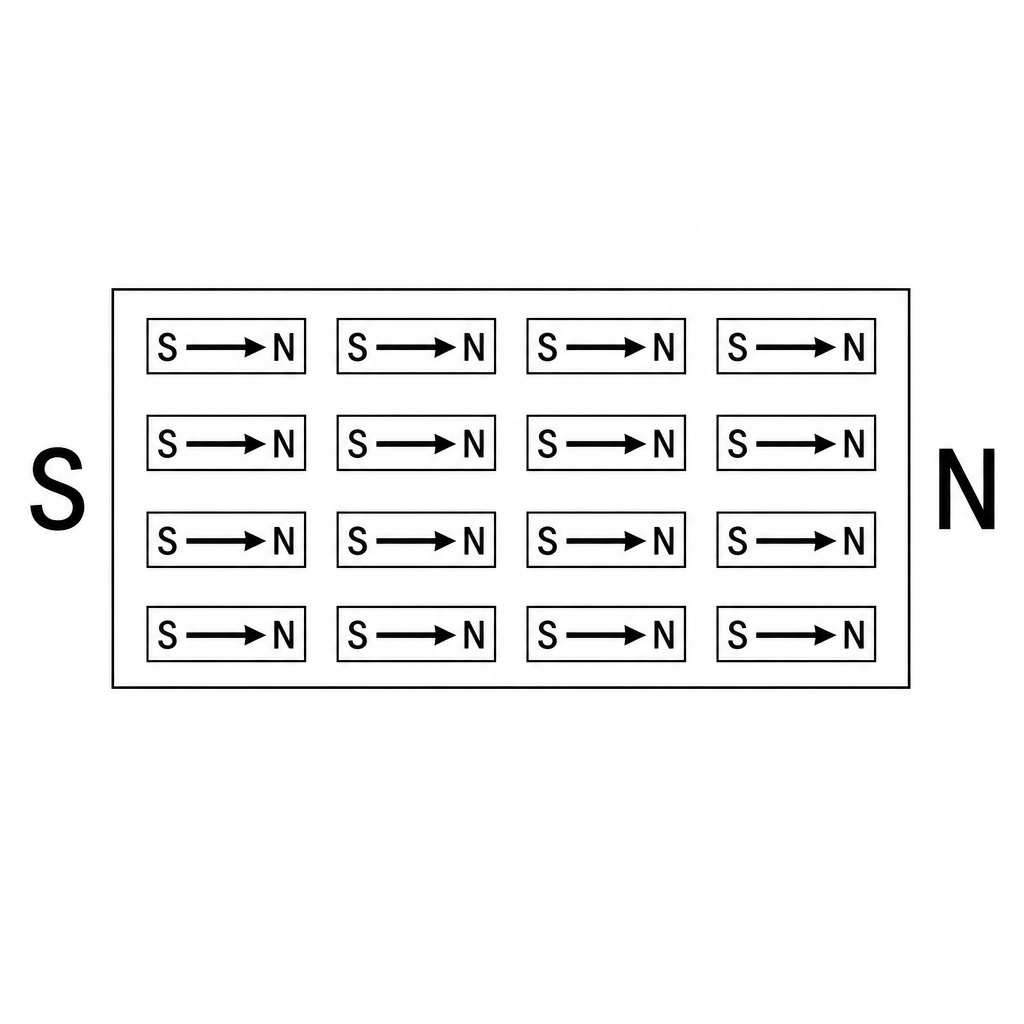
Magnetism is not a substance that can leak out. It is an arrangement. Line the molecular magnets up and you have a magnet. Scatter them and the magnetism is gone.
This is what demagnetisation really means. The magnetic molecules that were lying parallel in one fixed direction get scattered again into all directions at random, and the magnetic power is lost. Each cause below does that one job in its own way.
What Destroys a Magnet's Power
- (a) Heating the magnet
- (b) Hammering the magnet
- (c) Passing electricity in magnet
- (d) Natural loss
Heating the Magnet
Heat is movement. When a permanent magnet is heated, vibration is produced in its molecules and the molecules come into a state of motion. The molecular magnets can no longer hold their places, so their positions are disturbed. Once the positions of the molecular magnets that were lying parallel are spoiled, the magnetic power is destroyed.
The hotter the magnet gets and the longer it is kept hot, the more it loses. A little warming weakens it a little. A magnet left in a fire is usually finished for good.
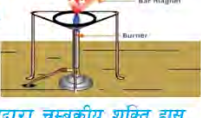
A heated magnet stays hot long after the flame is out. Hold it only with tongs and never with bare hands. Keep the flame away from your clothes and hair, and do this only with your teacher present.
Hammering the Magnet
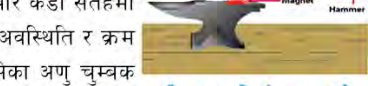
When a permanent magnet is hammered, or dropped again and again onto a hard surface, the positions and the order of its molecular magnets are disturbed. The molecular magnets that were sitting in a parallel order get scattered. If this is repeated over and over, the magnetic property of the magnet grows weaker.
One fall does not empty a magnet at once, but every jolt knocks a few more molecular magnets out of line. That is why a magnet that keeps rolling off the table is a weak magnet within a few months.
Passing Electricity in Magnet
When alternating current is passed around a magnet, its magnetic power is destroyed. In alternating current the positive and negative ends keep changing over without stopping, so the pull on the molecular magnets keeps reversing and produces vibration in them. Once the molecular magnets are vibrating, the positions of the magnetic molecules that were lying parallel are spoiled and the magnetic power is lost.
Alternating current is a current whose positive and negative ends keep changing continuously, so the direction of the current reverses again and again.
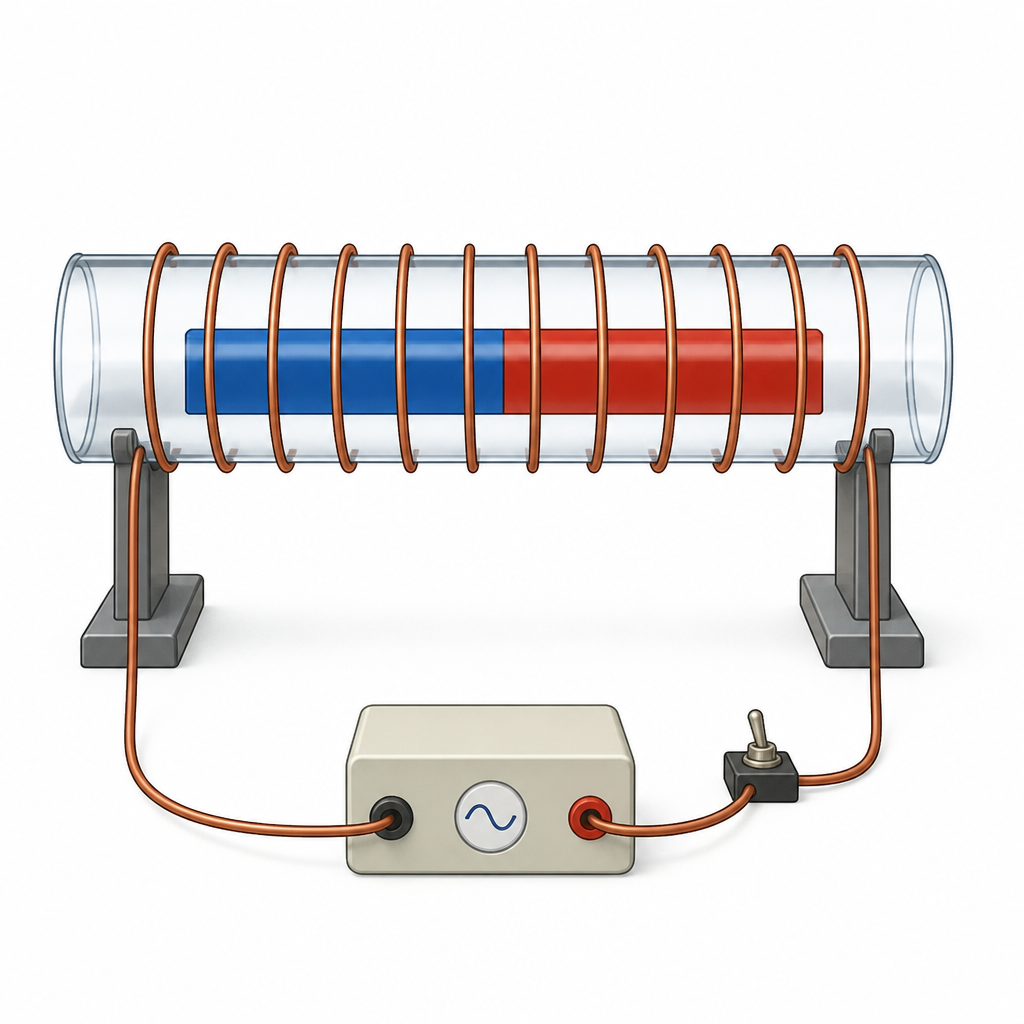
It is wrong to think that any electric current destroys magnetism. A steady direct current in a coil does the opposite. It pulls the molecular magnets into one order and makes a magnet. Only alternating current, whose direction keeps reversing, shakes that order apart. Read which current a question names before you answer.
Natural Loss
If a magnet is kept lying in the open for a long time, or used day after day, its magnetic power slowly wears away. An old magnet is a weaker magnet than it once was. If this process goes on long enough, the magnetic power of the magnet is destroyed completely.
Nothing dramatic happens here. Small everyday knocks, ordinary warmth in the room and a long stretch of time do between them, very slowly, what one blow of a hammer does at once.
| Cause | What happens to the molecular magnets |
| Heating | Vibration is produced, the molecules come into motion and their settled positions are disturbed. |
| Hammering | A sudden jolt spoils their positions and order, and the parallel molecular magnets get scattered. |
| Passing alternating current | The ends keep reversing, vibration is produced and the positions are spoiled. |
| Long passage of time | Small knocks and time together break the order down bit by bit. |
Doing It Yourself: Taking the Power Out With Current
The purpose of this experiment is to study the loss that takes place in magnetic power. You will need copper wire, a magnet, a low voltage alternating current supply, a switch, pins and a pair of pliers. Before you begin, count how many pins the magnet can pick up and write the number down.
- With your teacher's help, cut the copper wire with the pliers and wind it round a cylindrical object to make a solenoid.
- Join the solenoid to the low voltage alternating current supply with conducting wire and keep the switch off.
- Place the magnet inside the solenoid and switch on.
- Keep moving the magnet inside the solenoid to the right and to the left with insulated pliers.
- Switch off, take the magnet out with the pliers and bring it near the pins.
Count again. The magnet that lifted many pins a few minutes ago now lifts only a few, and if it was kept moving in the coil for long it lifts none at all. The alternating current has shaken the molecular magnets inside and broken the order they were holding.
Do this experiment only with your teacher. Use only a low voltage alternating current supply. Always switch off before making a connection and before taking the magnet out, never touch a bare wire, and move the magnet only with insulated pliers.
Ways to Protect a Magnet's Power
Once you know what destroys a magnet's power, the way to save it follows on its own. Keep the magnet away from anything that disturbs the order of its molecular magnets.
- (a) A magnet should not be put into a fire.
- (b) A magnet should not be dropped while it is being used.
- (c) A magnet should not be kept near a bare wire that is carrying current.
- (d) When a magnet is not in use it should always be kept in its own box.
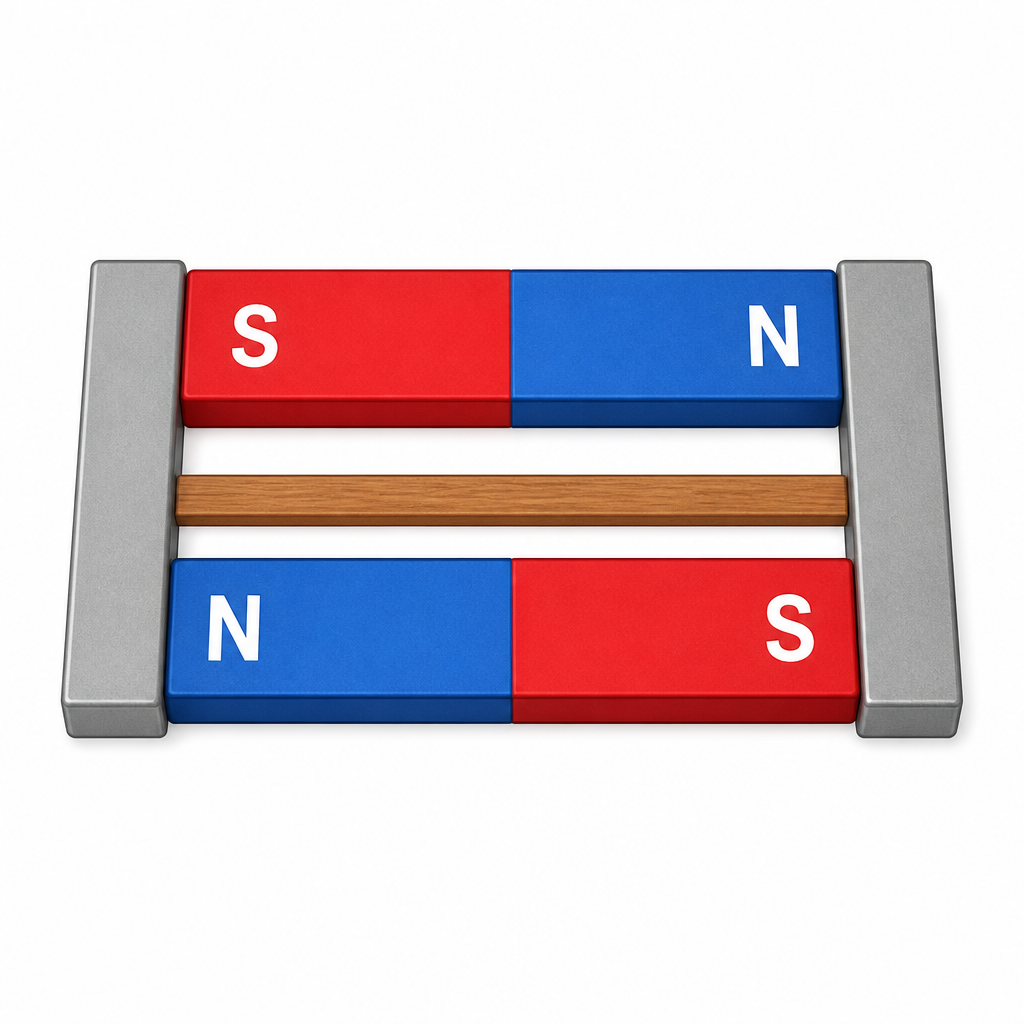
When magnets are stored, two bar magnets are laid side by side with the north pole of one beside the south pole of the other, and a small piece of soft iron is placed across each pair of ends. That piece is called a keeper. The keeper keeps the magnetic pull circulating inside the pair, so the order of the molecular magnets holds for far longer.
The full lesson is waiting for you
The notes are free to read in full. A free account opens the rest of the practice, and tracks your progress and confidence score for every subject. Presentations and videos need approval from Learn Yeti.