How Objects Fall Under Gravity
Hold a small stone in one hand and a flat sheet of paper in the other, then let both go from the same height at the same moment. The stone drops almost straight to the floor. The paper sways from side to side and lands much later. Both are pulled down by the Earth's gravity, so why do they fall so differently? The answer is the air. As the paper falls, its wide flat surface pushes against a lot of air, and the air pushes back on it. The stone is small and compact, so the air hardly slows it at all.
Now crumple the same sheet into a tight ball and drop it beside the stone. This time the two reach the floor at almost the same moment. The mass of the paper has not changed. Only its shape changed, and with it the amount of air it had to push aside. When the air resistance on a falling body is so small that it can be ignored, the body speeds up at a fixed rate. Near the Earth's surface that rate is 9.8 m/s². This value is called the acceleration due to gravity and is written g.
A heavy object does not fall faster simply because it is heavy. The flat paper was slow because of air resistance. If all the air were taken away, a feather and a stone released together would land together.
What Free Fall Means
Free fall: the motion of an object falling under the influence of gravity alone, without any obstruction.
The key word in this definition is 'alone'. Nothing slows a freely falling object and nothing holds it up. Only gravity pulls on it. For this reason, the acceleration of an object in free fall is equal to the acceleration due to gravity, g. On Earth that is 9.8 m/s², which means the speed of the object grows by 9.8 m/s every second. A stone let go from rest in free fall speeds up like this:
| Time after release | Speed of the stone |
| 0 s | 0 m/s |
| 1 s | 9.8 m/s |
| 2 s | 19.6 m/s |
| 3 s | 29.4 m/s |
| 4 s | 39.2 m/s |
In free fall the speed never settles. It keeps rising by the same amount every second for as long as the fall lasts, and this rate does not depend on the mass of the object.
Why True Free Fall Is Rare on Earth
The Earth is wrapped in a thick layer of air called the atmosphere. Anything falling through it rubs against the air. This frictional force acts opposite to the motion, so on a falling body it points upward and resists the fall. How large it is depends on the structure of the object: its size, its shape and how fast it is moving.
Air resistance: the frictional force that air exerts on an object moving through it, acting opposite to the direction of motion.
A second upward force also acts. Air, like water, pushes upward on anything inside it. This push is called upthrust. For most objects in air it is small, but it too reduces the effect of gravity on a falling body.
Upthrust: the upward force that a fluid such as air or water exerts on an object inside it.
Because of these two forces, a body falling through air is not under gravity alone, so strictly it is not in free fall. A stone dropped from a small height comes very close, because both forces are tiny compared with its weight. True free fall is possible only in a vacuum.
Vacuum: a space that contains no air or any other matter.
The Moon has no atmosphere. With no air to resist a falling body, any object dropped near the Moon's surface is in free fall. The Moon pulls more weakly than the Earth, and its acceleration due to gravity is only 1.63 m/s². Even so, whatever falls there speeds up the whole way down with nothing to slow it.
The Parachute: Falling at a Uniform Speed
A parachute is a large canopy of cloth joined by many strings to the person or load hanging below it. It is shaped to make air resistance as large as possible. During a parachute jump, this is what happens, in order:
- Just after the jump the speed is small, so the air resistance is small. The weight is much larger, so the parachutist speeds up.
- As the speed grows, the air resistance grows with it. The wide canopy pushes against a great deal of air, so the resistance rises quickly.
- Soon the air resistance becomes equal to the weight. The upward and downward forces are balanced.
- With the forces balanced, the acceleration of the parachute becomes zero. From then on it falls towards the ground at a uniform speed.
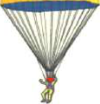
This uniform speed is slow enough for a safe landing on the ground. A parachute fall of this kind is not a free fall, because for most of the way down the air resistance is as strong as the pull of gravity.
The same idea can be tested with a small model. A circle is cut from thin plastic, and threads of equal length are tied at equal distances around its edge. The free ends are tied in one knot and a small toy or stone hangs from it. Dropped from a height, the model falls quickly at first and then drifts down at a steady speed.
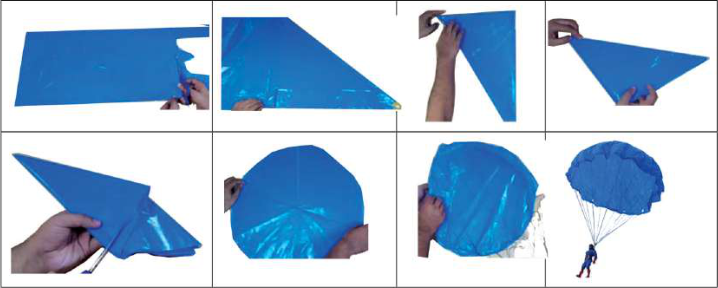
Release a model parachute only from a safe place, such as a staircase landing, with an adult nearby. Never lean over a roof edge, a balcony railing or an open window to drop it.
A parachute does not remove gravity. It builds up an upward force until that force equals the weight, and from then on the fall stops speeding up.
Why a Parachute Cannot Land You Safely on the Moon
A parachute works for one reason only: air pushes against its canopy. Atmospheric resistance is needed for a safe landing with a parachute. The Moon has no atmosphere, so there is nothing to push. Jumping towards its surface with a parachute is therefore a free fall. The speed keeps increasing all the way down, and the jumper strikes the surface at high speed. So a safe landing on the Moon using a parachute is not possible.
Even with the Moon's weaker gravity, the speed of a jumper falling from rest grows by 1.63 m/s every second. After 10 seconds it is 16.3 m/s, and after 20 seconds it is 32.6 m/s, which is about 117 km/h. It never levels off.
| Feature | On the Earth | On the Moon | |
| Air around the parachute | Thick atmosphere | No atmosphere | |
| Air resistance | Grows as speed grows | None | |
| Kind of fall | Not a free fall | Free fall | |
| Speed near the ground | Uniform and slow | Still increasing, high | |
| Landing | Safe | Unsafe |
Hailstones Fall at a Constant Speed
Hailstones are lumps of ice that form high inside clouds and fall from a great height. If a hailstone were in free fall, its speed would keep rising all the way down and it would strike the ground very hard. Instead, it reaches a certain speed and then falls at that constant speed. The reason is air resistance. The friction of the air on a falling hailstone produces an upward drag force. The faster the hailstone falls, the greater the resisting force on it. When the force of gravity on the hailstone and the frictional force on it become equal, it falls at a constant speed.
Drag force: the upward resisting force produced by the friction of air on a falling object. It grows larger as the object falls faster.
This is good for us. Because hail arrives at a limited speed, it does far less damage to crops, roofs, vehicles and people than it would if it fell freely.
Seeds Carried by the Wind
Plants make use of air resistance too. Some wind-dispersed seeds carry a light, fluffy part like fur, and others carry thin flat wings like a small fan. These parts work like small parachutes. They catch the air and give the seed a large air resistance for its tiny weight, so the seed falls slowly, as if floating, and stays in the air for some time. While it floats, the wind carries it away from the parent plant. As a result, the seeds are scattered far away. This is how the seeds of plants such as simal and sal are dispersed far and wide.
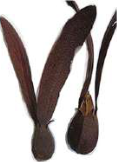


Why does travelling far help a seed? A seed that lands right under its parent has to compete with it for light, water and space once it sprouts. A seed carried far away has a better chance of growing in a new place.
Weightlessness in Free Fall
A spring balance measures weight because the object hanging from it pulls down on its spring. Now consider this set-up. A U-shaped iron frame has a thread tied loosely across its open top, and a stone is tied to the middle of the thread. The hook of a spring balance is hung at the point where the stone is tied, and the whole frame is lifted by the balance. The balance now shows a reading, which is the weight it is holding up.
Now the frame is released from the hand. The spring balance, the stone and the iron frame all fall downward with the same speed. Although the thread holding the stone was tied slack, it does not stretch downward, and the stone looks as if it is flying in the air. This happens because of free fall. Since the spring balance and the frame are both in free fall, there is no downward force on the spring of the balance, and it shows zero weight.
Before releasing the frame, lay foam or cardboard on the floor so that the spring balance is not damaged when it lands.
Weightlessness: the condition in which an object in free fall has zero weight.
Weightlessness does not mean gravity has switched off. Gravity is still pulling the stone, and that pull is exactly what makes it fall. The mass of the stone does not change either. What becomes zero is the weight the balance can detect, because the balance is falling along with the stone.
Astronauts inside artificial satellites and space stations orbiting the Earth are in a state of free fall. Just as the frame, the stone and the balance fell together, the station and everyone inside it fall around the Earth together. So the passengers inside the vehicle experience weightlessness. They float about the cabin, water drifts as round drops, and a weighing scale would read zero.
Free Fall or Not: The Cases Side by Side
To decide whether a fall is a free fall, ask one question: is gravity the only force acting on the object? The table below checks every case in this topic against that question.
| Situation | Free fall? | Reason |
| Stone dropped in a vacuum | Yes | Only gravity acts |
| Stone dropped a short way through air | Nearly | Air resistance is tiny compared with its weight |
| Parachute coming down on Earth | No | Air resistance balances the weight |
| Hailstone near the ground | No | Drag force balances gravity |
| Sal seed floating in the air | No | Its wings give a large air resistance |
| Parachute jumper on the Moon | Yes | There is no atmosphere |
| Astronaut inside a space station | Yes | Astronaut and station fall together |
The full lesson is waiting for you
The notes are free to read in full. A free account opens the rest of the practice, and tracks your progress and confidence score for every subject. Presentations and videos need approval from Learn Yeti.