What the Letter g Stands For
When you let go of a stone, it does not fall at one steady speed. The Earth's gravity keeps pulling it down, so its velocity grows the whole way down. The rate at which the velocity of a falling body grows is called the acceleration due to gravity, and it is written with the small letter g. Where there is no air to get in the way, a coin and a feather dropped together land together. That tells us something important: on the same planet, every falling body has the same g, whether it is heavy or light. The next question is where the value of g comes from, and why it is the planet that decides it and not the falling body.
Acceleration due to gravity: the acceleration produced in a freely falling body by the gravitational pull of a planet or satellite. It is written as g and its unit is m/s².
Free fall: a body is in free fall when gravity is the only force acting on it, with no air resistance or any other force.
Deriving the Formula for g
Imagine a body of mass m sitting on the surface of a planet. The planet has mass M and radius R. Because the body is on the surface, its distance from the centre of the planet is exactly R. Two laws you have already met describe the pull on this body in two different ways. Putting them side by side gives the formula for g.
Step 1: Newton's universal law of gravitation, where G is the universal gravitational constant, gives the force F between the planet and the body:
\[ F = \frac{GMm}{R^2} \;\; \text{(i)} \]
Step 2: This same force gives the body an acceleration g. By Newton's second law of motion, force equals mass times acceleration:
\[ F = mg \;\; \text{(ii)} \]
Step 3: Equations (i) and (ii) describe the same force, so their right-hand sides are set equal:
\[ mg = \frac{GMm}{R^2} \]
Step 4: Dividing both sides by m, which appears on both sides:
\[ g = \frac{GM}{R^2} \;\; \text{(iii)} \]
Equation (iii), \( g = \frac{GM}{R^2} \), is the formula for the acceleration due to gravity on the surface of any planet or satellite.
What the Formula Tells Us
Notice what is missing from equation (iii). The mass m of the falling body cancelled out in Step 4. So g depends only on the mass M and the radius R of the planet. On the same planet, a cricket ball, a stone and a feather all have the same g. This agrees with Galileo's result with falling balls, and with the coin and feather that fall together in a cylinder from which the air has been pumped out.
For any one planet, G and M do not change. G is the same everywhere in the universe, and the planet's mass is fixed. The Earth, however, is not a perfect sphere, so its radius R is different at different places. With G and M held constant, g changes only with R, and it changes as one over R squared:
\[ g \propto \frac{1}{R^2} \]
This is read as "g is inversely proportional to the square of the radius". If the radius became 2 times larger, g would become 2 × 2 = 4 times smaller. If the radius became 3 times larger, g would become 3 × 3 = 9 times smaller. Because of the square, a change in radius has a strong effect on g.
Inversely proportional to the square: one quantity is inversely proportional to the square of another when making the second k times larger makes the first k² times smaller. With G and M constant, g is inversely proportional to the square of the planet's radius.
Small g and capital G are different quantities. g is the acceleration due to gravity, about 9.81 m/s² on the Earth, and it changes from planet to planet. G is the universal gravitational constant, 6.67 × 10⁻¹¹ N m²/kg², and it is the same everywhere.
Mass and Radius Together: Earth and Jupiter
Since g depends on both mass and radius, a planet with an enormous mass does not automatically have an enormous g. Jupiter shows this clearly. Jupiter's mass is about 319 times the Earth's mass. If mass were the only thing that mattered, g on Jupiter would be 319 times the Earth's value. In fact it is only about 2.6 times. The main reason is Jupiter's radius, which is about 11 times the radius of the Earth.
Step 1: The larger mass multiplies g by 319, but the larger radius divides g by the square of 11. Squaring 11:
\[ 11^2 = 121 \]
Step 2: Combining the two effects to find the ratio of Jupiter's g to the Earth's g:
\[ \frac{g_J}{g_E} = \frac{319}{121} \approx 2.6 \]
Here \( g_J \) is the acceleration due to gravity on Jupiter and \( g_E \) is that on the Earth. The large radius cancels out most of the effect of the large mass. The square in R² is what makes radius such a powerful factor.
Calculating g for the Earth
Equation (iii) can now be used to find the value of g on the Earth's surface. The values needed are:
- Universal gravitational constant: \( G = 6.67 \times 10^{-11} \, \text{N m}^2/\text{kg}^2 \)
- Mass of the Earth: \( M = 5.972 \times 10^{24} \, \text{kg} \)
- Average radius of the Earth: \( R = 6371 \, \text{km} = 6.371 \times 10^{6} \, \text{m} \)
Change the radius from kilometres to metres before it goes into the formula, because the unit of G uses metres. 6371 km is 6371 × 1000 m, which is 6.371 × 10⁶ m. Putting in 6371 as it is makes the answer wrong by a factor of a million.
Step 1: Writing the formula to be used:
\[ g = \frac{GM}{R^2} \]
Step 2: Multiplying G by M. The numbers give \( 6.67 \times 5.972 = 39.8332 \) and the powers give \( 10^{-11} \times 10^{24} = 10^{13} \), so:
\[ GM = 39.8332 \times 10^{13} \]
Step 3: Squaring the radius. The number gives \( 6.371^2 \approx 40.5896 \) and the power gives \( (10^{6})^2 = 10^{12} \), so:
\[ R^2 = 40.5896 \times 10^{12} \]
Step 4: Dividing GM by R²:
\[ g = \frac{39.8332 \times 10^{13}}{40.5896 \times 10^{12}} \]
\[ g \approx 9.81 \, \text{m/s}^2 \]
This value comes from the Earth's average radius. Since R is different at different places on the Earth, the value of g is also slightly different from place to place.
Why g Is Greater at the Poles
The Earth is not perfectly round. It is slightly flattened at the poles and bulges out slightly around the equator. So a person standing at a pole is a little closer to the Earth's centre than a person standing on the equator. The radius from the centre to the equator is about 6378 km, while the radius from the centre to a pole is only about 6357 km.
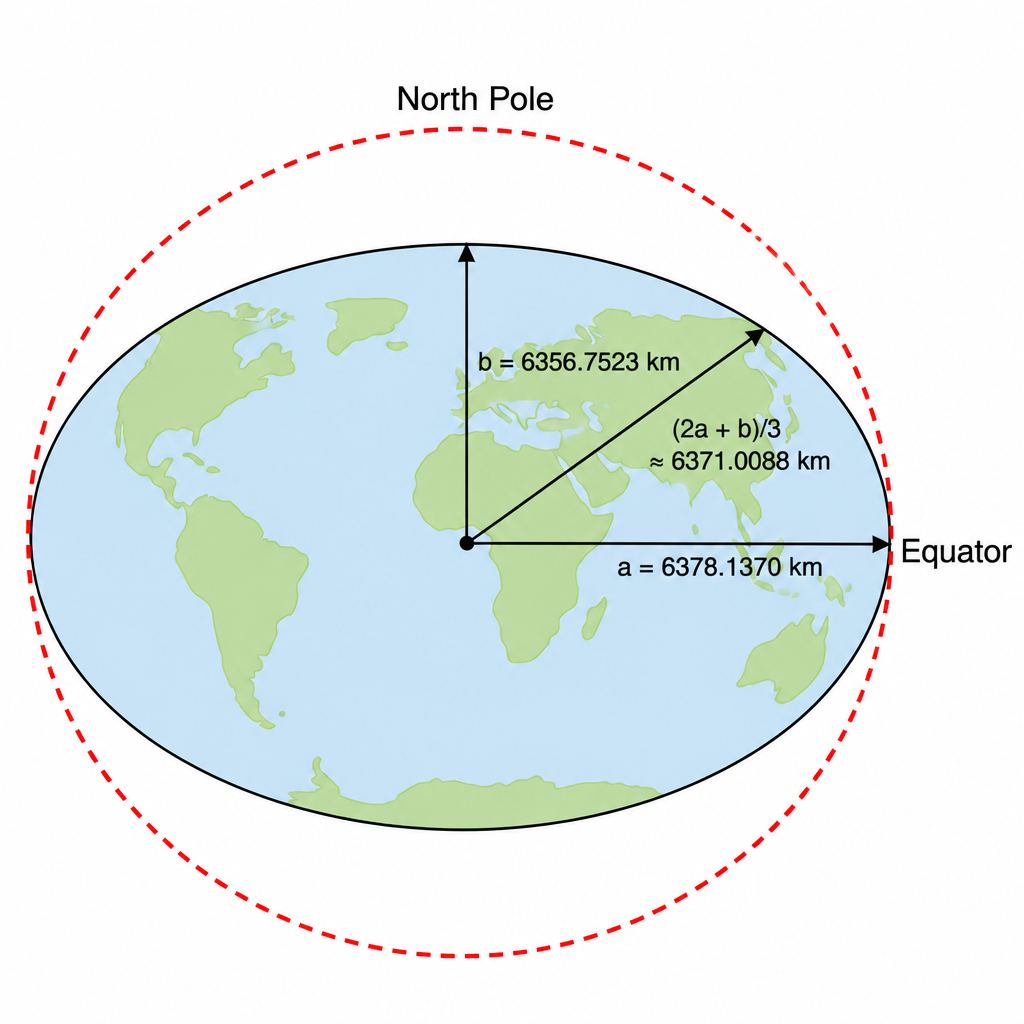
Since g is inversely proportional to the square of the radius, the smaller radius at the poles makes g larger there, and the larger radius at the equator makes g smaller there.
| Place | Radius | Value of g |
| Equatorial region | about 6378 km (larger) | 9.78 m/s² |
| Polar region | about 6357 km (smaller) | 9.83 m/s² |
Because g is higher in the polar region, an object dropped there falls slightly faster than the same object dropped in the equatorial region. The difference is small, but the formula shows exactly why it happens.
What the Value 9.81 Means
The average value of g on the Earth is taken as 9.81 m/s². This means that the velocity of a body falling freely towards the Earth increases by 9.81 m/s in every second. For a body dropped from rest, the velocity builds up like this:
| Time after release | Velocity |
| 0 s | 0 m/s |
| 1 s | 9.81 m/s |
| 2 s | 19.62 m/s |
| 3 s | 29.43 m/s |
When a body is thrown vertically upwards, the opposite happens. Gravity pulls against its motion, so its velocity decreases by 9.81 m/s in every second. A ball thrown up at 19.62 m/s, for example, is moving at 9.81 m/s after 1 second and has zero velocity after 2 seconds. The point where its velocity becomes zero is the maximum height it reaches. After that it starts to fall and returns to the Earth.
g is decided by the planet, not by the falling body: \( g = \frac{GM}{R^2} \). For the Earth, its average value is 9.81 m/s².
The full lesson is waiting for you
The notes are free to read in full. A free account opens the rest of the practice, and tracks your progress and confidence score for every subject. Presentations and videos need approval from Learn Yeti.